
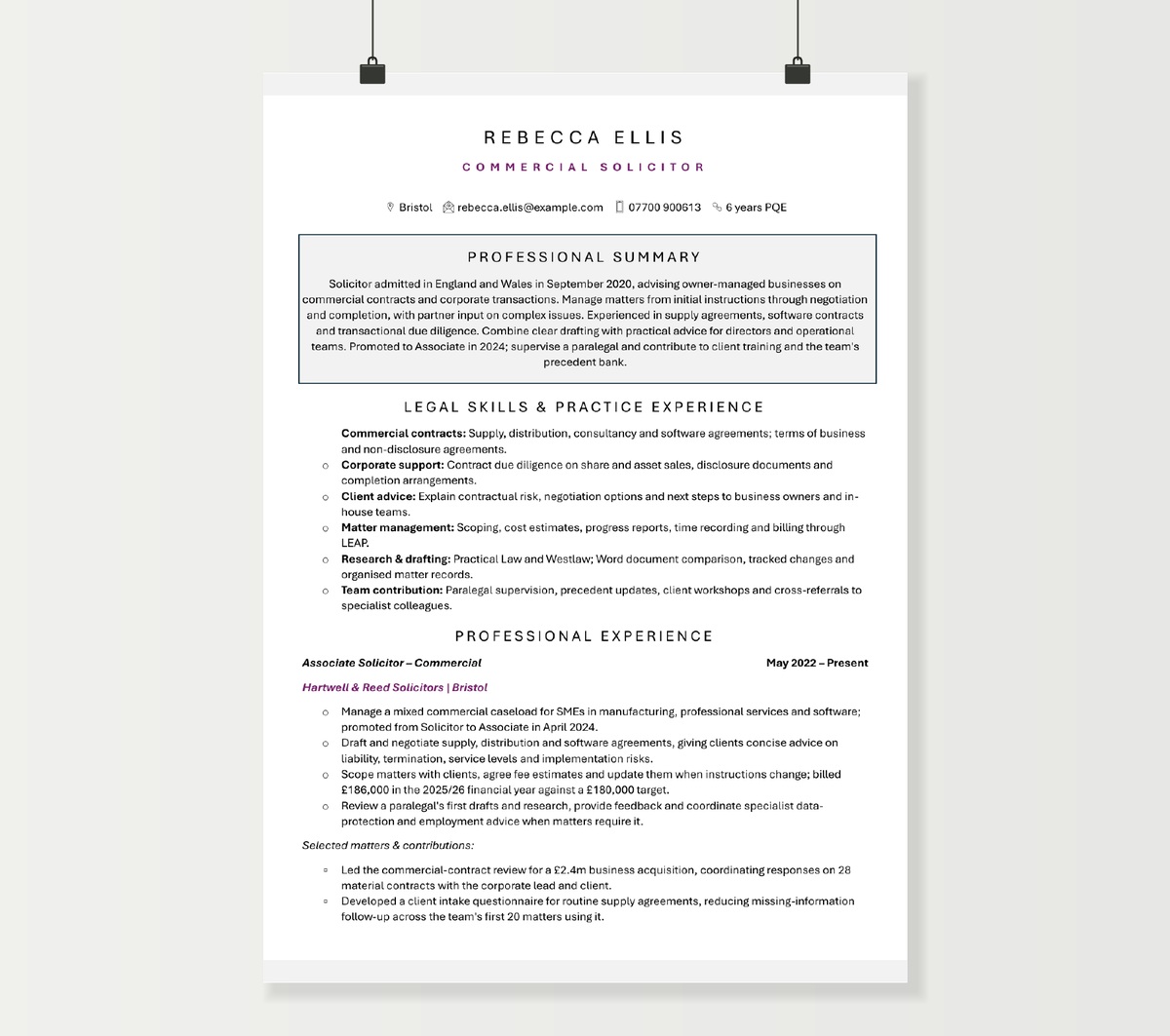
This solicitor CV template features a commercial solicitor qualified in England and Wales, with experience of business contracts and corporate transactions. The example shows admission details, a coherent route from trainee to associate, and selected matters with a clear personal contribution. The guide also explains how to adapt a lawyer CV for different practice areas, newly qualified roles and moves in-house.
Filename: FreeCVDownload_Solicitor.docx
Content of this CV template
Rebecca Ellis
COMMERCIAL SOLICITOR
Bristol | [email protected] | 07700 900613 | 6 years PQE
Professional summary
Solicitor admitted in England and Wales in September 2020, advising owner-managed businesses on commercial contracts and corporate transactions. Manage matters from initial instructions through negotiation and completion, with partner input on complex issues. Experienced in supply agreements, software contracts and transactional due diligence. Combine clear drafting with practical advice for directors and operational teams. Promoted to Associate in 2024; supervise a paralegal and contribute to client training and the team's precedent bank.
LEGAL SKILLS & PRACTICE EXPERIENCE
- Commercial contracts: Supply, distribution, consultancy and software agreements; terms of business and non-disclosure agreements.
- Corporate support: Contract due diligence on share and asset sales, disclosure documents and completion arrangements.
- Client advice: Explain contractual risk, negotiation options and next steps to business owners and in-house teams.
- Matter management: Scoping, cost estimates, progress reports, time recording and billing through LEAP.
- Research & drafting: Practical Law and Westlaw; Word document comparison, tracked changes and organised matter records.
- Team contribution: Paralegal supervision, precedent updates, client workshops and cross-referrals to specialist colleagues.
Professional experience
Associate Solicitor – Commercial | May 2022 – Present
Hartwell & Reed Solicitors | Bristol
- Manage a mixed commercial caseload for SMEs in manufacturing, professional services and software; promoted from Solicitor to Associate in April 2024.
- Draft and negotiate supply, distribution and software agreements, giving clients concise advice on liability, termination, service levels and implementation risks.
- Scope matters with clients, agree fee estimates and update them when instructions change; billed £186,000 in the 2025/26 financial year against a £180,000 target.
- Review a paralegal's first drafts and research, provide feedback and coordinate specialist data-protection and employment advice when matters require it.
Selected matters & contributions:
- Led the commercial-contract review for a £2.4m business acquisition, coordinating responses on 28 material contracts with the corporate lead and client.
- Developed a client intake questionnaire for routine supply agreements, reducing missing-information follow-up across the team's first 20 matters using it.
Solicitor / Trainee Solicitor | Sep 2018 – Apr 2022
Avonbridge Legal | Bath
- Completed a training contract from September 2018 to August 2020, with seats in commercial, corporate, property and dispute resolution; retained in the commercial team.
- Advised on trading terms, consultancy agreements and business-to-business service contracts, progressing to day-to-day management of smaller matters after qualification.
- Prepared contract summaries and disclosure schedules on corporate transactions, tracking outstanding information with clients and the supervising solicitor.
- Maintained matter records, researched drafting points and prepared clear client updates on outstanding decisions and completion requirements.
Selected matters & contributions:
- Prepared a revised set of supply terms for a regional manufacturer and helped its sales team introduce the documents through two practical briefing sessions.
- Coordinated signature and completion documents on a £1.1m asset purchase, resolving document queries with the transaction team before the agreed completion date.
Qualifications & admission
Solicitor of England and Wales – Admitted September 2020
Current practising certificate – Solicitors Regulation Authority
Legal Practice Course, Commendation – University of Law, 2018
LLB (Hons) Law, 2:1 – University of Reading, 2017
Professional development & interests
- Recent development: Contract drafting, commercial negotiation and data-protection clauses in supplier agreements (2025–2026).
- Client training: Co-present quarterly briefings on commercial contract issues for local business owners.
- Interests: Swimming, historical fiction and exploring coastal paths in the South West.
How to write a solicitor CV
A solicitor’s CV needs to make three things clear early: your qualification and jurisdiction, the work you can handle, and the level of responsibility you have carried. A recruiter should be able to move from your profile to a recent matter and understand why your experience fits the team. The strongest evidence is usually more precise than “excellent drafting skills” or “commercially aware”. It identifies the client context, the legal work and your contribution.
The example above follows a commercial solicitor in England and Wales. Use its approach to evidence, while choosing matters and responsibilities that reflect your own practice. A family lawyer, property solicitor and commercial litigator will need substantially different employment entries, even when they are applying at the same level of seniority.
Put your admission, specialism and experience in the opening
State your professional title, jurisdiction and admission date where they can be found quickly. Follow this with your main practice area and the clients or organisations you advise. “Solicitor of England and Wales, admitted September 2020, specialising in commercial contracts for owner-managed businesses” tells the reader much more than a general ambition to join a successful firm.
Post-qualification experience (PQE) is useful shorthand, but the admission date and employment history supply the context. If your post-qualification work spans more than one discipline, show how much of it relates to the vacancy. A solicitor with six years’ overall experience and two recent years in employment law has a different application to someone who has spent all six years in that team.
For applicants qualified in Scotland or Northern Ireland, use the appropriate jurisdiction and professional details. A UK-facing CV should make those distinctions easy to understand. Dual-qualified lawyers can give each admission separately, with the relevant jurisdiction first. Current practising status can sit in the qualifications section alongside admission, as it does in this example.
Build the experience section around matters the team recognises
Begin a role with a short account of the practice: the client base, work mix and extent of your own caseload. Then choose matters that demonstrate the capabilities the prospective team needs. The largest transaction or most unusual case is not automatically the best selection. A routine matter handled independently from instruction to completion may show readiness for the job more clearly.
For each selected matter, cover the type of instruction, a useful indication of scale or complexity, your work and the outcome or stage reached. For transactional work, this could include the agreement negotiated, the issues coordinated and completion. For disputes, it might include the stage of proceedings, evidence preparation, advice to the client, settlement work or liaison with counsel.
Rebecca’s CV identifies a £2.4m acquisition but describes her role as leading the commercial-contract review. That gives the transaction context and makes her responsibility clear. A bullet saying only “worked on a £2.4m acquisition” would leave the reader to guess whether she negotiated the main agreement, prepared due diligence, or organised completion documents.
Use enough legal detail to distinguish the matter without writing a case note. A short explanation of a difficult issue and how your work helped resolve it can be more persuasive than a lengthy list of documents. If several matters demonstrate the same skill, choose the clearest and use the space for a different part of your practice.
Choose evidence that fits your practice area
Commercial and corporate applicants can identify contract types, client sectors, transaction structure, due-diligence responsibility and negotiation experience. For a commercial role, it may be more useful to show how you advised on liability, service levels and termination than to list every corporate transaction the wider team completed. For a corporate role, your drafting and negotiation responsibilities on the transaction itself deserve more attention.
Property applicants can distinguish acquisitions and disposals, landlord-and-tenant work, development, financing support and ongoing portfolio management. Explain whether you acted for investors, occupiers, developers, lenders or individuals. Matter volume and values help when accompanied by complexity: a high-volume residential caseload and a smaller number of negotiated commercial leases demonstrate different capabilities.
For dispute resolution, select the kinds of dispute, forum and procedural stages relevant to the vacancy. Show where you investigated facts, developed evidence, drafted documents, instructed counsel, attended hearings or contributed to settlement. Advocacy experience is particularly useful when you identify the hearings or proceedings in which you appeared.
Family and private-client CVs often benefit from evidence of managing sensitive instructions and coordinating with other professionals. Name the relevant work, such as financial-remedy proceedings, children matters, estate administration, trusts or capacity issues, then describe your responsibilities. Client communication and file progression should be visible alongside technical knowledge.
For public-sector or specialist regulatory work, the reader needs to recognise the legal framework and setting in which you have applied it. Relevant procurement, governance, housing, planning or regulatory matters can demonstrate this. Keep the focus on your advice, drafting and delivery responsibilities rather than explaining the law to the recruiter.
Show what your advice enabled the client to do
“Provided legal advice” is too broad to carry much weight on its own. Explain who needed the advice, what decision they faced and how you presented the options. A business owner evaluating contract risk, an executor navigating estate administration and a management team responding to a dispute need different forms of support.
Useful evidence includes translating a complex issue into a short options paper, helping a client prioritise negotiation points, coordinating specialist advice, or keeping a matter moving when several decisions were outstanding. These examples show judgement and communication through the work itself.
Relationship-building can also be concrete. Describe repeat instructions, responsibility for a key client contact, referrals between teams or training delivered to clients. A workshop is stronger CV evidence when its audience and purpose are clear: briefing a manufacturer’s sales team on new supply terms, for example, explains why the legal work mattered operationally.
Use financial and workload measures in context
Private-practice employers may be interested in billings, recorded hours, recovery, work in progress and business development. Choose the measures relevant to your level and the vacancy. A billing figure becomes easier to interpret with the financial year and target; the example gives £186,000 billed against £180,000. A transaction value describes the matter’s scale and should sit separately from your fee contribution.
Caseload figures need similar context. State the type of work, typical complexity and support available. Thirty active files can mean very different things across litigation, conveyancing and private client. If part of your role involved supervising work handled by others, make that clear alongside the matters you managed personally.
Not every useful legal result is numerical. Completing a matter to an agreed timetable, producing a clearer precedent, resolving a recurring source of client queries or improving handover between teams can all strengthen an application. Describe the change and its practical effect. Where the outcome was shared, explain your contribution within it.
For business development, distinguish originating work from maintaining relationships or helping with pitches. At associate level, repeat instructions, a useful referral network and contributions to client briefings may be strong evidence. A more senior application can give greater detail on client growth, supervision and the commercial performance of a team.
Make matter management and supervision visible
Technical ability is easier to trust when the CV also shows how you organise the work. Scoping instructions, agreeing estimates, managing deadlines, reporting on progress and identifying when specialist input is needed are all part of a solicitor’s contribution. Select the responsibilities that show the autonomy expected in the new role.
Describe supervision precisely. Reviewing first drafts, delegating research, giving feedback, planning a trainee’s workload and line managing qualified colleagues are different levels of responsibility. Name the work and who you supported. You can show increasing seniority through these details without relying on the word “leadership”.
Include process improvements when they affected service or consistency. A revised intake questionnaire, a clearer precedent or an organised matter checklist can be useful evidence, particularly when you explain who adopted it. Software belongs alongside this work: a matter-management system used for deadlines and billing, document comparison for negotiations, or research tools used to investigate a specific issue.
Adapt a private-practice CV for an in-house role
An in-house employer needs to see how you work with colleagues who make operational and commercial decisions. Bring forward experience with procurement, sales, finance, HR, technology or senior management, according to the role. Show how you balanced the legal position with the organisation’s aims and explained options in a form colleagues could use.
Contract experience becomes more informative when connected to the business: supplier arrangements, customer agreements, outsourcing, product launches or technology procurement. Include responsibility beyond the signature where relevant, such as implementation queries, contract records, renewals, disputes or guidance for teams using standard terms.
Secondments can be especially valuable evidence. Give the setting, duration, reporting relationship and work you handled within the business. If you have not been seconded, examples of working directly with clients’ operational teams can still show the connection. Billing performance can remain a useful achievement, but business-facing advice and delivery should take priority in the version sent to an in-house team.
For an established in-house lawyer, add scope such as business units supported, external counsel management, legal budgets, governance work and improvements to contract processes where these formed part of the role. Choose evidence of the judgement you exercised, rather than making a long inventory of every legal question that reached the team.
Give a newly qualified CV a clear direction
For a newly qualified role, identify the intended practice area in the profile and make the relevant seat or work experience prominent. The reader needs to understand what you drafted, researched, negotiated or managed, the client contact you had and how your responsibility developed under supervision.
List training seats and dates so the overall route is clear, then give the relevant seat more detail. Other seats can demonstrate useful breadth: a disputes seat may strengthen a commercial application through evidence analysis and drafting, while a property seat may help explain transaction management. Choose those connections explicitly instead of giving every seat an identical number of bullets.
If you qualified through an apprenticeship or the SQE route with qualifying work experience, organise the employment history around the work and progression you actually completed. Rotational seats are one way to present training; sustained experience within one organisation can be equally clear. Put admission or anticipated admission separately from assessment results so the recruiter can understand your stage.
Earlier paralegal work can carry substantial weight when it is relevant to the practice area. Show the responsibility and development it gave you, then distinguish it from post-qualification employment. The paralegal CV example offers further ideas for presenting that part of a legal career.
Keep education and professional development relevant
Give the qualification name, provider, result where useful and completion date. Depending on your route, this may include an LLB or non-law degree, conversion course, LPC, SQE assessments, apprenticeship or jurisdiction-specific professional training. An experienced solicitor can keep academic detail compact; recent applicants may benefit from a relevant dissertation, prize or module where it supports the practice-area choice.
Use continuing development to reinforce your current work. A short selection of recent learning in the relevant discipline is more helpful than a complete attendance record. Where a course led to a change in a precedent, client guidance or the way you handled a matter, that application may deserve a place in your experience section too.
Relevant accreditations, panel memberships, additional rights of audience or specialist qualifications should be easy to find when they matter to the vacancy. Give their precise name and current status. For dual-qualified or overseas-qualified applicants, separate the admissions and show the jurisdiction of the work described in each role. This gives a UK employer a clear account of both your professional standing and your practice experience.
Before settling the final version, read the selected matters together. They should show a purposeful range of work at the level you are seeking, supported by clear dates and qualification details. The CV template library offers alternative layouts if you need a different balance between employment history and a separate list of representative matters.
Solicitor CV FAQs
Use the professional title and specialism that describe your qualification and the work you are applying for, such as Commercial Solicitor or Employment Solicitor. For a Legal Counsel vacancy, that target role can also appear in the profile while your admission details remain clear. “Lawyer” is a broader recruitment term; the precise title and jurisdiction give a hiring team the information it needs.
Give your original admission date and jurisdiction, then any later UK admission separately. Describe the jurisdiction and substance of the work in each role. This allows an employer to assess your total legal experience and its relevance to the vacancy without assuming that all post-qualification work was carried out in the same legal system. Your recent matters are often more useful evidence than a single combined PQE figure.
It can help when the employer needs more detail than fits comfortably in the CV, particularly for transactional or specialist disputes roles. Keep the strongest matters in the CV itself and use a short supplementary document for additional examples. Give the matter type, scale, dates and your contribution in a consistent format. An anonymised description can usually explain the experience without naming clients.
Lead with the experience that connects the two disciplines, such as relevant contract drafting, client sectors, procedural work or a recent secondment. Explain the intended direction briefly in the profile, then give concrete examples beneath the roles where you gained them. Recent training can support the move, but evidence of applied work helps the new team assess the level at which you could contribute.
Usually a compact account of the training contract is enough once recent qualified work provides stronger evidence. Retain a seat in more detail when it is relevant to a change of practice area, an in-house move or a distinctive part of the vacancy. The dates and route to qualification should remain clear even when the early descriptions are shortened.
Use a brief dated entry for the break, followed by a clear account of your most relevant legal work and recent preparation for returning. Relevant updating, refresher training, volunteering or other work can show what you have been doing recently. Give current admission and practising-status information separately, and use the profile to make your intended practice area and level clear. Earlier substantial matter experience can remain prominent when it is the best evidence for the role.




