This loan administrator CV template shows progression from financial-services support into property-loan administration. The editable Word example covers completion records, drawdowns, account maintenance and reconciliations. The guide helps you present the lending products, operational responsibilities and service improvements that matter for your next role.
Filename: FreeCVDownload_Loan_Administrator.docx
Content of this CV template
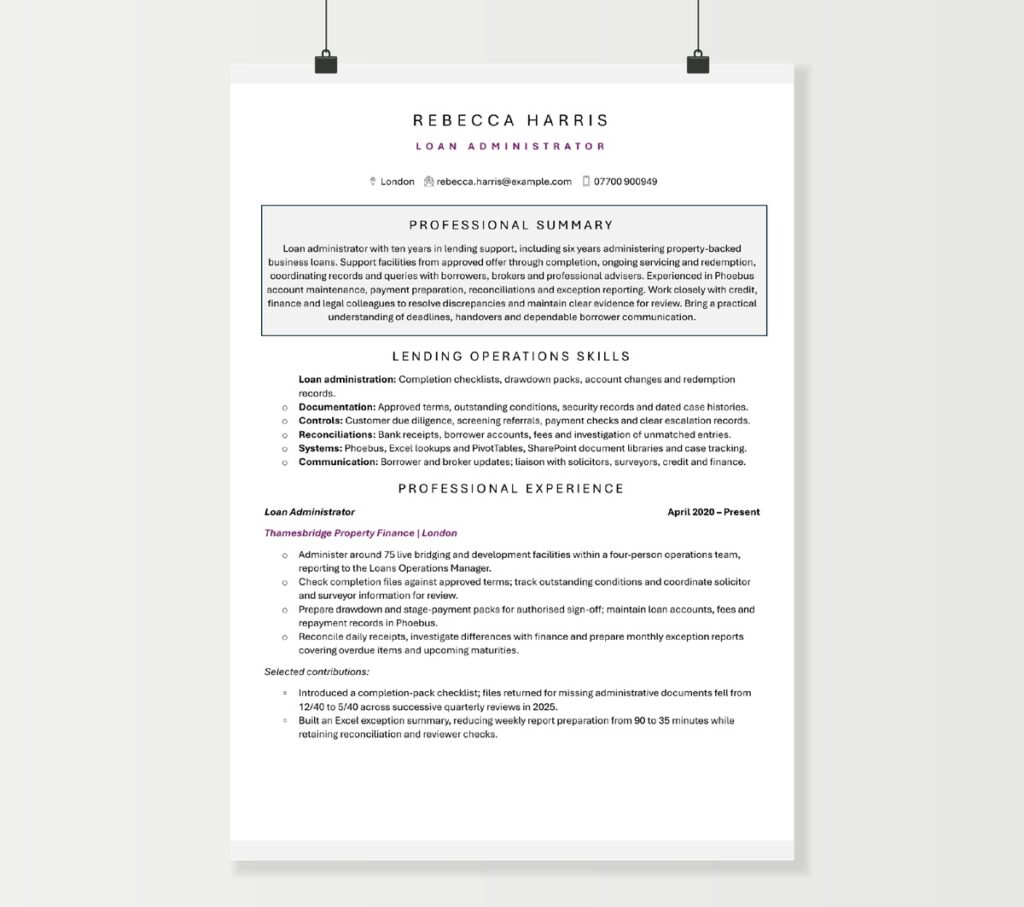
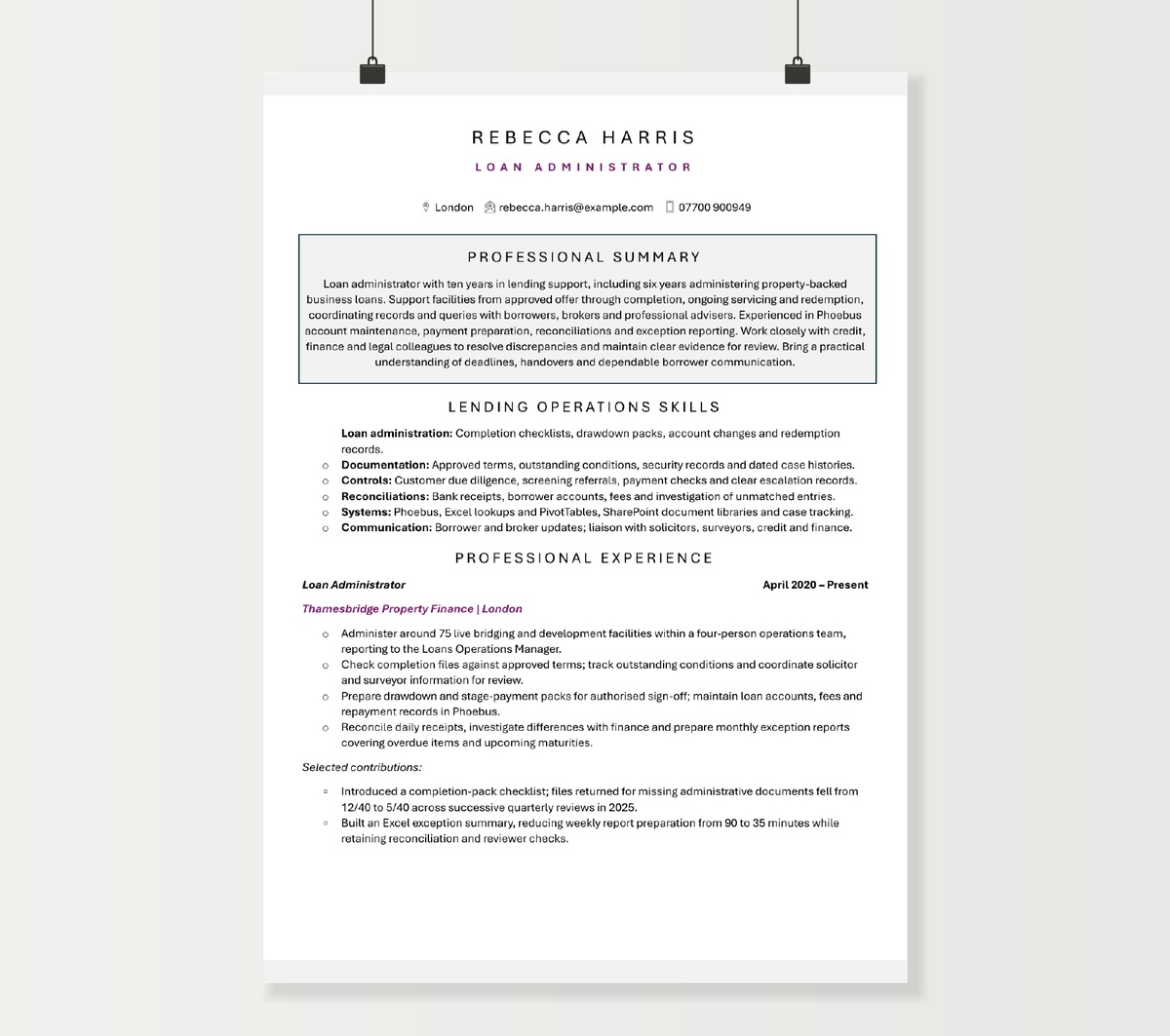
Rebecca Harris
LOAN ADMINISTRATOR
London | [email protected] | 07700 900949
Professional summary
Loan administrator with ten years in lending support, including six years administering property-backed business loans. Support facilities from approved offer through completion, ongoing servicing and redemption, coordinating records and queries with borrowers, brokers and professional advisers. Experienced in Phoebus account maintenance, payment preparation, reconciliations and exception reporting. Work closely with credit, finance and legal colleagues to resolve discrepancies and maintain clear evidence for review. Bring a practical understanding of deadlines, handovers and dependable borrower communication.
Lending operations skills
- Loan administration: Completion checklists, drawdown packs, account changes and redemption records.
- Documentation: Approved terms, outstanding conditions, security records and dated case histories.
- Controls: Customer due diligence, screening referrals, payment checks and clear escalation records.
- Reconciliations: Bank receipts, borrower accounts, fees and investigation of unmatched entries.
- Systems: Phoebus, Excel lookups and PivotTables, SharePoint document libraries and case tracking.
- Communication: Borrower and broker updates; liaison with solicitors, surveyors, credit and finance.
Professional experience
Loan Administrator | April 2020 – Present
Thamesbridge Property Finance | London
- Administer around 75 live bridging and development facilities within a four-person operations team, reporting to the Loans Operations Manager.
- Check completion files against approved terms; track outstanding conditions and coordinate solicitor and surveyor information for review.
- Prepare drawdown and stage-payment packs for authorised sign-off; maintain loan accounts, fees and repayment records in Phoebus.
- Reconcile daily receipts, investigate differences with finance and prepare monthly exception reports covering overdue items and upcoming maturities.
Selected contributions:
- Introduced a completion-pack checklist; files returned for missing administrative documents fell from 12/40 to 5/40 across successive quarterly reviews in 2025.
- Built an Excel exception summary, reducing weekly report preparation from 90 to 35 minutes while retaining reconciliation and reviewer checks.
Lending Support Administrator | September 2016 – March 2020
Northbank Business Finance | London
- Supported a small-business lending team with application records, document requests and borrower enquiries; progressed from routine administration to managing a shared case queue.
- Checked received documents for completeness, recorded customer due-diligence evidence and referred queries to the appropriate specialist.
- Prepared approved correspondence, maintained case notes and coordinated outstanding items with brokers and relationship managers.
- Updated repayment records and matched incoming receipts to account references, escalating unresolved differences to finance.
Selected contributions:
- Helped clear a backlog of 46 document requests older than ten working days, reducing it to 14 over six weeks through scheduled follow-up.
- Created a shared handover record for four colleagues, improving requests with a named owner and next action from 32/50 to 47/50.
Education & development
A levels: Business Studies B, Economics B, English Language C – Leyton Sixth Form College, 2016
Customer due diligence and financial crime awareness – Employer annual refresher, 2026
Phoebus loan administration – Employer training, 2021
Excel: lookups, PivotTables and reconciliation checks – Employer workshop, 2024
Additional information
- Team support: Inducted two administrators in document indexing, case notes and exception-report preparation.
- Working approach: Organise daily cut-offs and monthly reporting alongside borrower queries and planned team cover.
- Interests: Swimming, baking and visiting museums.
How to write a loan administrator CV
A loan administrator CV should make the movement of a lending case visible: the information you check, the transactions or records you maintain, the people you coordinate and the issues you resolve. Employers need to understand where you work in the loan lifecycle and how your contribution supports accurate, timely service.
Start with the lending environment. Property development, bridging finance, small-business loans, consumer lending and syndicated corporate facilities involve different documents, systems and relationships. A clear description of your experience helps the reader recognise the relevant parts immediately.
Place your experience in the loan lifecycle
Give each recent role a short scope statement covering products, customers, team and workload. A number of live accounts, active cases or monthly transactions can establish scale. Specify whether that is your own allocation or the wider team’s portfolio.
Then identify the stages you handled. Application support may involve collecting information and progressing outstanding requests. Completion work may involve checking conditions and preparing documentation. Servicing can include account changes, repayments, fees, statements, reconciliations and maturity follow-up.
Rebecca’s example focuses on property-backed business lending from approved offer onwards. Her experience is therefore described through completion packs, stage payments and ongoing accounts. An applicant from corporate loan operations would usually give more space to facility structures, servicing events and coordination with agents or participating lenders.
Use verbs that show the responsibility you held: prepared, checked, processed, reconciled, reviewed or authorised. They help the reader distinguish an administrator’s work from credit approval, specialist legal review or another team’s decision.
Show the evidence behind accurate completion work
“Maintained loan documentation” becomes more informative when you name the records and their purpose. Relevant examples include checking a pack against approved terms, tracking outstanding conditions, coordinating signed documents or recording the status of security information.
Choose an instance where your attention changed the next step. You may have identified inconsistent dates, obtained missing supporting material or clarified a discrepancy before a pack reached the reviewer. Explain the issue and the action you took, keeping the CV focused on operational judgement.
For development finance, describe your involvement with surveyor information, stage-payment packs and solicitor liaison. Preparing material for review, checking it against a checklist and approving a drawdown are distinct responsibilities; precise wording makes the level of your experience clear.
If you support security documentation, describe the work you actually own, such as maintaining records, following up outstanding documents or coordinating releases. This gives useful context without turning the CV into a catalogue of every document in a facility.
Make servicing and transaction experience specific
State the events you process regularly: drawdowns, repayments, interest or fee entries, account amendments, maturities or redemptions. Include the product and relevant complexity, such as staged advances, multiple currencies or a mix of bilateral and syndicated facilities.
For corporate banking roles, agency and participation experience should be distinguishable. Explain whether you coordinated borrower and lender communications, maintained servicing records, prepared notices, handled fee administration or supported settlement. Experience interpreting facility documentation is stronger when linked to those tasks.
Where payment activity is part of your role, explain your place in preparation, checking, release or investigation, together with the deadlines you work to. A concise description of cut-off management and exception handling can show both pace and control.
For a servicing role involving overdue payments, describe monitoring, contact, referrals and records. If a specialist collections team handles the next stage, explain how your information and handover support that team. That makes the breadth of your work understandable.
Use reconciliations to demonstrate problem solving
A reconciliation bullet should say what you compared and how you dealt with differences. Bank receipts against borrower accounts, ledger entries against a servicing system and payment notices against expected amounts are different pieces of work.
Describe a useful investigation: tracing an unmatched receipt, correcting an account reference, resolving a timing difference or agreeing an adjustment with finance. The employer can then see the reasoning behind your accuracy, rather than only an assertion that you are detail-oriented.
Reporting experience can also show judgement. Explain who used your report and what it helped them act on, such as outstanding documents, approaching maturities, overdue items or unresolved reconciliation differences. Give the frequency and your responsibility for checking the information.
Rebecca’s Excel improvement includes the time saved and the checks retained. This shows that the change made an established process more efficient while keeping the output useful for review.
Present controls through practical responsibilities
Customer due diligence, screening, financial-crime referrals and audit evidence can be important parts of lending administration. Give the relevant activity and your role in it: collecting and checking information, recording evidence, investigating an operational query or referring a case for specialist review.
A short example of spotting an inconsistency and ensuring it reached the right reviewer can demonstrate more than a long list of compliance abbreviations. Relevant training can sit in a separate development section, with the completion or refresher year.
Audit support deserves space where you have supplied records, explained a process or helped resolve an action. State the contribution and outcome, such as improving document retrieval or clarifying ownership of an outstanding item.
For experienced applicants, include checker responsibilities, procedure updates, quality sampling or coaching where these form part of your role. These are useful signs of progression towards senior operations work.
Choose achievements that reflect dependable service
Loan administration achievements often concern reliable processing rather than sales. Useful measures include returned packs, aged work, unresolved exceptions, response times and the effort required to prepare accurate reports.
- Give the starting point, result and period for a backlog reduction.
- For a quality measure, include the number reviewed or the definition used.
- For turnaround time, state the stage measured, such as receipt of a complete pack to readiness for review.
- For a team result, explain the part you contributed, including coordination with credit, legal or finance.
“Returned packs fell from 12 out of 40 to five out of 40 after a checklist change” lets the reader assess both scale and improvement. Where you have no suitable figure, a clear account of resolving a recurring problem or improving a handover can still be strong evidence.
Completion speed is most persuasive when its starting point is clear. A case waiting for a borrower document is different from a complete case awaiting internal action. That context helps the employer understand what your process improvement achieved.
Make systems experience useful to the next employer
Name the lending platforms you use and the activities you perform in them. Phoebus account maintenance, Loan IQ servicing and CRM case tracking describe different experience. Include relevant tasks such as booking transactions, updating records, investigating exceptions or producing reports.
Excel skills are stronger with an application: matching receipts, checking totals, creating an ageing report or summarising workload. Lookups, PivotTables or Power Query can support that account where they are part of your work. A short, applied description helps recruiters assess your capability more easily than a rating such as “advanced”.
System change work can be valuable too. If you tested a new workflow, checked migrated data or helped colleagues adopt a revised process, describe your contribution and the checks or results. This is particularly useful for contract roles involving operational change.
Show communication and progression
Borrowers, brokers, relationship managers, solicitors and surveyors need different information. Describe how you made an outstanding request clear, maintained a useful case history or coordinated an issue across teams. A good example shows the next action and how the case progressed.
For a first lending role, draw on experience handling detailed records, payments, document requests, deadlines or customer enquiries. Explain those responsibilities in their original context. The administrator CV example offers another way to organise a broader support background.
For an experienced application, lead with products, lifecycle coverage, systems and operational improvements. Keep qualifications proportionate: relevant school, college or degree results, followed by lending, systems and control training. A completed qualification and a course currently in progress can each be listed with their stage and date.
Use the final review to check that the CV answers three questions: what lending work have you handled, what responsibility did you hold, and what became better because of your contribution? Alternative Word layouts are available in the CV template library.
Loan Administrator CV FAQs
CeMAP is a mortgage-advice qualification. It may be relevant to a particular employer or career plan, but loan administration vacancies vary and many focus on operational experience, records, systems and communication. Use the requirements of the role you are applying for, and list CeMAP with its completion stage if you hold or are studying it.
Often, yes, where the platform is described as desirable or training is available. Explain the processes you can perform in your existing system and any experience learning a new one. If the vacancy requires immediate expertise in a named platform, make the extent of your relevant experience easy to assess.
List each assignment with dates, employer or agency arrangement, and a clear contract label. Distinguish the work undertaken on each assignment, such as servicing cover, a backlog exercise, migration checks or transaction processing. A short line about the purpose and completion of the assignment helps the chronology make sense.
Portfolio value can provide context when it is appropriate to share, but state whether it covers your allocation or the team’s book. The number of facilities, transaction volume, product mix or complexity may explain your experience just as well. Portfolio size becomes most useful when accompanied by your responsibilities.
Administration generally concerns progressing, recording and servicing lending activity, while underwriting centres on assessing credit risk and making or recommending lending decisions. Some roles combine elements of both. Describe the assessment, recommendation or approval responsibility you held alongside the operational work, so the reader can see the scope clearly.
Keep the employer’s title in your employment history and add a brief functional description if it helps, such as “lending support officer — loan administration”. Your profile can describe the type of role you are seeking. Clear duties and product information will do more to establish relevance than changing the official title.
Yes, particularly where it involves detailed records, sensitive enquiries, payments or coordinating several teams. Select examples showing accurate follow-up and a clear next action for the customer. Pair that evidence with any numerical, spreadsheet or document-checking responsibilities, which helps an employer see the operational skills you would bring.