
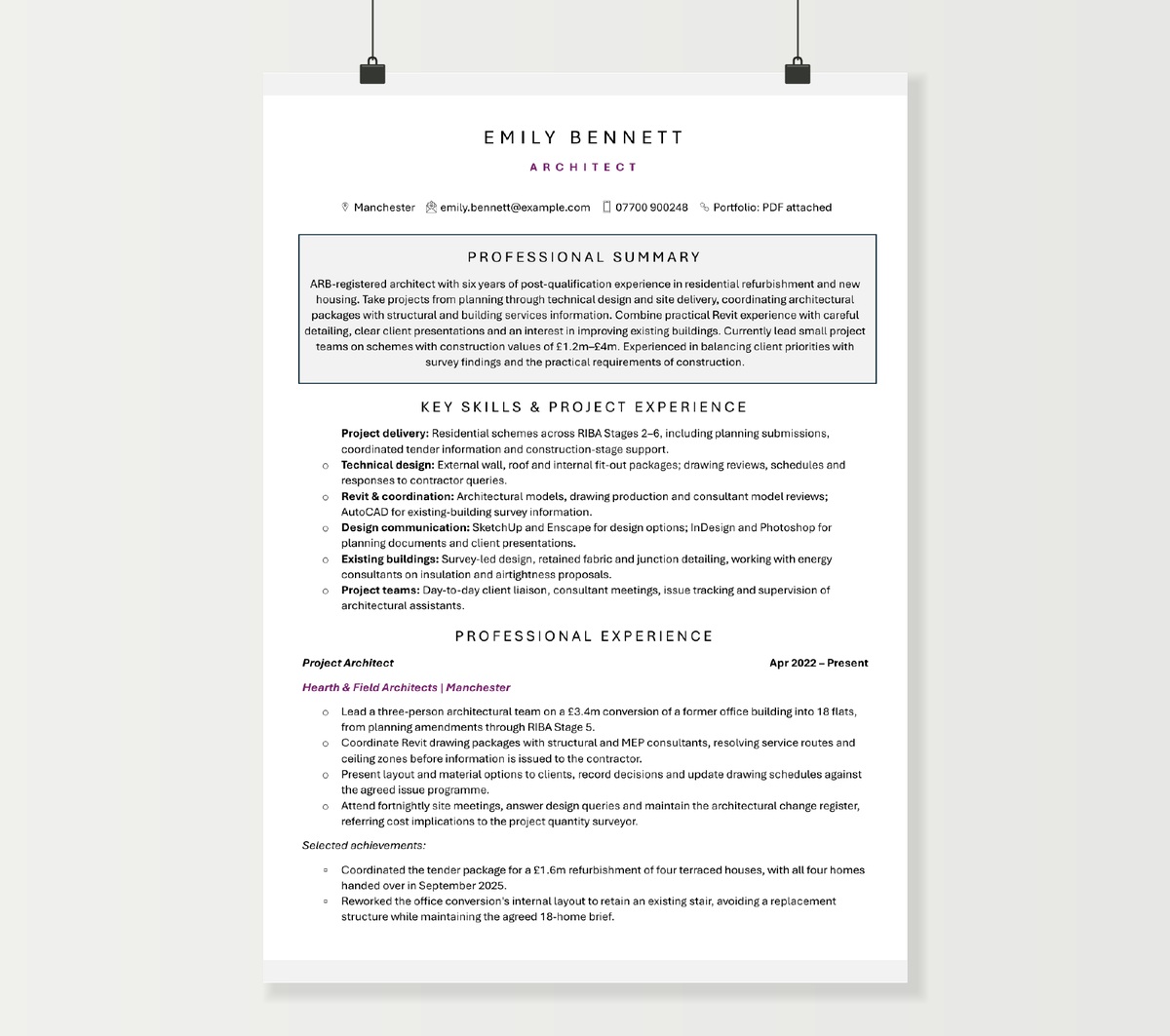
This architect CV template shows how to bring project experience, technical delivery and professional qualifications together in a clear application. The example follows an ARB-registered architect working on residential refurbishment and new housing, with project responsibilities, software use and selected achievements. Download the Word CV below, then use the guide to develop your own project-led application.
Filename: FreeCVDownload_Architect.docx
Content of this CV template
Emily Bennett
ARCHITECT
Manchester | [email protected] | 07700 900248 | Portfolio: PDF attached
Professional Summary
ARB-registered architect with six years of post-qualification experience in residential refurbishment and new housing. Take projects from planning through technical design and site delivery, coordinating architectural packages with structural and building services information. Combine practical Revit experience with careful detailing, clear client presentations and an interest in improving existing buildings. Currently lead small project teams on schemes with construction values of £1.2m–£4m. Experienced in balancing client priorities with survey findings and the practical requirements of construction.
KEY SKILLS & PROJECT EXPERIENCE
- Project delivery: Residential schemes across RIBA Stages 2–6, including planning submissions, coordinated tender information and construction-stage support.
- Technical design: External wall, roof and internal fit-out packages; drawing reviews, schedules and responses to contractor queries.
- Revit & coordination: Architectural models, drawing production and consultant model reviews; AutoCAD for existing-building survey information.
- Design communication: SketchUp and Enscape for design options; InDesign and Photoshop for planning documents and client presentations.
- Existing buildings: Survey-led design, retained fabric and junction detailing, working with energy consultants on insulation and airtightness proposals.
- Project teams: Day-to-day client liaison, consultant meetings, issue tracking and supervision of architectural assistants.
Professional experience
Project Architect | Apr 2022 – Present
Hearth & Field Architects | Manchester
- Lead a three-person architectural team on a £3.4m conversion of a former office building into 18 flats, from planning amendments through RIBA Stage 5.
- Coordinate Revit drawing packages with structural and MEP consultants, resolving service routes and ceiling zones before information is issued to the contractor.
- Present layout and material options to clients, record decisions and update drawing schedules against the agreed issue programme.
- Attend fortnightly site meetings, answer design queries and maintain the architectural change register, referring cost implications to the project quantity surveyor.
Selected achievements:
- Coordinated the tender package for a £1.6m refurbishment of four terraced houses, with all four homes handed over in September 2025.
- Reworked the office conversion's internal layout to retain an existing stair, avoiding a replacement structure while maintaining the agreed 18-home brief.
Architect / Part 2 Architectural Assistant | Sep 2017 – Mar 2022
Northline Design Studio | Manchester
- Joined as a Part 2 Architectural Assistant in September 2017 and progressed to Architect following Part 3 and ARB registration in 2020.
- Developed planning drawings and design and access statements for housing projects of 6–32 homes, incorporating feedback from planning and landscape consultants.
- Produced coordinated Revit drawings, door schedules and junction details for a 24-home development during RIBA Stages 3–5.
- Supported the project architect with site inspections, photographic records and snagging; tracked contractor queries through to agreed drawing revisions.
Selected achievements:
- Prepared a revised window and door schedule across the 24-home scheme, resolving inconsistent references before the procurement package was issued.
- Helped two incoming assistants adopt the studio's Revit sheet and revision conventions, reviewing their first drawing issues with the project architect.
Qualifications & registration
PGCert Professional Practice in Architecture (Part 3) – University of Cambridge, 2020
MArch Architecture (Part 2) – University of Sheffield, 2017
BA Architecture (Part 1), 2:1 – University of Sheffield, 2014
ARB registered – Since 2020
Additional information
- Portfolio: Selected residential projects, technical details and design development drawings available as a PDF alongside this CV.
- Recent CPD: Retrofit moisture risk, accessible housing design and fire stopping at external wall interfaces (2025–2026).
- Interests: Weekend cycling, pottery classes and visiting independent cinemas.
How to write an architect CV
An architect CV should let a practice picture where you would contribute to its work. That means showing the kinds of buildings you know, the stages you have worked through and the decisions or packages you have taken responsibility for. Your portfolio supplies the visual evidence; the CV gives that work its professional context.
Two architects with the same qualification and years in practice can offer very different experience. One may have developed concepts and planning submissions for large housing schemes. Another may have coordinated refurbishment details, answered site queries and worked closely with private clients. Make those differences visible early, especially when the vacancy has a particular design or delivery emphasis.
Choose a project-led emphasis that fits the practice
Start with the work the practice is recruiting someone to do. Look at the vacancy alongside its recent projects: building type, scale, new build or existing fabric, likely clients and the point at which the practice becomes involved. Use that context to decide which parts of your experience deserve the most space.
For a design-led housing studio, your strongest evidence might be a convincing response to a constrained site, planning negotiations and the development of a material palette. For a delivery role on larger buildings, consultant interfaces, construction information and the quality of your technical review may matter more. A small practice may need the breadth to move between client presentations, tender packages and site visits within the same week.
Your profile should identify your professional position, relevant project experience and the contribution you can make. A phrase such as “experienced across all RIBA stages” becomes much more useful when the next sentence explains where that experience is deepest.
“ARB-registered architect with experience in education and community buildings, including four years coordinating technical information through RIBA Stages 3–5. Lead architectural drawing packages, resolve structural and services interfaces and work with school clients to maintain a clear design brief.”
This gives a practice something concrete to assess. The experience section can then show the projects behind it, rather than spending another paragraph on broad claims about creativity and enthusiasm.
Make each project entry answer the right questions
Organise employment in reverse chronological order, but give the reader more than a list of practice names. Within each substantial role, select projects that explain your experience. A project title alone may mean little outside its locality; add enough context to make the work understandable.
A compact project description can identify the building type and scale, your stages, the project’s status, your responsibility and one useful outcome. You do not need a separate field for every item. A heading and two well-chosen bullets can carry the information naturally:
Community arts centre refurbishment, £2.8m — RIBA Stages 3–5
Coordinated the architectural tender package, including accessibility improvements and junction details between the retained building and a new entrance extension.
Worked with the structural engineer to resolve the entrance canopy connection before the steelwork package was issued; supported the project architect with site queries during construction.
The construction value helps the reader understand scale. The verbs identify the applicant’s work. The reference to the project architect explains how responsibility sat within the team. Together, these details are more informative than “involved in a successful £2.8m project”.
For a large practice, package responsibility can be the central story: façades, cores, residential layouts, internal fit-out or a particular building within a masterplan. For a smaller practice, a whole-project account may better reflect your role. Choose the level at which you can explain the work clearly at interview.
A long project list can sit in a separate project sheet or portfolio. On the CV, use the projects that collectively demonstrate the experience the vacancy needs. Three similar planning schemes may add less than a planning scheme, a technically demanding refurbishment and a project taken through construction.
Show what your RIBA stage experience involved
Stage numbers help practices scan a CV, but they work best beside the actual output. “Stages 2–6” describes a range; it does not tell the reader whether you led design development, produced a drawing package or joined the project during site delivery.
- Early design and briefing: show how you developed options, tested the brief, explored site constraints or prepared material for a client decision.
- Planning and spatial coordination: identify application drawings, design and access statements, consultant coordination or revisions responding to planning feedback.
- Technical design: name the packages, specifications, schedules or details you produced or reviewed, and the interfaces you coordinated.
- Construction and handover: describe site inspections, responses to queries, review of contractor information, snagging or handover records within your role.
Project history also needs a current status. A scheme awaiting a planning decision, a completed tender package and an occupied building demonstrate different things. Clear status makes ongoing and unbuilt work valuable evidence in its own right.
If your experience is concentrated in a few stages, develop that evidence properly. A technically strong Stage 4 architect can make a compelling application through package complexity, coordination and review responsibility. A newly qualified architect can show how earlier assistance grew into greater ownership without making every project sound like a project-running role.
Describe design judgement, not just the finished building
Portfolio images show what a project looks like. The CV can explain a decision that improved it: preserving an existing element, reorganising a circulation route, responding to a difficult boundary or translating a client’s changing brief into a workable arrangement.
Keep the explanation short enough to remain CV evidence. Identify the constraint, your response and the effect on the project. For example, a revised entrance arrangement may have created step-free access within the existing footprint. An alternative façade layout may have reconciled a planning requirement with the structural grid. These are specific professional contributions even when there is no financial metric.
Where design was developed collaboratively, explain your part in that process. “Developed three layout options for client review, then coordinated the preferred option with the landscape consultant” shows design ability, communication and follow-through in one sentence.
Make technical skills readable through the work they support
A software list is useful for a quick match, but practices also need to understand how you use those tools. Group your main applications by purpose and support the most important ones in project bullets.
For Revit, relevant evidence might include maintaining an architectural model, producing coordinated construction drawings, creating schedules, reviewing consultant models or helping colleagues follow issue conventions. For a BIM coordination role, explain the information workflow or coordination responsibility you held, including the common data environment where relevant. That tells the reader much more than a proficiency bar.
AutoCAD, Vectorworks and Archicad may be central to a particular practice. Name the tools used in your recent work and the type of output you produced. If you are moving between platforms, a short line about relevant training and previous CAD or model-based delivery gives the practice a useful basis for discussing the transition.
For design communication, connect SketchUp, Rhino, Enscape or Adobe applications to their use: developing options, testing massing, producing client visuals, composing planning documents or preparing competition submissions. A long list of every application you have opened can obscure the tools that actually shape your work.
Technical knowledge deserves the same treatment. “Building Regulations” is broad; a project bullet about coordinating accessible layouts, fire strategy information or external wall details shows where that knowledge entered your work. Name the relevant UK jurisdiction when it helps a practice understand experience gained elsewhere. Keep the emphasis on your contribution and the specialists you worked with.
Give refurbishment and environmental work useful detail
Existing-building experience can be particularly persuasive when the application shows how you dealt with what was already there. Survey information, retained structure, uncertain junctions, heritage constraints and work around occupied spaces all influence the architectural task.
Choose an example that connects the constraint with your output: coordinating new services through an existing structure, developing window details for retained masonry or revising drawings after an opening-up survey. This gives “refurbishment experience” substance without turning your CV into a technical report.
For sustainability, describe the element of the design you worked on and the evidence available. You might have compared façade options with an energy consultant, developed insulation and airtightness details, supported embodied-carbon assessment or reviewed post-occupancy feedback. If you include a performance figure, identify whether it is a design prediction, an assessment result or measured performance, along with the scope it covers.
Put specialist qualifications such as a Passivhaus credential in the qualifications section with their full title. Applied project experience belongs in the project account. Keeping both visible helps a practice distinguish formal training from the work you have delivered.
Show how you work with clients, consultants and contractors
“Excellent communication skills” misses the variety of communication an architect undertakes. Choose evidence that shows the audience and the decision or coordination task: presenting options to a private client, recording a design-team decision, incorporating a consultant’s advice or explaining a detail to a contractor.
A project architect’s CV should also make day-to-day responsibility clear. Did you chair coordination meetings, maintain an issue programme, allocate drawing work, review assistants’ output or keep the client informed of decisions affecting the brief? These details show how you helped a team keep work moving.
Site experience becomes stronger when it goes beyond “attended site meetings”. Explain the information you reviewed, the record you produced or how a query led to an agreed revision. Where you supported contract administration, identify the work undertaken and the contract context if relevant to the vacancy. If you held a named appointment, give its precise title rather than relying on a broad description such as “managed compliance”.
For senior posts, include the practice-facing side of responsibility too: fee proposals, resource planning, scope changes, client retention or mentoring. State team size and the nature of supervision. Reviewing two assistants’ drawings is different from managing a department, and both can be useful evidence for the right vacancy.
Use outcomes that reflect architectural work
Architectural results often emerge over years and through many contributors. Your strongest CV achievements may therefore be a completed milestone, a resolved design problem or a better way of coordinating information, rather than a dramatic percentage improvement.
Separate project scale from the effect of your work. A £12m construction value, 60 homes or a 4,000m² floor area establishes context. An achievement explains what changed because of the work you contributed: a coordinated tender issue, an accepted planning revision, an existing feature retained or a difficult interface resolved before manufacture.
Where you have useful numerical evidence, provide the basis. If a review reduced drawing discrepancies, explain the drawing set or issue being compared. If an alternative detail reduced cost, distinguish the cost consultant’s estimate from an agreed saving at procurement. For an energy figure, indicate the calculation or measurement stage.
Plain, proportionate outcomes often read best:
“Coordinated the revised façade setting-out with the structural engineer and specialist subcontractor, resolving bracket locations before the manufacture release.”
This names the interface, the collaborators and the milestone. It gives an interviewer a useful project to explore, with a clear account of the applicant’s contribution.
Let the CV and portfolio do different jobs
Keep the CV easy to scan for dates, role, registration, project scope and tools. Let the portfolio provide drawings, photographs and the visual sequence of design development. A few strong project references on the CV can guide the reader to the relevant portfolio pages.
Match the portfolio evidence to the vacancy. A concept role may benefit from sketches, options and design development. A technical role needs readable details, sections, coordination or construction information. A project-running role benefits from a sequence showing how the work progressed, alongside concise captions identifying your contribution.
Use consistent project titles across both documents. Where a title is anonymised, use the same description throughout. Captions can state the practice, stage and your role so the reader understands how the work was produced. For collaborative images, distinguish your design or drawing contribution from the overall team credit.
Follow the practice’s requested submission format and file limit. A focused PDF is often easier to review than a large archive. A website link can supplement it where useful, but the application should still contain the material the employer asks to receive. Place the portfolio reference with your contact information so it is easy to find.
Present qualifications and progression at the right level
For a registered architect, make ARB registration easy to locate and list academic or professional awards separately. Include the qualification title, institution and completion year. Where Part 1, Part 2 or Part 3 is how a historic qualification is commonly understood, that label can help a practice interpret the sequence. Professional membership can sit alongside registration under its own name and status.
A promotion from architectural assistant to architect is worth showing within an employment entry, particularly if both roles were at one practice. Give the qualification or registration year and indicate how responsibility developed. This makes post-qualification experience visible without losing the value of earlier project work.
For Part 1 and Part 2 applicants, education and selected university projects may deserve more prominence. Choose projects for the abilities they reveal: responding to a brief, developing a proposition, resolving a building section, investigating materials or presenting a coherent design. Give enough context for a reader outside your course to understand the task. Placement work can then show how those skills translated into practice.
As professional work accumulates, let it take the lead. Academic awards and a distinctive thesis may still be relevant, but school subjects and lengthy module lists usually contribute less than a well-explained live project.
For international experience, state the location of the projects and the jurisdiction of your registration. Make your present UK registration position clear in the application. Then explain the work a UK practice can assess directly: building type, project stages, technical packages, consultant coordination and client responsibility. This gives overseas experience its proper weight while making the professional context understandable.
Finish with a CV a practice can navigate quickly
Read the first page as a project director choosing people for a particular team. It should be straightforward to find your current role, professional status, relevant sectors, strongest stage experience and recent responsibilities. Read the project entries alongside the portfolio to check that names, dates, status and contributions line up.
The downloadable example uses a clear text-led layout so the portfolio can carry the visual work. If another arrangement would suit your career history better, browse the full CV template collection. Whichever design you choose, preserve enough space for the project evidence that distinguishes you from another applicant with the same software and qualifications.
Architect CV FAQs
Use a description at the level you are permitted to share, such as ‘mixed-use development, London’ or ‘private residential refurbishment’. You can still describe your role, project stages and the type of package you worked on where those details are disclosable. A short CV entry can carry useful evidence without naming the client or reproducing restricted drawings. For the portfolio, use material cleared for external use and keep the same anonymised project description across both documents.
Yes, when they show something relevant that your built work does not. Label the status clearly: competition entry, shortlisted proposal, planning-stage scheme or university project. Explain your contribution and the design question you addressed. A shortlist or award can be a useful result; an unbuilt scheme can also demonstrate strong research, option development or coordination. For a delivery vacancy, balance these entries with evidence of technical or construction-stage work.
Give your dates and contribution within the employment entry for the practice where you did the work. If you returned to the same project at another practice, explain the later role separately, including any change in stage or package responsibility. A project may have been completed after you left; a phrase such as ‘worked on Stages 2–4; subsequently completed in 2025’ keeps the overall project history and your own involvement easy to follow.
Yes. A short separate entry can identify the dates, type of commission and scope, particularly if it adds direct client contact or project stages missing from your main job. Describe whether you provided design assistance, a drawing package or a wider service. For work delivered as a subconsultant, show that relationship. If it was occasional work, that description helps the reader understand the overlap in dates and the scale of the commitment.
A concise dated line in the career history is usually enough for a substantial break. If Part 3 was completed while you remained employed, put the qualification in education and show any resulting progression within the practice role. For a return to practice, recent relevant CPD, software refreshers and the project experience you want to build on can sit near the top of the CV. There is no need to turn a short explanation of the timeline into the main story of the application.
A photograph is not normally needed for a UK architect CV. Strong typography, spacing and a clear hierarchy can demonstrate care without taking room from project evidence. Use the portfolio for drawings and photographs at a size that makes them worth viewing. If a practice specifically requests a combined CV and portfolio, put a readable CV section first and follow its page and file-size instructions.




