
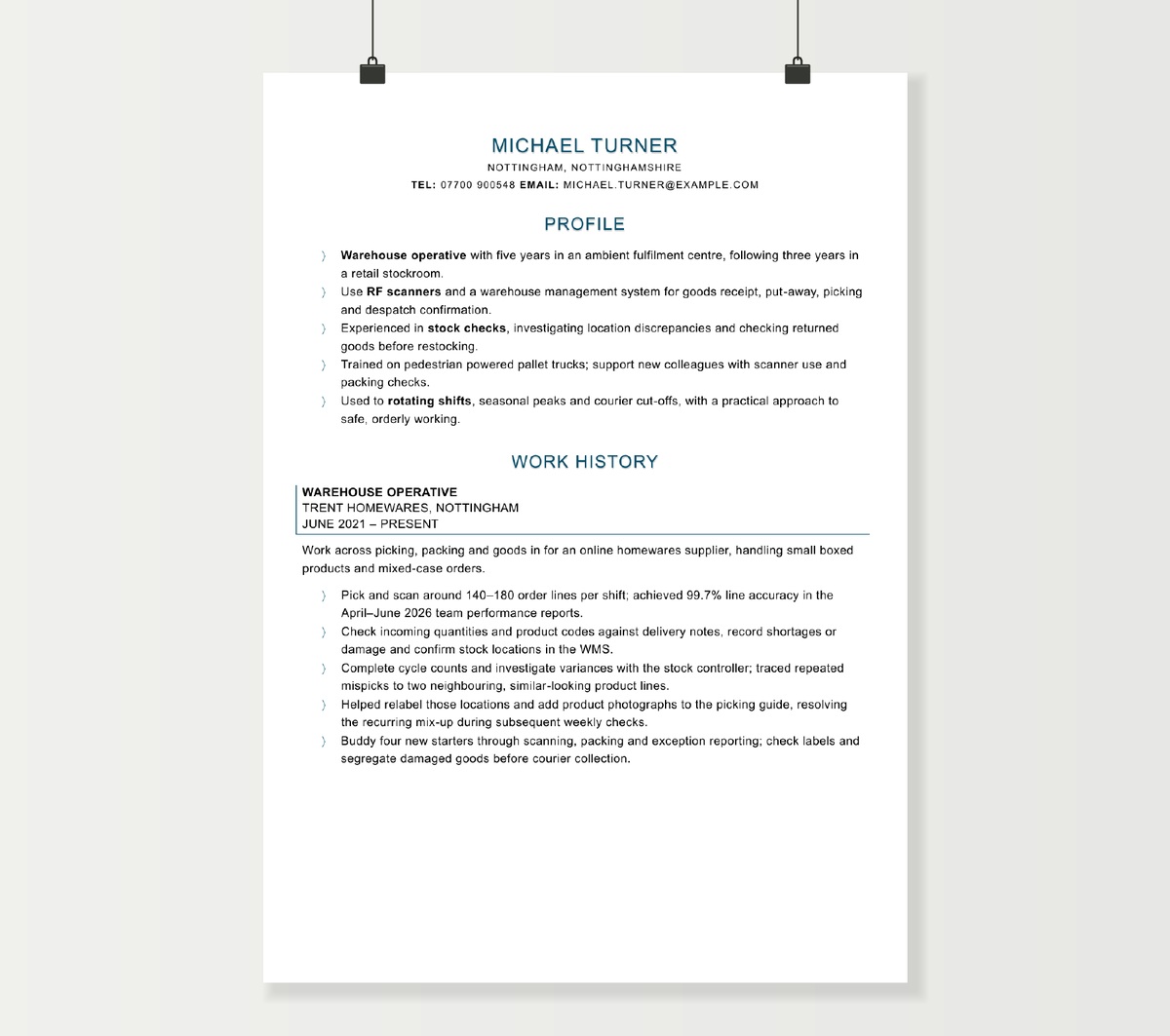
This warehouse operative CV template follows an experienced picker and packer who has taken on goods-in checks, stock counts and new-starter support. The example shows how to describe warehouse systems, equipment training and dependable performance in practical terms. Download the Word CV and use the guide to build an application for a warehouse, distribution or fulfilment role.
Filename: FreeCVDownload_Warehouse_Operative.docx
Content of this CV template
MICHAEL TURNER
NOTTINGHAM, NOTTINGHAMSHIRE
tel: 07700 900548 email: [email protected]
PROFILE
- Warehouse operative with five years in an ambient fulfilment centre, following three years in a retail stockroom.
- Use RF scanners and a warehouse management system for goods receipt, put-away, picking and despatch confirmation.
- Experienced in stock checks, investigating location discrepancies and checking returned goods before restocking.
- Trained on pedestrian powered pallet trucks; support new colleagues with scanner use and packing checks.
- Used to rotating shifts, seasonal peaks and courier cut-offs, with a practical approach to safe, orderly working.
WORK HISTORY
WAREHOUSE OPERATIVE
TRENT HOMEWARES, NOTTINGHAM
JUNE 2021 – PRESENT
Work across picking, packing and goods in for an online homewares supplier, handling small boxed products and mixed-case orders.
- Pick and scan around 140–180 order lines per shift; achieved 99.7% line accuracy in the April–June 2026 team performance reports.
- Check incoming quantities and product codes against delivery notes, record shortages or damage and confirm stock locations in the WMS.
- Complete cycle counts and investigate variances with the stock controller; traced repeated mispicks to two neighbouring, similar-looking product lines.
- Helped relabel those locations and add product photographs to the picking guide, resolving the recurring mix-up during subsequent weekly checks.
- Buddy four new starters through scanning, packing and exception reporting; check labels and segregate damaged goods before courier collection.
STOCKROOM ASSISTANT
OAKFIELD HOME & GARDEN, NOTTINGHAM
SEPTEMBER 2018 – MAY 2021
Joined a home and garden retailer after school, receiving deliveries and replenishing the shop floor from a busy stockroom.
- Checked cages against delivery paperwork, reported missing cartons and organised stock by department and selling season.
- Prepared click-and-collect orders, matched product variants and kept reserved items separate from saleable stock.
- Supported quarterly stocktakes and reconciled recounts with the supervisor, including checking items held for customer collection.
- Helped reorganise the seasonal stock area so daily replenishment items were easier to reach; regularly covered early delivery shifts.
EDUCATION & TRAINING
GCSES
NOTTINGHAM COMMUNITY SCHOOL – 2018
Six GCSEs at grades 4–6, including English Language and Mathematics.
PEDESTRIAN POWERED PALLET TRUCK TRAINING
TRENT HOMEWARES, IN-HOUSE – 2022; REFRESHER 2025
WAREHOUSE SAFETY AND MANUAL HANDLING
TRENT HOMEWARES, INDUCTION AND ANNUAL UPDATES – 2021–2026
OUTSIDE WORK
I play five-a-side football, enjoy fishing and help maintain the pitches at my local football club.
How to write a warehouse operative CV
A warehouse manager needs to see where you can contribute on a shift: receiving deliveries, putting stock away, picking the right items, preparing orders for collection or keeping stock records accurate. A useful warehouse CV makes that experience easy to find. The strongest details usually concern the products you handled, the systems and equipment you used, and how your work helped orders move through the building correctly and on time.
Start with the operation you are applying to. A chilled distribution centre assembling store deliveries has different priorities from a small online retailer processing individual parcels. Both need dependable operatives, but the evidence that makes your application relevant will differ.
Give the reader a clear picture of your warehouse experience
Use your profile to establish the type of work you know and the responsibilities you could take on. “Five years in ambient fulfilment, covering RF picking, goods-in checks and cycle counts” gives more information than a string of qualities such as hardworking, motivated and efficient. Add a particularly relevant training detail or working pattern when it answers an important requirement in the vacancy.
At the start of each job, describe the setting in one sentence. Useful details include e-commerce or store distribution, food or non-food stock, chilled or ambient conditions, and individual items, cases or pallets. This makes the rest of the entry easier to understand. Someone accustomed to packing fragile homewares has different handling experience from someone loading full pallets of packaged groceries.
The downloadable example follows an operative who moved from a retail stockroom into fulfilment. The earlier role remains useful because it establishes experience of delivery checks, replenishment, reserved stock and stocktakes. If your route is similar, our retail assistant CV can help you identify the stock-handling responsibilities within a customer-facing job.
Describe the stages of the operation you actually worked on
“General warehouse duties” hides useful experience. Choose the parts of the stock journey that best match the new role and explain your contribution to them.
- Goods in: checking quantities, product codes and condition against delivery paperwork; recording shortages or damage; confirming receipt and stock locations.
- Put-away and replenishment: moving stock into allocated locations, maintaining pick faces, recording transfers and working with stock rotation where relevant.
- Picking and packing: the method used, such as handheld scanning, voice picking or paper lists; the orders or products handled; and the checks completed before packing.
- Despatch: matching labels and paperwork, sorting by carrier or route, preparing pallets or cages, and working to collection cut-offs.
- Returns: checking product condition, recording reasons, separating damaged goods and returning approved items to the correct stock status and location.
A job entry does not need a bullet for every stage. Give the most space to the work you did regularly and the experience the new employer needs. For a goods-in vacancy, receipt checks and resolving delivery discrepancies may deserve the first two bullets even if picking occupied more of your previous shift.
For food distribution, stock rotation, date checks and experience in chilled conditions can be particularly relevant. For clothing returns, product variants, condition checks and accurate restocking matter. Include those distinctions in the employment entry rather than leaving the reader to infer them from the employer’s name.
Make scanner and warehouse-system experience understandable
A short systems line can name the warehouse management system (WMS), RF scanner, voice-picking equipment or courier platform you used. The employment section should then show what you did with it. Receiving stock, confirming put-away, scanning a pick, recording a damaged item and investigating a stock discrepancy are different activities.
If your employer used an internal system whose name would mean little elsewhere, describe its function: “Used the in-house WMS to book in deliveries, confirm locations and record stock-count variances.” This still gives a recruiter useful evidence of digital working. A scanner brand alone is usually less informative than the transactions you completed.
Explain what happened when the system and the physical stock disagreed. For example, you might have checked neighbouring locations, carried out a recount and passed the findings to the stock controller. That demonstrates attention to detail more convincingly than simply listing it as a skill. If you had authority to make stock adjustments, include that responsibility; if adjustments went through another colleague, describe the investigation and handover.
Show output and accuracy in terms a recruiter can interpret
Warehouse figures need a unit and a period. Order lines, items, cases, completed orders and pallets measure different things. “Picked around 160 order lines per shift” is understandable; “processed 160” leaves the reader guessing. Product size, travel distances, picking method and the proportion of the shift spent on other tasks also affect output, so a little context helps.
Where you have performance records, pair productivity with quality. The example CV gives a range of order lines and a recorded line-accuracy figure over a named quarter. Other useful measures include packing errors, stock-count accuracy, damaged items, on-time completion against a collection cut-off or the time taken to clear a returns backlog. Use the measure your workplace actually tracked and explain whether it describes your own work or the team’s result.
Good evidence also comes from specific problems resolved. Identifying two easily confused product locations, improving their labels and helping stop the resulting mispicks shows observation and follow-through. You can describe that result without forcing it into a savings figure. Similarly, being trusted to work across three stations or help new starters gives a clear sense of your value even when there is no individual performance dashboard.
For a busy seasonal period, explain the responsibility that increased: handling an additional carrier collection, covering replenishment as well as picking, or checking despatch paperwork for the late shift. This is more useful than saying only that you worked well under pressure.
Present equipment training precisely
Put relevant mechanical handling equipment training in a short, clearly labelled section. Give the equipment type, training provider or in-house employer, and the date of training or most recent refresher. Reach trucks, counterbalance trucks and pedestrian powered pallet trucks are distinct, so their names help the recruiter match your background to the equipment on site.
Connect training with practical use in the work history. A certificate entry tells the reader you completed training; an employment bullet explains whether you used that equipment for replenishment, loading or moving stock during normal shifts. Where a certificate records an equipment category, that can sit alongside the plain-English description.
Employers sometimes use “forklift licence” as shorthand in adverts. For a CV, the actual training details are clearer. HSE’s lift-truck training guidance distinguishes basic, job-specific and familiarisation training. A new employer will need to consider your experience in relation to its equipment and site. Your CV’s job is to make the existing training and recent use easy to assess.
Demonstrate safe working through everyday responsibilities
Keep safety evidence practical: checking equipment before use, reporting damaged racking or packaging, keeping pedestrian routes clear, segregating damaged goods or following site procedures around loading areas. Choose examples relevant to your previous responsibilities and the vacancy. One well-chosen bullet can show this more effectively than a long list of general safety terms.
Manual-handling training, warehouse induction, food-handling instruction and employer refresher sessions can be included under training. Their value is clearest when the employer, topic and date are recorded. An in-house course belongs on the CV when it is relevant; it does not need to be presented as an external qualification.
Team communication matters here too. Shift handovers, reporting a short pick promptly and explaining a stock issue to the next station all help prevent avoidable delays. Show who you worked with and what information you passed on. If you buddied new starters, describe the tasks you helped them learn and how many people you supported.
Make shifts and availability easy to assess
Warehouse adverts often specify a pattern rather than simply “full time”: alternating early and late shifts, permanent nights, four on/four off, or a rota including weekends. Where your availability matches, a short line near the profile or in additional information can answer that question immediately. Experience of an equivalent pattern can also sit in the relevant job entry.
For a site with early starts or limited public transport, confirming that you can reach the location for the advertised shift is useful. A driving licence is worth including when travel arrangements or the role make it relevant. The aim is to make practical fit clear without using valuable space on a long account of your commute.
Build a first warehouse CV from relevant experience
For an entry-level vacancy, select evidence of following a process, checking quantities, handling stock, meeting time commitments and working with others. Retail replenishment, kitchen deliveries, parcel sorting, event setup or charity-shop stock work can all supply useful examples. Describe what you handled and checked, rather than relying only on a transferable-skills list.
School leavers can give more prominence to English and maths qualifications, an apprenticeship in progress, work experience and practical responsibilities. A supply chain warehouse operative apprenticeship should state its level, employer or training provider and expected completion date. Include the warehouse tasks already undertaken so the qualification has a clear workplace context.
Experienced applicants can usually keep education brief and use the space for the breadth of their warehouse work. If your responsibilities have grown, show the change: starting on packing, becoming competent in goods in, taking on cycle counts, then helping colleagues. That progression can strengthen an application even when your formal job title has stayed the same.
Organise agency and seasonal work so the experience is visible
Several short assignments are common in warehousing. Show the agency as the employer and identify the main placements, with dates and the type of operation. For example, an agency entry can contain separate lines for a Christmas fulfilment assignment and a later food-distribution placement. This lets a recruiter see both continuity and the different environments you know.
Give your most relevant or substantial placements enough detail to show the work. Shorter assignments doing similar duties can be grouped under the same agency entry. If you returned for another peak season or moved from an agency placement to a permanent job, make that visible: it explains the dates and shows that an employer wanted you back.
Choose a layout that keeps job dates, equipment training and work evidence easy to scan. You can compare other designs in the Word CV template library while keeping the emphasis on the warehouse experience that suits the vacancy.
Warehouse Operative CV FAQs
Yes. Many picking, packing and general warehouse roles provide the training needed for their operation. Other vacancies specifically require recent reach-truck or counterbalance experience. Check the equipment requirements for the individual job. For a role offering training, stock-handling experience, careful checking and reliable shift attendance can be more useful evidence than an unrelated equipment course.
Use the title that best describes the work you are seeking, while keeping your employment titles clear. A heading such as Warehouse Operative – Picking and Packing can connect a broad vacancy title with your specialism. If your current title is unusual, add a short explanation in brackets in the work history so the reader can recognise the role.
Describe the system and the tasks you completed: handheld RF scanning, electronic picking instructions, goods-receipt entries or despatch confirmation. Those details remain useful without a product name. You can add the name later if it is available from your training records or former employer.
Give the equipment type and training date, then add any refresher or assessment date and when you last used the equipment at work. That separates the age of the certificate from your recent practical experience. HSE does not prescribe one universal refresher interval; an employer assesses training needs in light of competence, equipment and working conditions.
Keep your substantive job title and add the acting responsibility, for example Warehouse Operative, with shift-leader cover during annual leave. Explain what that cover involved: allocating work, giving handovers, checking completion or supporting a small team. This makes the additional responsibility visible and helps an employer understand its scope and frequency.
Use concrete evidence such as being asked back for another peak season, moving from temporary to permanent employment, regularly covering agreed early shifts or being trusted with opening preparation. If your manager's review specifically recognised dependable attendance, you can include that recognition. A brief, relevant example is enough; reliability does not need a numerical score.




