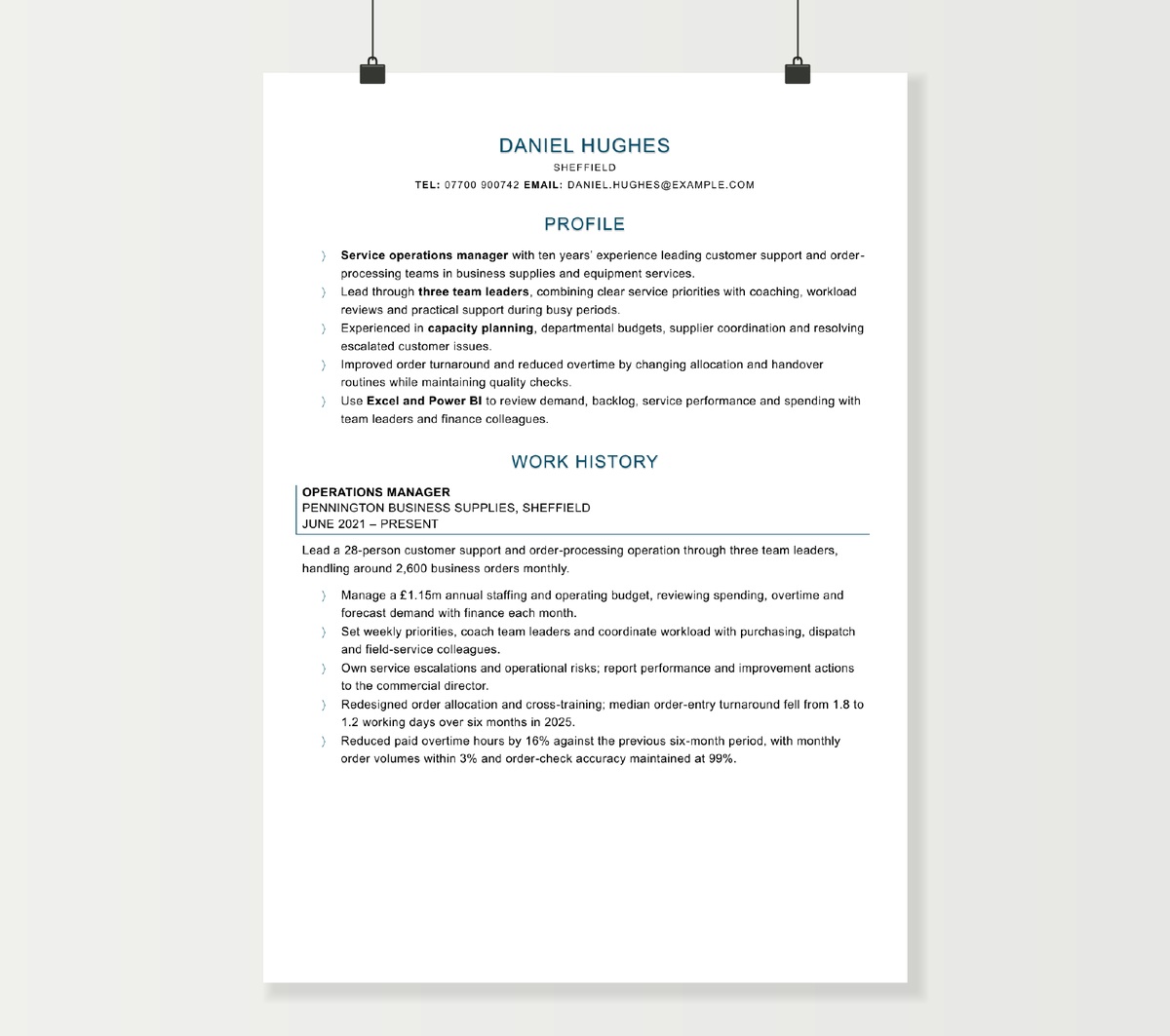
This operations manager CV template shows a service operations manager leading customer support and order-processing teams. The Word example makes team size, budget responsibility and service improvements easy to follow. The guide explains how to present the operational scope of your own role, from leading team leaders to managing capacity, costs, service standards and change.
Filename: FreeCVDownload_Operations_Manager.docx
Content of this CV template
DANIEL HUGHES
SHEFFIELD
tel: 07700 900742 email: [email protected]
PROFILE
- Service operations manager with ten years’ experience leading customer support and order-processing teams in business supplies and equipment services.
- Lead through three team leaders, combining clear service priorities with coaching, workload reviews and practical support during busy periods.
- Experienced in capacity planning, departmental budgets, supplier coordination and resolving escalated customer issues.
- Improved order turnaround and reduced overtime by changing allocation and handover routines while maintaining quality checks.
- Use Excel and Power BI to review demand, backlog, service performance and spending with team leaders and finance colleagues.
WORK HISTORY
OPERATIONS MANAGER
PENNINGTON BUSINESS SUPPLIES, SHEFFIELD
JUNE 2021 – PRESENT
Lead a 28-person customer support and order-processing operation through three team leaders, handling around 2,600 business orders monthly.
- Manage a £1.15m annual staffing and operating budget, reviewing spending, overtime and forecast demand with finance each month.
- Set weekly priorities, coach team leaders and coordinate workload with purchasing, dispatch and field-service colleagues.
- Own service escalations and operational risks; report performance and improvement actions to the commercial director.
- Redesigned order allocation and cross-training; median order-entry turnaround fell from 1.8 to 1.2 working days over six months in 2025.
- Reduced paid overtime hours by 16% against the previous six-month period, with monthly order volumes within 3% and order-check accuracy maintained at 99%.
CUSTOMER SERVICE TEAM LEADER
NORTHFIELD EQUIPMENT SERVICES, SHEFFIELD
APRIL 2016 – MAY 2021
Managed nine customer service advisers handling equipment bookings, order enquiries and service appointments for regional business customers.
- Prepared rotas, reviewed call and case volumes, and adjusted daily cover around absence, training and service demand.
- Held monthly one-to-ones, supported recruitment and coordinated induction with experienced advisers.
- Introduced a daily aged-case review; cases open for more than five working days fell from 74 to 31 over twelve weeks.
- Developed two senior advisers to cover shift leadership, improving continuity during leave and supporting their subsequent promotion.
EDUCATION & DEVELOPMENT
BA (HONS) BUSINESS MANAGEMENT, 2:1
SHEFFIELD HALLAM UNIVERSITY – 2013
Studied operations, business finance and organisational behaviour.
MANAGEMENT DEVELOPMENT
BUDGETING AND FORECASTING – EMPLOYER PROGRAMME, 2023
RECENT TRAINING
COACHING TEAM LEADERS – 2024; POWER BI REPORTING – 2025
INTERESTS
Hillwalking in the Peak District, cycling and watching live cricket.
How to write an operations manager CV
Operations manager is a broad title. It can describe responsibility for a factory, a service centre, a group of contracts, a studio or much of a small business. Your CV needs to establish what the operation does and what falls within your authority before it can make your achievements meaningful.
A strong application shows how you turn business priorities into a working operation: the people and resources you organise, the performance you monitor and the decisions you make when demands compete. It also shows that improvements become part of everyday delivery. That combination gives an employer a clearer picture than a long list of management responsibilities.
Start with the operation you are equipped to lead
Use your profile to identify the environment in which you have built your experience. Include the kind of service or product delivered and one or two features of your management scope. For example, a service operations manager might lead through three team leaders across customer support and scheduling. A manufacturing applicant might manage production, maintenance and quality across two shifts. A smaller business may need someone whose remit includes suppliers, systems and office operations.
Then select a relevant strength supported by your work history: improving service turnaround, managing seasonal demand, developing first-line managers or implementing a new operating model. A profile that connects your setting and contribution helps the reader judge your fit quickly. The details belong in the jobs below it.
For a move between sectors, explain the operational features that transfer. Multi-site delivery, time-sensitive workloads, customer contracts, dispersed teams or variable demand may be more useful connections than the product itself. Give specialist knowledge appropriate weight where the vacancy depends on it; operations roles in technical or regulated environments can require experience that a general management profile will not convey.
Make the boundaries of your responsibility visible
Begin each job with a compact description of its scope. Give the reader a sense of scale using the measures that matter in that setting: workforce, sites, shifts, service volume, output, customers, operating hours or budget. Daniel’s example establishes a 28-person operation, three team leaders and approximately 2,600 monthly business orders. His budget is described as departmental staffing and operating expenditure, which makes the financial responsibility clear.
Separate direct reports from the wider workforce you lead. “Managed four team leaders responsible for 60 colleagues across two shifts” shows a different management structure from “supervised 60 staff”. Explain whether you also coordinate contractors, shared services or teams that report elsewhere. This helps a recruiter understand the scale of your influence as well as your formal authority.
Where the remit changed, show the progression. You might have taken on another site, added scheduling to an existing customer-service function or become accountable for a larger budget. A short line describing that expansion can carry more weight than a change in title. For a promotion within one employer, separate the roles and dates so the growth in responsibility is visible.
Show the decisions behind operational performance
Daily delivery is full of choices: allocating capacity, prioritising a backlog, adjusting cover, coordinating another department or escalating a risk. Use your experience bullets to show the choices you made and why they mattered. “Reviewed weekly demand and redeployed trained colleagues between booking and order teams to protect service deadlines” explains the management work more clearly than “responsible for resource planning”.
Choose examples that reflect the vacancy’s operating pressures. In a service environment, these may involve response times, case ageing, scheduling or first-time resolution. In manufacturing, they may involve output, quality, changeovers or unplanned downtime. In a contract operation, agreed service levels and customer commitments may provide the main frame. The CV should use the measures that the next employer can connect to its own operation.
State what a metric measures. Order-entry turnaround is different from order-to-delivery lead time, just as cases closed is different from customer issues resolved. A short definition or specific label makes the result easier to assess. Give the period and, where useful, the starting point: “Reduced cases open for more than five working days from 74 to 31 over twelve weeks.”
Put efficiency gains in their operational context
Cost and productivity results are strongest when the reader understands what changed around them. If overtime fell, was workload broadly stable? If output increased, did quality hold? If a backlog reduced, was the change sustained after temporary support ended? Include the piece of context that makes your example persuasive.
Daniel’s CV pairs lower overtime with comparable order volumes and maintained order-check accuracy. That makes the result more informative than a cost percentage on its own. Another applicant might pair higher throughput with a stable defect rate, or faster service with improved customer feedback. You do not need to add every available measure; choose the one that helps explain the operational value.
Describe financial effects in the terms in which they were realised. Lower supplier spend, reduced paid overtime and avoided recruitment are different outcomes. Time released for other work is valuable capacity, even where the payroll cost stays the same. A bullet such as “Released six hours of weekly reconciliation work, allowing the team to absorb a new reporting requirement within existing staffing” gives that improvement a clear business purpose.
For larger savings or budget achievements, identify your contribution. You may have built the case, implemented the change, negotiated with a supplier or led the operational work alongside finance. An employer should be able to see both the overall result and the part you were responsible for delivering.
Give people leadership its own evidence
An operations manager often achieves results through other managers. Include an example of how you developed that capability: clearer objectives, regular performance discussions, support with difficult decisions, a structured induction or preparation for promotion. Explain what team leaders could do more effectively as a result.
Workforce planning can also demonstrate leadership. Show how you balanced demand with available skills, cover, training and working patterns. For a seasonal operation, describe the scale of the peak and your role in preparing for it. For a multi-site team, explain how you maintained consistent expectations while giving local managers room to respond to their own workload.
Recruitment, absence management and performance reviews are relevant when they formed a substantial part of your remit. Select the aspects that explain your level of responsibility. “Coached three team leaders through monthly workforce and performance reviews” may be a more useful senior-management statement than listing each routine HR task. For a first operations manager application, acting-up responsibility or leading a cross-team initiative can show readiness to work beyond a single team.
Explain how an improvement became normal practice
Operations employers need changes that survive the initial launch. When describing an improvement, include the operational problem, your role in changing the process and a sign that the new approach was embedded. That sign could be trained colleagues, ownership transferred to team leaders, a revised handover or a review after several months.
For example: “Introduced a shared scheduling process across three teams, trained six shift leads and reviewed exceptions weekly; missed handovers fell from 22 to eight per month over the next quarter.” The reader can see the implementation and the result. Where a change involved several functions, identify the relationships you managed, such as IT configuration, finance approval or consultation with service teams.
Name Lean, Six Sigma, root-cause analysis or another improvement approach when it helps explain your work. A short reference to how you used it is more useful than a collection of methodology names. The CV needs the management evidence rather than a description of the technique itself.
A substantial transformation can have a small selected-project subsection under the relevant employer. Keep its link to the ongoing operation visible: what changed, how delivery continued during the transition and what you remained accountable for afterwards. The project manager example can help with presenting a defined implementation, particularly where it sits alongside a wider operational role.
Show how you manage risk and service continuity
Include the controls and responsibilities relevant to your operation. These might involve health and safety, quality checks, customer contracts, information handling, supplier performance, audits or business continuity. Explain your role in maintaining them: reviewing risks, closing actions, preparing evidence, coordinating an incident or checking that a new process is followed.
An operational incident can be a useful example when it demonstrates judgement. Describe the disruption at an appropriate level, the response you coordinated and the outcome for the service. A supplier failure, system outage or sudden staffing shortage might show how you prioritised critical work and kept stakeholders informed. Follow-on changes, such as a revised contingency arrangement, can show what you took forward.
Give sector-specific qualifications and responsibilities clear labels. A technical operations vacancy may place particular weight on contractor oversight or engineering knowledge; a service-centre role may focus more on customer commitments and data quality. Select the evidence for the setting instead of trying to make one CV cover every form of operational risk.
Connect systems and reporting to management action
List the systems that help establish your operational experience, such as an ERP, warehouse system, CAFM platform, workforce-planning tool or CRM. Explain whether you use the system to manage work, own a process within it, train colleagues or lead an implementation. Those distinctions give a clearer picture than a software list.
For reporting tools, describe the decisions they support. Excel and Power BI may help you review demand, capacity, backlog or spending. An achievement might involve agreeing a consistent measure across teams or replacing separate reports with a view that managers use in weekly planning. Include automation where it changed a useful workflow, with the time, reliability or service benefit made clear.
Budget experience deserves similar precision. State the scope of the budget and your involvement in planning, forecasting, variance reviews and corrective action. If finance colleagues produce the accounts and you manage operational spending, that can be described directly. It still demonstrates valuable financial responsibility.
Select qualifications and earlier experience around your next step
Show the qualifications that support your management and sector knowledge, with their exact titles, providers and dates. Relevant management, safety, technical or improvement awards may be useful, depending on the vacancy. Employer development programmes can also show recent learning; label them as such and connect the most useful learning to your work where possible.
For an experienced applicant, recent operational responsibility should carry most of the detail. Earlier roles can explain how you developed the practical understanding behind your management decisions. A team leader seeking a first operations role may give more space to cross-team coordination, budget exposure and occasions when they covered for a manager. An established operations manager moving to a larger remit should emphasise leadership through others, broader resource decisions and results maintained across teams or sites.
When reviewing the final CV, check whether each major achievement can be understood without knowledge of your employer’s internal structure. A recruiter should be able to see the operation, your authority and the result. The template library offers other examples if you want to compare how different levels of responsibility are presented.
Operations Manager CV FAQs
Use that description when your remit includes accountability for both income and costs within the relevant profit-and-loss account. If you manage a departmental cost budget, describe its value, scope and your forecasting or spending authority instead. If you influence commercial performance alongside another budget owner, explain that arrangement. Clear financial scope helps a recruiter compare your experience with the vacancy.
Label each assignment as interim or fixed term and give its purpose, dates and operational scope. For example, you might have stabilised a service, covered a vacancy or led a transition. Include the position at handover as well as the changes made. Several assignments through one consultancy can sit under a single employer heading with separate client or project entries.
Yes, where your responsibilities match the operational remit. Keep your actual title and add a concise explanation such as service operations or multi-site delivery. Make team leadership, resources, performance and financial responsibility visible in the role summary. That gives employers the information needed to assess the work behind a title that may differ between organisations.
Describe the circumstances and the standard you maintained. Sustaining service during a system migration, a period of rapid recruitment, higher demand or supplier disruption can be a substantial achievement. Include the workload or change involved, the actions you led and the service or quality result. Operational value includes reliable delivery through difficulty as well as improvement from one percentage to another.
It can provide relevant evidence of staffing, suppliers, scheduling, costs, systems and customer delivery. Give the business context and scale, then focus on the responsibilities that match the employed role. Where you also handled sales or specialist delivery yourself, separate those duties from the work of organising the operation. This helps an employer understand how your experience would translate into its management structure.
The CV should contain the relevant conclusions and enough context to understand them. Internal reports are rarely necessary at the initial application stage. If an employer requests supporting evidence, a concise anonymised case study or a purpose-made example can explain your approach without sharing operational records. Agree the format and scope with the recruiter before preparing a larger supporting pack.