
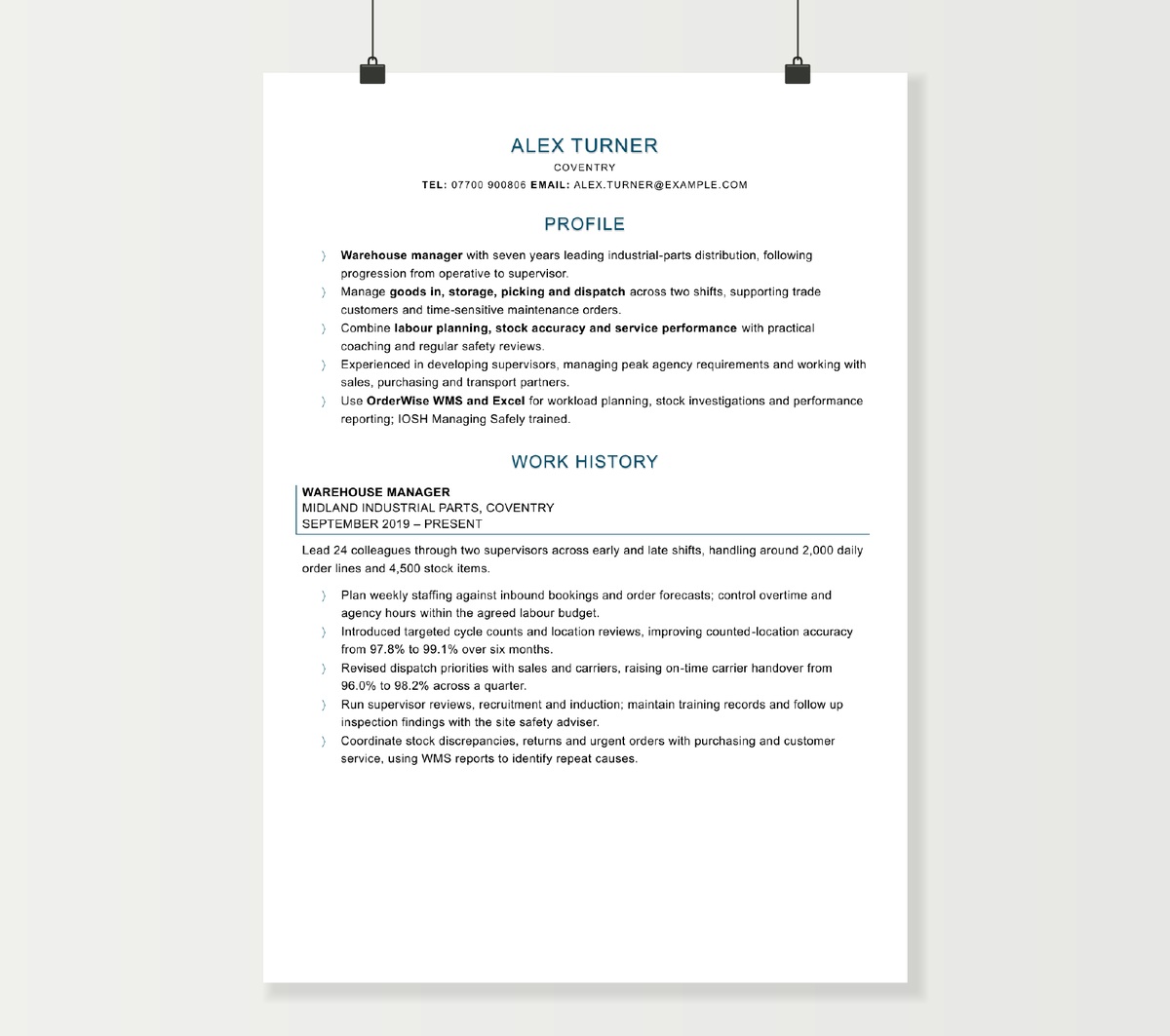
This warehouse manager CV template follows an experienced distribution professional from warehouse operations into supervision and site management. The Word example covers two-shift leadership, stock accuracy, labour planning and carrier handovers. The guide explains how to present the scale of your operation and the results behind it, whether you manage a small hands-on warehouse or a larger team through supervisors.
Filename: FreeCVDownload_Warehouse_Manager.docx
Content of this CV template
ALEX TURNER
COVENTRY
tel: 07700 900806 email: [email protected]
PROFILE
- Warehouse manager with seven years leading industrial-parts distribution, following progression from operative to supervisor.
- Manage goods in, storage, picking and dispatch across two shifts, supporting trade customers and time-sensitive maintenance orders.
- Combine labour planning, stock accuracy and service performance with practical coaching and regular safety reviews.
- Experienced in developing supervisors, managing peak agency requirements and working with sales, purchasing and transport partners.
- Use OrderWise WMS and Excel for workload planning, stock investigations and performance reporting; IOSH Managing Safely trained.
WORK HISTORY
WAREHOUSE MANAGER
MIDLAND INDUSTRIAL PARTS, COVENTRY
SEPTEMBER 2019 – PRESENT
Lead 24 colleagues through two supervisors across early and late shifts, handling around 2,000 daily order lines and 4,500 stock items.
- Plan weekly staffing against inbound bookings and order forecasts; control overtime and agency hours within the agreed labour budget.
- Introduced targeted cycle counts and location reviews, improving counted-location accuracy from 97.8% to 99.1% over six months.
- Revised dispatch priorities with sales and carriers, raising on-time carrier handover from 96.0% to 98.2% across a quarter.
- Run supervisor reviews, recruitment and induction; maintain training records and follow up inspection findings with the site safety adviser.
- Coordinate stock discrepancies, returns and urgent orders with purchasing and customer service, using WMS reports to identify repeat causes.
WAREHOUSE OPERATIVE / SUPERVISOR
AVON ELECTRICAL DISTRIBUTION, RUGBY
AUGUST 2010 – AUGUST 2019
Joined as a warehouse operative in 2010 and became supervisor in 2015, leading an eight-person team supplying electrical wholesalers.
- Allocated daily receiving, replenishment and picking work, checked progress against dispatch cut-offs and arranged cover during absence.
- Investigated stock variances, checked returns and coordinated annual counts with the stock controller and finance team.
- Trained six colleagues in handheld scanning and location procedures during a warehouse-system upgrade.
- Helped reorganise fast-moving lines near packing benches, reducing repeat travel while maintaining clear access routes.
QUALIFICATIONS & TRAINING
LEVEL 3 AWARD IN LEADERSHIP AND MANAGEMENT
ILM – 2017
Applied workplace learning through team briefings, performance conversations and a stock-control improvement project.
IOSH MANAGING SAFELY
COMPLETED 2023
RECENT TRAINING
COUNTERBALANCE REFRESHER – 2024; FIRST AID AT WORK – 2025
INTERESTS
Cycling, restoring old furniture and following Coventry City.
How to write a warehouse manager CV
A warehouse manager CV needs to make the operation visible. A manager running goods in, stores and dispatch for a manufacturer has a different remit from someone leading a night shift in an automated distribution centre. Both may have the same job title. Explain the products, people and service demands behind yours, then show how you improved the way that operation performed.
Start with the size and shape of your responsibility
Use your profile to establish your management level, operating environment and strongest relevant contribution. “Warehouse manager with seven years in industrial-parts distribution, leading 24 colleagues across two shifts” gives an employer a useful starting point. Follow it with the work that distinguishes you: developing supervisors, improving stock accuracy, managing seasonal labour or introducing a warehouse management system.
At the start of each recent job, include a short scope statement. Choose the measures that explain the role best:
- Direct reports, total team size and whether you manage through supervisors or team leaders.
- Shift pattern, operating hours and whether your remit covers one department, the whole warehouse or several sites.
- Typical order lines, pallets, receipts or stock-keeping units, with a separate indication of peak demand where useful.
- Product and handling requirements, such as small components, bulky goods, fresh produce or production materials.
- Responsibility for labour spending, inventory control, carrier coordination and customer service commitments.
Floor area can help describe a large or constrained site, but throughput and complexity often say more. A small warehouse with frequent urgent orders and thousands of product lines may require substantial planning. Put the most meaningful details first rather than filling the introduction with every available number.
Make management visible beyond the daily task list
“Responsible for goods in and dispatch” explains the function. Your next bullets should explain the decisions you made: balancing incoming deliveries against dispatch capacity, adjusting rotas to demand, agreeing priorities with sales, or resolving recurring discrepancies with purchasing. Show where you owned a decision and where you worked with another team.
People management deserves concrete evidence. State how you developed supervisors, recruited and inducted staff, planned skills cover or handled performance reviews. A training matrix is more useful on the CV when connected to an operational need: for example, broadening trained cover across receiving and packing so planned absence did not leave one section dependent on a single person.
For larger teams, distinguish total headcount from direct reports. “Led 60 colleagues through four team leaders” conveys a different management structure from “supervised eight operatives”. For a smaller warehouse, hands-on work can strengthen the application when it sits alongside planning, stock control and team responsibility.
Choose results that explain service, accuracy and cost
Warehouse achievements become persuasive when the reader can understand what was measured. Name the result, explain your intervention and give the period or operating conditions that make the comparison meaningful.
- Stock accuracy: specify whether the measure concerns counted locations, units, product lines or inventory value. Connect improvement to the discrepancy reviews, transaction controls or counting programme you managed.
- Service: identify the point under your control, such as orders ready for collection, on-time carrier handover or production material availability. Distinguish this from delivery performance further down the chain.
- Productivity: pair lines or pallets per labour hour with the nature of the work and a quality measure where available. A change in order mix can explain why a simple before-and-after figure needs context.
- Cost: describe overtime, agency usage, damage, packaging or rework reductions, including the volume or service level maintained.
- Capacity: show how additional demand, new customers or a relocation were absorbed, with the period and your planning responsibility.
The example CV measures on-time carrier handover, rather than implying responsibility for every delivery after dispatch. Its stock result refers to counted locations. This precision makes the figures easier for a hiring manager to assess.
A useful result does not always need a percentage. Completing a stocktake on schedule, preparing a team for a new customer contract, developing two supervisors or clearing an inherited returns backlog can all demonstrate effective management. Explain the scale and practical benefit.
Give WMS and ERP experience an operational purpose
Name the systems you use, then explain what you do with them. OrderWise, SAP, Odoo or another warehouse or ERP platform may support receiving, put-away, replenishment, picking, stock adjustments and dispatch. Select the functions relevant to the vacancy and connect them to an employment example.
A concise skills entry might read “OrderWise WMS: workload reports, location accuracy reviews and stock investigations; Excel: labour and dispatch performance reporting”. This tells the reader more than a software list or a rating out of five. If you build Power BI reports, explain the operational decisions those reports support. If you use dashboards created by an analyst, describe the decisions and follow-up you own.
System-change experience needs a clear account of your contribution. Requirements gathering, testing scan workflows, cleaning location data, preparing training and managing cutover are different responsibilities. A strong bullet identifies yours and the outcome: successful adoption across a shift, fewer manual corrections or a stable transition through a busy period.
For automated sites, include the equipment or environment where relevant and show how you worked with engineering and control-room colleagues on availability, escalation or recovery planning. The CV should establish your operational leadership within that system.
Show control of stock and warehouse standards
Inventory responsibility extends beyond arranging counts. Explain your role in investigating differences, improving transaction discipline, managing returns and working with finance on stock reconciliation. Where responsibility is shared with an inventory team, describe how you coordinated action across receiving, storage and dispatch.
Choose sector details carefully. Food warehouses may value evidence of date rotation, traceability, hygiene standards and audit preparation. Manufacturing stores may prioritise material availability, production schedules and controlled stock movements. A third-party logistics operation may require customer-specific service reporting and contract reviews. These details belong in the experience that demonstrates them.
Safety evidence should also describe management activity. Examples include closing inspection actions, reviewing risk assessments with the safety team, maintaining operator training records, managing equipment checks and improving pedestrian access. A statement about the actions you led is usually more informative than a broad claim of an excellent safety record.
Explain planning across the warehouse boundary
Warehouse managers often influence service through relationships outside their own team. Show how you worked with sales on urgent orders, procurement on delivery schedules, production on material requirements, finance on stock differences or carriers on collection capacity. Include the issue resolved, rather than simply saying you liaised with departments.
Peak planning can be particularly valuable. Describe the forecast you worked from, changes to staffing or storage, temporary-worker induction and the result through the peak. For a new contract or site move, distinguish preparation from the live transition and explain what you personally coordinated.
If your responsibility includes transport planning or distribution contracts beyond the warehouse, the logistics manager CV example offers a useful comparison for deciding which responsibilities to emphasise.
Present training in proportion to the role
List relevant management, logistics and safety qualifications with the awarding organisation and completion date. IOSH Managing Safely, a leadership qualification or sector-specific food-safety training can support the experience above it. Give recent, relevant development more space than a long list of routine internal courses.
For forklift or other material-handling training, state the equipment category and the date of relevant training or refresher assessment. In a hands-on role this may deserve a prominent entry. In a larger management post, the stronger evidence may be your responsibility for competence records, authorised operators and planned cover.
Applicants with substantial warehouse experience can keep education short. A degree may be relevant, particularly for roles with a broader supply-chain remit, but the CV should still show how you have managed people, stock and service in practice.
Moving from supervisor into warehouse management
Give greater weight to occasions when you planned beyond your own task or shift. Acting-up periods, rota planning, recruitment interviews, investigations, stocktake coordination and responsibility for a section improvement all help demonstrate readiness. Include the scope and dates of temporary management cover so the progression is easy to follow.
Show how you developed others as well as what you delivered yourself. Training starters, coaching team leaders or organising cross-training provides stronger management evidence than adding more detail about picking and packing. The warehouse operative example can help organise earlier experience; as your career progresses, reserve the most space for decisions, leadership and results.
For an established manager, compress older operational jobs while retaining the progression they demonstrate. Recent entries should carry the detail on budgets, team structure, systems change and service performance. This keeps the CV focused on the level of responsibility you are applying for.
Warehouse Manager CV FAQs
Group them under the employer, with a separate job title and date range for each significant promotion. Give the latest role the most space and show what expanded: team size, shifts, labour planning, budget or site responsibility. If the earlier roles were brief, a sentence such as ‘Joined as an operative in 2010; promoted to supervisor in 2015’ can preserve the progression without repeating the same warehouse duties.
Use the opening section to connect the operating demands. Relevant parallels might include high product variety, strict cut-offs, traceability, rapid replenishment or managing agency staff at peak. Then make the sector-specific experience easy to identify in your work history. For example, a manufacturing stores manager can emphasise material availability and stock control when applying to distribution, while an employer handling fresh food may place particular weight on food-sector experience.
Use an appropriate level of scale, such as ‘a two-shift regional distribution centre’, ‘more than 20 colleagues’ or a broad throughput range. You can describe the direction and operational effect of an improvement without publishing commercially sensitive figures. Team development, a completed system transition and a service problem resolved can also provide useful evidence without naming customers or disclosing contract values.
Separate assignments when they demonstrate different responsibilities, such as peak cover, a site launch or a recovery project. State the contract or interim nature alongside the dates and describe the brief and result. Several similar short assignments can sit under the agency or consultancy, with selected client sectors and achievements beneath them. This makes a contracting career easy to understand without a succession of repetitive job entries.
State the shift, department and reporting line in the role introduction, then explain the decisions you owned. Labour allocation, team performance, incident escalation, service handovers and coordination with other shifts are all substantial responsibilities. For a move into whole-warehouse management, include work that crossed those boundaries, such as a site-wide stocktake, shared training plan or project delivered with other department managers.
Usually the clearest place for an achievement is under the job where it happened, beside the scale and operating context. A short selected-achievements section can help an experienced manager foreground a major site opening, turnaround or systems implementation. Keep the detail in one place and make the employer, period and your contribution clear, so the reader can connect the result to your career history.




