
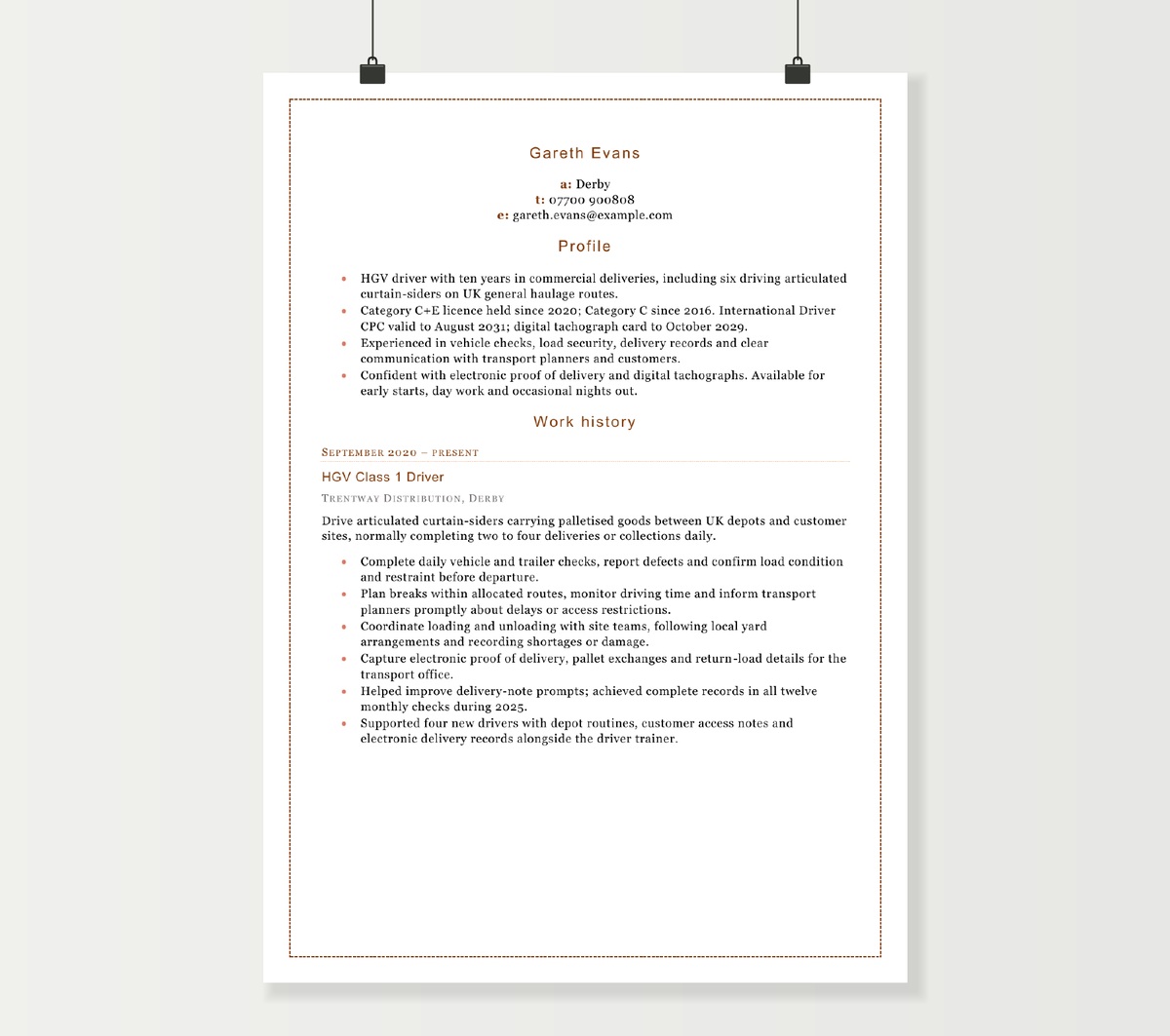
This HGV driver CV template follows a driver who progressed from warehouse work to Class 2 multi-drop deliveries and then Class 1 general haulage. The Word example puts licence categories, Driver CPC and tachograph status near the top, followed by practical driving, delivery and customer-service experience. The guide covers experienced, newly qualified and returning drivers.
Filename: FreeCVDownload_HGV_Driver.docx
Content of this CV template
Gareth Evans
a: Derby
t: 07700 900808
Profile
- HGV driver with ten years in commercial deliveries, including six driving articulated curtain-siders on UK general haulage routes.
- Category C+E licence held since 2020; Category C since 2016. International Driver CPC valid to August 2031; digital tachograph card to October 2029.
- Experienced in vehicle checks, load security, delivery records and clear communication with transport planners and customers.
- Confident with electronic proof of delivery and digital tachographs. Available for early starts, day work and occasional nights out.
Work history
September 2020 – present
HGV Class 1 Driver
Trentway Distribution, Derby
Drive articulated curtain-siders carrying palletised goods between UK depots and customer sites, normally completing two to four deliveries or collections daily.
- Complete daily vehicle and trailer checks, report defects and confirm load condition and restraint before departure.
- Plan breaks within allocated routes, monitor driving time and inform transport planners promptly about delays or access restrictions.
- Coordinate loading and unloading with site teams, following local yard arrangements and recording shortages or damage.
- Capture electronic proof of delivery, pallet exchanges and return-load details for the transport office.
- Helped improve delivery-note prompts; achieved complete records in all twelve monthly checks during 2025.
- Supported four new drivers with depot routines, customer access notes and electronic delivery records alongside the driver trainer.
June 2016 – August 2020
HGV Class 2 Driver
East Midlands Trade Supplies, Derby
Delivered trade supplies in an 18-tonne rigid, making eight to twelve regional drops daily.
- Used a tail lift and pallet truck at trade counters and customer premises.
- Checked delivery notes and recorded receipts, returns and discrepancies.
- Completed vehicle checks and defect reports before daily departures.
- Updated customers and transport colleagues about access or timing changes.
- Maintained tachograph records and completed driver briefings and CPC training.
- Updated access notes for 25 regular sites to support relief drivers.
July 2012 – May 2016
Warehouse Operative
East Midlands Trade Supplies, Derby
Prepared orders and supported loading before joining the driver-training programme.
- Picked and checked stock against customer orders.
- Grouped deliveries by route and labelled pallets for dispatch.
- Worked with drivers to resolve quantity differences before loading.
- Recorded returned products and passed damage queries to the supervisor.
- Kept loading and storage areas clear during busy dispatch periods.
- Completed Category C training and initial Driver CPC in 2016.
Qualifications and training
Category C+E, 2020 | Category C and initial Driver CPC, 2016
35 hours International Driver CPC periodic training completed, August 2026
Load-security refresher, 2025 | 7 GCSEs including English and Maths, 2012
Interests
Fishing, live music and maintaining a classic motorcycle.
How to write an HGV driver CV
An HGV driver CV should answer the transport manager’s first questions quickly: which vehicles can you drive, what work have you done in them, and are your professional qualifications current? Once that is clear, the experience section should show how you handle the deliveries, checks, records and communication that keep the operation running.
Put your licence and driver qualifications near the top
State the actual licence category alongside the job-market term: Category C+E for Class 1 work or Category C for Class 2. Include when you gained the relevant entitlement, particularly when an employer asks for a length of experience. The date you obtained a category and the time you have spent driving commercially can be shown separately.
Driver CPC and digital tachograph card status should also be easy to find. A compact entry with the qualification or card and its expiry month and year is useful. Where the distinction matters to the job, identify whether your Driver CPC is National or International. International work needs the appropriate qualification; the GOV.UK Driver CPC guidance explains the training routes.
Add relevant specialist training with its scope and date, such as ADR or lorry-loader training, when it supports the work you are seeking. Then describe the practical experience in your employment history. A qualification and regular use of the equipment provide different pieces of information.
The example puts C+E, Category C, Driver CPC and tachograph card details in the profile. A separate “Licences and driver qualifications” section can work equally well. Choose the arrangement that makes the relevant information immediately visible.
Describe the type of driving, not just the vehicle class
Two Class 1 drivers can have very different working backgrounds. Explain the vehicle or trailer, the load and the delivery pattern at the start of each recent role. This might be articulated curtain-sider general haulage, refrigerated depot deliveries, container movements or specialist plant transport.
For Class 2 work, identify the vehicle and customer environment where useful: an 18-tonne rigid on trade deliveries, multi-temperature foodservice vehicles or a vehicle equipped for construction-site deliveries. Include handling equipment you used, such as a tail lift, pallet truck or cages, within the relevant job.
Then give enough scale to make the work understandable. Typical drops per shift, the geographical area and the mix of depots and customer premises can be more useful than an isolated annual mileage figure. State whether work involved day runs, nights, tramping or occasional nights out. These details help an employer judge how closely your experience matches their operation.
Show what you do before, during and after a run
A strong work-history entry covers more than driving between locations. Select the responsibilities most relevant to the vacancy and explain them in ordinary language:
- Vehicle and trailer readiness: daily checks, defect reporting and communication with the transport office or workshop.
- Loading and delivery: checking load condition, securing the load, coordinating with site teams and using the equipment relevant to your work.
- Journey management: working to allocated routes, planning breaks, monitoring time and keeping planners informed about delays or access difficulties.
- Records: electronic proof of delivery, signed notes, returns, pallet exchanges, shortages or damage.
- Customer contact: confirming access, explaining a delivery issue and arranging the next step with the transport team.
These examples demonstrate the application of drivers’ hours knowledge, safe working and service standards. The CV can show that you use those routines consistently without becoming a list of regulations.
Be precise about loading responsibility. Some drivers move goods into customer premises; others coordinate with forklift teams or exchange trailers. The relevant detail is the work you carried out and how it fitted the delivery. For plant or specialist loads, name the equipment and associated training that helps explain the responsibility.
Make customer service and digital systems count
Multi-drop drivers often build regular customer relationships. Include how you handled delivery discrepancies, restricted access, returns or changes to timing. An example of working with a customer and planner to complete a difficult delivery provides stronger evidence than “excellent customer service”.
Depot and trunking work still involves communication: trailer handovers, yard instructions, load information and timely updates to the transport office. Explain the part of the handover you owned.
Systems experience belongs alongside these activities. Electronic proof of delivery, handheld scanners, digital tachographs and in-cab messaging are useful terms when connected to a task. Name a particular platform if it is relevant to the vacancy, then explain what you recorded or communicated with it. A long list of vehicle brands usually adds less than the type of operation and your recent experience.
Choose results that demonstrate dependable performance
Useful evidence includes accurate delivery records, positive customer feedback, improved access information, support for new drivers and successful work through peak periods. Select results you can explain in terms of your own contribution and the conditions of the route.
If you include an on-time delivery figure, identify the period and the service being measured. A fuel-efficiency result is more meaningful with context about comparable vehicles, routes and loads. A telematics improvement can work well when linked to driver coaching and a defined review period.
The example uses complete delivery records across a year’s monthly checks and updated access notes for 25 regular sites. These show care for the work beyond the driving itself. They also give an interviewer clear points to explore.
Numbers are optional where another form of evidence is stronger. Being selected to support new starters, taking on a regular customer route or learning a new type of delivery can show trust and development. Describe the responsibility and its practical value.
Structure agency experience so the work is easy to follow
For several short assignments, list the agency and overall dates, followed by the main types of driving and selected longer placements. This keeps the career history readable while showing the variety of vehicles, depots or products you have handled.
A substantial assignment can have its own sub-entry when it demonstrates relevant experience, such as six months on refrigerated night deliveries or regular cover on a pallet-network route. Make the agency relationship clear and give each employer or placement the appropriate date range.
Where an agency assignment became permanent employment, show the transition under the same workplace if that makes the progression clearer. Earlier warehouse or van-driving roles can be kept brief, with the loading, customer-service and delivery-record experience that led into HGV work.
Build a useful CV as a newly qualified or returning driver
Newly qualified drivers should make the licence category, test date, Driver CPC and tachograph card status prominent. Training, a completed employer assessment and any supervised familiarisation can sit in a short practical-development section. Give the vehicle or operation involved so the reader understands the experience.
Use previous work for evidence of reliable shifts, customer contact, checks and accurate records. Warehouse experience may include loading, dispatch paperwork and communicating with drivers. The warehouse operative CV example can help organise this earlier work. It should support the driving application while leaving your new qualifications easy to find.
For a return after a break, retain the earlier driving history and show your current position clearly: renewed qualifications, recent assessment or refresher training, and the work you have done since. A transport manager needs to understand both your established experience and how recently you have used it.
An experienced driver can reverse that emphasis. Lead with the vehicle and operation you know best, give the current cards and qualifications concisely, and use recent jobs to demonstrate service, judgement and familiarity with the kind of routes being offered.
Finish with practical details that help match you to the work
Availability for early starts, nights, weekends or nights out can make a useful short entry when it is relevant to the vacancy. Base location and travel to the depot may also matter for remote sites or very early starts. Keep this information specific enough to help the employer assess the fit.
Older school qualifications can occupy one line beneath driver training. The main space should go to the licence and work evidence that establishes your suitability for the particular vehicle, load and service.
HGV Driver CV FAQs
Both terms are used for large goods vehicle work. Match the vacancy's wording in the heading and include the relevant category, such as ‘HGV Class 1 Driver — Category C+E’. The category and the type of driving experience make the application clearer than repeating both abbreviations throughout the CV.
The useful CV information is your category, relevant entitlement dates and current qualification or card status. A recruiter can request the details needed for licence checking at the appropriate stage of the recruitment process. A full licence number or scan does not add evidence about your driving experience.
List the C+E entitlement and date prominently, then describe your Class 2 commercial experience under the jobs where you gained it. Add recent articulated-vehicle training, assessment or familiarisation in a short separate entry. This makes both your new entitlement and the substantial delivery experience you bring to a Class 1 role easy to understand.
Use the same career history, but bring international routes, border or port handovers, relevant delivery documentation and nights-away experience forward. Include the countries or regions and the types of loads. Make your Driver CPC status clear: National and International Driver CPC cover different work, so the qualification entry should match the role you are applying for.
A concise entry showing your current Driver CPC status and recent periodic training is usually enough. Select individual courses when they are particularly relevant to the vacancy, such as work with vulnerable road users or a topic connected to the loads and deliveries involved. Specialist qualifications can have their own entry with the relevant scope and date.
They are different qualifications for different responsibilities. On a driving CV, label Driver CPC clearly alongside the licence and tachograph information. If you also hold a transport-management qualification, list its exact title separately and explain any planning or supervisory experience it supports. This avoids an ambiguous ‘CPC qualified’ entry.




