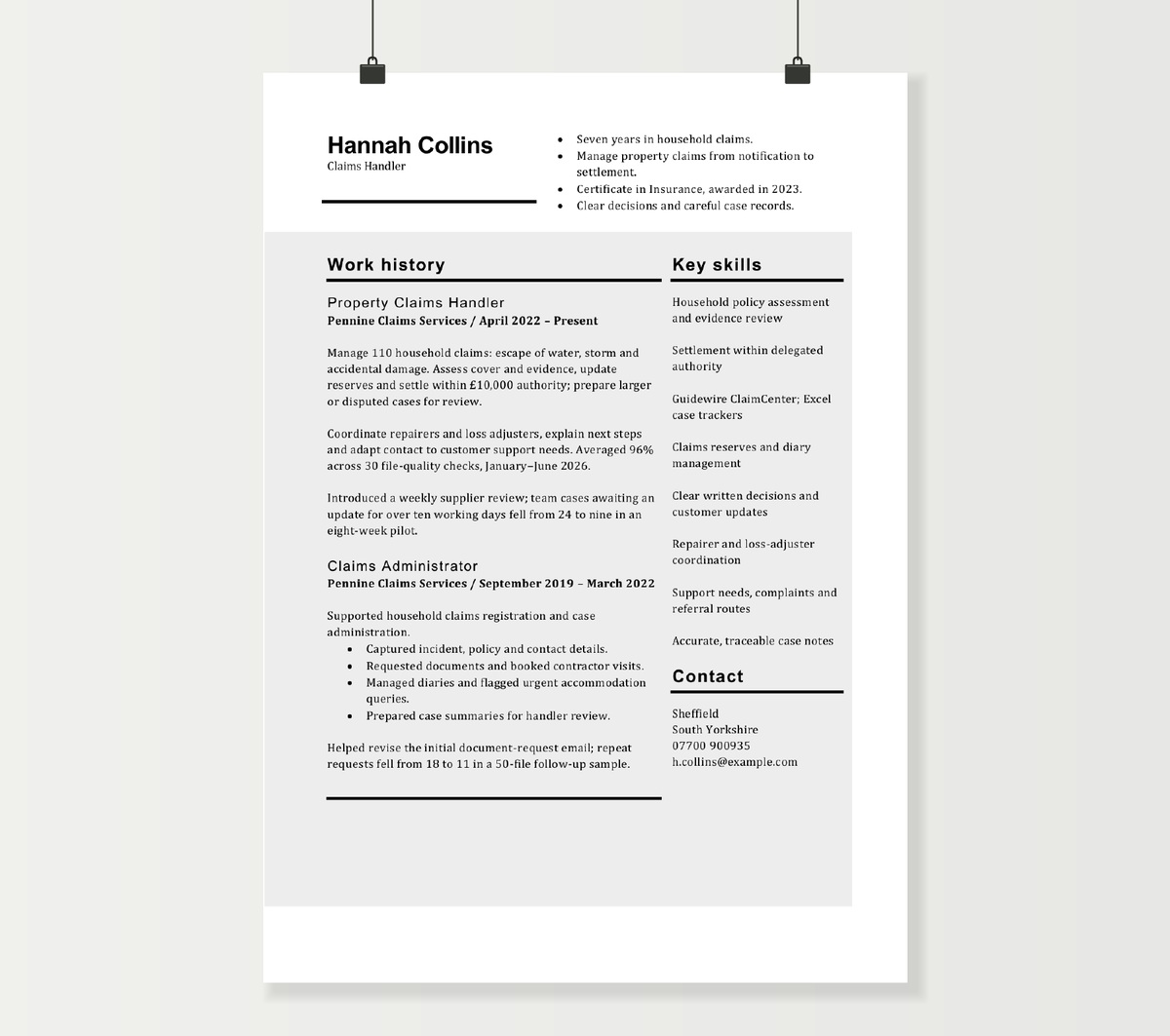
This claims handler CV template follows a household property claims professional who progressed from customer service and claims administration to managing cases through to settlement. The Word example combines technical scope with customer care and file quality. The guide explains how to present your claims specialism, decision-making responsibility and results.
Filename: FreeCVDownload_Claims_Handler.docx
Content of this CV template
Hannah Collins
Claims Handler
Contact
Sheffield
South Yorkshire
07700 900935
- Seven years in household claims.
- Manage property claims from notification to settlement.
- Certificate in Insurance, awarded in 2023.
- Clear decisions and careful case records.
Work history
Property Claims Handler
Pennine Claims Services / April 2022 – Present
Manage 110 household claims: escape of water, storm and accidental damage. Assess cover and evidence, update reserves and settle within £10,000 authority; prepare larger or disputed cases for review.
Coordinate repairers and loss adjusters, explain next steps and adapt contact to customer support needs. Averaged 96% across 30 file-quality checks, January–June 2026.
Introduced a weekly supplier review; team cases awaiting an update for over ten working days fell from 24 to nine in an eight-week pilot.
Claims Administrator
Pennine Claims Services / September 2019 – March 2022
Supported household claims registration and case administration.
- Captured incident, policy and contact details.
- Requested documents and booked contractor visits.
- Managed diaries and flagged urgent accommodation queries.
- Prepared case summaries for handler review.
Helped revise the initial document-request email; repeat requests fell from 18 to 11 in a 50-file follow-up sample.
Customer Service Adviser
Rivelin Home Retail / July 2017 – August 2019
Handled telephone and email enquiries about furniture orders, deliveries and aftercare.
- Clarified delivery problems and agreed practical next steps.
- Checked order histories before responding to queries.
- Coordinated replacement parts and appointments with suppliers.
- Recorded promises and followed up unresolved cases.
- Explained returns and warranty processes in plain language.
- Escalated complaints with a concise record of events.
- Maintained accurate customer records in the CRM.
- Helped two new colleagues learn the aftercare workflow.
Key skills
Household policy assessment and evidence review
Settlement within delegated authority
Guidewire ClaimCenter; Excel case trackers
Claims reserves and diary management
Clear written decisions and customer updates
Repairer and loss-adjuster coordination
Support needs, complaints and referral routes
Accurate, traceable case notes
Qualifications
Certificate in Insurance, Chartered Insurance Institute, 2023.
Study and training
- IF1: Insurance, legal and regulatory.
- IF2: General insurance business.
- IF4: Insurance claims handling process.
- Customer vulnerability and complaints: internal training, 2025.
- Household policy workshops: internal training, 2024.
- Guidewire ClaimCenter: employer training, 2022.
- A levels: English (B), Business (C), Psychology (C), Sheffield College, 2017.
- Nine GCSEs at A*–C, including English and Maths, 2015.
Hobbies and interests
Enjoy swimming, baking and weekend walks with friends.
How to write a claims handler CV
A claims handler CV should make two things clear: the decisions you are equipped to make and the way you help a claim move towards a fair resolution. Technical knowledge, accurate records and customer communication belong together in the evidence you choose.
The title covers quite different jobs. A first-notification handler, a broker supporting a client’s claim, a household settlement handler and a specialist dealing with injury or legal expenses will have different responsibilities. Establishing your particular remit early helps the employer judge the relevance of the rest of your CV.
Identify your claims specialism and level of ownership
Use the profile to name the classes of insurance or claim types central to your experience. For example, household property, motor accidental damage, credit hire, travel, employers’ liability, public liability or legal expenses each gives the reader a useful starting point.
Add the setting: insurer, broker, third-party administrator, loss-adjusting practice or another claims service. This helps explain whose interests you represent, the parties you work with and the decisions you can take.
State the stages you handle. First notification of loss, evidence gathering, coverage assessment, reserving, negotiation, payment and recovery can sit with different people. If you manage cases from notification to closure, explain that in the profile and support it through the employment entry.
Hannah’s example identifies household claims and a move from administration to settlement responsibility. Her current role then gives a typical open caseload, the main loss types and her delegated authority. Those details make her experience easier to place than an unexplained claim to handle complex cases.
Describe the judgement behind a claims decision
Show how you assess information and turn it into a supported next step. Depending on your role, this might involve policy wording, incident accounts, repair estimates, photographs, medical information, expert reports or correspondence from other parties.
A useful example can describe the issue, the evidence you reviewed and the decision or recommendation that followed. Keep the explanation focused on your contribution: resolving an inconsistency, clarifying cover, requesting a specialist opinion or preparing a reasoned referral.
Distinguish coverage, liability and the amount payable where those are separate parts of your work. A motor or liability handler may need evidence about responsibility for the loss; a property handler may place greater emphasis on policy cover, cause and extent of damage, repair scope and settlement options.
Authority levels can clarify seniority. If you can disclose the relevant limit, connect it to the activity it governs, such as settlement or reserve approval. Also show how you prepare cases above that level for review. A well-supported recommendation demonstrates judgement even when final approval sits elsewhere.
For specialist vacancies, choose the detail that differentiates your experience. Credit hire, injury, litigation, recoveries and legal expenses each have their own documents and stakeholders. Include the processes you have used in practice, with a short account of your responsibility rather than a long list of terminology.
Make caseload management concrete
Give a typical active caseload or workload range if it helps explain the role. Add enough context to make the number meaningful: claim type, complexity, stage and whether you own the cases or provide shared support.
Then explain how you keep cases moving. Diary control, outstanding-evidence reviews, supplier follow-up, reserve updates and prioritisation of urgent needs are useful examples. Show an occasion when you identified a delay or changed the way work was monitored.
Hannah’s supplier-action example gives an eight-week pilot and a reduction in files waiting more than ten working days for an update. It describes a specific bottleneck and the work she introduced, rather than treating the number of closed claims as the only measure of success.
For high-volume first-notification roles, accurate capture, appropriate triage and effective handover may be the stronger measures. For more complex portfolios, demonstrate sustained ownership, timely reviews and coordination across a longer claims journey.
Claims systems belong in this account. Name the platform where relevant, then explain what you use it for: case notes, activities, reserves, payments, correspondence, document management or reporting. Excel trackers can also be valuable when they solve a defined monitoring problem.
Show customer care through decisions and communication
Claims often arrive at difficult moments for the customer. A CV can demonstrate empathy through practical actions: explaining an evidence request, agreeing an accessible contact method, providing a clear update after a delay or coordinating urgent support with the appropriate team.
Include both written and spoken communication where the job uses them. Decision letters, email-based case handling and clear summaries can be as important as telephone confidence. Describe the kind of information you explain and how you check that the next steps are understood.
Experience supporting customers with additional needs is useful when linked to the work. You might record agreed contact preferences, arrange a representative’s involvement through the appropriate process or adapt the pace and format of communication. The CV needs the professional action and outcome, without personal details about an individual customer.
Complaints experience should be described at the level you performed. Recognising and referring a complaint, investigating it and issuing a formal response are different responsibilities. State which you handled, the information you gathered and how you worked with the complaints team or manager.
For customer-service applicants moving into claims, these examples can provide a strong bridge. The customer service adviser CV example can help you identify evidence about case ownership and difficult conversations from an earlier role.
Explain your work with insurers, specialists and suppliers
Identify the parties you coordinate and what you achieve through that contact. Repair networks, loss adjusters, brokers, solicitors, medical experts and other insurers play different roles, so choose the relationships that matter to your vacancy.
A broker-side handler can show how they assemble evidence, monitor the insurer’s response, explain the position to the client and raise a well-supported challenge where appropriate. That is valuable claims experience even where the insurer controls the settlement decision.
An insurer or delegated handler might instead foreground instructions to specialists, review of reports, agreement of repair scope or negotiation within authority. Make the output visible: a clarified position, an agreed action, a reviewed settlement proposal or a case progressed to the next stage.
If your experience includes site inspections and assessment of loss, distinguish those activities from desk-based coordination. The loss adjuster CV example offers a related way to present field investigation and technical reports.
Balance efficiency measures with file quality and customer outcomes
Choose results that explain good handling, rather than relying on speed or volume alone. Useful measures can include file-audit scores, overdue actions, document completeness, repeat contact, review timeliness or customer feedback.
Give the period and basis of the figure. Hannah’s quality result refers to 30 sampled checks over six months. Her document-request improvement refers to a 50-file follow-up sample. These details help the reader understand what was measured.
Where you use settlement, recovery or cost figures, explain the nature of the result and your contribution. A recovery secured, an incorrect duplicate payment identified and a negotiated repair estimate are different achievements. Pair the amount with the decision or evidence that produced it.
Team improvements also belong on the CV. Describe the process you changed, the colleagues involved and the observed effect. For senior applications, add coaching, technical referrals, quality reviews or workload support that shows how you improve the work of other handlers.
Present regulatory awareness through the work you do
FCA requirements, customer outcomes, data handling and internal claims standards can matter to the role. They are more useful on a CV when supported by examples of clear decisions, appropriate referrals, accurate records and responsive customer support.
Include relevant training and explain its practical application. A file review, a revised communication template or a better way of recording support needs can show how learning changed your work.
Fraud-awareness experience should similarly identify your contribution: recognising indicators, documenting concerns and referring them through the specialist route. Applicants with a dedicated investigation remit can then explain the additional responsibility they hold.
This section should remain a concise account of professional practice. A claims CV gains more from one strong example than from a catalogue of regulations without evidence of how you worked within them.
Use qualifications to support your next step
List the full insurance qualification, awarding body and completion date. Relevant CII units can help an early-career applicant show the knowledge they have developed, especially where a claims-focused unit supports the target role.
If study is in progress, state the qualification being pursued and the units completed. This gives the employer a clear view of your development without requiring a lengthy course history.
Entry routes vary. Some claims vacancies provide training for applicants with customer-service experience; others seek a particular insurance background or qualification. For a first claims role, prioritise careful information gathering, written communication, numeracy, record keeping and examples of taking a customer problem through to resolution.
Experienced handlers should give the greatest space to the claims they manage, the decisions they make and their progression in authority or complexity. A move into a new class of business is easier to assess when the transferable handling skills and the new learning are both visible.
Claims Handler CV FAQs
It can be a strong foundation, especially for a role offering training. Describe the information you capture, how you identify urgent needs, the checks you complete and the quality of your handovers. Make the stages you have handled clear, then use customer-service and investigation examples to support your readiness for a wider caseload.
Lead with the handling skills that transfer: evidence review, policy interpretation, customer communication, diary control, supplier contact and reasoned decisions. Keep your motor specialism visible and add relevant learning in the new class. The application should show both an established claims foundation and a considered move into the employer’s area.
Describe the type and complexity of claims you handle, the decisions you make independently and the matters you refer for approval. An appropriate value band may be useful if permitted. Clear responsibility and a well-chosen case example can communicate seniority without a precise financial limit.
Include them when you understand the measure and can give a useful period or response base. Explain whether the result is individual or team-based, and pair it with evidence about the service provided. A score is more informative alongside an example of clear updates, effective follow-up or a resolved communication problem.
Yes, as a short anonymised account of the issue, your contribution and the outcome. Keep only the context needed to understand the work, such as the claim type and the reason it required judgement. Usually one or two sentences within the employment entry are enough; detailed supporting examples can be prepared for interview.
That depends on the vacancy. Some employers recruit for customer skills and provide insurance training, while others ask for a qualification or progress towards one. Put completed study and relevant units in the qualifications section, and use practical handling evidence to show what you can already contribute.
Label the contract or temporary assignment clearly and give its dates, claims type and scope. Describe how quickly you became effective, the cases or tasks you handled and the handover at the end. Several short assignments can be grouped under the agency or contracting period, with enough detail to show progression and relevant experience.