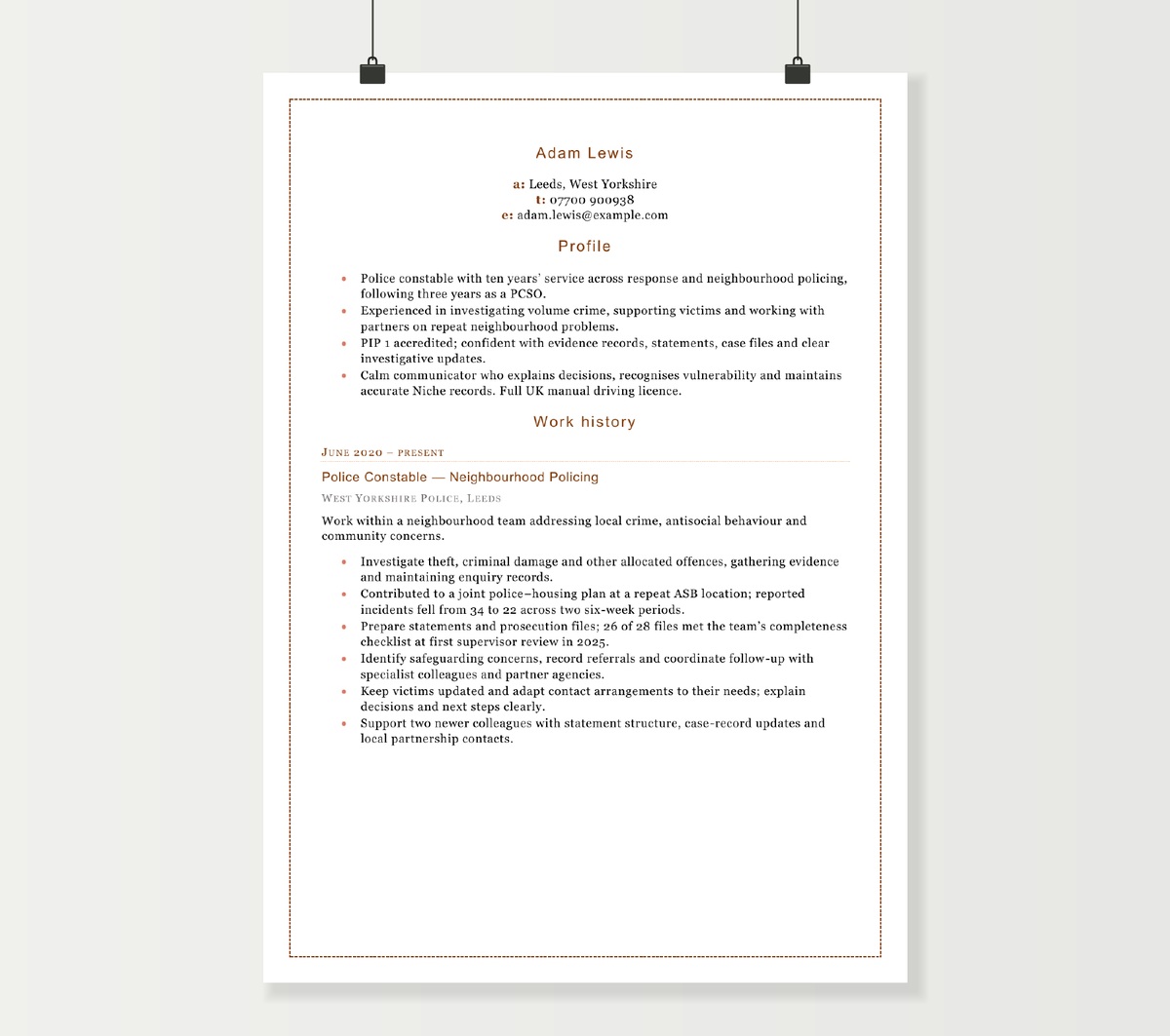
This police officer CV template follows a constable who moved from response policing into neighbourhood work after earlier service as a PCSO. The Word example combines operational responsibility, victim support and practical improvements. The guide helps serving officers present their experience and new applicants select relevant evidence for the recruitment route they are pursuing.
Filename: FreeCVDownload_Police_Officer.docx
Content of this CV template
Adam Lewis
a: Leeds, West Yorkshire
t: 07700 900938
Profile
- Police constable with ten years’ service across response and neighbourhood policing, following three years as a PCSO.
- Experienced in investigating volume crime, supporting victims and working with partners on repeat neighbourhood problems.
- PIP 1 accredited; confident with evidence records, statements, case files and clear investigative updates.
- Calm communicator who explains decisions, recognises vulnerability and maintains accurate Niche records. Full UK manual driving licence.
Work history
June 2020 – present
Police Constable — Neighbourhood Policing
West Yorkshire Police, Leeds
Work within a neighbourhood team addressing local crime, antisocial behaviour and community concerns.
- Investigate theft, criminal damage and other allocated offences, gathering evidence and maintaining enquiry records.
- Contributed to a joint police–housing plan at a repeat ASB location; reported incidents fell from 34 to 22 across two six-week periods.
- Prepare statements and prosecution files; 26 of 28 files met the team’s completeness checklist at first supervisor review in 2025.
- Identify safeguarding concerns, record referrals and coordinate follow-up with specialist colleagues and partner agencies.
- Keep victims updated and adapt contact arrangements to their needs; explain decisions and next steps clearly.
- Support two newer colleagues with statement structure, case-record updates and local partnership contacts.
September 2016 – May 2020
Police Constable — Response
West Yorkshire Police, Leeds
Attended emergency and priority incidents, completing probation in 2018.
- Assessed immediate risks and requested appropriate support.
- Preserved scenes and gathered initial witness accounts.
- Recorded evidence and maintained continuity of exhibits.
- Prepared investigation handovers and safeguarding referrals.
- Supported victims and witnesses through initial enquiries.
- Completed PIP 1 accreditation in 2019.
August 2013 – August 2016
Police Community Support Officer
West Yorkshire Police, Leeds
Supported neighbourhood patrols and community engagement.
- Listened to residents and recorded local concerns.
- Shared relevant information with neighbourhood officers.
- Supported crime-prevention visits and public events.
- Liaised with housing staff about recurring problems.
- Helped organise six resident drop-in sessions.
- Maintained accurate activity and contact records.
Qualifications and development
Initial police training and probation completed, 2018; PIP 1 accreditation, 2019.
Officer safety and first-aid refreshers, 2026; vulnerability and victim-care development, 2025.
A levels: Sociology (B), English (C), History (C), Leeds, 2013.
Interests
Running, five-a-side football and cooking for friends.
How to write a police officer CV
A police officer CV should show the judgement behind your work: how you assess information, communicate with people, take responsibility and contribute to public safety. Operational experience matters, but the strongest examples also explain the service you provide to victims, witnesses and communities.
Start with the recruitment route. New-entry campaigns, transfers, rejoiner opportunities and specialist posts can ask for different application formats. A CV is useful where requested and as a structured record of evidence for an application form. Use the force’s instructions to decide what to submit and where more detailed competency examples belong.
Establish your current role and scope of service
For a serving officer, put your substantive rank, current area of work and length of service near the top. A response constable, neighbourhood officer and detective may share a rank while bringing different experience. Name the work that is most relevant to the post.
Organise postings so progression is easy to follow. You can use one force heading with dated roles beneath it, or separate employment entries for significant moves. Give attachments, secondments and acting responsibilities their dates and remit so the reader can see how they fit your substantive role.
Adam’s example shows PCSO service, response policing and a move into neighbourhood work. It distinguishes the earlier support role from service as a constable and gives a clear account of his current responsibilities.
For a transfer, probation completion and relevant accreditations may be useful early information. A rejoiner can give the dates of previous service, substantive rank on leaving, later employment and recent development. The destination force’s campaign determines eligibility and what evidence it needs.
Choose incidents that demonstrate judgement
A list of incident types establishes breadth, but a selected example shows how you work. Describe the situation briefly, the responsibility you held, the action you took and the result. The emphasis should be on the decisions and contribution an assessor can attribute to you.
Useful evidence might involve recognising a change in risk, bringing together conflicting information, adapting communication or securing support from another team. Explain why your contribution mattered to the person, investigation or service.
Keep the level of detail appropriate to a CV. The type of incident, professional challenge and outcome will usually provide enough context. A fuller application example can develop your reasoning, alternatives and learning where the form asks for them.
For response experience, consider the balance between immediate action and follow-through. Initial enquiries, evidence preservation, victim care, recording and a clear handover can all demonstrate a sound professional contribution.
Make investigation and case-file experience clear
State the types of investigations you have carried and the stages you handled. Initial attendance, witness accounts, interviewing, evidence review, disclosure work, case preparation and court attendance may be distributed across different officers and teams.
Identify your investigative accreditation where it is relevant. PIP 1 experience concerns priority and volume investigations; specialist detective vacancies may require PIP 2 accreditation for serious and complex work. Present the level and status alongside evidence of its use, with any current development shown separately.
Case quality can be a useful achievement. Examples include better first-review completeness, timely completion of agreed enquiries, clearer evidence schedules or improved handovers. Explain the measure and review stage so the reader knows what the result represents.
Adam’s file example gives the number reviewed, the period and the team checklist used. It shows a practical quality standard without relying only on the final outcome of a prosecution, which involves decisions by others as well as the investigating officer.
Name relevant records or evidence systems in context. “Maintained enquiry records and victim updates in Niche” says more about your work than a systems list alone. Include the tools that matter to the vacancy and explain specialist abbreviations on first use where the audience may be broader.
Show victim care, safeguarding and communication
Evidence of public service often lies in routine decisions. You might have agreed a suitable contact method, explained a delayed next step, recognised a support need or coordinated a referral with a specialist colleague.
Describe how you identified and responded to vulnerability within your role. The CV can establish the situation at a broad level and focus on assessment, referral, recording and follow-up. That gives the reader useful evidence while keeping the person’s circumstances private.
Communication examples should show adaptation. Working with someone who is distressed, communicating through an interpreter, explaining a decision to a concerned resident or managing a disagreement each calls for more than a general claim to good interpersonal skills.
Where relevant, include how you kept victims or witnesses informed through an investigation. Regular updates, clear explanations and coordination with support services can demonstrate ownership even when the case itself is lengthy or complex.
Explain neighbourhood work through the problem and the partnership
For neighbourhood applications, show how you understand a recurring issue and work with others to address it. Identify the broad problem, the information you used, your contribution to the response and how progress was reviewed.
Partners might include housing teams, schools, local businesses, youth services or community groups. Name the relationship that mattered and what you did together. “Liaised with stakeholders” leaves too much of the work unexplained.
A result can include fewer repeat reports, a resolved access problem, better reporting arrangements or a more consistent support plan. Give the place or group at an appropriate level of generality and explain the comparison period where numbers are used.
Adam’s ASB example presents a joint police–housing plan and a change in reported incidents over two six-week periods. The wording preserves his contribution within the partnership. For a longer project, you could also include how the team checked whether the change continued.
Community engagement becomes stronger evidence when it leads somewhere: a concern brought into a problem-solving plan, a reporting barrier identified or a relationship that improved the team’s understanding of local needs.
Use the assessment framework to select evidence
Read the framework and level named in the vacancy before choosing your examples. For England and Wales, the College of Policing’s competency and values framework provides a useful reference where the campaign uses it. Police Scotland and PSNI have their own recruitment guidance and application processes.
Build the CV around evidence rather than repeating competency labels. Taking ownership might appear in the way you followed an enquiry through; collaboration in a partnership response; critical analysis in how you tested an initial assumption. One well-chosen example may demonstrate several qualities.
Values should be visible in the choices you describe. Respectful communication, a reasoned challenge, acknowledgement of another perspective or a decision that prioritised a person’s needs can provide tangible evidence of professional conduct.
If a separate statement is requested, use it to develop the required examples in depth. The CV can then provide the chronology, scope and selected results that help the assessor understand your background.
Present training and specialist capability proportionately
Prioritise training, accreditation and authorisations relevant to the role. Give the level or course title and completion or currency information where it helps the employer understand your readiness for the post.
Driving qualifications, public-order training, investigative development, safeguarding specialisms or tutor responsibilities can be valuable for particular vacancies. Connect them to recent use in the employment section rather than allowing a long course list to dominate the CV.
For specialist posts, make the required status easy to locate. A completed accreditation, an examination pass and work towards accreditation represent different stages. Present the stage you have reached and the practical experience accompanying it.
Older general education can be brief for an experienced officer. New entrants should give the qualifications relevant to their chosen route, including completed results or current study as requested by the campaign.
Build a convincing CV before joining the police
Relevant evidence can come from customer service, care, education, the armed forces, public service, volunteering or many other settings. Choose occasions when you handled a difficult conversation, assessed information, supported someone, worked with others or followed a responsibility through.
Explain the task and outcome in the language of the original role. A careful account of resolving a service problem or coordinating support is more useful than recasting ordinary experience as police work.
Special constabulary service, PCSO work or police-staff experience can be particularly relevant. Give the correct role, dates and responsibilities, followed by examples of your contribution. Voluntary status can sit clearly alongside paid employment.
For applicants moving from another public-facing occupation, the security officer CV example may help with presenting incident records, calm communication and handovers where those form part of your background. Keep the examples centred on the responsibilities of your own role.
Practical details such as a driving licence, relevant languages and availability for the advertised pattern can answer useful recruitment questions. Give them appropriate space alongside the experience and qualifications. Alternative layouts are available in the CV template library.
Police Officer CV FAQs
Follow the format specified by the force and campaign. Many police recruitment routes use an online form with eligibility, employment and evidence sections. A CV can help you organise that information and may be requested for some transfers or specialist roles, but the required form remains part of the application.
Not every entry route requires a degree. In England and Wales, routes differ in their academic requirements and training structure; some accept applicants without a degree. Present the qualifications relevant to the specific campaign. Police Scotland and PSNI operate separate recruitment processes, so use their current requirements when preparing those applications.
State your substantive rank and list the acting or temporary role with its dates. Describe the additional responsibility, such as allocating work, reviewing decisions or supporting colleagues, and include a result or learning point. This lets the reader understand both your established position and the leadership experience gained.
The CV normally needs your professional history and contact details. Forces collect identifiers, vetting information and declarations through their specified recruitment channels. Use those sections for the requested information, and keep the CV focused on experience, qualifications and relevant capability.
Yes, where they add useful evidence. Give the award or source of feedback, the year and a short account of the contribution recognised. A commendation linked to victim care, teamwork or sustained problem solving is easier to assess than an unexplained award title.
Name the country, service, rank, duties and dates, then explain the experience in terms a UK recruiter can understand. List qualifications with their original titles and any formally confirmed equivalence. The destination force’s route determines how overseas service is considered, so the CV should make the background clear rather than assume a particular transfer status.
Yes, but the emphasis changes. Translate the work into responsibilities relevant to the vacancy, such as investigation, evidence review, safeguarding, partnership working or supervision. Explain police terminology and select outcomes that the civilian employer can assess. A CV for leaving policing will usually need a different profile and selection of examples from one prepared for a force transfer.