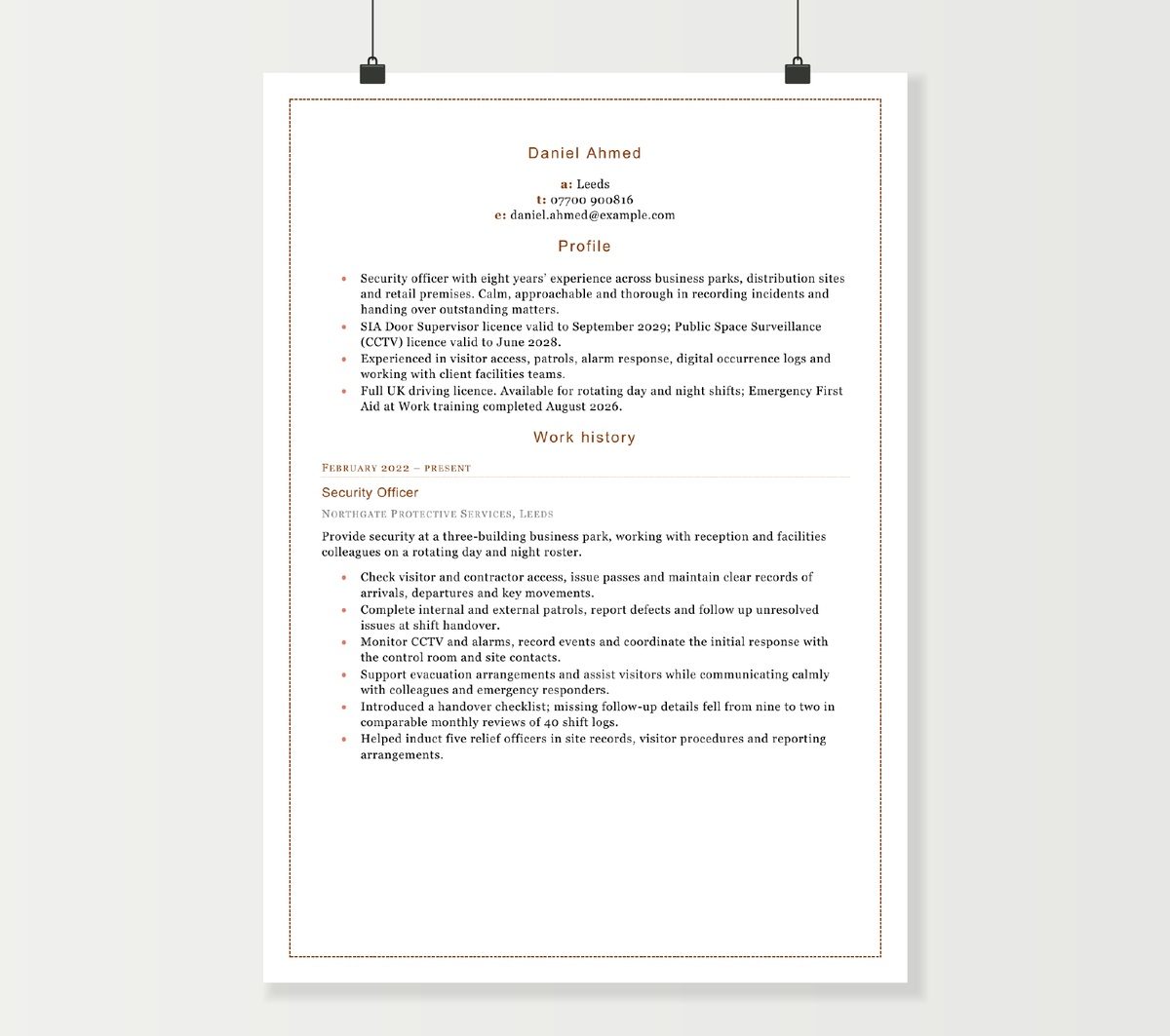
This security officer CV template follows an experienced site officer with earlier relief-security and retail experience. The Word example brings together SIA licence status, access control, patrols, reporting and practical improvements to shift handovers. The guide covers security officer and security guard applications across different settings, including applicants entering the industry.
Filename: FreeCVDownload_Security_Officer.docx
Content of this CV template
Daniel Ahmed
a: Leeds
t: 07700 900816
Profile
- Security officer with eight years’ experience across business parks, distribution sites and retail premises. Calm, approachable and thorough in recording incidents and handing over outstanding matters.
- SIA Door Supervisor licence valid to September 2029; Public Space Surveillance (CCTV) licence valid to June 2028.
- Experienced in visitor access, patrols, alarm response, digital occurrence logs and working with client facilities teams.
- Full UK driving licence. Available for rotating day and night shifts; Emergency First Aid at Work training completed August 2026.
Work history
February 2022 – present
Security Officer
Northgate Protective Services, Leeds
Provide security at a three-building business park, working with reception and facilities colleagues on a rotating day and night roster.
- Check visitor and contractor access, issue passes and maintain clear records of arrivals, departures and key movements.
- Complete internal and external patrols, report defects and follow up unresolved issues at shift handover.
- Monitor CCTV and alarms, record events and coordinate the initial response with the control room and site contacts.
- Support evacuation arrangements and assist visitors while communicating calmly with colleagues and emergency responders.
- Introduced a handover checklist; missing follow-up details fell from nine to two in comparable monthly reviews of 40 shift logs.
- Helped induct five relief officers in site records, visitor procedures and reporting arrangements.
July 2018 – January 2022
Relief Security Officer
West Riding Security Services, Leeds
Covered six distribution and retail sites, adapting to local assignment instructions and client requirements.
- Managed vehicle arrivals and checked delivery bookings with warehouse teams.
- Conducted patrols and reported access, lighting and other site defects.
- Maintained occurrence books, incident reports and radio contact with colleagues.
- Provided a visible shop-floor presence and assisted customers and store teams.
- Helped resolve difficult interactions calmly and sought support when required.
- Prepared site handovers covering outstanding incidents, visitors and keys.
September 2015 – June 2018
Retail Assistant
Westbrook Home Stores, Leeds
Supported customers, stock replenishment and closing routines in a homewares store.
- Handled customer enquiries, payments and returns at the service desk.
- Checked deliveries and raised stock discrepancies with the supervisor.
- Helped customers find products and arranged assistance for bulky items.
- Kept aisles clear and reported damaged shelving or other hazards.
- Supported evening close-down checks alongside the duty manager.
- Showed new colleagues how to record unresolved customer enquiries.
Qualifications and training
Level 2 Door Supervisor qualification, 2017; refresher award, August 2026.
Level 2 CCTV qualification, 2022; Emergency First Aid at Work, August 2026.
7 GCSEs including English and Mathematics, 2015. ACT Awareness and ACT Security e-learning, August 2026.
Interests
Five-a-side football, cooking and walking in the Yorkshire Dales.
How to write a security officer CV
A strong security officer CV makes three things easy to establish: the work you are licensed and trained for, the environments you know, and how you help a site run safely and smoothly. Patrols and access control matter, but so do a clear incident report, a useful handover and a calm conversation with someone who needs assistance. Bring those parts of the job together in your experience.
Put licence status where recruiters can find it
Give the type of SIA licence and its expiry date near the top of the CV. “SIA Door Supervisor licence — valid to September 2029” is more informative than “SIA qualified”. Where you hold more than one licence, list each separately, including Public Space Surveillance (CCTV) if relevant to the vacancy.
Keep qualifications and licences distinct. A licence-linked course belongs in your training section; the active licence belongs in a short licence or key-information section. If an application or renewal is in progress, give its current stage and the relevant training dates so the employer can understand your availability.
The required licence depends on the activity. A door supervisor licence also permits security guarding, while CCTV requirements depend on the work being carried out. Use the vacancy to identify the credentials to foreground and the SIA’s guidance on licensed activities when you need to check the distinction. This is especially useful when moving between a guarding role, a control room and a licensed venue.
Give the reader a picture of your sites
Begin each employment entry with the setting and scope. A distribution centre, shopping centre, office building and college all need security, but the daily priorities differ. Explain whether you work at a fixed site, cover several locations, operate in a control room or carry out mobile patrols.
Useful context includes the number of buildings or sites, the shift pattern, the people you work with and the main service you provide. For example, “Provide security across a three-building business park, working with reception and facilities colleagues” immediately gives the subsequent bullets a setting.
For contracted security work, name your employer and identify the client environment underneath. You can describe a financial-services office or food-production site without naming the client. If the same site changes contractors, show the employment dates and continuity clearly rather than leaving the reader to infer several unrelated moves.
Connect routine duties to their purpose
Replace an isolated list of “patrols, CCTV, access control” with short descriptions of the work. For access control, that may mean checking contractor bookings, issuing visitor passes, maintaining key records or coordinating vehicle arrivals. For patrols, it may involve identifying defects, recording findings and passing unresolved matters to the next shift.
Name electronic systems when they add substance. An access-control platform, digital occurrence book, visitor-management system or CCTV platform can help a recruiter recognise relevant experience. Explain the functions you use, particularly if the role combines a reception desk with monitoring and reporting. Familiarity with email, Word and digital forms can also be valuable where reports are a regular part of the shift.
For mobile or relief work, show how you settle into different sites: reading assignment instructions, learning local reporting arrangements, maintaining contact with a control room and producing a complete handover. A driving licence and the locations or travel area you can cover are useful when the vacancy depends on mobility.
Make reporting and handovers a strength
Good records are a significant part of a security officer’s contribution. Describe the documents you produce and how others use them: daily occurrence logs, incident reports, visitor records, fault reports or shift handovers. This shows written communication through the job rather than through a general claim about communication skills.
A stronger bullet follows the information through to its recipient: “Recorded access faults and passed outstanding actions to facilities colleagues and the incoming shift.” If you helped improve the quality of a log or introduced a useful checklist, explain what became clearer or more reliable.
Incident examples can be brief and focused on your actions. Outline the type of situation, the people you coordinated with and the resulting handover or resolution. A CV can demonstrate observation, judgement and reporting without reproducing an operational report or including identifying details about individuals.
Show calm communication in the setting that matters
Security work often involves helping someone as well as checking access or responding to a concern. Give evidence of explaining arrangements, directing visitors, resolving misunderstandings or obtaining support during a difficult interaction. This is particularly valuable for front-of-house, retail and education roles.
Choose examples that show both service and judgement. You might have reassured a visitor during an evacuation, coordinated with a store manager during a disturbance, or helped a contractor resolve an access query while maintaining the site’s checks. Say who you worked with and what you contributed.
For college or other public-facing environments, relevant experience may include supporting vulnerable people and reporting concerns to the appropriate team. For retail roles, a visible presence and cooperation with store colleagues are useful evidence alongside loss-prevention work. The emphasis should fit the people and circumstances you will encounter in the new role.
Select evidence for the kind of security work you want
A CV becomes more persuasive when its detail matches the site. The following are useful areas to consider when choosing employment bullets:
- Corporate and front-of-house security: professional visitor reception, passes, contractor coordination, building knowledge, loading-bay arrangements and liaison with facilities teams.
- Retail security: customer assistance, calm responses to difficult behaviour, teamwork with managers, incident records and relevant CCTV or body-worn equipment experience.
- Industrial and distribution sites: vehicle movements, delivery checks, gatehouse records, patrols, weighbridge duties where applicable and communication with warehouse or production colleagues.
- Education settings: opening and closing, access arrangements, student and visitor communication, behaviour-related incidents and reporting through the institution’s procedures.
- Mobile and relief security: multiple-site coverage, lone-working arrangements, alarm attendance, check calls, driving and the ability to adapt to different assignment instructions.
Specialist roles may need additional evidence, such as control-room experience, screening equipment or particular clearances. Put that experience prominently when it is central to the vacancy. A general guarding CV can then be adapted through selection and emphasis rather than by adding a long list of every possible security duty.
Use achievements that reflect dependable security work
Security achievements do not have to involve a dramatic incident. A clearer handover, fewer missing entries, a recurring fault brought to the right team, or a better induction for relief officers can show a useful contribution. Explain the problem, your action and what changed.
The example CV compares incomplete follow-up details in two monthly reviews of 40 shift logs. Giving the review size makes the result understandable. Other useful evidence includes the number of colleagues inducted, sites covered or a process improvement adopted by the supervisor.
For team results, describe your part in the work. If a site’s incident trend improved after several changes, identify the action you contributed and the period being discussed. For an individual CV, the strongest result is often the one you can explain clearly at interview rather than the largest headline number.
Present training and working arrangements clearly
List current first-aid training with its exact title and completion date, followed by relevant refresher or specialist courses. ACT Awareness and ACT Security, fire-related training, conflict-management refreshers and site-specific development can be useful where they support the vacancy. Keep the section selective so licence status remains easy to identify.
For an experienced officer, a recent refresher and evidence of applying the training usually deserve more prominence than a long account of school subjects. An applicant entering the industry can give more space to the licence-linked qualification, first aid and relevant customer-facing work.
Include day or night availability, driving and travel flexibility when they help an employer assess the advertised roster. “Available for rotating days and nights across Leeds” is a practical statement. Any more detailed discussion of rota preferences can follow during recruitment.
Build a first security CV from relevant experience
Retail, hospitality, reception, logistics and public-service work can provide useful examples of dealing with people, maintaining records, following site routines and responding to changing demands. Select two or three situations that demonstrate those abilities in your original role, then give your security training its own clear section.
For example, a retail assistant can describe resolving customer enquiries, supporting closing checks and reporting hazards. A warehouse colleague can show delivery records, controlled site access or communication with drivers where those were part of the job. The receptionist CV example is useful for presenting visitor-facing experience; the customer service example can help you select evidence of handling enquiries and difficult conversations.
Use month-and-year dates throughout. Where an employer requests a checkable history, a clear sequence of work, study and other periods makes the later screening process easier. Your CV can remain concise while providing the chronology needed to understand your experience.
Security Officer CV FAQs
The licence type, status and expiry date usually give a recruiter enough information at the initial stage. If the employer requests the number for verification, provide it through its recruitment process. You can keep the CV focused on your qualifications and experience while supplying the additional checking details when required.
Often, yes. Employers use both titles for similar guarding work, so adapt the profile and selected experience to the duties and setting rather than treating the titles as separate careers. A control-room, door-supervision or specialist screening role may need a different emphasis and additional credentials.
List the employers and their dates, then explain that the role continued at the same client site following the contract transfer. You can group the shared duties beneath that explanation. This shows continuity and avoids repeating an identical job description for each contractor.
State the qualification and completion date, followed by the application stage. Some employers recruit trainees or support licence applications, while others need an active licence before the role starts. That clear status helps them judge the timing alongside your customer-service or site experience.
Usually a grouped entry under the security employer or agency works better. Give the overall dates, the kinds of sites covered and any longer placement that adds relevant experience. Keep a fuller assignment history available for screening or an application form that requests it.
Yes, where it demonstrates relevant responsibilities. Translate ranks, unit names or specialist terminology into the work a civilian employer needs to understand: managing access, recording incidents, communicating under pressure, coordinating colleagues or supporting people. Put current SIA status alongside that experience so the recruiter can assess both the background and the requirements of the new post.