
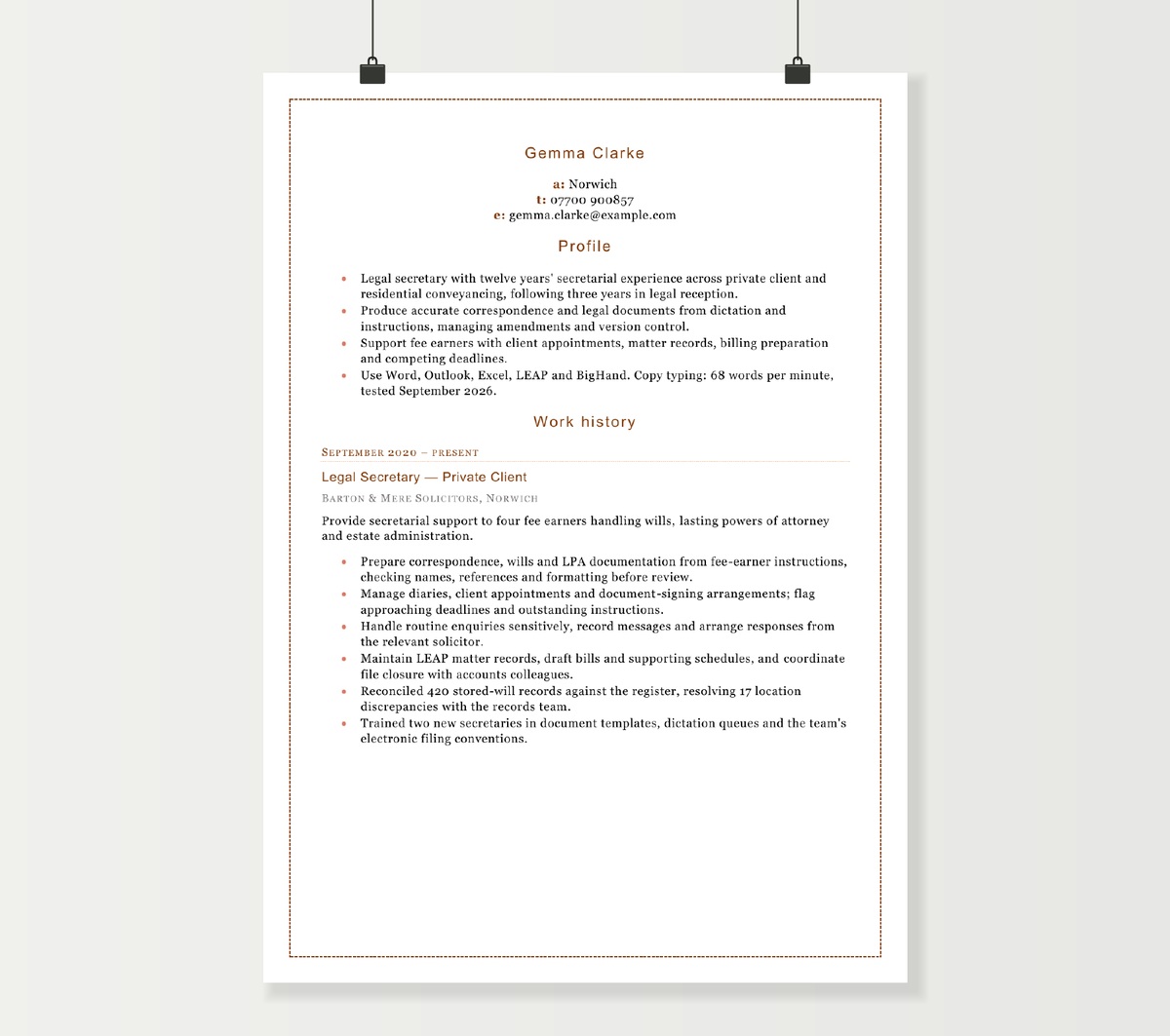
This legal secretary CV template follows a candidate who progressed from reception into conveyancing and private-client support. The Word example covers document production, client contact, diary management and case records. The guide explains how to present your contribution to a legal team, including experience in different practice areas and a first move into legal support.
Filename: FreeCVDownload_Legal_Secretary.docx
Content of this CV template
Gemma Clarke
a: Norwich
t: 07700 900857
Profile
- Legal secretary with twelve years' secretarial experience across private client and residential conveyancing, following three years in legal reception.
- Produce accurate correspondence and legal documents from dictation and instructions, managing amendments and version control.
- Support fee earners with client appointments, matter records, billing preparation and competing deadlines.
- Use Word, Outlook, Excel, LEAP and BigHand. Copy typing: 68 words per minute, tested September 2026.
Work history
September 2020 – present
Legal Secretary — Private Client
Barton & Mere Solicitors, Norwich
Provide secretarial support to four fee earners handling wills, lasting powers of attorney and estate administration.
- Prepare correspondence, wills and LPA documentation from fee-earner instructions, checking names, references and formatting before review.
- Manage diaries, client appointments and document-signing arrangements; flag approaching deadlines and outstanding instructions.
- Handle routine enquiries sensitively, record messages and arrange responses from the relevant solicitor.
- Maintain LEAP matter records, draft bills and supporting schedules, and coordinate file closure with accounts colleagues.
- Reconciled 420 stored-will records against the register, resolving 17 location discrepancies with the records team.
- Trained two new secretaries in document templates, dictation queues and the team's electronic filing conventions.
September 2014 – August 2020
Legal Secretary — Conveyancing
Waverley Quay Solicitors, Norwich
Supported two solicitors with residential sales, purchases and remortgages.
- Typed correspondence and prepared transaction documents for solicitor review.
- Opened matters and gathered client identification documents for checks.
- Ordered searches and prepared Land Registry applications as instructed.
- Liaised with clients, agents and lenders on routine progress enquiries.
- Maintained completion diaries and prepared document packs to agreed deadlines.
- Introduced a file-closing checklist subsequently used by all three department secretaries.
September 2011 – August 2014
Receptionist / Office Assistant
Waverley Quay Solicitors, Norwich
Provided reception and administration for a high-street legal practice.
- Welcomed clients and arranged meeting rooms and appointments.
- Routed calls and recorded clear messages for fee earners.
- Scanned incoming correspondence to the correct matter files.
- Distributed post and maintained collection and delivery records.
- Retrieved archived files and updated the storage register.
- Covered colleagues' reception breaks and helped prepare client meeting packs.
Qualifications and training
Legal Secretaries Diploma | Institute of Legal Secretaries and PAs, 2015
Advanced Word document formatting, 2024 | Workplace confidentiality and AML updates, 2026
9 GCSEs, including English and Maths | Norwich, 2011
Interests
Swimming, baking and visiting the Norfolk coast.
How to write a legal secretary CV
A legal secretary CV should make it easy for a firm to see which lawyers and practice areas you can support. The strongest evidence is often practical: producing a complex document accurately, keeping a busy diary workable, maintaining matter records and giving clients a calm, professional first response. Describe that work in the context of the team, rather than relying on a general list of office skills.
Put your practice-area experience near the top
State the areas of law you have worked in and your level of experience. Private client, conveyancing, litigation, family, corporate and intellectual property teams can have quite different document and diary requirements. A profile that identifies your relevant practice areas helps the reader understand your fit before they reach the employment history.
Add the type of support you provide: one-to-one partner support, a shared allocation of fee earners, a document-production team or broad secretarial cover in a small practice. Where useful, give the number and seniority of the people you support. Four solicitors with a shared workflow describes a different job from supporting one partner with extensive diary and travel demands.
When moving between practice areas, bring forward the experience that carries across: accurate document work, client contact, diary coordination, billing and case systems. Then identify the relevant exposure you already have to the new area. Occasional cover for a probate team can be useful evidence alongside a longer conveyancing background.
Describe the documents you produce and the work involved
“Typing and correspondence” gives only a partial picture. Select the document types that matter for the vacancy and explain your contribution: transcription, preparation from templates or instructions, amendments, proofreading, formatting, collation or preparation for review.
Private-client examples might include wills, powers of attorney and estate correspondence. Conveyancing experience can include transaction documents, search requests and post-completion paperwork. Litigation support may involve court documents, indexed bundles and correspondence with counsel or other parties. Use the terminology of the jurisdiction and team in which you worked.
Document complexity can be more useful than volume. A long agreement with tracked amendments, cross-references and changing schedules demonstrates different skills from a high daily output of standard letters. Where you improved a template, corrected recurring formatting problems or organised a document library, explain the benefit to the team.
Keep the review route clear through the verbs you choose. Preparing a document from a solicitor’s instructions, incorporating amendments and submitting a final version for approval gives the reader a precise account of skilled support. It also helps distinguish your contribution from the lawyer’s drafting or advisory work.
Make typing and software skills practical
If you have a recent typing result, include the speed and whether it relates to copy or audio typing. The date or testing context can help the reader interpret it. Audio transcription experience also benefits from a description of the material you handle, particularly where several fee earners use different dictation styles.
Name the systems you use and connect them to tasks. BigHand may support digital dictation; LEAP, SOS or another case system may hold matter information and correspondence. A document-management system, billing platform and court or property portal each serve a different purpose. A short skills line is useful, followed by evidence of use in the employment section.
For Microsoft Word, relevant capabilities include styles, automatic numbering, tracked changes, tables, cross-references and document comparison. Pick the features you use in your work rather than filling the CV with every menu function. Outlook experience can be demonstrated through complex diaries and shared inboxes; Excel through useful billing schedules, registers or tracking sheets.
Show how you keep matters and deadlines organised
Explain your role in the life of a matter: opening the file, gathering information, maintaining correspondence, recording key dates, preparing bills or closing and archiving the record. This helps an employer see how much of the support process you understand.
Diary evidence should go beyond booking appointments. You may coordinate client meetings around a solicitor’s court commitments, arrange signing appointments, maintain completion dates or flag missing instructions ahead of a deadline. Describe how you work with fee earners and colleagues when priorities compete.
For litigation, identify the support you give to hearing preparation and bundles, including indexing or pagination where relevant. In conveyancing, completion and post-completion administration may deserve more space. In private client, document-signing arrangements, correspondence and the organisation of original documents can be important. The practice area should determine which examples appear first.
Give client care a recognisable setting
Legal clients may be dealing with bereavement, a property move, a dispute or an unfamiliar process. A useful CV explains the contact you handle: arranging appointments, answering routine progress questions, gathering information, recording messages and organising a response from the appropriate lawyer.
Examples of adapting communication can be valuable, such as supporting clients who prefer telephone contact or coordinating appointments with an interpreter. A line about keeping a client informed while obtaining a solicitor’s response conveys more than “excellent telephone manner”. Where you have supported demanding corporate clients or several third parties on a transaction, include that context.
Information handling is also best expressed through working practice. Accurate matter references, controlled document versions, agreed access arrangements and careful handling of original records demonstrate reliability. Relevant confidentiality or data-protection training can sit in the development section, with the work history showing how that knowledge supports the team.
Include billing and business support where they are part of the role
Many legal secretarial and PA positions include time-entry support, draft bills, cost schedules, expense claims or coordination with accounts. State the tasks you carry out and the approval arrangements. Producing billing information for a fee earner’s review is a useful responsibility in its own right.
For roles with wider PA duties, add diary planning, travel, events, client relationship records and business-development support where relevant. Give this space in proportion to the vacancy. A practice looking for high-volume document support may care more about production skills; a partner-facing PA appointment may give greater weight to anticipation, coordination and business administration.
Use achievements that reflect good legal support
Useful results often involve accuracy, organisation or dependable service. You might have resolved inconsistencies in an archive register, cleared a file-closing backlog, introduced a checklist, improved document retrieval or trained colleagues in a new system. Explain the starting point, your action and the change it produced.
The example CV describes reconciling stored-will records and resolving location discrepancies. That is a specific improvement with a defined scope. A checklist adopted by the department is another tangible result, even without a percentage saving. Numbers are most helpful when they explain scale or a measured change.
Team contribution can also provide strong evidence. Covering a busy colleague’s allocation, supporting a system transition or helping two new secretaries become familiar with the firm’s templates shows practical value. Tie the example to what the team needed and what you delivered, rather than presenting ordinary duties as a string of dramatic claims.
Present qualifications and a first move into legal support
List legal secretarial qualifications with the full title, provider and completion year. Relevant business administration, typing and software qualifications can also support an application. Recent training is useful when it relates to document production, systems or the firm’s working requirements.
For a first legal role, draw evidence from administration, reception or other work involving detailed records, deadlines and sensitive enquiries. Show document accuracy, organisation and client service through concrete tasks. A legal secretarial course can add evidence of practical preparation; a law degree can demonstrate legal study, with office and document skills presented alongside it.
Legal reception experience is particularly useful when it includes matter correspondence, client appointments or archiving. The receptionist CV example can help you identify relevant evidence from that starting point. For established secretaries, recent legal responsibilities should take more space than school qualifications or early general office duties.
Let the employment history show progression
Keep actual job titles and add the practice area where it helps. If you progressed within one firm, separate the roles and dates so the development is visible. Increasing fee-earner responsibility, more complex documents, training colleagues or taking ownership of a support process can show progression without a management title.
For several temporary assignments, give each firm’s practice area, dates and main allocation, or group short placements under the agency with a clear summary. A short explanation such as maternity cover or a document project gives the reader context. The finished CV should leave a clear impression of the legal work you understand and the support an employer could expect from you.
Legal Secretary CV FAQs
Compare the duties rather than relying on the title. Some firms use Legal PA for a role combining document production, billing and fee-earner support; others place much greater weight on complex diaries, travel and business-development administration. Make the relevant parts of your experience prominent and keep your existing job title accurate in the employment history.
State the jurisdiction and practice area beside the role, and name the systems or procedures you supported where relevant. For a move elsewhere in the UK, emphasise transferable document, diary and client-service skills alongside any experience of the target jurisdiction. This helps the firm distinguish your established capability from the local procedures you would be learning.
Name the systems you know and the tasks you carry out in them, such as opening matters, storing correspondence, maintaining dates or preparing bills. Experience of learning a previous system or helping colleagues through a change can also be useful. Employers can then see the working knowledge you would bring to training on their platform.
An application usually needs a CV rather than a document portfolio. If a sample is requested, a purpose-built document using sample information can demonstrate styles, numbering, tables or tracked amendments. An agreed training example may also be suitable. Firms may instead assess these skills through a document or typing exercise during recruitment.
Keep the employment dates clear and give a brief entry for the break if it helps the timeline. Bring your relevant practice-area experience forward, then add recent preparation such as Word training, a typing assessment or case-system refresher. This gives the employer a useful picture of both your established legal support experience and your readiness to return.




