
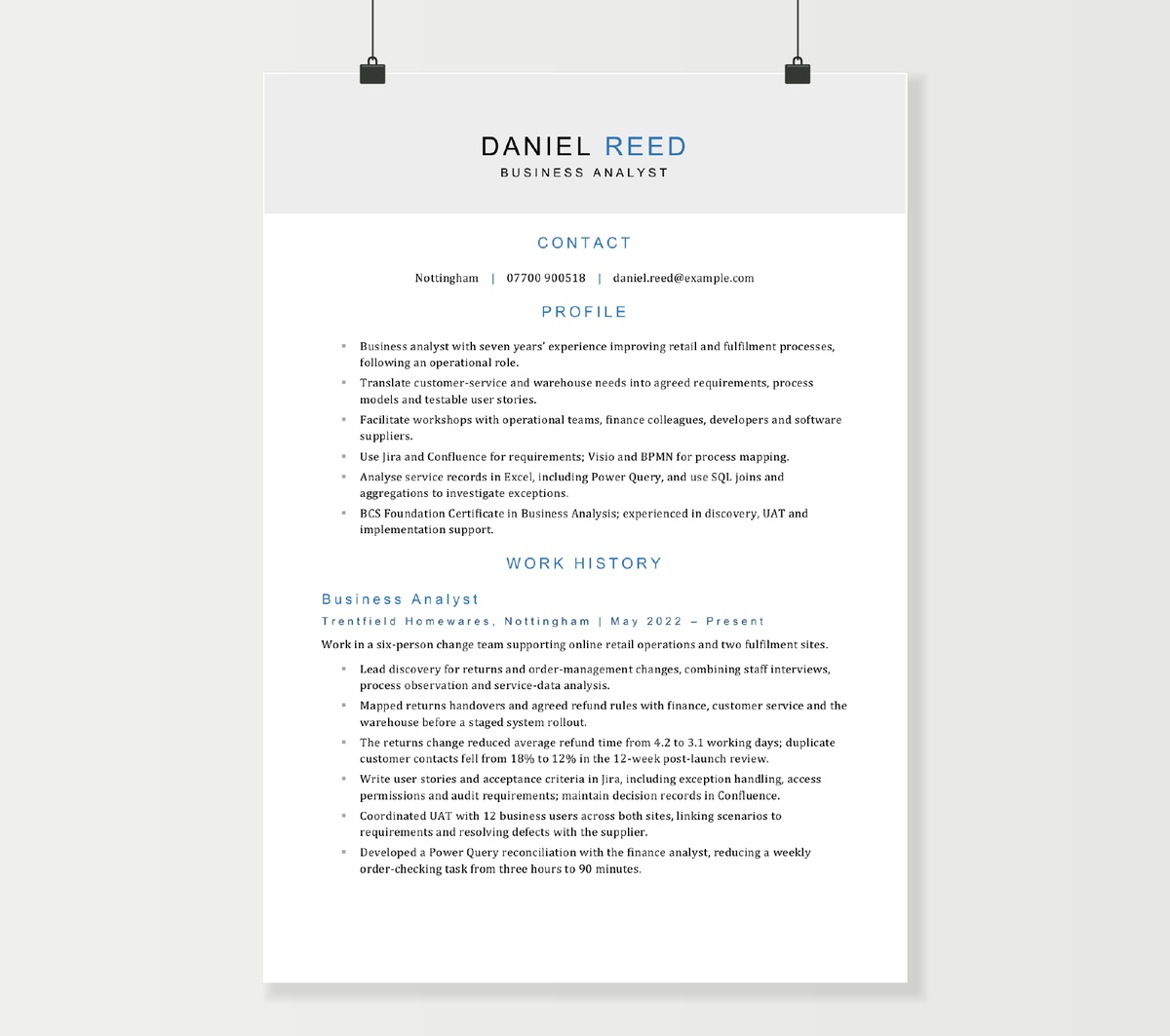
This business analyst CV template follows an analyst who moved from fulfilment operations into business change. The Word example shows how to connect workshops, requirements, process maps and testing with improvements to a retail service. The guide covers business, digital and technical analyst applications, including first BA roles and more experienced appointments.
Filename: FreeCVDownload_Business_Analyst.docx
Content of this CV template
Daniel Reed
Business Analyst
Contact
Nottingham | 07700 900518 | [email protected]
Profile
- Business analyst with seven years’ experience improving retail and fulfilment processes, following an operational role.
- Translate customer-service and warehouse needs into agreed requirements, process models and testable user stories.
- Facilitate workshops with operational teams, finance colleagues, developers and software suppliers.
- Use Jira and Confluence for requirements; Visio and BPMN for process mapping.
- Analyse service records in Excel, including Power Query, and use SQL joins and aggregations to investigate exceptions.
- BCS Foundation Certificate in Business Analysis; experienced in discovery, UAT and implementation support.
Work history
Business Analyst
Trentfield Homewares, Nottingham | May 2022 – Present
Work in a six-person change team supporting online retail operations and two fulfilment sites.
- Lead discovery for returns and order-management changes, combining staff interviews, process observation and service-data analysis.
- Mapped returns handovers and agreed refund rules with finance, customer service and the warehouse before a staged system rollout.
- The returns change reduced average refund time from 4.2 to 3.1 working days; duplicate customer contacts fell from 18% to 12% in the 12-week post-launch review.
- Write user stories and acceptance criteria in Jira, including exception handling, access permissions and audit requirements; maintain decision records in Confluence.
- Coordinated UAT with 12 business users across both sites, linking scenarios to requirements and resolving defects with the supplier.
- Developed a Power Query reconciliation with the finance analyst, reducing a weekly order-checking task from three hours to 90 minutes.
Junior Business Analyst
Eastbridge Fulfilment, Nottingham | July 2019 – April 2022
Promoted into the change team supporting warehouse and customer-service systems.
- Documented current and proposed dispatch processes in Visio, including carrier cut-offs and exception routes.
- Prepared requirements and sample data for a carrier integration, working with the senior BA and development team.
- Investigated order-status discrepancies using Excel and SQL; findings informed revised interface validation rules.
- Prepared UAT scenarios and user guidance for a rollout to 35 colleagues; supported the first month of live operation.
Operations Coordinator
Eastbridge Fulfilment, Nottingham | September 2016 – June 2019
Coordinated order queries and dispatch priorities between account handlers and the warehouse.
- Maintained exception reports and followed unresolved delivery issues through to completion.
- Represented the operations team in workshops for a replacement order-management system.
Qualifications and training
BSc Business Management — Upper Second Class Honours
Nottingham Trent University | 2016
BCS Foundation Certificate in Business Analysis | 2020
Further training: BPMN process modelling (2023); SQL for business analysis (2024).
Hobbies and interests
I enjoy badminton, cooking for friends and exploring local walking routes.
How to write a business analyst CV
A business analyst CV should let the reader follow your contribution from a business problem to a decision or delivered change. Requirements documents, workshops and process maps matter because of what they helped the organisation understand and do. The most convincing employment entries connect those activities: what needed to change, how you investigated it, what you agreed with people and what happened next.
The example above follows an operational route into business analysis. Its returns project brings together process discovery, business rules, delivery and a review of the service after launch. That same approach can work for a banking programme, a hospital system or an internal finance process, while the evidence you choose should reflect the vacancy.
Establish what kind of business analyst you are
Use the opening profile to identify your strongest combination of business context, analysis experience and delivery work. “Business analyst with seven years’ experience improving retail and fulfilment processes” immediately gives Daniel’s application a direction. A systems analyst might instead lead with integrations and data flows; a business change specialist might emphasise operating models, service redesign and options appraisal.
Read the responsibilities alongside the job title. A role centred on a CRM implementation needs evidence of how you understood users, agreed workflows and worked with the supplier. A strategic change role may place more weight on capabilities, business cases and organisational implications. Bring the relevant experience into the profile and the opening bullets of your recent roles, while keeping the chronology easy to follow.
The distinction from a data analyst is useful when selecting evidence. If most of your work concerns reporting, statistical analysis or dashboard development, the data analyst CV example offers a closer starting point. For a BA application, explain how any data work supported requirements, options or change decisions.
Give each project enough context to be understood
Start an employment entry with the organisation, team and scope of the role. Then select projects that demonstrate different strengths. One might show discovery and stakeholder agreement; another might show a difficult system integration, testing or operational rollout. Three descriptions of almost identical workshops add less than two well-chosen projects with a clear personal contribution.
A useful project account includes the business need, the people or systems involved, your analysis, the decision or deliverable it supported and the result or current stage. You can usually cover that in two or three related bullets. Daniel’s returns example establishes the handover problem, explains his work with finance and operations, and follows it with the results of the rollout.
For a long role with several substantial assignments, short project subheadings can make the work easier to scan. For consultancy or contract work, keep each client assignment attached to the relevant employer or contract dates. A recruiter should be able to tell whether you supported one workstream, led the analysis for a project, or coordinated several analysts across a programme.
Show the judgement behind requirements work
“Gathered requirements” gives little sense of the analysis involved. Explain where the requirements came from and what you did to make them usable. You might have compared interview findings with service records, resolved conflicting business rules, identified an overlooked user group or separated a requested feature from the underlying need.
Include the form of the requirements where it helps the reader understand the work: user stories and acceptance criteria, functional specifications, business rules, use cases or a requirements catalogue. Then show how they were agreed and maintained. Traceability is especially useful evidence when a change had to remain connected to a business objective, policy obligation or test outcome across several releases.
Non-functional requirements can distinguish an experienced analyst’s CV. Choose a concrete aspect you helped define, such as access permissions, audit records, performance, availability or accessibility. In the example, permissions and audit requirements sit naturally beside exception handling. This shows attention to how a service needs to operate as well as what its main workflow should do.
A strong bullet might read: “Agreed exception and approval rules with finance and branch managers, then linked the requirements to supplier test scenarios.” It names a difficult part of the work and shows what made the output useful. The number of requirements written is usually secondary to that explanation.
Use process modelling to demonstrate an improvement
When you mention as-is and to-be processes, identify the process and the issue being examined. Handoffs, duplicate entry, unclear ownership, approval delays and different local practices all provide useful context. Add the notation or tool where relevant, then explain what the model helped people decide.
For example, mapping a customer-onboarding process becomes persuasive CV evidence when the reader learns that it exposed repeated checks across two teams and informed a single agreed approval route. The value lies in the analysis and agreement; the diagram is part of the evidence. BPMN, Visio, Miro or another tool can appear in the same sentence without dominating it.
For operating-model work, show the breadth of your contribution across people, responsibilities, processes, information and systems. State whether you mapped capabilities, evaluated options, developed a service blueprint or helped agree new ownership arrangements. Senior applications benefit from explaining the organisational decision that this work supported and how implementation was taken forward.
Make stakeholder work specific
Identify the groups whose needs you had to reconcile. “Worked with stakeholders” could mean anything from taking meeting notes to securing agreement on a contentious change. Clinical users and software suppliers, finance and operations, or product teams and information-security colleagues each suggest a different challenge.
Describe the purpose of your facilitation and the agreement reached. You might have brought regional teams to a common process, clarified a disputed business rule or helped a sponsor choose between delivery options. Interviews, observation, walkthroughs and workshops can all be relevant; select the method that explains the work best.
Influencing evidence is particularly valuable when you achieved agreement without line-management authority. A short account of competing priorities, the evidence you brought and the decision reached shows more than a claim to be a confident communicator. For senior roles, include how you kept decisions moving when ownership was unclear or several organisations were involved.
Follow the work through testing and implementation
Show what happened after requirements were documented. This could include answering developer questions, reviewing supplier designs, maintaining requirements through changes, preparing user acceptance testing or helping the business judge readiness for release. Give your particular responsibility and the scale where it is informative.
Daniel’s CV names 12 business users across two sites and explains that he linked UAT scenarios to requirements and coordinated defect resolution. That is more informative than “supported testing”. Other useful evidence includes agreeing business test coverage, preparing representative scenarios, organising defect triage and presenting outstanding issues to the person making the release decision.
Implementation may involve revised procedures, training material, handovers, service support or post-launch reviews. Include these where you contributed, especially for roles involving transition to business as usual. An analyst who stayed close to users after launch can explain what was learned and how that informed later changes.
Put tools in the context of your work
A compact skills section helps recruiters find relevant tools and techniques. Group them by use: requirements and collaboration, modelling, and analysis. The employment history should then demonstrate the tools that are central to the vacancy. This avoids making a reader infer practical experience from a long list of product names.
- Jira, Azure DevOps and Confluence: indicate whether you managed requirements, refined stories, maintained decisions, traced tests or supported a delivery backlog.
- Visio, BPMN, UML and service blueprints: identify the processes, interactions or service arrangements you modelled and how the output was used.
- Excel and Power Query: describe the reconciliation, operational analysis or cost comparison you performed. Daniel connects these tools to an order-checking task.
- SQL and BI tools: give the purpose and level of the work, such as investigating exceptions with joins and aggregations or agreeing reporting requirements with an analytics team.
- APIs, integrations and data mapping: explain your role in defining information flows, business rules, source-to-target mappings or error-handling requirements.
Technical BA vacancies can require deeper systems knowledge, while other roles concentrate on business processes and organisational change. Use the vacancy to decide how much space each area deserves. A concise description of your actual use makes it easy for a hiring manager to judge the fit.
Describe delivery approaches through responsibilities
Agile, waterfall and hybrid experience is most useful when attached to something you did. For an iterative product team, you might describe discovery, story refinement, working with the product owner and responding to feedback across releases. For a governed programme, requirements baselines, impact assessments, dependencies and formal approval points may be more relevant.
If you have also taken on product-owner or project-management responsibilities, identify them clearly. Prioritising a backlog with a product owner and holding the authority to set its priorities are different levels of responsibility. The CV can show either effectively by naming the decisions you made and the people you worked with. Applicants whose next role centres on delivery ownership may also find the project manager example useful.
Explain benefits with a meaningful baseline
Choose outcomes connected to the problem you analysed: processing time, error rates, repeat contacts, manual effort, completion rates or the quality of a control. State the comparison and period where they matter. In Daniel’s CV, the refund measure uses working days and the results belong to a 12-week review, giving the figures a clear setting.
Make the sequence from your contribution to the team’s result visible. Mapping a process and agreeing rules helped shape a rollout; the rollout improved the service. That connection is stronger than attributing the entire programme benefit to one analyst. For time savings, the scale and frequency of the task help a reader understand whether the improvement was material.
Business cases and options appraisals often concern expected benefits. Present those as estimates or forecasts, and distinguish them from results observed after implementation. If you left before benefits were measured, the approved option, completed analysis, successful business testing or release reached can provide the endpoint of the CV entry.
Some valuable outcomes are qualitative. Agreement on a disputed definition, acceptance of a workable process across several teams or identification of a critical dependency can demonstrate sound analysis. Explain the decision it enabled rather than forcing every bullet into a percentage.
Use domain knowledge to strengthen the application
Sector experience helps when the CV makes its practical relevance clear. In financial services, this might involve a particular product, risk process or reporting obligation. In healthcare, it might involve patient pathways, clinical workflows and the people responsible for clinical safety. In retail, orders, stock, payments and returns can establish familiarity with the business.
For a move between sectors, look for comparable analysis challenges: multiple approval groups, complex case handling, service handovers or legacy-system replacement. Explain the transferable work alongside the context you already know. Expand specialist internal acronyms so that an external recruiter can follow your experience.
Present a first BA application or a move into senior work
For a first BA role, look within your operational, support, testing or project experience for work that already involved analysis. Examples include investigating recurring errors, representing users during a system change, documenting a process or comparing options for a service improvement. Give those contributions prominence under the role in which they happened.
A selected project can help a graduate or career changer demonstrate a more complete chain of work. Choose one with a clear problem, some evidence gathering, options, requirements and a way to assess the proposed result. A university project, voluntary assignment or improvement in your existing workplace can all be useful. Explain which parts you completed and the outcome or recommendation.
For a senior BA application, move beyond showing that you can produce good analysis. Include how you shaped an uncertain brief, chose an approach, handled dependencies, influenced senior decisions or developed other analysts. If you established standards, explain what they improved: consistency of requirements, review quality or the ability to reuse analysis across teams.
Give qualifications and supporting examples the right space
List the full name of relevant BA qualifications, the awarding body and completion year. BCS and IIBA qualifications may help demonstrate formal development; a relevant degree, apprenticeship or substantial operational background provides further context. For an established analyst, recent delivery evidence generally deserves more space than a detailed account of older study.
A small portfolio can be useful for someone entering the field or moving towards a different kind of BA work. A short case study with a readable process extract, selected requirements and an explanation of the decisions is easier to assess than a folder of unexplained documents. Use material you can share openly, with enough context for a reader to understand its purpose. Experienced applicants may find that concise project evidence within the CV already does the job.
Choose a layout that gives your project evidence room to breathe. This example keeps recent analysis and outcomes together on the first page, with earlier progression and qualifications on the second. The CV template library offers other designs if a different balance of projects and employment history suits your application.
Business Analyst CV FAQs
Yes, where your experience fits the responsibilities. Keep the recognisable employment title and use the description beneath it to show the analysis you carried out. For example, an operations coordinator might have investigated failures, mapped processes and represented users during an implementation. A profile aimed at business analysis can connect that experience with your next step without making the employment history confusing.
Use a consistent format that makes the assignment and contractual relationship clear, such as Business Analyst — client sector or name, via agency or consultancy, followed by the assignment dates. Where a consultancy employed you across several clients, keep it as the employer and nest the principal assignments beneath it. This helps the reader understand continuity, repeat engagements and the scope of each project.
It can be useful when it shows relevant analysis. Explain the stage reached and the decision your work supported. An options appraisal that led an organisation to stop an unsuitable investment can demonstrate good judgement. For a programme cancelled for other reasons, focus on completed discovery, agreed requirements or findings that were used elsewhere, with a brief explanation of the project’s status.
Describe the sector, type of change, stakeholders, methods and your contribution at a level you can share. A phrase such as customer-onboarding redesign for a UK financial-services organisation may give sufficient context. A concise account of the decision or delivery stage can stand on its own; detailed client documents and commercially sensitive figures are not necessary for a strong CV entry.
Follow the application format requested by the employer. Where a supporting statement is required, use it to address the person specification with selected evidence, including any sector-specific requirements. The CV provides your chronology and concise project record; the statement can explain how that experience meets each criterion. A strong CV is a useful source of evidence for both documents.
Include a brief statement of the current clearance level when it is relevant to the vacancy and appropriate to disclose. Some roles ask for existing clearance, while others ask for eligibility to undergo vetting; those are different requirements. Keep the CV to the relevant status and leave sensitive assignment details, reference numbers and any transfer arrangements for the employer’s recruitment process.




