
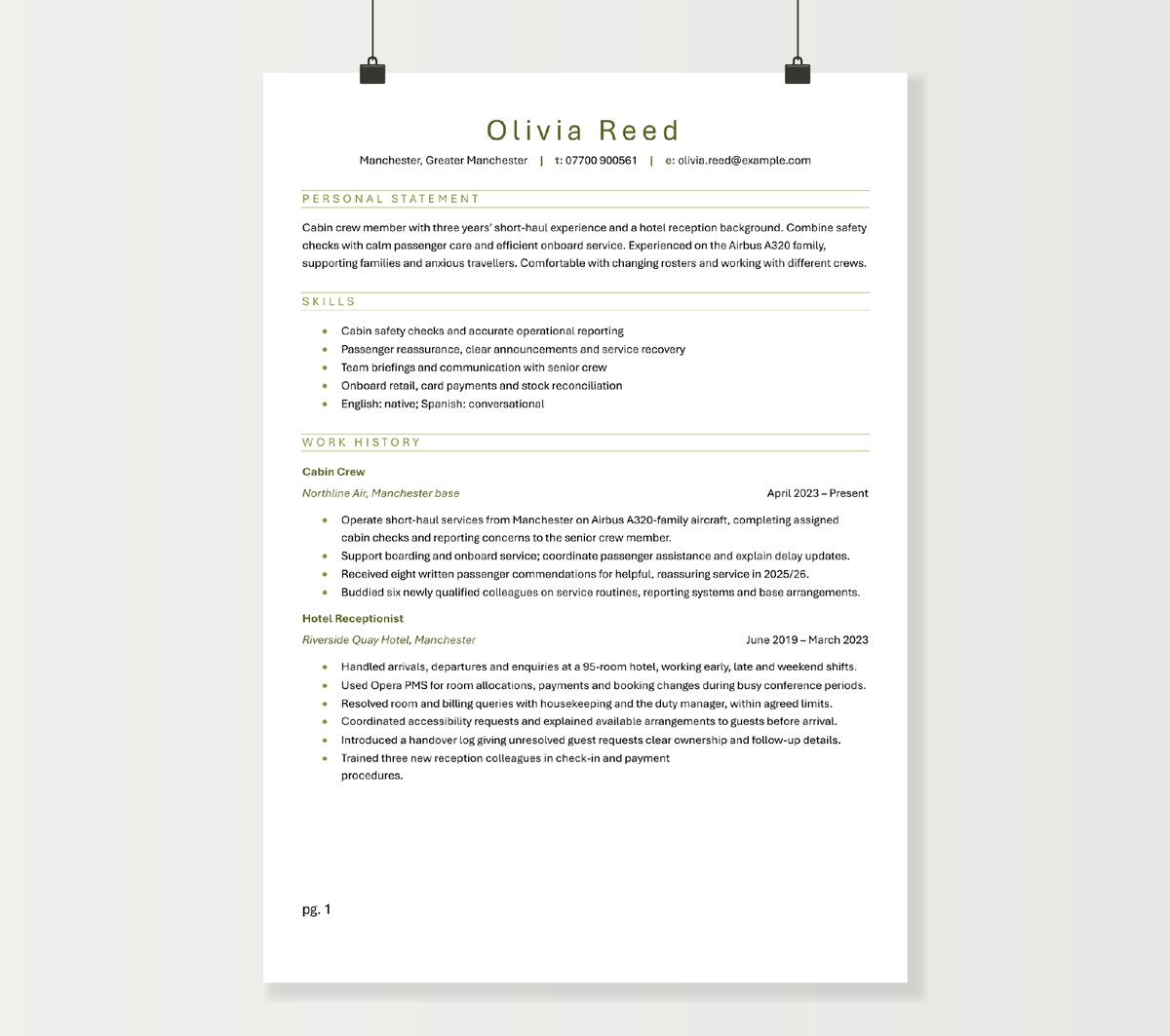
This cabin crew CV template follows an experienced crew member who moved into aviation from hotel and retail work. The Word example brings together safety responsibilities, passenger care, onboard service and current training. The guide explains what to include for a first airline application, a move between airlines or progression to a senior cabin role.
Filename: FreeCVDownload_Cabin_Crew.docx
Content of this CV template
Olivia Reed
Manchester, Greater Manchester | t: 07700 900561 | e: [email protected]
Personal statement
Cabin crew member with three years’ short-haul experience and a hotel reception background. Combine safety checks with calm passenger care and efficient onboard service. Experienced on the Airbus A320 family, supporting families and anxious travellers. Comfortable with changing rosters and working with different crews.
Skills
- Cabin safety checks and accurate operational reporting
- Passenger reassurance, clear announcements and service recovery
- Team briefings and communication with senior crew
- Onboard retail, card payments and stock reconciliation
- English: native; Spanish: conversational
Work history
Cabin Crew
Northline Air, Manchester base
April 2023 – Present
- Operate short-haul services from Manchester on Airbus A320-family aircraft, completing assigned cabin checks and reporting concerns to the senior crew member.
- Support boarding and onboard service; coordinate passenger assistance and explain delay updates.
- Received eight written passenger commendations for helpful, reassuring service in 2025/26.
- Buddied six newly qualified colleagues on service routines, reporting systems and base arrangements.
Hotel Receptionist
Riverside Quay Hotel, Manchester
June 2019 – March 2023
- Handled arrivals, departures and enquiries at a 95-room hotel, working early, late and weekend shifts.
- Used Opera PMS for room allocations, payments and booking changes during busy conference periods.
- Resolved room and billing queries with housekeeping and the duty manager, within agreed limits.
- Coordinated accessibility requests and explained available arrangements to guests before arrival.
- Introduced a handover log giving unresolved guest requests clear ownership and follow-up details.
- Trained three new reception colleagues in check-in and payment procedures.
Retail Sales Assistant
Cedar Home, Manchester
August 2017 – May 2019
- Served customers in a busy city-centre homeware store alongside a team of eight.
- Explained product options, processed sales and refunds, and balanced the till at closing.
- Managed promotional queues and helped customers collecting online orders.
- Completed stock checks and kept customer areas tidy and accessible.
Training and education
Cabin crew training
Northline Air
2023 – 2026
- UK Cabin Crew Attestation — initial training completed April 2023.
- Airbus A320-family aircraft and operator conversion training — April 2023.
- Recurrent safety, first-aid and crew resource management training and checks — April 2026.
Education
Manchester sixth-form college
2017
- A levels: English Language and Spanish. Eight GCSEs A–C including English and Mathematics (2015).
Hobbies and interests
- Swimming: Regular sessions at a local leisure centre.
- Cooking: Trying Spanish recipes with friends.
- Music: Live gigs and playing acoustic guitar.
Additional information
Manchester-based with own transport; available for early, late and weekend rosters.
How to write a cabin crew CV
A cabin crew CV should show that passengers and colleagues can rely on you. Airlines need people who follow safety procedures, communicate clearly, respond calmly and provide good service while working to a changing roster. Enjoying travel may explain your interest in the job, but your experience of looking after people is what gives the application substance.
Olivia’s example combines three years of flying with earlier hotel and retail work. Her aviation entry puts safety and passenger care first, while the earlier roles explain where she developed service recovery, payment handling and shift-working experience. A first-time applicant can build an equally focused CV using relevant evidence from other settings.
Choose your strongest route into the role
Start with a short profile that identifies your current background and the experience most relevant to the airline. Experienced crew can state their operating experience, aircraft family, type of service and recent responsibilities. A new entrant can lead with customer-facing work, communication and reliability in a busy team.
For example, a hotel receptionist could introduce experience supporting international guests, resolving problems during evening shifts and coordinating requests with other departments. A retail supervisor might emphasise customer care, team briefings and responsibility for payments. Someone from care or healthcare may have strong evidence of reassurance, observation and calm communication with people who need support.
Use the rest of the CV to substantiate that opening. Two or three concrete examples will establish your fit more effectively than a profile filled with personality adjectives. For an airline-specific application, prioritise the service and operating context of that role: short-haul, long-haul, premium service, onboard retail or a senior cabin position.
Make safety awareness visible without writing a training manual
For experienced crew, describe the safety responsibilities you carry out as part of normal operations. Assigned cabin checks, passenger briefings, reporting concerns, maintaining cabin readiness and completing operational records all help show consistent professional practice. Link them to your role within the crew and the procedures you work to.
A strong account can include an occasion when you noticed a concern, communicated it promptly and supported the senior crew member’s response. The value lies in your attention, judgement and coordination. The CV needs enough context to understand your contribution, rather than a step-by-step description of a safety procedure.
For a first application, look for evidence of responsible working in your existing role. You might follow food-allergen procedures, recognise when a guest needs help, report an unsafe condition or use a clear escalation route during an incident. Present the activity in its original setting so the airline can see the foundation you would bring to training.
Training and operational experience can sit alongside each other. A first-aid course belongs under qualifications or training; an example of supporting a distressed customer belongs in employment. This gives the reader both the preparation and the human context.
Describe passenger care through specific situations
Cabin service involves people with different needs and expectations, often in an unfamiliar or stressful environment. Select examples that show how you listened, explained the options and coordinated practical help. Relevant situations include nervous travellers, families, language barriers, disrupted journeys and customers requiring assistance.
“Provided excellent customer service” can become a more useful bullet such as: “Kept passengers informed during an extended ground delay, checked individual assistance needs and coordinated requests with the senior crew member.” This shows what good service looked like during a demanding part of the journey.
Applicants from hospitality can use the same level of detail. Explain how you resolved a booking problem, supported an accessibility request or helped a guest understand arrangements when plans changed. The receptionist CV example is useful if you are choosing which front-desk experience to carry into an airline application.
Include recognition where it adds evidence: named customer feedback, a service award or selection to support new colleagues. A modest, clearly described result is enough. Passenger care often depends on a combination of good judgement and consistent small actions.
Show teamwork in the confined, time-sensitive cabin environment
Airline teams often change from one duty to the next. Explain how you contribute to briefings, pass on relevant information, help colleagues and adapt to the needs of the flight. For experienced crew, the interfaces with the senior crew member, flight deck and ground teams may be especially useful.
Give your communication a purpose. Coordinating a passenger assistance requirement, clarifying a service change or handing over a concern tells the reader more than “excellent team player”. If you regularly support new starters, explain the scope: buddying during service routines, helping them navigate base processes or providing feedback through the appropriate colleague.
For a senior cabin application, bring leadership forward. Include crew briefings, allocation of duties, coaching, reporting and coordination during disruption, at the level you currently hold. A senior post needs evidence of taking responsibility for other people’s work as well as performing your own duties well.
Include the commercial side of service where it matters
Onboard retail, food and drink sales, stock checks and payment handling are important in many cabin roles. Describe the tasks you have handled and how you maintained a good customer experience while doing them. Product knowledge, clear explanations and accurate reconciliation can all be relevant.
If you have access to meaningful sales results, identify whether they relate to you, a crew or a base, and give the period. A result from a particular route or promotion is easier to assess when the context is clear. Other evidence may be just as useful, such as accurate end-of-duty stock records or helping colleagues become confident with a new payment device.
Retail and restaurant applicants can draw on closely related experience: recommending products, explaining choices, handling card payments, balancing tills and keeping service moving during peaks. Put the customer interaction and your responsibility in the same bullet.
Give aviation training a clear, compact section
Experienced crew should make their training history easy to scan. Identify the Cabin Crew Attestation you hold, the issuing organisation and date, relevant aircraft and operator training, and the latest recurrent training and checking. Use the terminology from your records so an airline can understand your background.
An attestation and an aircraft or operator qualification are different parts of that picture. A brief entry for each is clearer than a general “fully qualified cabin crew” statement. The CAA’s explanation of cabin crew training sets out how the attestation and operational training fit together.
If you are applying for your first cabin role, present completed education and relevant customer-service, first-aid or language training. Airline entry routes can include initial cabin training, so your existing experience and readiness to learn may be the main evidence at application stage. Check the particular vacancy to decide which qualifications deserve prominence.
For returning crew, give the dates of previous flying and the latest training you completed. That lets the recruiting airline assess the appropriate route back. A short note about subsequent customer-facing work can show how you have continued to use service and communication skills during the break.
Make languages and communication skills meaningful
List languages with a clear level, such as native, fluent, professional working proficiency or conversational. Where a recognised qualification helps establish the level, include it. A short example of using the language with customers can make the entry more useful than a row of flags or percentage bars.
Spoken communication is only part of the job. Clear written reports, accurate records, confident announcements and careful listening all deserve consideration. Choose evidence suited to your background: briefing colleagues, explaining changes to guests or recording an incident so the next person can follow up.
For applications where English is an explicit requirement, a well-written CV supports the rest of the evidence. Keep sentence structure straightforward and use the airline’s familiar role terminology. Previous work serving an international customer base can add helpful context.
Use dates and base availability to remove practical uncertainty
State your town or area and, where relevant, the airport base you are applying to. A concise availability line can cover early starts, late finishes, weekends and a planned relocation. Previous experience of comparable shift patterns is stronger evidence than a broad statement that you are flexible.
Employment entries should have clear month-and-year dates. Seasonal contracts can be labelled as such, with each flying season visible. If you returned to the same airline for several seasons, group them under one employer while showing the separate periods and any work between them.
Airline screening may ask for a fuller employment, education and activity history than the CV itself needs. Keeping your dates organised makes it easier to complete those forms consistently. Career breaks can have short neutral entries where needed to make the sequence understandable, leaving most CV space for relevant experience.
Practical requirements such as reach, swimming, travel documents and base commuting vary between airlines and roles. Answer the employer’s application questions in the requested place. On the CV, give concise role-relevant availability information when it helps the recruiter understand your application.
Choose evidence that suits a first application or a next step
For a first cabin role, select your strongest people-facing work even if the job titles are unrelated to aviation. Paid work, volunteering and substantial team responsibilities can all provide useful examples. Explain the setting, what you did and the result: a resolved complaint, a well-managed queue, clear support during disruption or successful training of a colleague.
For experienced crew, give recent aviation work most space and shorten earlier employment to the evidence that still matters. Aircraft experience and training should be easy to find, but they need the supporting account of passenger care, teamwork and responsibility.
For promotion, show how your contribution has widened. Acting-up duties, coaching, consistent recognition and responsibility for reports or briefings can help demonstrate readiness for a senior role. Give the frequency or scope where useful, so the reader can distinguish an occasional task from an established responsibility.
This example uses a two-page format to accommodate flying, hospitality and retail experience. A first applicant with a shorter history may need less space. You can choose another design from the CV template collection while keeping the emphasis on safety, service and the evidence relevant to your next airline role.
Cabin Crew CV FAQs
Follow the airline's instructions. Some recruitment events specifically request an English CV with an identification photograph, while other applications collect any required image separately. If no photograph is requested, the CV can focus on your experience and qualifications. Prepare the version required for that application rather than assuming every airline uses the same format.
Many airline entry routes include initial training for successful applicants, so a privately purchased course is not automatically needed. Check whether the vacancy is for new entrants or experienced attestation holders and what training the airline provides. A completed travel or cabin-crew course can be listed as education, while an actual Cabin Crew Attestation should have its own precise entry.
The core experience can remain the same, but adjust the practical information. For a named-base vacancy, make your location or relocation plan relevant to that base. For a wider talent pool, explain the bases or work patterns you can realistically consider if the application asks. A talent-pool entry is an expression of interest in future opportunities, so use it to present your current strengths and keep the information up to date.
The CV normally needs a concise summary of relevant eligibility and training, with supporting documents supplied through the airline's recruitment process when requested. Attestation type, issuer, dates and aircraft experience can establish the useful context without filling the CV with document details. Keep certificates and employment records organised for the later checks.
Name the airline, base, operating period, aircraft experience and the country or authority associated with your attestation or qualification. Add the service and leadership responsibilities most relevant to the UK role. The recruiting airline can then assess your training route and any additional requirements; your CV should make the existing experience easy to understand rather than trying to decide the conversion process.
Yes. Label it as a seasonal or fixed-term contract and give the months worked. Include the aircraft or service context, training completed and useful responsibilities from the season. If you were invited back or returned in a later year, that is helpful progression evidence. The contract label explains the short duration without needing a lengthy account of why it ended.




