
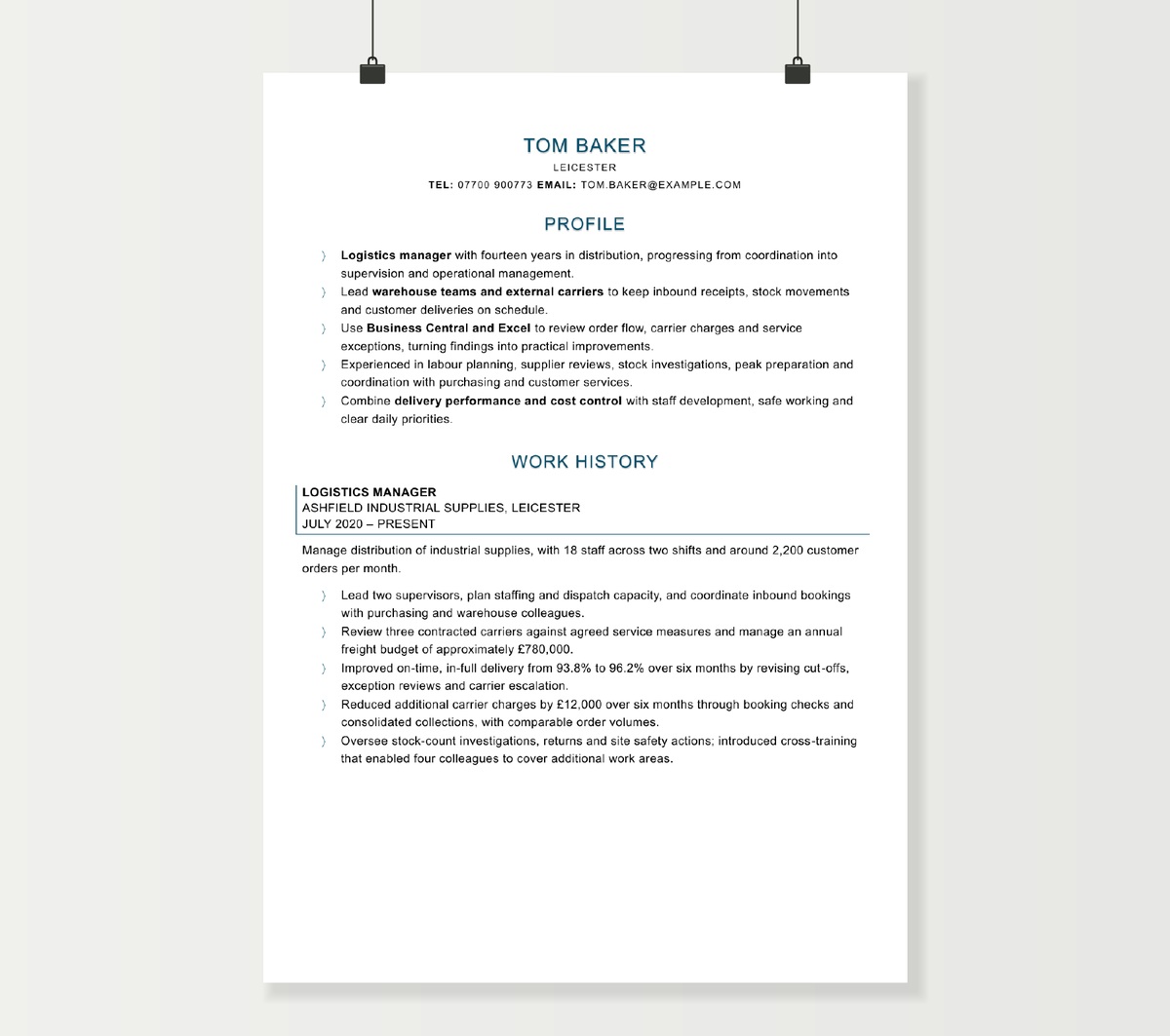
This logistics manager CV template follows a candidate who progressed from logistics coordination and supervision into managing a distribution operation. The Word example covers team leadership, carrier performance, stock control and delivery improvements. The guide explains how to present this experience for distribution, manufacturing, international and project-logistics roles.
Filename: FreeCVDownload_Logistics_Manager.docx
Content of this CV template
TOM BAKER
LEICESTER
tel: 07700 900773 email: [email protected]
PROFILE
- Logistics manager with fourteen years in distribution, progressing from coordination into supervision and operational management.
- Lead warehouse teams and external carriers to keep inbound receipts, stock movements and customer deliveries on schedule.
- Use Business Central and Excel to review order flow, carrier charges and service exceptions, turning findings into practical improvements.
- Experienced in labour planning, supplier reviews, stock investigations, peak preparation and coordination with purchasing and customer services.
- Combine delivery performance and cost control with staff development, safe working and clear daily priorities.
WORK HISTORY
LOGISTICS MANAGER
ASHFIELD INDUSTRIAL SUPPLIES, LEICESTER
JULY 2020 – PRESENT
Manage distribution of industrial supplies, with 18 staff across two shifts and around 2,200 customer orders per month.
- Lead two supervisors, plan staffing and dispatch capacity, and coordinate inbound bookings with purchasing and warehouse colleagues.
- Review three contracted carriers against agreed service measures and manage an annual freight budget of approximately £780,000.
- Improved on-time, in-full delivery from 93.8% to 96.2% over six months by revising cut-offs, exception reviews and carrier escalation.
- Reduced additional carrier charges by £12,000 over six months through booking checks and consolidated collections, with comparable order volumes.
- Oversee stock-count investigations, returns and site safety actions; introduced cross-training that enabled four colleagues to cover additional work areas.
WAREHOUSE AND DISPATCH SUPERVISOR
EAST MIDLANDS TRADE DISTRIBUTION, LEICESTER
AUGUST 2012 – JUNE 2020
Joined as Logistics Coordinator in 2012 and became Warehouse and Dispatch Supervisor in 2016, leading an eight-person shift.
- Planned picking and loading priorities, allocated daily work and liaised with carriers over collections and delivery queries.
- Introduced location checks and a revised count schedule; monthly stock adjustments fell from 42 to 26 over four months.
- Investigated short shipments and returns, reconciled dispatch records and kept sales colleagues informed of stock and delivery issues.
- Trained new starters, maintained shift handovers and supported a warehouse-system upgrade through transaction testing and floor support.
QUALIFICATIONS & DEVELOPMENT
CILT(UK) LEVEL 3 CERTIFICATE IN LOGISTICS AND TRANSPORT
COMPLETED 2018
Completed alongside supervisory work; focused on business management and warehousing operations.
IOSH MANAGING SAFELY
COMPLETED 2024
A LEVELS AND WORKPLACE DEVELOPMENT
3 A LEVELS – 2012; BUSINESS CENTRAL TRAINING – 2023
INTERESTS
Cycling, watching rugby and cooking for family and friends.
How to write a logistics manager CV
A logistics manager CV should make the operation understandable before it asks the reader to judge your results. What moved, between which locations, through whose facilities and under your control? Once that is clear, your achievements in delivery, cost, stock and team performance have a useful frame of reference.
The title covers very different jobs. You might run a distribution site, manage an outsourced delivery network, coordinate manufacturing materials or plan deliveries to a construction project. Build the CV around the version of logistics management the employer needs, using your closest experience as the main evidence.
Define the operation you managed
Use the profile to establish your sector, management level and strongest area of responsibility. “Logistics manager with experience of trade distribution, warehouse leadership and contracted carrier performance” tells the reader where you are likely to add value. A string of broad claims about supply-chain excellence tells them much less.
Under each role, give a compact description of scale. Select the measures that explain that operation: sites, staff, shifts, typical order or shipment volumes, stock lines, countries served or freight spend. Two or three relevant measures are usually enough to orient the reader before the detailed experience points.
Clarify the flow you owned. Inbound receipts, storage, picking, dispatch, last-mile delivery and returns are separate responsibilities even when they sit within one department. Identify your part and the handovers you managed. If you worked on production supply, explain whether your responsibility extended to line-side delivery or another defined point.
Tom’s example establishes a two-shift distribution operation, its staffing and monthly orders. The freight budget and contracted carriers appear in the experience points, where they show the commercial and supplier responsibilities within that role.
Separate team leadership from supplier management
State who reported to you and how you managed the wider operation. Leading supervisors across several shifts differs from directly allocating work to a small dispatch team. A role with one internal report may still involve substantial responsibility for a third-party provider, so describe both relationships.
For your own team, give evidence of labour planning, shift cover, induction, coaching, performance reviews or developing supervisors. Link a people-management example to operational readiness where possible: cross-training that improved cover, a clearer handover between shifts, or preparation for a seasonal increase in demand.
For carriers and third-party logistics providers, explain your commercial and operational involvement. You may review service levels, investigate repeated failures, challenge charges, negotiate a service change or contribute to a tender. Identify whether you selected the provider, managed the ongoing contract or monitored delivery against terms agreed elsewhere.
A strong point describes the issue, the discussion or change you led and what improved. Regular supplier meetings become meaningful when connected to fewer missed collections, quicker resolution of claims or more reliable delivery information.
Choose delivery measures that explain the result
Delivery performance is central to many logistics CVs, but the measure needs a clear meaning. On-time dispatch, on-time delivery and on-time, in-full delivery describe different stages and outcomes. Use the measure your operation actually tracked and spell out an abbreviation such as OTIF at its first use.
Give a starting point, end point and period where available. Add the actions that changed performance: revised order cut-offs, better booking information, clearer exception ownership, supplier recovery plans or a different collection pattern. This helps an employer judge the management skill behind the number.
Keep the basis of comparison visible. A result for one customer, depot or route can be valuable when labelled that way. If the business grew or the product mix changed, a per-order or per-shipment measure may explain the improvement more clearly than a total.
Delivery results can sit alongside evidence of damage, claims, returns, backlog, stock accuracy or vehicle turnaround. Select the measures that reflect your responsibilities. A construction logistics manager may have stronger evidence in delivery-slot compliance and waiting time than in the distribution measures used by a retailer.
Show how you controlled costs
Logistics costs have several components. Freight rates, accessorial or additional charges, storage, labour, re-deliveries and emergency transport may respond to different management decisions. Name the cost area and explain what you changed.
For a saving, include the period and whether it was delivered, annualised or forecast. If you negotiated a rate, describe the relevant service or route. If you consolidated collections, explain the operational change and give the resulting cost reduction. A useful CV point makes the link between decision and financial effect easy to follow.
Pair cost evidence with the service outcome where relevant. Consolidating loads may reduce transport spend while maintaining agreed delivery days. A revised staffing plan may reduce agency hours while covering the same workload. This shows that you considered the operation as a whole.
Distinguish budget responsibility from involvement in cost reporting. Managing an annual freight budget, approving invoices within a limit and preparing monthly variance reports are all worthwhile responsibilities, but they indicate different authority. Describe the decisions you could make and the information you provided to finance or senior management.
Give stock and warehouse experience enough detail
If warehousing forms part of your role, show how goods and records stayed aligned. Relevant evidence includes receiving discrepancies, location control, cycle counts, stock investigations, returns handling and changes to picking or dispatch processes.
Choose an example that demonstrates investigation and follow-through. You might have used count differences to identify a location problem, revised a receiving check, or improved the handover between returns and available stock. Explain what changed and how you assessed the result.
Be specific about the measure. A reduction in the number of stock adjustments is different from an improvement in location accuracy or a reduction in the value written off. Give the reader the measure you used and enough context to understand its importance.
When applying from a warehouse supervisory background, use this section to show growing responsibility for the wider flow: carrier bookings, customer priorities, purchasing contact and the effect of stock decisions on delivery. The warehouse operative CV example can help identify earlier practical experience worth retaining briefly as the foundation for that progression.
Connect systems knowledge to operational decisions
List the relevant warehouse management, transport management and enterprise resource planning systems you have used, with the work you performed in them. Stock reconciliation, order release, carrier booking, material movements and reporting are more useful descriptions than a list of product names.
Make your level of involvement clear. Daily system use, report development, user testing, training colleagues and leading an implementation each demonstrate something different. If you worked through a system change, identify the part you owned and how you helped the operation continue during the transition.
Excel deserves similar treatment. Explain whether you analysed carrier charges, reviewed service exceptions, reconciled stock records or planned resources. If you used Power BI or another reporting tool, connect it to a decision or improvement rather than treating the dashboard as the result in itself.
A systems project becomes convincing CV evidence when it includes the operational problem, your contribution to testing or rollout and the effect on users or service. This is especially useful for applicants moving from supervision into a role with broader process responsibility.
Reflect the sector’s particular demands
For manufacturing logistics, explain the relationship between material availability and production. Relevant experience may include inbound scheduling, line-side supply, packaging loops, production changes or coordination with planning and procurement. Show how you handled shortages or changed priorities and kept colleagues informed.
For international logistics, specify the markets, transport modes and product types you handled. Describe your work with forwarders, customs brokers and overseas warehouses, including documentation coordination, clearance queries and returns. These details show the practical depth of your experience far better than “global logistics”.
For construction or project logistics, lead with the project environment and your planning responsibilities. Delivery booking, site access, laydown areas, stores, work-front coordination and interfaces with contractors may be central. A short project description can establish the scale and constraints before you explain your contribution.
For food or other products with particular handling requirements, make that context visible. Shelf life, traceability, temperature-controlled movements or specialist packaging may shape the work. Select the requirements relevant to your experience and show how they affected planning, controls and coordination.
Present safety and resilience through your actions
Safety responsibilities are stronger when described as work you performed. Examples include reviewing a loading-area arrangement with colleagues, following up inspection actions, organising training, investigating an incident or improving the handover of a recurring concern. Put relevant training in the qualifications section and use the work history to demonstrate application.
Disruption also gives useful evidence of judgement. Explain how you managed a capacity shortfall, missed collection, system outage or unexpected demand change. State the constraint, the options you coordinated and the effect on customers or production.
Peak planning can be equally valuable. Show how you used forecasts, supplier capacity, labour plans and contingency arrangements to prepare. If the result was maintaining service through a busier period, give the workload change and service measure so the reader can see the significance.
Make the move into management visible
If you are seeking your first logistics manager role, emphasise decisions you have already owned. Shift planning, leading a supplier review, resolving a recurring delivery problem or covering a manager’s responsibilities can show readiness for broader accountability.
Give dates for internal progression and explain how the role expanded. A coordinator who moved into supervision can show the transition from processing work to allocating resources, supporting staff and reviewing performance. The example CV presents that progression within one employer entry.
For experienced managers, prioritise larger changes and the results you sustained: a new provider, an additional site, an improved operating process or a team developed to take on more responsibility. The operations manager CV guide also offers useful ways to present leadership across several functions when that matches the role you are targeting.
Include logistics qualifications, management study and relevant safety or systems training with their full titles and dates. Record professional membership separately from qualifications. Your experience should remain the centre of the CV, with education and development showing the knowledge behind your decisions and how you have continued to progress. For positions involving the nominated transport-manager role, the government’s operator licensing guide explains the professional requirements.
Logistics Manager CV FAQs
It depends on the responsibilities. The logistics manager title can cover warehousing, outsourced distribution, international shipments or project logistics. A role that includes acting as the nominated transport manager on an operator's licence has specific professional requirements. Check the vacancy's wording and identify the exact qualification you hold; Transport Manager CPC and Driver CPC are different.
Yes. Describe the customer sector, service, geographical coverage and operational scale. For example, a national trade-distribution account with a defined order volume and delivery schedule gives useful context. A spending range, number of sites or type of service can demonstrate responsibility where the customer name or exact contract value is commercially sensitive.
Translate the scope into terms a civilian employer can assess: people led, stores or inventory responsibility, transport coordination, equipment availability and work with contractors. Briefly explain service-specific titles and systems, then give examples of planning, handovers and improvements. Retain relevant qualifications and make the connection to the target operation clear, whether that is warehousing, distribution or project support.
Give separate entries where your role or employer changed materially. If you managed several sites in one position, summarise the network and highlight the locations or projects that best demonstrate the required experience. For short assignments, a dated list beneath one employer or interim-management entry can show the range without repeating the same responsibilities.
Often, particularly for stock control, team leadership, service reporting and carrier management. Explain the aspects that transfer and add any relevant experience with pallet movements, timed bookings, account-specific requirements or proof-of-delivery queries. The employer needs to see how your operating experience connects with its customers and delivery pattern, rather than relying on the sector label alone.




