
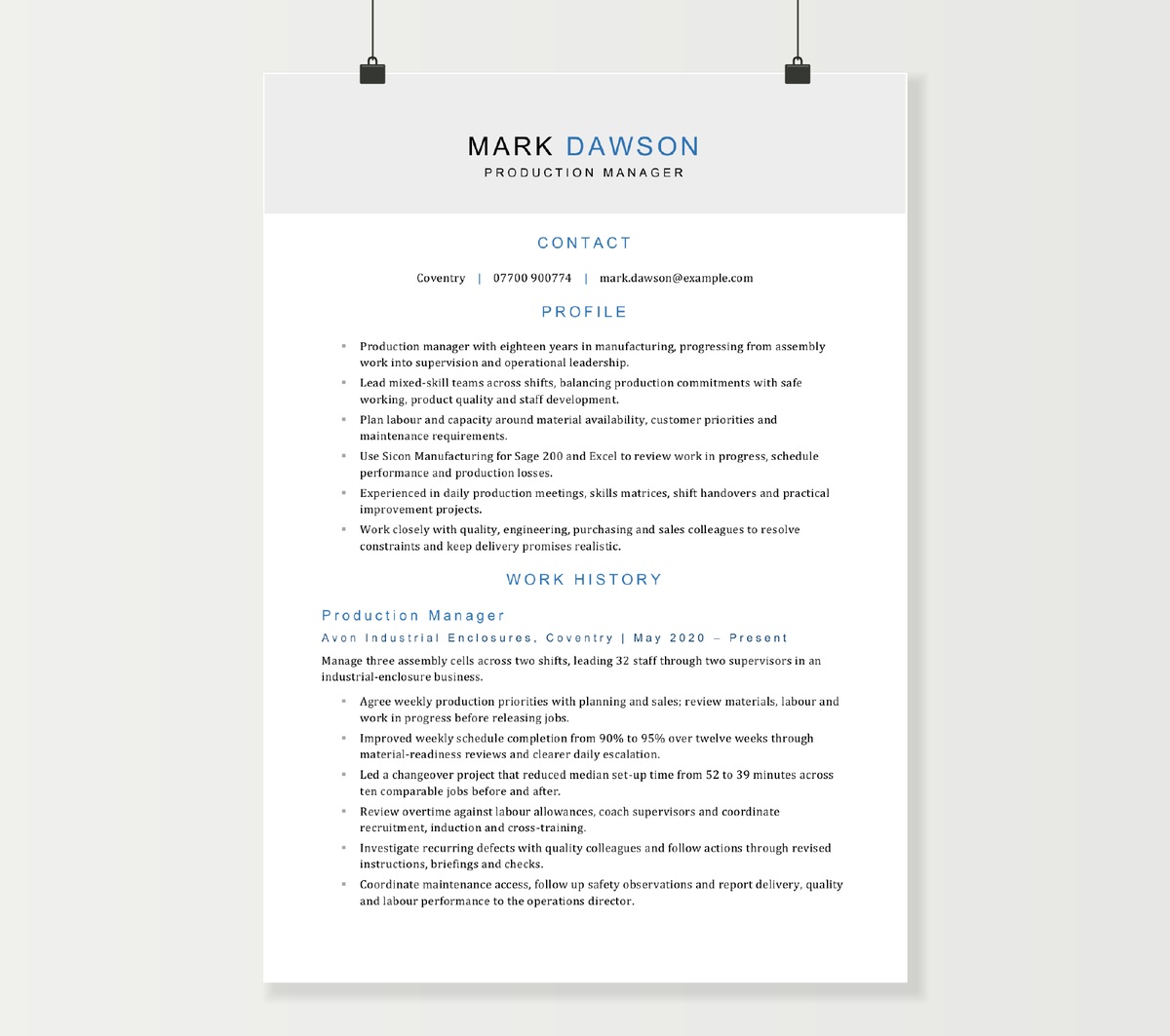
This production manager CV template shows a manufacturing career progressing from production operative to supervisor and manager. The Word example presents responsibility for people, production planning and practical improvements across an assembly operation. The guide explains how to make the scale, demands and results of your own production experience clear to an employer.
Filename: FreeCVDownload_Production_Manager.docx
Content of this CV template
Mark Dawson
Production Manager
Contact
Coventry | 07700 900774 | [email protected]
Profile
- Production manager with eighteen years in manufacturing, progressing from assembly work into supervision and operational leadership.
- Lead mixed-skill teams across shifts, balancing production commitments with safe working, product quality and staff development.
- Plan labour and capacity around material availability, customer priorities and maintenance requirements.
- Use Sicon Manufacturing for Sage 200 and Excel to review work in progress, schedule performance and production losses.
- Experienced in daily production meetings, skills matrices, shift handovers and practical improvement projects.
- Work closely with quality, engineering, purchasing and sales colleagues to resolve constraints and keep delivery promises realistic.
Work history
Production Manager
Avon Industrial Enclosures, Coventry | May 2020 – Present
Manage three assembly cells across two shifts, leading 32 staff through two supervisors in an industrial-enclosure business.
- Agree weekly production priorities with planning and sales; review materials, labour and work in progress before releasing jobs.
- Improved weekly schedule completion from 90% to 95% over twelve weeks through material-readiness reviews and clearer daily escalation.
- Led a changeover project that reduced median set-up time from 52 to 39 minutes across ten comparable jobs before and after.
- Review overtime against labour allowances, coach supervisors and coordinate recruitment, induction and cross-training.
- Investigate recurring defects with quality colleagues and follow actions through revised instructions, briefings and checks.
- Coordinate maintenance access, follow up safety observations and report delivery, quality and labour performance to the operations director.
Production Supervisor
Midland Metal Products, Coventry | Jul 2014 – Apr 2020
Supervised fourteen operators producing fabricated assemblies, following promotion from the production team.
- Allocated work, checked job packs and managed shift handovers, reporting shortages and equipment concerns promptly.
- Cross-trained eight operators across a second work area, improving cover during holidays and demand peaks.
- Introduced a shared tooling location system with operators, reducing repeated searches and improving shift readiness.
- Conducted regular one-to-ones, supported attendance management and coordinated refresher training with quality colleagues.
Production Operative
Midland Metal Products, Coventry | Aug 2008 – Jun 2014
Built experience in assembly, inspection and production records before taking on team-support duties.
- Assembled components to job instructions, completed in-process checks and recorded quantities and material issues.
- Helped new starters learn workstation routines and supported stock counts and improvement activities.
Qualifications and development
ILM Level 3 Certificate in Leadership and Management
Employer-sponsored study, completed 2017
Safety training and education
IOSH Managing Safely, 2023. Workplace 5S training, 2024. Eight GCSEs including English and Maths, 2008.
Hobbies and interests
I enjoy hill walking, watching football and cooking at home.
How to write a production manager CV
A production manager CV needs to show what happened on the shop floor because you were there. An employer wants to understand the operation you led, how you organised people and resources, and whether your decisions improved delivery, quality or cost. A list of responsibilities becomes much more convincing when it is attached to a recognisable production environment.
This guide focuses on manufacturing production management. Start with the part of your background that matches the vacancy: a high-volume line, a varied assembly operation, batch processing, a regulated supply chain or a production shift with substantial responsibility outside normal office hours. Those settings create different demands, even when the job titles look similar.
Make the size and shape of your operation clear
Give each recent job a short scope statement before its achievement bullets. Include the product or process, the number of people you led, the reporting structure and the lines, cells or shifts in your remit. A reader should be able to distinguish a manager leading supervisors across a department from someone directly supervising one shift.
For instance, the example CV describes three assembly cells, two shifts and 32 staff led through two supervisors. That information makes the later scheduling and training achievements easier to assess. A process manufacturer might instead give plant capacity or weekly tonnage; a made-to-order business could describe product variety, typical batch size and lead-time demands.
Select the scale measures that explain the difficulty of the job. A high unit count can be useful for a repetitive packing line, while a smaller volume of complex assemblies may say more about technical coordination and skilled labour. Add the operating context where it matters: seasonal demand, new-product launches, customer-specific variants, ageing equipment or a major expansion.
Clarify the limits and breadth of your remit through positive detail. If you controlled labour expenditure and overtime, say so. If you also owned the departmental budget, capital proposals or maintenance function, explain that additional responsibility. For applications involving a wider site remit, our operations manager example may help you decide which responsibilities deserve greater prominence.
Show how you led people through production demands
Team size is only the starting point. Production managers are often assessed on their ability to develop supervisors, resolve performance issues, maintain staffing and help people adapt to change. Include evidence of the management work behind the output figures.
- Development: skills matrices, structured induction, training coverage, coaching or progression into team-leader roles.
- Consistency between shifts: clearer handovers, common priorities, escalation arrangements and communication with night or weekend teams.
- Day-to-day management: attendance, appraisals, recruitment, holiday planning and work with HR on individual support or performance.
- Engagement in change: involving operators in a revised layout, standard-work trial or improvement project and showing how their input shaped the result.
Choose examples that reveal your approach. “Developed the production team” is broad; “Cross-trained eight operators across a second work area, improving cover during holidays and demand peaks” shows a specific management action and its operational value. If you lead through supervisors, include how you set expectations and helped them make decisions, rather than describing every operator-level task.
People outcomes can be useful even when a financial saving is unavailable. A stronger succession plan, reliable cover for a specialist process or a supervisor taking on a larger area can demonstrate a meaningful result. Describe the change clearly and connect it to production needs.
Explain planning responsibility through the constraints you managed
“Responsible for production planning” can cover anything from following a daily schedule to agreeing capacity commitments with sales. State where you fitted into the planning process and what you decided: sequencing jobs, balancing cells, allocating skills, agreeing overtime, managing work in progress or coordinating subcontracted work.
A strong bullet connects a constraint, your response and an outcome. Material shortages, changing customer priorities, a bottleneck process or a planned shutdown can all provide useful context. In the example CV, readiness reviews and daily escalation support a measured improvement in schedule completion. The reader sees both the result and the management work that contributed to it.
Include collaboration with planning, purchasing, maintenance, quality and commercial colleagues where it explains the achievement. An improved schedule may have depended on earlier material checks, realistic promise dates or agreed maintenance windows. This demonstrates that you can manage the interfaces that affect production, not simply report missed targets.
For shift-management roles, give suitable weight to judgement when support functions are unavailable. An example of prioritising work, escalating a quality concern and handing over a clear recovery plan can be more revealing than another sentence about attending daily meetings.
Choose production measures that tell a useful story
The strongest results are understandable without a tour of the factory. Choose measures that fit the work and briefly identify their scope and period. You might use schedule attainment, delivery performance, first-pass yield, scrap, rework, downtime, changeover duration, labour hours or output per shift. Three well-explained results can carry more weight than a dense row of unexplained percentages.
For overall equipment effectiveness (OEE), name the line or process and give the before-and-after level over a defined period. Explain the principal change you led, such as addressing repeated stoppages with engineering or improving changeover preparation. The CV needs evidence of your contribution; it does not need an explanation of the OEE calculation.
Give other measures similarly precise labels. Schedule completion and customer on-time delivery measure different stages of the operation. Scrap and rework may have different cost implications. A change from 90% to 95% is five percentage points, so showing both figures is often the clearest wording.
Keep the comparison meaningful. Where product mix, volume or shift patterns changed, add the detail needed to interpret the result: comparable jobs, the same product family, or output maintained during a reduction in overtime. For cost achievements, distinguish a reduction in actual expenditure from released capacity or an avoided future cost. Each can be valuable, but they tell different stories.
“Led a changeover project that reduced median set-up time from 52 to 39 minutes across ten comparable jobs before and after.”
This example works because the reader can see the measure, the scale of the comparison and the improvement. A follow-up interview can explore the project in depth. The CV establishes why that conversation is worthwhile.
Turn improvement methods into evidence of implementation
Lean, 5S, root-cause analysis, SMED and Six Sigma can be relevant, but their value comes from application. Select the methods that feature in your strongest work and put them beside the change they helped achieve.
A practical improvement entry can follow the sequence of problem, contribution, change and result. You might describe working with operators to reorganise tooling, coordinating a trial with engineering, securing training time and checking whether the new arrangement held across shifts. That tells an employer more about implementation than “continuous improvement champion”.
Include the human side of a technical change. A new machine or layout may have required staff consultation, revised responsibilities, training and a careful production handover. Your role in making that transition work is particularly useful evidence for a management application. The manufacturing engineer CV guide offers a complementary perspective for applicants whose recent experience is more focused on process development.
For larger investment projects, identify whether you built the business case, contributed operational requirements, managed installation disruption or led the production start-up. A project budget, capacity gain or ramp-up milestone can help establish scope, provided the sentence also makes your part in the work clear.
Give safety and quality their own evidence
Production results are more persuasive when the CV also shows how you maintained control. Choose examples such as closing inspection actions, improving a handover around a recurring hazard, coordinating refresher training, resolving a repeat defect or preparing your department for an audit. Describe what you did and the area affected.
Make this section specific to your manufacturing setting. Food production applicants may need to present experience of hygiene, traceability, HACCP controls, cleaning records and audit preparation. Aerospace or other controlled manufacturing roles may place greater weight on specification control, process records, non-conformance actions and coordination with inspection. In an assembly business, training consistency and in-process checks may be particularly relevant.
Place the relevant standard or system alongside the work you performed. “Supported an ISO 9001 surveillance audit by preparing production records and closing two departmental actions” is more informative than a list of standard numbers. If your responsibility included leading an audit or owning a quality process, make that level of involvement clear.
Show how you worked with quality and engineering specialists. A production manager can demonstrate sound judgement through containment, escalation, resource decisions and follow-through without turning the CV into a technical procedure.
Present systems as part of your decision-making
Name the ERP, MRP, manufacturing execution or reporting tools you used, then add the relevant activity. Employers may be looking for someone who can review work orders, interpret shortages, monitor WIP, check labour bookings or turn downtime records into an improvement priority.
The example links Sicon Manufacturing for Sage 200 and Excel to work in progress and performance review. Your own evidence might involve SAP production orders, an MES dashboard or Excel analysis used in a weekly capacity meeting. A short phrase about the task gives the software name substance.
If you helped introduce a system, distinguish the contribution: testing production transactions, improving shop-floor data capture, training supervisors or checking that reports reflected actual work. The value is in how the system supported production control and how you helped people use it.
Make progression and development work together
For an experienced manager, lead with the most relevant recent operation and its results. Earlier operator or technician work can be shorter, while still showing the practical foundation of your judgement. Separate promotions with dates so the reader can follow the growth from direct supervision to broader responsibility.
For a first production-manager application, bring forward acting-up periods, responsibility for several teams, coaching of team leaders, labour planning and cross-department improvement work. Explain the additional scope beyond your normal supervisor role. A specific period covering the manager, with decisions and outcomes, is stronger than a general statement that you are ready for the next step.
List qualifications with their full titles, levels and completion dates. Relevant evidence may include an engineering qualification, apprenticeship, management certificate, safety training or improvement qualification. Keep employer training distinct from externally awarded qualifications, and use recent work examples to show how that learning has influenced your management.
A candidate who developed through shop-floor experience can build a strong CV around that progression. A graduate moving into management may need more detail on frontline team responsibility and practical decision-making. In both cases, the central question is the same: what evidence shows that you can lead this employer’s production operation?
Production Manager CV FAQs
Yes, if the responsibilities match the vacancy. Keep your employment title and add a short explanation of the production scope beneath it. Team size, shift responsibility, planning decisions and the people you reported to help an employer compare roles. You can use the profile to explain that you are seeking a production-manager position and highlight the experience that supports that move.
Use one employer heading with separate dated roles, or repeat the employer under each role if that is clearer in your chosen layout. Give the most recent position the most space and show what changed at each promotion: a larger team, more lines, responsibility across shifts or greater control over resources. Long tenure becomes useful evidence of progression when the changes are visible.
Place site certifications and accreditations in the relevant employment context, alongside your involvement in maintaining them. Your qualifications section is the place for courses or credentials awarded to you, such as auditor training or a management qualification. Keeping these separate helps the reader understand both the environment you worked in and your individual development.
Label each assignment as interim or fixed-term and give its dates, operating context and remit. Focus on what you were brought in to achieve, such as stabilising a shift, supporting a ramp-up or covering a management vacancy. Where several assignments were through one consultancy, a single consultancy entry with selected dated assignments can keep the chronology readable. Include handover or sustained performance evidence where it helps explain the outcome.
Use approved ranges, percentages or operational measures that still explain the work. Team size, number of lines, shift pattern, product complexity and the nature of a change can establish substantial responsibility. A result expressed as reduced changeover time or improved schedule attainment may be useful without disclosing customer names, unit margins or commercially sensitive output figures.




