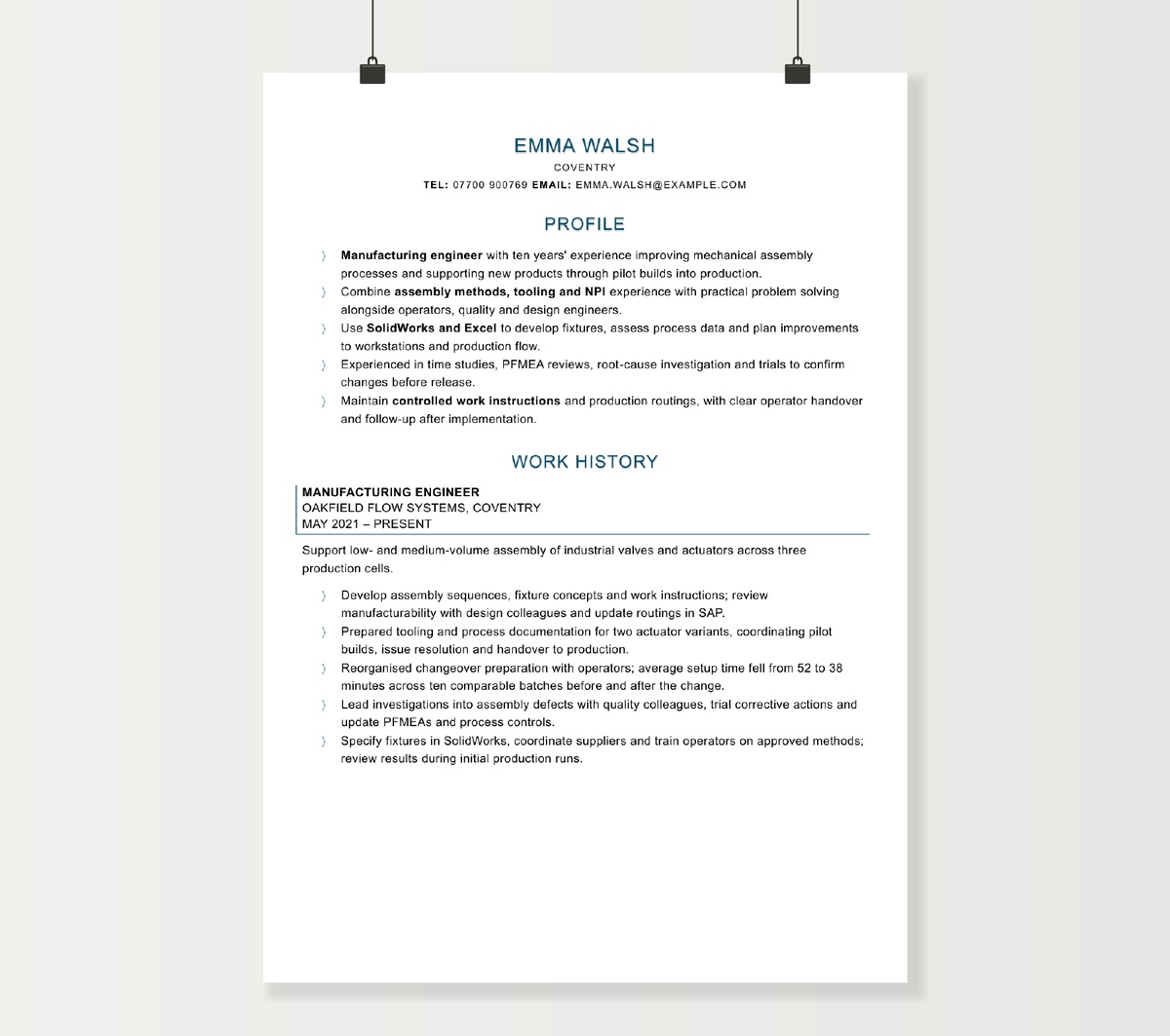
This manufacturing engineer CV template follows a mechanical engineering graduate who developed through production engineering into responsibility for assembly methods, tooling and new-product introduction. The Word example combines practical factory experience with measured improvements. The guide covers manufacturing and production engineering applicants, from graduates and experienced technicians to engineers leading more complex projects.
Filename: FreeCVDownload_Manufacturing_Engineer.docx
Content of this CV template
EMMA WALSH
COVENTRY
tel: 07700 900769 email: [email protected]
PROFILE
- Manufacturing engineer with ten years' experience improving mechanical assembly processes and supporting new products through pilot builds into production.
- Combine assembly methods, tooling and NPI experience with practical problem solving alongside operators, quality and design engineers.
- Use SolidWorks and Excel to develop fixtures, assess process data and plan improvements to workstations and production flow.
- Experienced in time studies, PFMEA reviews, root-cause investigation and trials to confirm changes before release.
- Maintain controlled work instructions and production routings, with clear operator handover and follow-up after implementation.
WORK HISTORY
MANUFACTURING ENGINEER
OAKFIELD FLOW SYSTEMS, COVENTRY
MAY 2021 – PRESENT
Support low- and medium-volume assembly of industrial valves and actuators across three production cells.
- Develop assembly sequences, fixture concepts and work instructions; review manufacturability with design colleagues and update routings in SAP.
- Prepared tooling and process documentation for two actuator variants, coordinating pilot builds, issue resolution and handover to production.
- Reorganised changeover preparation with operators; average setup time fell from 52 to 38 minutes across ten comparable batches before and after the change.
- Lead investigations into assembly defects with quality colleagues, trial corrective actions and update PFMEAs and process controls.
- Specify fixtures in SolidWorks, coordinate suppliers and train operators on approved methods; review results during initial production runs.
PRODUCTION ENGINEER
MIDLAND COMPONENT ASSEMBLIES, RUGBY
SEPTEMBER 2016 – APRIL 2021
Joined as a graduate engineer in 2016 and progressed to Production Engineer in 2018, supporting machined-component assembly and test.
- Completed time studies and revised workstation layouts with production supervisors to improve material access and assembly flow.
- Designed a locating fixture that reduced typical manual alignment time from 15 to 10 minutes per assembly during a 20-unit production trial.
- Updated bills of materials, routings and illustrated instructions following approved engineering changes; supported prototype and pilot builds.
- Analysed rework records in Excel and helped quality and production colleagues investigate recurring fit and alignment problems.
QUALIFICATIONS & DEVELOPMENT
BENG (HONS) MECHANICAL ENGINEERING
COVENTRY UNIVERSITY – 2016
Upper Second Class Honours; final-year project on fixture design for repeatable assembly.
PFMEA AND STRUCTURED PROBLEM SOLVING
EMPLOYER TRAINING – 2023
SOLIDWORKS AND MANUFACTURING IMPROVEMENT
FIXTURE DESIGN – 2022; LEAN WORKSHOPS – 2024
INTERESTS
Swimming, baking and weekend walks with friends.
How to write your CV
A manufacturing engineer CV should make it easy to picture the production environment in which you work and the changes you can deliver. Employers need to understand your methods, materials, equipment and technical responsibility, as well as the improvements that followed. A good application connects engineering decisions with what happened on the factory floor.
Start by identifying the emphasis of the vacancy. Some roles concentrate on new-product introduction and industrialisation; others on established production, tooling, process capability or equipment support. Give your closest experience the most space, then use the rest of the CV to show the breadth that will help you settle into the team.
Put the manufacturing setting into the opening lines
Your profile and the first sentence under each employer can establish the context: the products, processes, materials and type of production. Low-volume precision assemblies, high-volume injection moulding and large fabricated equipment create quite different engineering problems. “Ten years in manufacturing” leaves those differences unexplained.
Select the details that affect the work. Batch sizes, product variety, manual or automated operations, number of cells and relevant customer requirements may be useful. A figure for the entire factory’s output adds less if the reader cannot see which part you supported.
The example focuses on mechanical assembly of valves and actuators. That makes its fixture design, alignment work, pilot builds and changeover improvement coherent. Another applicant might lead with machining, composites, welding, electronics assembly or a particular special process. The aim is to show depth in a recognisable setting.
Build experience around changes you helped make
Routine production support belongs on the CV, but selected projects usually provide the strongest evidence of engineering judgement. Choose work that shows the problem, your contribution and the result. A line that says you “used Lean tools to improve efficiency” leaves all three unclear.
Useful examples might include a revised assembly sequence, a new fixture, a bottleneck investigation, a process transferred to another line or equipment introduced for a new product. State what you actually did: collected observations, analysed data, developed the method, coordinated trials, changed the documentation or supported production after release.
A project can be significant without a large capital value. A straightforward tooling change may show excellent practical judgement if it addressed a recurring source of variation and made the job easier to perform consistently. The reader needs enough detail to understand the engineering, rather than a long account of every meeting.
Show how new products reached production
For new-product introduction, describe the stages in which you were involved. Design reviews, manufacturing feasibility, process planning, tooling, prototype builds, pilot runs and production handover each provide different evidence. Saying “supported NPI” is a starting point; explaining your deliverables gives it substance.
For example, you might have prepared the routing and work instructions, specified a fixture and coordinated trial-build issues through to resolution. Include the product or process complexity that mattered, such as several variants, a new material or a tight assembly tolerance. If you owned one workstream within a larger launch, make that scope clear.
Design-for-manufacture experience is strongest when linked to a decision. Explain how you worked with design colleagues on access, assembly sequence, component location, material choice or the practicality of a manufacturing method. The CV should communicate the contribution and its consequence, with the detailed technical discussion left for interview.
Handover is worth mentioning where it demonstrates that the process became usable by production. Approved instructions, operator training, initial-run support and follow-up on remaining issues can distinguish a delivered manufacturing solution from an unfinished design exercise.
Present tooling, CAD and technical documentation as outputs
Recruiters can assess CAD experience more readily when they know what you produced. Fixture models, tooling drawings, workstation layouts and manufacturing aids tell a different story from product design. Name the software and connect it to the work you can discuss in depth.
Separate design, specification and implementation where that helps explain your role. You may have designed a fixture yourself, prepared requirements for a toolmaker or coordinated the supplier’s design and acceptance trials. Each can be relevant, particularly when the vacancy involves working with external equipment or tooling suppliers.
Manufacturing documentation also deserves precise treatment. Bills of materials, routings, illustrated work instructions, process specifications and engineering-change records support different parts of production. Choose the documents you owned or substantially improved and explain how they were used.
For ERP or manufacturing systems, identify the activity rather than simply listing a brand. Updating routings in SAP, maintaining manufacturing bills of materials or using production records to investigate rework shows the practical value of your system knowledge.
Make quality and process-control experience concrete
Process failure mode and effects analysis (PFMEA), control plans, statistical process control and structured root-cause investigation can all be useful on a manufacturing engineer CV. Their value comes from the work behind the terms. Explain the process concerned and whether you led the activity, contributed technical input or implemented the resulting changes.
A quality example can follow a simple sequence: the recurring problem, how you investigated it, the change trialled and the evidence used to confirm the result. This is enough to show your approach without turning the CV into a technical report.
If capability studies are central to your experience, identify the characteristic or process assessed and what your analysis helped decide. A capability index is more informative when attached to a defined process and study context than when presented as a free-standing achievement. The same applies to measurement-system work: explain its purpose and your responsibility.
Sector-specific documentation and approvals should be visible where they matter to the vacancy. Aerospace, automotive, medical and other regulated manufacturing environments use different arrangements. Describe your experience with the relevant system and the work you completed within it, rather than placing every standard in a single skills list.
Choose measures that describe the improvement accurately
Manufacturing results are persuasive when the measure matches the problem. Useful possibilities include:
- Quality: first-pass yield, a defined defect rate, rework hours or scrap for a particular product or process.
- Flow: setup time, cycle time, queue time, work in progress or lead time through a defined area.
- Capacity: output achieved under comparable operating conditions, or capacity released at a constrained operation.
- Delivery: a completed production transfer, trial programme or equipment handover with its scope and timing.
- Cost: a verified reduction in material, tooling or processing expenditure, with the basis of the comparison.
Keep the boundaries visible. A shorter cycle at one workstation is a different result from higher output across the whole line. Overall equipment effectiveness, or OEE, also combines several factors; a specific loss reduction may be the clearest way to explain your contribution if that was the focus of the project.
The example compares setup time over ten comparable batches before and after a change. Its earlier fixture result is explicitly a production trial. Both give the reader a useful scale and setting for the number. For a longer-term improvement, a review period can show that the result continued after the initial trial.
Distinguish a forecast benefit from a result measured in production. Business cases, capacity studies and investment proposals can still be strong evidence. Give the proposal’s status and your contribution, then add realised outcomes where the work has reached that stage.
Show how changes worked for operators and other teams
Manufacturing engineering depends on cooperation with people who use, maintain, inspect and supply the process. Show this through the work: developing a method with experienced operators, agreeing a trial with production, resolving a tooling issue with a supplier or investigating defects with quality colleagues.
Operator training and clear instructions can be important results in their own right. Describe the process introduced, the group supported and the follow-up that helped it settle into routine use. That evidence is more convincing than a general claim of strong communication skills.
Safety can also be presented through your contribution to the engineering change: risk assessment input, a revised handling arrangement, equipment acceptance or a safer work method agreed with the relevant specialists. Focus on the activity and outcome that demonstrate your judgement.
For senior posts, give more space to coordinating resources, managing technical risks, making investment recommendations and balancing quality, cost and delivery requirements. Technical leadership may involve guiding a cross-functional project without having direct reports; explain the arrangement so the reader can recognise the responsibility.
Use qualifications and development to explain your route
List the engineering qualification, subject, awarding institution and completion date clearly. A relevant degree, HNC, HND or apprenticeship can establish the foundation; practical experience then shows how you have developed it. The example’s mechanical engineering degree supports a career in manufacturing methods and assembly, rather than defining the candidate as a product designer.
Relevant development might include CAD, process improvement, metrology, PFMEA or a specialist manufacturing method. Give the provider or describe it as employer training where appropriate. A formally awarded Six Sigma qualification can be listed with its level and provider; experience contributing to improvement projects belongs in the work history whether or not it came with a belt qualification.
For graduates, a placement or final-year project can provide an early technical example. Describe what you designed, investigated or tested, the practical constraints and your individual contribution. Keep useful shop-floor experience visible, including observations or trials that changed your approach.
Technicians moving into manufacturing engineering can lead with the analytical and development work they already do: improving a method, investigating recurring defects, updating instructions or supporting a new build. Explain increasing responsibility and relevant study together, so the reader can follow the progression.
Tailor the emphasis to the next manufacturing environment
When moving sectors, look for the manufacturing challenge that transfers. Experience of controlled processes, traceability, tight tolerances or complex assembly may be relevant beyond the exact product you made. Connect those features with a specific project rather than assuming that a sector name will explain the relevance.
A role focused on equipment support needs evidence of practical troubleshooting and collaboration with maintenance. An industrialisation role may give greater weight to process definition, new equipment and production readiness. A continuous-improvement role calls for a clear account of sustained changes and the people involved in implementing them.
The mechanical engineer example offers a comparison for applications with more design and technical-development work. For positions centred on breakdowns and planned upkeep, the maintenance engineer CV uses a different balance. On a manufacturing engineer application, keep the link between engineering decisions and a capable, usable production process at the centre.
CV FAQs
Yes, where the vacancy concerns manufacturing methods, tooling, process improvement or production support. Manufacturing Engineer and Production Engineer titles overlap in many organisations. Keep your own employment titles and use the profile and experience to show the relevant work. Some production roles emphasise a particular process or industry, so the responsibilities in the advert are a better guide than the title alone.
It depends on the role. Employers may specify a degree, HNC, HND, apprenticeship background or equivalent experience, with professional registration as a separate consideration. If you hold IEng, CEng or another relevant registration, include it clearly alongside your qualifications. Institution membership and professional registration are distinct, so give the status you hold. The practical experience required by the vacancy should remain easy to find.
A short portfolio can help when the vacancy places particular weight on tooling, layouts or development projects. A clear project summary with selected diagrams may explain your contribution better than a large collection of drawings. Where work is commercially confidential, an appropriately anonymised description of the problem, decisions and outcome can provide useful evidence on the CV, with further detail discussed through the employer's preferred process.
State the stage reached and the evidence available. Tooling completed, a successful assembly trial, issues resolved across pilot builds or an agreed process specification can all demonstrate progress. Trial results and forecast production benefits can be presented separately, with the scope made clear. This gives the reader a useful account of your work even before full production data exists.
Give the contract dates and purpose, such as a launch, production transfer, equipment introduction or a defined improvement programme. Follow with the work completed and the handover or stage reached when the assignment ended. This helps the recruiter see a sequence of delivered projects rather than a series of unexplained short jobs. If several assignments were through one consultancy, show that relationship clearly.