This mechanical engineer CV template features an engineer who designs machinery and test equipment, taking projects from requirements and CAD through manufacture and build support. The Word example shows technical skills in context, practical design improvements and progression from graduate engineer. The guide also covers how to adapt your CV for analysis, building services and other mechanical engineering specialisms.
Filename: FreeCVDownload_Mechanical_Engineer.docx
Content of this CV template
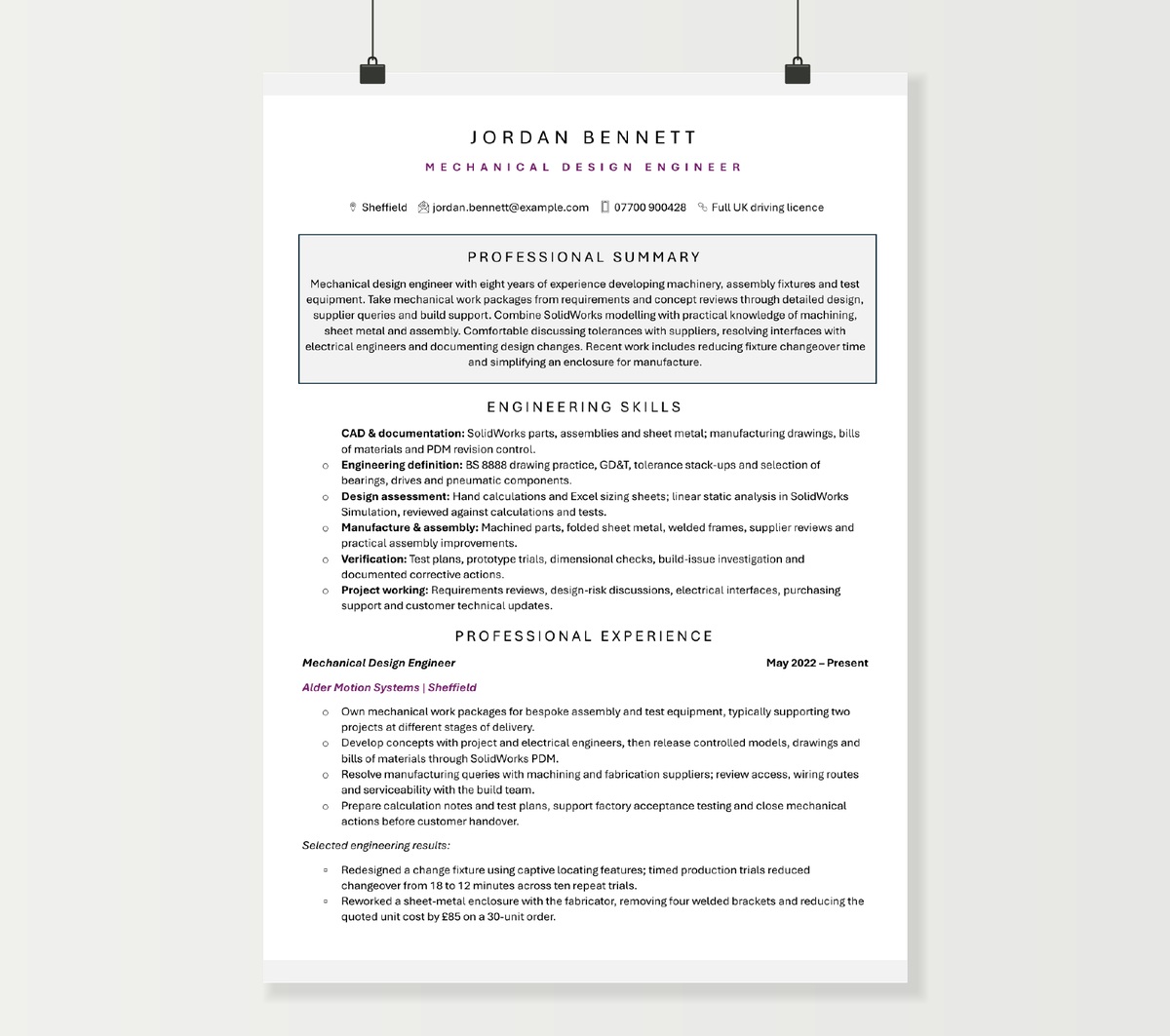
Jordan Bennett
MECHANICAL DESIGN ENGINEER
Sheffield | [email protected] | 07700 900428 | Full UK driving licence
Professional summary
Mechanical design engineer with eight years of experience developing machinery, assembly fixtures and test equipment. Take mechanical work packages from requirements and concept reviews through detailed design, supplier queries and build support. Combine SolidWorks modelling with practical knowledge of machining, sheet metal and assembly. Comfortable discussing tolerances with suppliers, resolving interfaces with electrical engineers and documenting design changes. Recent work includes reducing fixture changeover time and simplifying an enclosure for manufacture.
Engineering skills
- CAD & documentation: SolidWorks parts, assemblies and sheet metal; manufacturing drawings, bills of materials and PDM revision control.
- Engineering definition: BS 8888 drawing practice, GD&T, tolerance stack-ups and selection of bearings, drives and pneumatic components.
- Design assessment: Hand calculations and Excel sizing sheets; linear static analysis in SolidWorks Simulation, reviewed against calculations and tests.
- Manufacture & assembly: Machined parts, folded sheet metal, welded frames, supplier reviews and practical assembly improvements.
- Verification: Test plans, prototype trials, dimensional checks, build-issue investigation and documented corrective actions.
- Project working: Requirements reviews, design-risk discussions, electrical interfaces, purchasing support and customer technical updates.
Professional experience
Mechanical Design Engineer | May 2022 – Present
Alder Motion Systems | Sheffield
- Own mechanical work packages for bespoke assembly and test equipment, typically supporting two projects at different stages of delivery.
- Develop concepts with project and electrical engineers, then release controlled models, drawings and bills of materials through SolidWorks PDM.
- Resolve manufacturing queries with machining and fabrication suppliers; review access, wiring routes and serviceability with the build team.
- Prepare calculation notes and test plans, support factory acceptance testing and close mechanical actions before customer handover.
Selected engineering results:
- Redesigned a change fixture using captive locating features; timed production trials reduced changeover from 18 to 12 minutes across ten repeat trials.
- Reworked a sheet-metal enclosure with the fabricator, removing four welded brackets and reducing the quoted unit cost by £85 on a 30-unit order.
Design / Graduate Engineer | Sep 2018 – Apr 2022
Calder Engineering Products | Rotherham
- Joined as a Graduate Mechanical Engineer in September 2018 and progressed to Design Engineer in January 2020, supporting small industrial handling systems.
- Created component and assembly models, detailed drawings and parts lists under the lead engineer's review; incorporated workshop feedback before release.
- Sized shafts and selected bearings for conveyor assemblies, recording load assumptions and calculations for design review.
- Supported prototype builds, investigated fit problems and updated drawings through the engineering-change process.
Selected engineering results:
- Revised a bearing-housing tolerance scheme with the machine shop, eliminating hand-fitting on the next 24 assemblies checked during build.
- Created reusable model configurations for six standard conveyor widths, reducing repeated modelling work on subsequent customer variants.
Education & training
BEng (Hons) Mechanical Engineering, 2:1 – Sheffield Hallam University, 2018
Certified SOLIDWORKS Professional – Mechanical Design, 2022
SolidWorks Simulation training – Linear static analysis, 2023
PDM user training – Document release and revision control, 2022
Development & interests
- Recent development: Practical GD&T workshop (2025) and internal design-risk review training (2026).
- Team contribution: Support a graduate engineer with drawing reviews and preparation for design meetings.
- Interests: Restoring an older road bike, hillwalking and live music.
How to write a mechanical engineer CV
A mechanical engineer CV needs to show what you have engineered, the decisions you made and what happened when the design met the real world. A list of CAD packages leaves most of that story untold. Employers also need to understand your field: machinery, products, building services, analysis, manufacturing and maintenance can sit under similar job titles while requiring quite different evidence.
Jordan’s example is built around mechanical design for machinery and test equipment. The drawings, calculations, supplier discussions and build results belong to that career. Use the same depth of explanation for your own specialism, choosing evidence that makes sense for the role you want.
Make your engineering specialism clear from the start
Use the profile to establish the products or systems you work on, your level of responsibility and the stages of a project you cover. “Mechanical engineer with experience in design and problem-solving” gives little direction. “Mechanical design engineer developing low-volume assembly equipment from customer requirements through detailed design and factory testing” gives the reader a much clearer starting point.
The next sentence can identify the technical strengths that matter most to the vacancy. For a manufacturing design role, these might be assemblies, tolerances and production drawings. For a building-services position, they might be heating and ventilation design, calculations, coordinated models and site delivery. An analyst may lead with structural assessment, vibration or thermal work and the methods used to validate it.
At senior level, add the scale of your authority: ownership of a subsystem, responsibility for design approval, technical leadership of a team or management of a supplier package. This helps the reader distinguish an experienced contributor from someone accountable for wider engineering decisions.
Build experience entries around engineering work packages
Give each employer a short context line. Describe the equipment, sector and production environment, such as bespoke test rigs, high-volume components or refurbishment of occupied buildings. Then select work packages that show the range and depth of your contribution.
A useful project description answers four connected questions: what requirement were you addressing, what did you own, how did you establish that the solution was suitable, and where did the work reach? These can fit into two or three bullets rather than becoming a full technical report.
- Requirement: a repeated alignment problem, a restricted installation space, an overheating enclosure or a production bottleneck.
- Your contribution: concept selection, calculations, detail design, supplier development, test planning or investigation.
- Evidence: an approved review, a measured test result, inspection data, supplier quotation or controlled drawing release.
- Outcome: a successful build, a resolved failure, a shorter process, a verified performance target or a package ready for the next project stage.
Keep your part visible within team projects. “Designed the fixture and coordinated its electrical interfaces” is more informative than “delivered a complete automated line” when the line involved several disciplines. If a project is still running, the latest completed milestone can be a strong outcome in its own right.
Show what sits behind your CAD experience
Name the CAD software requested by the employer where it forms part of your experience, then explain what you produce with it. SolidWorks, Inventor, Creo, NX and CATIA experience becomes more useful when attached to parts, complex assemblies, sheet metal, surfacing, weldments or detailed drawings. The relevant combination depends on the engineering work.
Include the route from model to manufacture. This may involve drawing standards, geometric dimensioning and tolerancing, bills of materials, configuration control and release through a PDM or PLM system. A sentence about releasing a complete drawing pack and resolving machine-shop queries conveys more readiness for production than a software rating bar.
For example, a design engineer could write: “Produced the enclosure model, folded-part drawings and BOM; agreed bend tolerances with the fabricator and updated the released pack after the first build.” This shows the purpose of the CAD work and how it connected to manufacturing.
If your strongest experience is in a different package from the one advertised, put that package beside the transferable work: assembly modelling, drawings, configuration management or surface development. Recent training in the requested package can sit separately. This gives the employer a practical picture of both your established capability and your transition.
Present calculations and simulation as engineering judgement
For analysis-heavy roles, go beyond naming ANSYS, Abaqus, MATLAB or a CAD simulation module. Identify the type of analysis, the physical question and the checks you used. Relevant detail might include static strength, fatigue, thermal behaviour, vibration, flow or a tolerance study. Choose the subjects that match the vacancy.
A compact bullet can connect method and decision: “Assessed bracket stiffness using hand calculations and linear static FEA, compared predicted deflection with a bench test and revised the section before release.” The reader can see why the analysis was performed and what you did with the result.
For specialist applications, add enough depth to show your level: defining load cases, choosing modelling assumptions, checking sensitivity, interpreting results or preparing a calculation report for independent review. For a broader design role, one well-chosen example may be sufficient. The CV should demonstrate your judgement without reproducing the analysis itself.
Academic simulation experience is still useful when clearly located within a dissertation or project. State the engineering problem, your approach and how you assessed the result. A short account of model limitations and comparison with experimental data can be more persuasive than a colourful contour plot on its own.
Connect design to manufacture, assembly and maintenance
Practical feedback is valuable evidence for a mechanical engineering CV. Explain how you worked with machinists, fabricators, technicians, production engineers or maintenance colleagues, and what changed as a result. Useful examples include a revised tolerance scheme, better tool access, fewer fasteners, a more accessible service component or a simpler assembly sequence.
Jordan’s enclosure example links a design change to a supplier quotation and a defined order quantity. His bearing-housing example links the tolerance decision to subsequent builds. Both are stronger than a broad claim to “design for manufacture” because the reader can understand the engineering and operational benefit.
Materials and processes deserve similar treatment. Mention aluminium machining, injection moulding, castings, composites or welded steel where relevant, but attach the choice to a component or design constraint. In maintenance or reliability applications, shift the emphasis towards equipment condition, failure investigation, corrective actions, shutdown planning and the effect on availability.
Make verification, risk and change control visible
A finished model is only one stage of engineering delivery. Show how your work was checked and accepted: design reviews, calculations, inspection, prototype trials, factory or site acceptance tests, commissioning evidence or another appropriate verification route.
Include the documents you owned when they matter to the role. These could be a test plan, calculation note, design-risk assessment, technical file contribution, change request or operating instruction. Describe your responsibility with enough precision to show whether you prepared, reviewed, coordinated or approved it.
Standards work well in the CV when they are connected to an activity. Drawing practice, pressure systems, machinery or building-services requirements may be highly relevant within a particular sector. Select the standards you have applied and explain the work they informed. A long standards list without context makes it harder to assess how that knowledge will transfer.
For changes made after manufacture or installation, explain how the issue was investigated, the solution agreed and the records brought up to date. Closing that loop demonstrates care for the equipment’s life beyond the original design release.
Choose measures that reveal the effect of your work
Mechanical engineering results can be measured in several ways: mass, cycle time, changeover time, recurring part cost, scrap, rework, energy use, reliability or test performance. The best measure is the one that helps the reader understand the purpose of the work.
Include the basis of the comparison. A quoted saving per unit differs from a realised saving across a production run; a prototype test differs from sustained in-service performance. Phrases such as “on the first 24 assemblies”, “during ten changeover trials” or “on a 30-unit order” make the evidence easier to interpret.
Some valuable outcomes are not financial or percentage improvements. Passing a required test, resolving a fit issue before production, obtaining design approval or completing a release package for a fixed build date can all support a strong bullet. Pair the milestone with the technical problem you resolved so it carries substance.
Show how you work across engineering boundaries
Mechanical interfaces often decide whether a project works. Describe coordination with electrical, controls, software, civil or process colleagues where it shaped the design. Cable routes, instrumentation access, heat dissipation, loads at an interface and maintenance clearances are more useful details than a general claim to teamwork.
Client and supplier communication should also have a purpose. You might have clarified an incomplete requirement, explained an option at a design review, resolved a supplier deviation or agreed an installation sequence. State the decision or deliverable that followed the conversation.
For senior roles, include technical mentoring, checking, resource planning and responsibility for engineering quality. Where your next move is towards managing delivery, the project manager CV example offers a useful comparison for presenting schedules, budgets and stakeholder responsibilities alongside technical work.
Give qualifications and professional development the right weight
List the exact qualification, institution and completion year. Early-career applicants can add relevant modules, a dissertation or a strong design project. Experienced engineers can usually give that space to professional work. Apprenticeships, HNCs, HNDs and practical training should be easy to find when they form your route into engineering.
Show professional registration and institution membership clearly as separate information. If you are working towards registration, describe the current stage briefly, such as a structured development scheme or preparation for professional review. Relevant recent CPD can demonstrate the direction in which your technical responsibility is growing.
Software certifications can support a capability claim; the experience section should then show its application. Keep a completed certification distinct from an attendance-based course. For roles involving site work, relevant access, safety or inspection training may deserve more prominence than a general software course.
Adapt the evidence for your career stage
A graduate CV can lead with education and two or three substantial projects. Give each project a title, date, engineering objective and your own contribution. A team design project becomes much stronger when the reader knows you selected the drive, calculated the shaft loads or organised the test programme. Include placement and workshop experience that helped you understand manufacturing or installation.
An experienced CV should normally lead with employment and selected outcomes. Recent responsibilities deserve most space; older roles can show the foundations of your progression. Promotions, larger work packages, greater checking responsibility and exposure to customers all help make that progression visible.
When changing sector, identify the engineering that transfers. A machinery designer moving towards medical equipment might emphasise controlled documentation, verification, materials and manufacturability. A move into building services needs evidence relevant to building systems and project coordination. Keep the CV centred on that connection rather than giving every past project equal weight.
If you prefer a different layout for your technical experience, browse the Word CV template collection. The most useful format is one that leaves room to explain your engineering contribution while keeping qualifications and tools easy to find.
Mechanical Engineer CV FAQs
A short portfolio can help when the application depends on design thinking, product development or the quality of technical drawings. Use a few relevant pieces with captions explaining the requirement, your contribution and the outcome. A drawing extract, test photograph or before-and-after design can add more than a gallery of rendered models. A link or separate PDF keeps the CV readable, and material cleared for sharing is the easiest evidence for a recruiter to circulate.
Use a description at the level you can share: the equipment type, engineering challenge, scale of your responsibility and verification approach. For example, an automated inspection fixture for a precision manufacturer can be informative without identifying the customer or disclosing drawings. Anonymised project summaries and approved aggregate outcomes often provide enough context for the CV; public or personal projects can supply visual evidence for a portfolio.
The vacancy determines the requirement. Some posts specify professional registration, others welcome progress towards it, and many focus on relevant qualifications and practical experience. CEng is a professional registration based on assessed competence and commitment, separate from holding a degree. Put your present registration or development stage clearly on the CV and give the employer the engineering evidence relevant to the post.
For a graduate or early-career application, it can have its own entry under Engineering projects, particularly if it involved design, manufacture and testing. Name your subsystem and responsibilities, then explain a decision and result. Team leadership, procurement and workshop coordination can also be relevant. As professional experience grows, retain the project only while it adds useful evidence that your employment history does not already provide.
Give the contract dates, assignment title and a brief description of the product or project. For several assignments through one consultancy or agency, a single employer heading with dated sub-projects can make the history easier to follow. Focus on the deliverables completed during each assignment, such as a design release, analysis package or commissioning milestone. This makes the fixed duration understandable and shows what you were brought in to achieve.
Yes, when it explains the practical quality of your designs. Machining, assembly, inspection or fault-finding experience can show why you understand tool access, tolerances, build sequence and serviceability. Give a specific connection to design work, such as modifying a drawing after a prototype build. A concise account is usually more effective than a long list of workshop equipment.