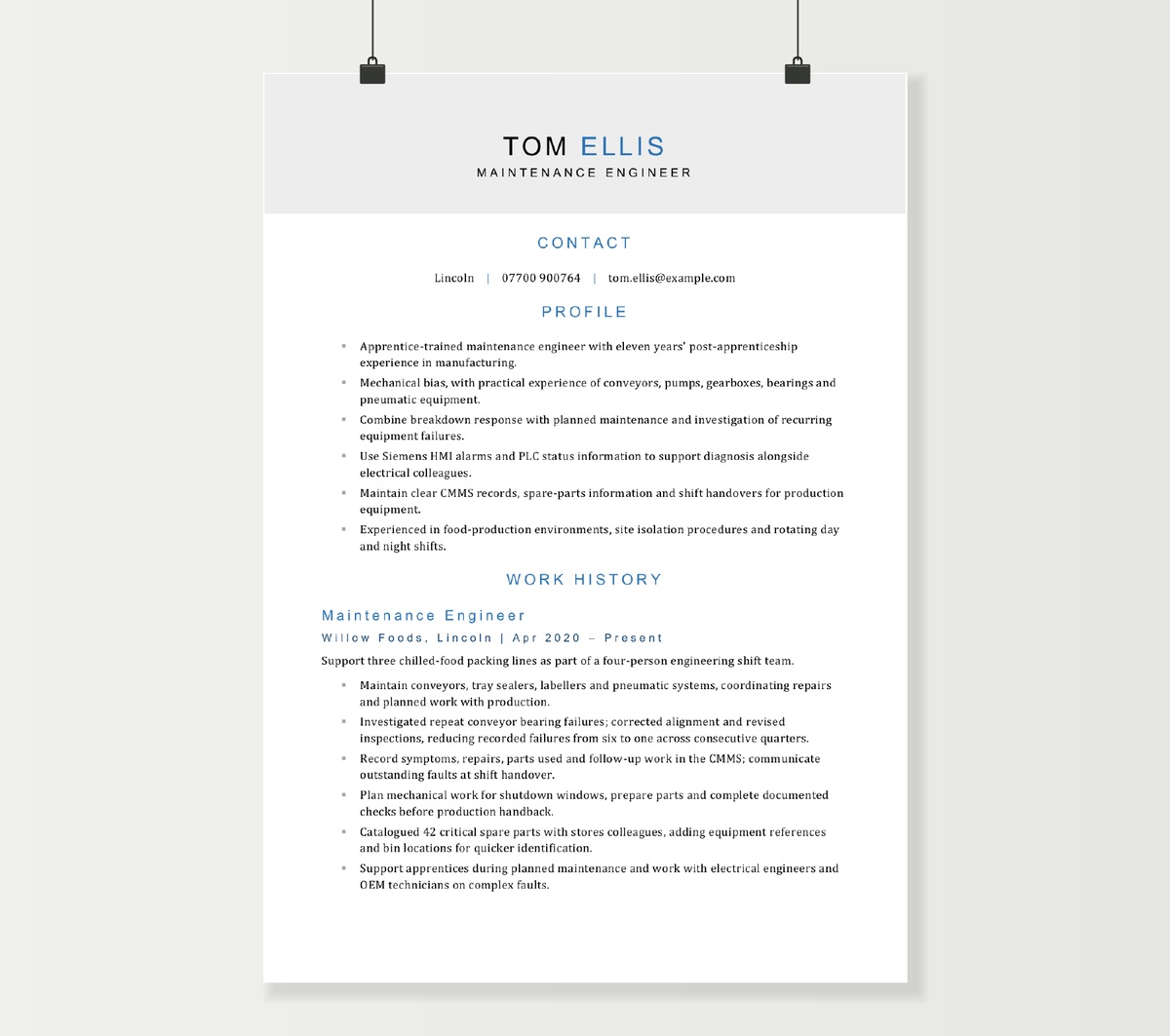
This maintenance engineer CV template follows an apprentice-trained engineer with a mechanical bias and experience in food and packaging production. The Word example brings together breakdown response, planned maintenance, equipment improvements and shift communication. The guide covers mechanical, electrical and multi-skilled applicants, including engineers completing their apprenticeship or moving between industries.
Filename: FreeCVDownload_Maintenance_Engineer.docx
Content of this CV template
Tom Ellis
Maintenance Engineer
Contact
Lincoln | 07700 900764 | [email protected]
Profile
- Apprentice-trained maintenance engineer with eleven years' post-apprenticeship experience in manufacturing.
- Mechanical bias, with practical experience of conveyors, pumps, gearboxes, bearings and pneumatic equipment.
- Combine breakdown response with planned maintenance and investigation of recurring equipment failures.
- Use Siemens HMI alarms and PLC status information to support diagnosis alongside electrical colleagues.
- Maintain clear CMMS records, spare-parts information and shift handovers for production equipment.
- Experienced in food-production environments, site isolation procedures and rotating day and night shifts.
Work history
Maintenance Engineer
Willow Foods, Lincoln | Apr 2020 – Present
Support three chilled-food packing lines as part of a four-person engineering shift team.
- Maintain conveyors, tray sealers, labellers and pneumatic systems, coordinating repairs and planned work with production.
- Investigated repeat conveyor bearing failures; corrected alignment and revised inspections, reducing recorded failures from six to one across consecutive quarters.
- Record symptoms, repairs, parts used and follow-up work in the CMMS; communicate outstanding faults at shift handover.
- Plan mechanical work for shutdown windows, prepare parts and complete documented checks before production handback.
- Catalogued 42 critical spare parts with stores colleagues, adding equipment references and bin locations for quicker identification.
- Support apprentices during planned maintenance and work with electrical engineers and OEM technicians on complex faults.
Maintenance Fitter
Fenland Packaging, Boston | Sep 2015 – Mar 2020
Maintained corrugated-packaging production equipment after completing the company's apprenticeship.
- Diagnosed mechanical faults and replaced bearings, belts, chains and pneumatic components using engineering drawings.
- Completed planned inspections and lubrication tasks, recording defects and arranging follow-up repairs with the supervisor.
- Rebuilt three conveyor gearboxes during a planned shutdown, completing installation and test runs with the shift team.
- Helped introduce pre-assembled changeover kits for two machines, reducing preparation time by around 20 minutes per changeover.
Engineering Maintenance Apprentice
Fenland Packaging, Boston | Sep 2011 – Aug 2015
Completed a four-year apprenticeship with college study and supervised workshop and production maintenance.
- Developed fitting, measurement and drawing-reading skills through planned repairs and component replacement.
- Assisted experienced engineers with breakdowns, inspections and equipment handovers.
Qualifications
EAL Level 3 NVQ Extended Diploma
Engineering Maintenance, mechanical pathway | Lincoln College, 2015
Technical study and development
BTEC Level 3 Diploma in Engineering, 2014; employer training in pneumatics and Siemens PLC diagnostics, 2024–2026.
Hobbies and interests
I enjoy cycling, fishing and restoring old furniture.
How to write a maintenance engineer CV
A maintenance manager reading your CV needs to understand what equipment you can support, how you approach faults and whether your work helps the site run reliably. The strongest examples connect practical engineering work with a clear result: a recurring failure resolved, a shutdown completed, a maintenance task improved or a more useful handover to the next shift.
Start with the plant and responsibilities in the vacancy. A food-packing engineer, an electrical engineer in automated manufacturing and a mechanical engineer maintaining process equipment may share a job title while doing substantially different work. Your CV should make the relevant overlap easy to see.
State your technical background and working environment
Use the profile to establish your main discipline, qualification route and recent environment. If you have a mechanical or electrical bias, state it alongside the additional work you undertake. “Apprentice-trained engineer with a mechanical bias, maintaining conveyors, gearboxes and pneumatic equipment in food production” is a useful introduction because it gives the reader something concrete to assess.
For a multi-skilled role, explain the balance through your experience. You might diagnose electrical faults on motors and drives while also replacing mechanical components, or have a mechanical background with further training in sensors and control-system diagnostics. A small number of specific capabilities is more useful than a broad claim to cover every discipline.
Include the operating context when it affects the role: continuous production, seasonal demand, a high-speed packing line, heavy process plant or rotating shifts. Tom’s example identifies chilled-food packing, a four-person engineering shift team and three lines. That establishes the scale without using production volume as a substitute for engineering evidence.
Describe equipment in terms of work performed
Choose the equipment most relevant to the vacancy and connect it to maintenance activity. Pumps and gearboxes could involve inspection, overhaul, replacement, alignment or fault diagnosis. For conveyors, a recruiter may want to see drives, bearings, chains, belts, tracking or the associated pneumatic and sensing equipment. The task tells them more than the asset name alone.
Manufacturers and models help when they establish a close match, particularly for PLCs, drives, robots or specialist production machines. Keep them alongside the function and your use of them. A named control platform with a description of diagnostic work is easier to interpret than an unexplained list of product codes.
A short technical section can group experience into mechanical systems, electrical and controls, and maintenance systems. Then use the employment history to demonstrate the most important capabilities in context. For a mechanically focused application, give the detailed mechanical work more room; for an electrical role, bring circuits, motors, drives and diagnostic evidence forward.
Make fault-finding examples show your contribution
A strong breakdown example identifies the equipment or symptom, the useful finding and the action or outcome. “Responded to breakdowns” describes the duty. “Investigated repeat conveyor bearing failures, corrected alignment and revised inspection checks” shows the engineering contribution.
You do not need to describe every test. Select the part that demonstrates judgement: using fault history to find a pattern, combining operator feedback with inspection, tracing a fault from an alarm to a component, or deciding when specialist support was needed. Include the lasting result where you have it.
Different examples can demonstrate different strengths. One may show a prompt, methodical response during production; another, investigation of a repeat failure; a third, coordination with an OEM technician on a difficult fault. This gives a fuller picture than several bullets that all say you minimised downtime.
If the repair was a team effort, identify your part. You might have completed the mechanical work while an electrical colleague dealt with the drive, or prepared evidence that helped the supplier diagnose an intermittent problem. That is useful evidence of both technical scope and teamwork.
Show what you contribute to planned maintenance
Describe the planned work you actually perform or organise: inspections, servicing, lubrication, condition checks, component replacement, shutdown preparation or follow-up repairs. Add whether you work from an established schedule, help revise tasks or plan a section of a shutdown.
Where you have improved a maintenance plan, explain the reason and the effect. A recurring defect may have led to a revised inspection point, a different service interval agreed with the team, or a clearer job instruction. A planner reviewing your CV will want to understand the evidence behind the change as well as the completion rate.
Shutdown experience deserves more than “assisted with shutdowns”. State the equipment or work package, your responsibility, preparation and handback. Preparing parts, identifying access requirements, coordinating with production and recording outstanding work can be valuable alongside the repair itself.
Condition-monitoring experience should identify the activity and what you did with the findings. Taking readings, interpreting trends, escalating a developing defect and arranging a planned repair are different contributions. Describe the stage you handled and any relevant training or specialist support.
Choose reliability measures with enough context
Useful measures include repeat failures, unplanned downtime, time to repair, maintenance completion, spare-parts availability and changeover preparation. Give the equipment, period and comparison so the reader can understand the scale. Tom’s example compares six and one recorded bearing failures across consecutive quarters; the claim is tied to a particular recurring problem.
For a downtime result, explain whether the figure concerns one machine, a line or the site. If the plant uses mean time between failures or mean time to repair, name the measure and the equipment covered. A result over a defined operating period is easier to assess than an isolated percentage.
Overall equipment effectiveness (OEE) can be useful when you explain the part maintenance influenced. For example, a repair programme might improve availability while other teams work on speed losses or quality. Describe your contribution within that wider result.
There are also worthwhile achievements without a large percentage. Rebuilding three gearboxes during an agreed shutdown, establishing a critical-spares list or producing clearer fault histories can show practical value. Add the benefit where it is known, such as faster parts identification or better preparation for the next planned intervention.
Be specific about PLCs, electrical work and automation
Employers use “PLC experience” to mean different things. Your CV can make it precise by describing the platform and activity: reading alarm information, checking input and output status, tracing a fault using drawings and diagnostic software, backing up a programme, or making an approved logic change. Each description establishes a different level of involvement.
In this example, Tom uses HMI alarms and PLC status information to support diagnosis alongside electrical colleagues. An electrically biased engineer might instead describe independent fault finding on motors, variable-speed drives and control circuits, with separate evidence of programming or commissioning work if relevant.
For robots, servo systems or industrial networks, apply the same approach. Name the system and explain whether you operated recovery routines, diagnosed faults, replaced components or worked with a specialist on modifications. Training belongs beside the practical experience it supports.
This level of detail is especially helpful when moving from a less automated site. It gives the employer a clear view of your existing strengths and the systems you have recently started using.
Include safe working and production handback as experience
Show the work-control arrangements you have used, such as site isolation procedures, permits, risk assessments and documented handback checks. Place them within maintenance examples where possible. “Prepared a shutdown work package and completed the site handback checks with production” conveys a practical responsibility.
Sector requirements also matter. In food production, this may include hygiene controls, tool and parts accountability, and coordination before equipment returns to use. In process industries, permits, contractor coordination and the site’s maintenance controls may deserve more prominence. The CV needs to show your experience of the setting rather than explain how the procedure is performed.
List relevant training with its date and describe any formal site responsibility in its proper context. This helps an employer understand the work you have been trained and assessed to undertake, as well as the environment in which you carried it out.
Give maintenance records and handovers proper weight
Name the computerised maintenance management system (CMMS) if it is useful to the application, then say what you recorded or used it for. Fault symptoms, work completed, parts consumed, defect follow-up and equipment history all have practical value. Experience improving the quality of those records can be a strong contribution.
For shift roles, describe how you communicate equipment status and outstanding work. This could include a clear handover to the next engineer, discussion of production priorities or coordination with stores before a planned repair. A specific example gives more substance to “good communicator”.
Spare-parts work can also show judgement. Explain how you identified critical items, clarified equipment references, reviewed recurring usage or helped prepare shutdown kits. Tom’s list of 42 parts has a purpose: making the correct items easier to identify during maintenance.
Present qualifications and development clearly
Give the full title, level, awarding organisation and completion year of your main engineering qualification, including the pathway where relevant. Record your apprenticeship employer and dates so the practical training is visible alongside college study. An NVQ, BTEC, HNC or HND can be listed separately when each contributes useful information.
Follow with selected recent training relevant to the vacancy: a particular PLC platform, drives, pneumatics, condition monitoring or an electrical qualification. An employer can then connect the formal learning to the tasks in your experience section. The example uses the mechanical pathway of an engineering-maintenance qualification and recent diagnostics training.
For your first role after an apprenticeship, give more space to practical rotations, supervised work and the point at which you took on greater responsibility. Include a completed repair, improvement or planned-maintenance task that you can explain in detail. For an experienced engineer, recent equipment and reliability evidence should lead, with the apprenticeship kept as a clear foundation.
Adapt the evidence when moving into a different role
When changing industries, identify the technical overlap first: rotating equipment, conveyors, electrical drives, pneumatics, fault-finding methods or planned maintenance. Then show experience adapting to a new machine or production process. This gives the employer evidence of both transferable skills and learning.
If you are applying for a lead or supervisory position, add how you allocated work, supported apprentices, coordinated contractors or prepared a shutdown. Keep enough hands-on evidence to establish the technical background behind those responsibilities.
For a move towards design or broader engineering projects, the mechanical engineer CV example offers a different emphasis on engineering development and project evidence. For a maintenance application, keep equipment support, reliability and the operational team at the centre. Other layouts are available in the CV template library.
CV FAQs
Requirements vary by the electrical work involved and the employer. Some vacancies specify it as essential, others as desirable, while mechanically focused roles may prioritise a different apprenticeship or qualification. List the exact electrical award you hold and its completion date, alongside the work and further training that demonstrate your practical scope. Compare this evidence with the individual vacancy rather than treating all maintenance posts as interchangeable.
Show the changes within that employer: apprenticeship completion, promotion, new production lines, different shift responsibilities or increasingly complex equipment. Separate role headings can make that progression visible. Recent upgrades, reliability improvements and work with suppliers help show how your experience has continued to develop even though the employer stayed the same.
Use the machine's function and relevant technical features, such as an automated filling line, a high-speed conveyor system or process pumps. You can describe the fault, your maintenance responsibility and an approved result without naming a customer, product or proprietary design. The recruiter mainly needs to understand the engineering involved and the level at which you worked.
Yes. Translate service-specific job titles and equipment descriptions into the maintenance work involved: diagnostics, inspection, repair, records, parts planning and team coordination. Give the civilian-recognised qualifications separately and explain the operating environment in plain language. A practical example showing systematic fault finding and a successful handover can make the transfer clearer than a list of military course abbreviations.
Give the agency or contracting employer, host site or sector, dates and the scope of each substantial assignment. Identify the work package, such as conveyor overhaul, planned servicing or installation support, and what you completed or handed over. Several short assignments can sit under one contracting heading when that makes the chronology clearer, with the most relevant projects described individually.