This procurement manager CV template follows a career from purchasing assistant to buyer and manager in manufacturing. The Word example brings together sourcing, supplier performance and commercial results, with clear context for the spend and team managed. The guide covers how to present your own procurement experience across direct materials, services and capital projects.
Filename: FreeCVDownload_Procurement_Manager.docx
Content of this CV template
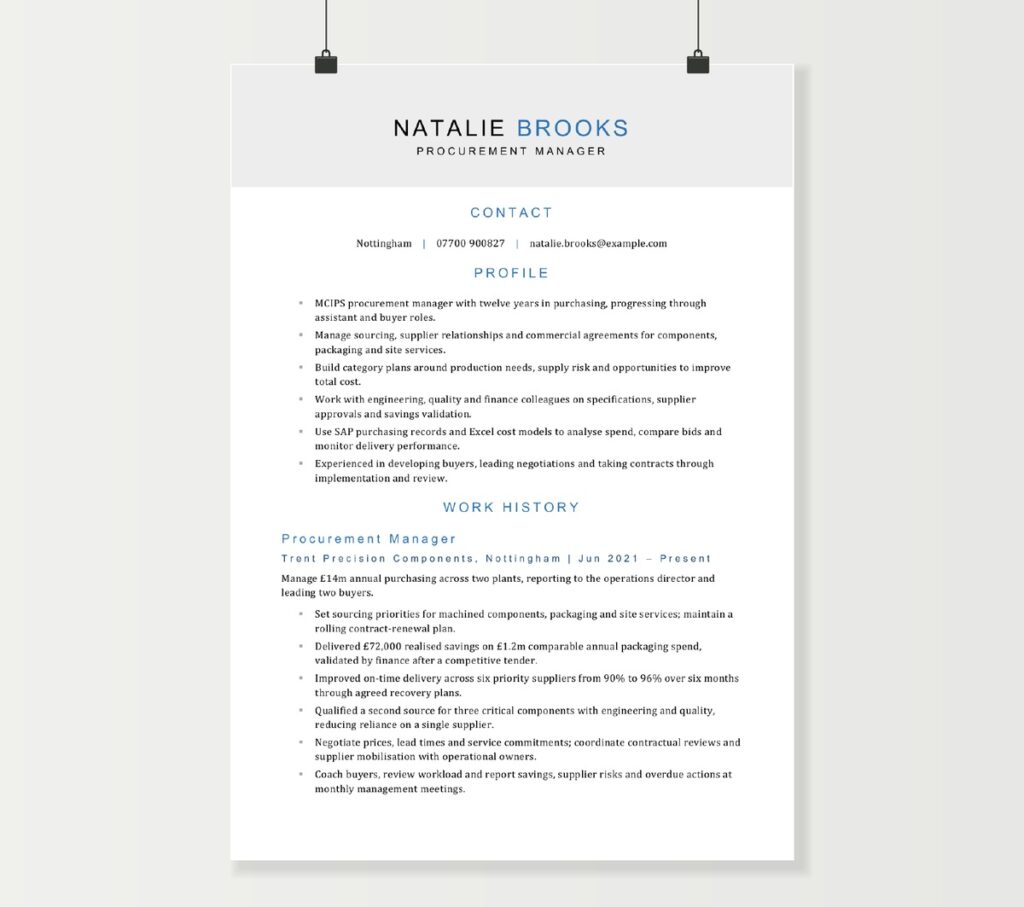
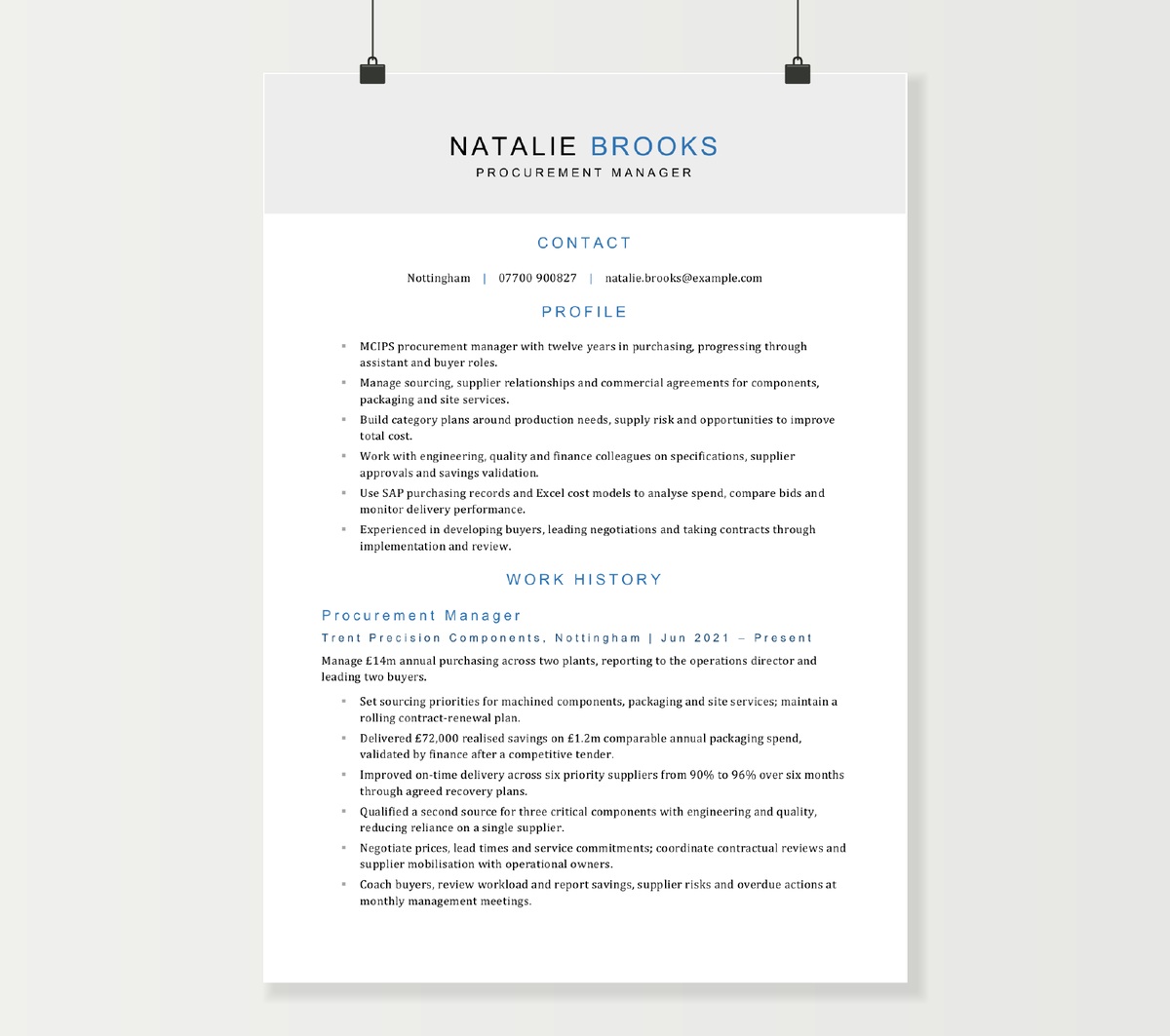
Natalie Brooks
Procurement Manager
Contact
Nottingham | 07700 900827 | [email protected]
Profile
- MCIPS procurement manager with twelve years in purchasing, progressing through assistant and buyer roles.
- Manage sourcing, supplier relationships and commercial agreements for components, packaging and site services.
- Build category plans around production needs, supply risk and opportunities to improve total cost.
- Work with engineering, quality and finance colleagues on specifications, supplier approvals and savings validation.
- Use SAP purchasing records and Excel cost models to analyse spend, compare bids and monitor delivery performance.
- Experienced in developing buyers, leading negotiations and taking contracts through implementation and review.
Work history
Procurement Manager
Trent Precision Components, Nottingham | Jun 2021 – Present
Manage £14m annual purchasing across two plants, reporting to the operations director and leading two buyers.
- Set sourcing priorities for machined components, packaging and site services; maintain a rolling contract-renewal plan.
- Delivered £72,000 realised savings on £1.2m comparable annual packaging spend, validated by finance after a competitive tender.
- Improved on-time delivery across six priority suppliers from 90% to 96% over six months through agreed recovery plans.
- Qualified a second source for three critical components with engineering and quality, reducing reliance on a single supplier.
- Negotiate prices, lead times and service commitments; coordinate contractual reviews and supplier mobilisation with operational owners.
- Coach buyers, review workload and report savings, supplier risks and overdue actions at monthly management meetings.
Buyer
Trent Precision Components, Nottingham | Sep 2017 – May 2021
Bought production components and consumables, coordinating requirements with planning and stores.
- Compared quotations, negotiated order terms and maintained supplier pricing and lead-time records in SAP.
- Supported new-product sourcing, arranging samples and following technical approvals with engineering colleagues.
- Consolidated routine consumables orders into weekly deliveries, reducing deliveries from five to two per week.
- Resolved supply shortages and invoice queries, keeping production planners informed of revised delivery commitments.
Purchasing Assistant
Eastgate Industrial Supplies, Derby | Aug 2014 – Aug 2017
Supported three buyers in an industrial supplies business.
- Raised purchase orders, chased acknowledgements and maintained supplier and item records.
- Reconciled delivery discrepancies with stores and helped prepare supplier-review information.
Qualifications and development
MCIPS — Member, Chartered Institute of Procurement & Supply
Admitted 2021. CIPS Level 6 Professional Diploma, 2020.
Further training and education
Commercial negotiation training, 2024. Three A levels including Business Studies, 2014.
Hobbies and interests
I enjoy badminton, baking and weekend walks in the Peak District.
How to write your procurement manager CV
A procurement manager CV needs to make your commercial judgement visible. An employer wants to understand what you buy, the decisions you own and how those decisions improve the business. Your most useful evidence may be a sourcing exercise, a supplier recovery, a contract renewal or a change in how departments plan their purchases.
Give these examples enough context to be understood. A percentage saving becomes more informative when the reader can see the category, the spend involved and whether the benefit has reached the accounts. A supplier agreement becomes more interesting when it solves a particular quality, capacity or service problem.
Establish the scope of your procurement responsibility
Start each recent position with a short description of your remit. Include the organisation’s setting, your main categories, the annual spend you manage and the scale of the operation. Team size, sites and geographical coverage can all help, provided they explain the work. This also gives unfamiliar employer names some meaning.
In the example CV, Natalie manages £14m of annual purchasing across two plants and leads two buyers. That makes the following achievements easier to assess. For an indirect category role, an equally useful introduction might specify responsibility for facilities, professional services and IT across a national office estate.
Choose the spend measure that describes your involvement: directly managed annual spend, spend influenced through a sourcing project, or the value of a particular contract. A three-year contract value and an annual category budget describe different things. Clear labels allow the reader to compare them sensibly.
Your opening profile should then bring together your procurement background, relevant categories and level of responsibility. An experienced direct-materials buyer moving into management will have a different introduction from an established procurement leader building a charity’s commercial function. Let that distinction guide which experience appears first.
Make sourcing projects the centre of your evidence
A strong sourcing example follows the decision far enough to show its value. Identify the business requirement, your contribution to the sourcing approach and what happened after award. You can cover this in two or three connected bullets within a job, rather than trying to compress an entire project into a string of acronyms.
- The requirement: a capacity constraint, fragmented purchasing, an expiring service contract or a new product requiring a different supplier capability.
- Your commercial work: clarifying the specification, researching the market, comparing total costs, managing the tender or negotiating terms.
- The implementation: securing approval, coordinating a supplier transition, agreeing measures with the service owner or introducing a review timetable.
- The result: a realised cost reduction, improved service, shorter lead times, greater supply resilience or a better-controlled contract.
Select projects that resemble the vacancy’s demands. For a capital procurement role, the equipment or works package, project stage and relationship with engineering may matter more than the number of purchase orders. In IT procurement, explain the service or licence category and the commercial issues you handled, such as renewal exposure, service levels or changes in demand.
Category strategy also benefits from a practical example. Show how spend and market analysis led to a decision: consolidating suitable purchases, opening competition, developing an alternative source or changing a requirement with its operational owner. This gives substance to a phrase such as “strategic sourcing”.
Explain savings in terms a finance colleague would recognise
Procurement achievements often become difficult to interpret because several different benefits are grouped under “savings”. Give the amount, period and comparison in the same sentence wherever possible. State whether the benefit is realised, annualised or a forecast for a contract still being implemented.
The example’s £72,000 saving is linked to £1.2m of comparable annual packaging spend and finance validation. That is more useful than a stand-alone percentage because the reader can judge the scale and basis. For a newer agreement, a phrase such as “negotiated an estimated £45,000 annual reduction at forecast volumes” explains the stage the result has reached.
Cost avoidance deserves its own description. An agreed increase below a supplier’s opening proposal, for example, has a different baseline from a reduction against the previous year’s paid price. Describe the negotiation and the comparison used. Where changes in volume, specification or commodity prices materially affect the result, a few words of context will make your contribution clearer.
Include value beyond price when it matters. Examples include agreed payment terms, reduced minimum order quantities, a more useful service commitment or lower stock exposure. Link the commercial change to its operational effect. A contract with a lower unit price may still involve higher freight, implementation or maintenance costs, so total-cost evidence can be particularly persuasive.
Show how suppliers performed after the agreement
Supplier relationship management is strongest on a CV when it includes a problem, your intervention and the subsequent position. Choose a supplier or defined group where you can explain the improvement. Useful measures include on-time delivery, rejected batches, service response, overdue corrective actions or recovery against a mobilisation plan.
Natalie’s delivery result applies to six priority suppliers over six months. Keeping that scope visible makes it meaningful. Your own evidence might describe agreeing recovery milestones with an underperforming supplier, changing review arrangements with the operations team and achieving a sustained improvement over the next quarter.
Resilience is another source of strong examples. Show what you secured: an approved alternative supplier, qualified production capacity, a workable exit arrangement or better visibility of a critical dependency. Explain your commercial role alongside the technical, quality or operational work carried out by colleagues. This is particularly useful for materials with lengthy qualification periods or services that are difficult to replace quickly.
For ethical and sustainability objectives, focus on decisions and follow-through. Relevant evidence might include adding a supplier assessment to a sourcing process, incorporating a measurable requirement in an agreement or following up an identified issue through supplier reviews. The CV should show how the objective affected purchasing decisions.
Give stakeholder influence and leadership a practical setting
“Stakeholder management” can cover everything from sharing a spreadsheet to changing a director’s preferred specification. Use an example that shows the level of influence involved. Describe who you worked with, what had to be agreed and how that affected the procurement.
A buyer who persuaded engineering to consider a standard component, or a procurement manager who aligned several sites around a shared service specification, has a useful story. The same applies to presenting a sourcing recommendation to a finance committee, resolving conflicting priorities between departments or helping a service owner prepare for a contract transition.
Separate line management from project leadership. For direct reports, include the team structure and relevant coaching, workload planning or development responsibilities. For a sourcing team drawn from other departments, explain how you coordinated the work and secured decisions. Both can demonstrate leadership; each gives the recruiter a different picture of your experience.
If the position includes wider site or service responsibility, the operations manager CV example may also help you present that part of your remit. Keep procurement decisions prominent when they are the main purpose of the vacancy.
Match systems and commercial knowledge to the work
List procurement systems with their practical use. “SAP: supplier records, purchase orders and spend extraction” gives more information than the product name alone. For an e-sourcing platform, identify whether you used it for tender administration, evaluation, auctions or contract records. If you improved a process or helped implement a system, give that work a place in your experience section.
Excel, Power Query or a reporting tool can be valuable when linked to a purchasing decision: consolidating spend, comparing bid scenarios, tracking contract coverage or checking supplier performance. Choose the functions that are relevant to your work. A recruiter can then see both the technical capability and its commercial purpose.
Contract knowledge should be equally specific. State the types of agreements or forms you have worked with and the contribution you made to commercial schedules, negotiation, review or administration. For construction and capital roles, relevant NEC or JCT experience may deserve a clear mention. For services, service levels, renewal provisions and transition arrangements may be more relevant.
Adapt public-sector experience to the vacancy
Public procurement applications benefit from evidence of governance as well as commercial results. Present the stage you handled, the stakeholders involved and the decisions or approvals you supported. Evaluation coordination, procurement records, contract mobilisation, social value and committee reporting can all provide useful examples when they are relevant to the role.
Name the procurement regime that applies to the work you describe. Experience under earlier legislation can remain relevant to existing contracts and procurements; the government’s guidance on transitional arrangements explains this distinction. Devolved Scottish procurement has its own rules, so make the jurisdiction clear where it affects your experience.
When moving between sectors, lead with comparable commercial challenges: complex services, limited supplier markets, multiple decision makers or continuity requirements. Then show the relevant additional knowledge or training. This gives an employer a reason to consider your background beyond the sector label.
Present CIPS study and progression clearly
Give the exact level of completed CIPS qualifications and the completion year. If you are studying, state the programme and your progress or expected completion date. Put current MCIPS membership in a clearly labelled qualification or professional membership section. MCIPS and MCIPS Chartered are distinct designations, so the precise membership grade is useful information.
For an established manager, qualifications can follow the experience section. A senior buyer applying for a first management role may give recent study more prominence, particularly where it supports a move into category strategy or commercial leadership. Relevant degrees and focused development in negotiation, contracts or leadership can sit alongside CIPS information.
Progression should be visible in the employment history too. Keep earlier purchasing roles concise and use the newer positions to show how your decision-making widened: from expediting orders to owning a category, from supporting negotiations to leading them, or from an individual remit to developing buyers. The CV template library offers other layouts if a different balance of projects and career history suits your experience.
Procurement Manager CV FAQs
Some vacancies accept relevant commercial experience or candidates working towards CIPS, while others make MCIPS an essential requirement. Read that distinction in the person specification. Where the route is flexible, bring forward evidence of category ownership, negotiations, supplier management and the level of decisions you have handled. Include current study with its exact level and progress so the employer can assess both experience and development.
Use the category and business context without identifying the supplier or disclosing sensitive terms. Rounded spend bands, percentage changes and a description of the operational result can still convey the scale of the work. For example, a multi-site maintenance contract with an improved response commitment can demonstrate commercial judgement without revealing prices or contractual wording. Choose details that are appropriate to share externally.
Keep the title recorded by your employer in the employment history. If its meaning is unclear outside the business, add a short explanation of the remit, such as strategic sourcing and supplier management. Your profile and skills can naturally use the terminology of the vacancy where it describes your work. This lets a recruiter understand the match while keeping your career progression easy to follow.
Give each substantial assignment a concise mandate, dates and outcome: a tender programme, a supplier transition, a function set-up or an urgent contract renewal. Group shorter assignments under an interim or consulting period if that makes the sequence clearer, while retaining enough dates and context to explain it. State the stage reached at handover, such as contract award or mobilisation completed, so the reader can assess the work within its timeframe.
It can help for capital procurement, consulting or programme roles where a few large assignments need more detail than the main CV allows. Keep the CV understandable on its own, then use a short, clearly labelled appendix for selected projects, values or spend bands, your responsibility and outcomes. For a general procurement manager vacancy, a well-chosen example within each recent role will often give the reader what they need.