
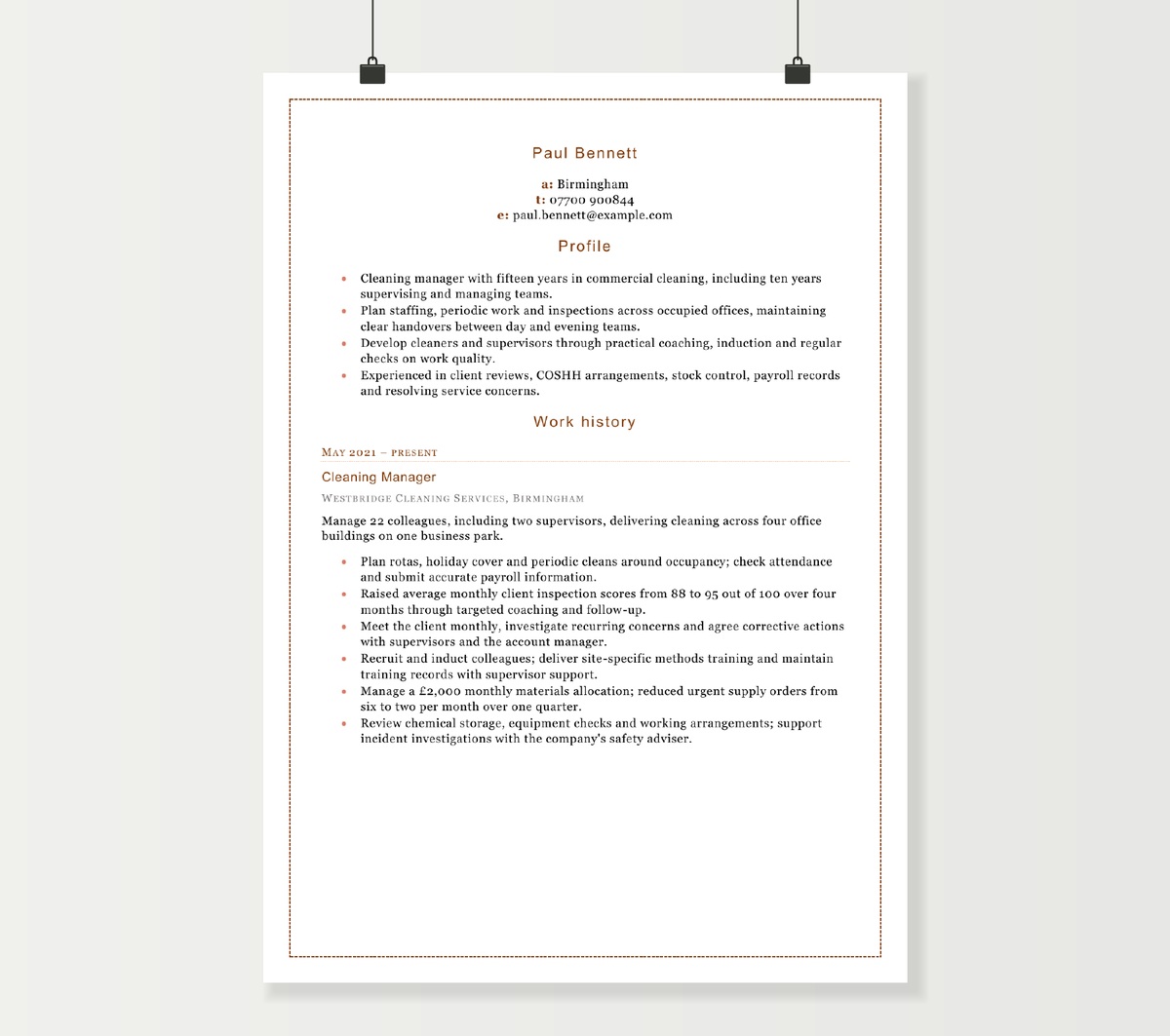
This cleaning manager CV template follows a candidate who progressed from cleaner to supervisor and then management of an office-cleaning team. The Word example covers staffing, inspections, client communication and stock control. The guide explains how to show your management contribution for single-site, area and specialist cleaning roles.
Filename: FreeCVDownload_Cleaning_Manager.docx
Content of this CV template
Paul Bennett
a: Birmingham
t: 07700 900844
Profile
- Cleaning manager with fifteen years in commercial cleaning, including ten years supervising and managing teams.
- Plan staffing, periodic work and inspections across occupied offices, maintaining clear handovers between day and evening teams.
- Develop cleaners and supervisors through practical coaching, induction and regular checks on work quality.
- Experienced in client reviews, COSHH arrangements, stock control, payroll records and resolving service concerns.
Work history
May 2021 – present
Cleaning Manager
Westbridge Cleaning Services, Birmingham
Manage 22 colleagues, including two supervisors, delivering cleaning across four office buildings on one business park.
- Plan rotas, holiday cover and periodic cleans around occupancy; check attendance and submit accurate payroll information.
- Raised average monthly client inspection scores from 88 to 95 out of 100 over four months through targeted coaching and follow-up.
- Meet the client monthly, investigate recurring concerns and agree corrective actions with supervisors and the account manager.
- Recruit and induct colleagues; deliver site-specific methods training and maintain training records with supervisor support.
- Manage a £2,000 monthly materials allocation; reduced urgent supply orders from six to two per month over one quarter.
- Review chemical storage, equipment checks and working arrangements; support incident investigations with the company's safety adviser.
April 2016 – April 2021
Cleaning Supervisor
Westbridge Cleaning Services, Birmingham
Supervised an evening team of eight cleaners in a busy office building.
- Allocated work and arranged absence cover with the site manager.
- Checked completed areas and coached colleagues on recurring quality issues.
- Maintained supplies and reported equipment defects for repair.
- Organised carpet and floor-care work during agreed access windows.
- Introduced a written handover for unresolved tasks and client requests.
- Inducted six new starters and supported their first-month reviews.
July 2011 – March 2016
Cleaner
Parkway Contract Cleaning, Birmingham
Delivered routine cleaning in offices, shared kitchens and washrooms.
- Worked to site schedules and agreed quality standards.
- Used floor-care equipment following training and site instructions.
- Stored products correctly and followed COSHH information.
- Reported hazards, damage and supply shortages promptly.
- Supported periodic deep cleans and office-move preparation.
- Helped new colleagues learn routes and site arrangements.
Qualifications and training
BICSc Licence to Practice — renewed 2024 | IOSH Managing Safely — 2022
COSHH, manual handling and team supervision — workplace training, 2025
7 GCSEs, including English and Maths | Birmingham, 2011
Interests and additional information
Gardening, watching football and cooking. Full UK driving licence.
How to write a cleaning manager CV
A cleaning manager CV should show how you organise people, maintain standards and keep the service working for the client. Your practical cleaning experience is valuable, but the employment section also needs to demonstrate the decisions you make about staffing, quality, training, resources and problems that need resolving.
Put the size and demands of the service first
Start each management role with the setting and team. State whether you managed one large site, several buildings on a campus or a geographically spread contract. Include the number of cleaners and supervisors, the shift pattern and any important features of the premises. Offices, schools, retail stores and clinical areas have different access arrangements and service demands.
“Manage 22 colleagues, including two supervisors, across four office buildings” immediately establishes more than “manage daily cleaning operations”. If your post combined supervision with substantial cleaning work, make that clear too. Working-manager experience can be particularly relevant to smaller sites where the manager remains part of the daily delivery team.
For an area role, describe the region, number of contracts and how you kept in touch with sites. For a large single-site position, team structure, building use and service hours may provide a better indication of complexity than floor area alone. Identify the cleaning company as your employer and describe the client setting where that helps explain the contract.
Show how you kept shifts covered and work organised
Staffing is a substantial part of cleaning management. Give examples of preparing rotas, arranging holiday cover, responding to absence and allocating work around changes in occupancy or opening hours. Explain the scope of the work: an evening office team, early-morning retail cover or teams spread across several shifts.
Include the administrative side when it was your responsibility. Checking attendance, resolving timesheet queries, submitting payroll information and organising recruitment all help an employer understand your management experience. Name the scheduling or time-and-attendance system if it is relevant, together with the work you performed in it.
The strongest examples connect organisation with service. A clearer handover may have reduced missed requests; a planned relief rota may have made holiday cover more dependable; a revised schedule may have accommodated a new area without disrupting the existing service. Explain the change and its practical effect.
Turn inspections into evidence of improvement
Regular checks belong on the CV, but their value becomes clearer when you explain what happened afterwards. State whether you carried out supervisor inspections, joint client audits or checks against a contract-specific standard. Then show how you identified recurring issues, agreed corrective work and followed up.
A useful achievement might be: “Raised average monthly client inspection scores from 88 to 95 out of 100 over four months through targeted coaching and follow-up.” The scoring basis and timeframe make the result understandable. Another applicant might describe reducing repeat washroom complaints or improving the completion of periodic work.
Give comparisons a consistent basis. If the checklist, inspected areas or service specification changed, choose wording that makes the result clear in that context. Where there is no comparable score, describe an issue you resolved and how the client or manager confirmed the improvement. A short, concrete account is more useful than a general claim of exceptional standards.
Make team development visible
Describe how you helped colleagues perform the work, from induction to refresher training and supervisor development. Relevant evidence includes demonstrating site methods, checking understanding, observing work, keeping training records and supporting someone taking on responsibility for a shift.
Explain your approach through an example. You may have introduced a practical induction checklist, arranged short demonstrations for recurring quality problems or helped supervisors give more useful feedback. If you adapted communication for a team with different language or literacy needs, show the arrangements that helped people understand the work.
Recruitment, attendance discussions and performance matters can also be relevant. Identify your role and the support available from the account manager or HR team. This shows the level of people-management responsibility you have held without filling the CV with confidential staff situations.
Present safety and cleaning knowledge at the right level
Use examples of the arrangements you supervised: chemical information and storage, COSHH assessments, equipment checks, manual handling, lone working, access and reporting of hazards or incidents. Explain whether you maintained records, delivered site training, checked working practices or contributed to a review with a safety adviser.
Your technical cleaning background supports these responsibilities. Mention relevant floor-care, carpet-cleaning or specialist equipment experience, particularly where you planned periodic work or trained colleagues. The CV should show the type of work and your responsibility for it; detailed instructions about products, dilution or cleaning techniques belong elsewhere.
Match specialist standards to the setting. For healthcare applications, experience of cleaning schedules, inspections and cooperation with infection-prevention or clinical colleagues may deserve prominence. Applicants working in England can check the terminology in the NHS standards of healthcare cleanliness. Commercial-office experience should be presented on its own strengths, with any relevant specialist training identified separately.
In schools, explain how you organised access, holiday cleans and working arrangements around pupils and staff. Food-production, laboratory or other specialist environments may have their own documented procedures and training requirements. Name the setting and the relevant work you have carried out so the employer can assess the match.
Explain client relationships and cost control
Client contact can range from dealing with a daily request to presenting a monthly contract review. Describe who you worked with, what you discussed and how you followed actions through. A useful example might show how you investigated a repeated complaint, agreed a change to the schedule and checked that the concern had been resolved.
State your commercial responsibility accurately and specifically. You may have controlled labour hours, monitored overtime, ordered materials, approved invoices within a limit or contributed to a contract’s profit-and-loss review. A materials allowance and a full contract budget are different responsibilities, and both can provide useful evidence.
Cost achievements are strongest when the service result remains visible. Fewer emergency supply orders, reduced product waste or better equipment availability can demonstrate effective control. Explain the change in ordering, storage or maintenance that produced the result. If you negotiated or helped prepare a revised specification, make your contribution clear.
Include periodic work and contract changes
Cleaning managers often organise work that falls outside the daily routine: floor treatments, carpet cleaning, holiday programmes, building reopenings and new contract starts. Select examples that show planning, access coordination and resource decisions.
For mobilisation, explain your part in checking the site, preparing schedules, arranging supplies, recruiting or inducting the team and establishing inspections. For a change in service, show how you briefed colleagues and maintained continuity. An area manager can also describe how they brought several sites onto consistent reporting or inspection arrangements.
Give the scale where it adds meaning: the number of buildings, new starters, shifts or weeks available before opening. A completed programme to an agreed handover date can be a strong achievement even without a savings figure.
Show the progression from cleaner or supervisor
Earlier hands-on experience explains your understanding of the work. Keep it focused on the areas that support your next role: equipment, quality checks, helping new colleagues, covering a supervisor or handling client requests. The cleaner CV example can help with presenting this stage of your career.
If you are seeking your first manager post, give evidence of responsibilities you have already taken on. Leading a shift, arranging cover, carrying out joint inspections, inducting colleagues or controlling site stock are relevant stepping stones. An experienced manager can give more space to developing supervisors, managing several contracts, improving service and handling the commercial side.
Show formal promotions with dates, including when they happened within the same employer. This makes increasing responsibility visible and avoids repeating the same cleaning duties under every title.
List training in a way employers can assess
Give the name of the qualification or training, the provider or awarding organisation where relevant, and the completion or renewal date. BICSc Licence to Practice, specific assessed cleaning skills, supervisor development and IOSH Managing Safely each describe different learning. Identify the particular award or course rather than grouping everything under “BICSc trained” or “health and safety”.
Separate practical workplace instruction from externally assessed awards. Both can be useful: recent site training in machinery, manual handling or incident reporting shows current development, while an assessed qualification provides a recognisable reference point. A driving licence and relevant travel availability can sit in a brief additional-information line for area or mobile roles.
Use the remaining space for evidence that supports the application, rather than extending the training list with unrelated courses. The CV template collection includes alternative layouts if your career history needs a different balance of roles and qualifications.
Cleaning Manager CV FAQs
It can provide useful evidence of scheduling, recruiting helpers, checking work, ordering supplies and managing customer relationships. Describe the number of clients or colleagues, the type of work and the responsibilities you held. For a commercial contract role, bring forward any experience with larger premises, documented specifications or teams working to shared schedules, and show how your business experience relates to those demands.
Your own language skills can be useful where they helped with induction, day-to-day communication or client contact. State the language and your practical level, or give a brief example of its use. You can describe experience supporting a multilingual team without listing personal details about colleagues. Some vacancies request a particular language, so make relevant ability easy to find.
Yes. Explain the management responsibilities that transfer, such as staffing, inspections, training, access arrangements and handovers. Add any experience communicating with daytime clients or coordinating work around occupied areas. The shift difference becomes easier for an employer to assess when the CV shows both your independent decision-making and how you worked with the wider service.
List the employers and their dates clearly, and explain that you continued on the same client contract following the transfer. You can group the entries under the site if that makes the history easier to follow. Include any promotion or change in team size separately. This preserves a clear employment record while showing your long-term knowledge of the operation.
A brief statement of the relevant check and its date is usually enough when the vacancy makes it useful. Include Update Service membership if relevant. Leave the certificate number for the employer's checking process. Requirements depend on the role and setting, and a prospective employer will decide what check is needed for its post.




