
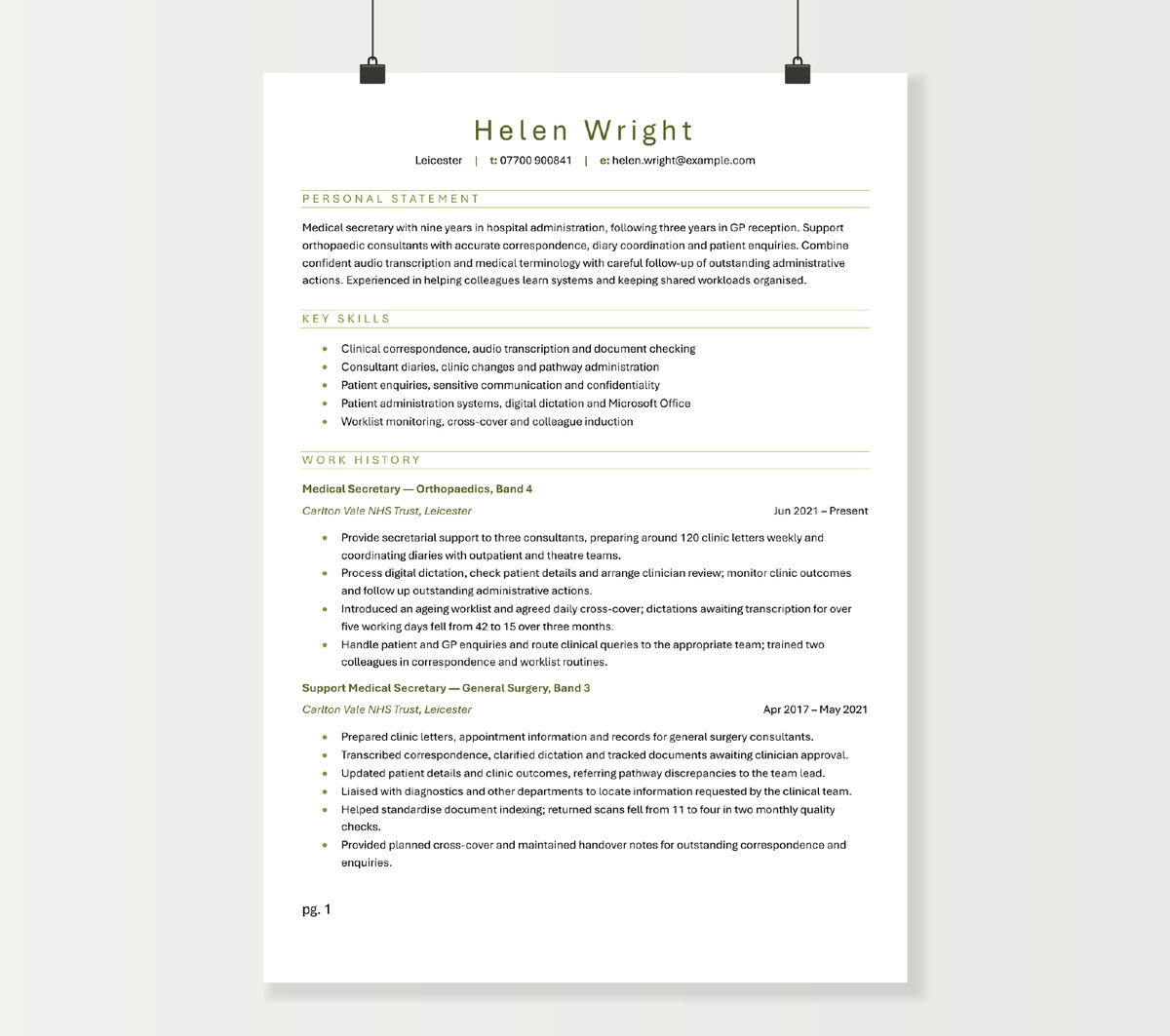
This medical secretary CV template shows progression from GP reception to hospital secretarial work. The Word example combines clinical correspondence, consultant support, patient enquiries and administrative improvements. The guide helps you present this experience for hospital, primary care and private practice roles, including a first move into medical administration.
Filename: FreeCVDownload_Medical_Secretary.docx
Content of this CV template
Helen Wright
Leicester | t: 07700 900841 | e: [email protected]
Personal statement
Medical secretary with nine years in hospital administration, following three years in GP reception. Support orthopaedic consultants with accurate correspondence, diary coordination and patient enquiries. Combine confident audio transcription and medical terminology with careful follow-up of outstanding administrative actions. Experienced in helping colleagues learn systems and keeping shared workloads organised.
Key skills
- Clinical correspondence, audio transcription and document checking
- Consultant diaries, clinic changes and pathway administration
- Patient enquiries, sensitive communication and confidentiality
- Patient administration systems, digital dictation and Microsoft Office
- Worklist monitoring, cross-cover and colleague induction
Work history
Medical Secretary — Orthopaedics, Band 4
Carlton Vale NHS Trust, Leicester
Jun 2021 – Present
- Provide secretarial support to three consultants, preparing around 120 clinic letters weekly and coordinating diaries with outpatient and theatre teams.
- Process digital dictation, check patient details and arrange clinician review; monitor clinic outcomes and follow up outstanding administrative actions.
- Introduced an ageing worklist and agreed daily cross-cover; dictations awaiting transcription for over five working days fell from 42 to 15 over three months.
- Handle patient and GP enquiries and route clinical queries to the appropriate team; trained two colleagues in correspondence and worklist routines.
Support Medical Secretary — General Surgery, Band 3
Carlton Vale NHS Trust, Leicester
Apr 2017 – May 2021
- Prepared clinic letters, appointment information and records for general surgery consultants.
- Transcribed correspondence, clarified dictation and tracked documents awaiting clinician approval.
- Updated patient details and clinic outcomes, referring pathway discrepancies to the team lead.
- Liaised with diagnostics and other departments to locate information requested by the clinical team.
- Helped standardise document indexing; returned scans fell from 11 to four in two monthly quality checks.
- Provided planned cross-cover and maintained handover notes for outstanding correspondence and enquiries.
Medical Receptionist
Brookfield Medical Practice, Leicester
Mar 2014 – Mar 2017
- Booked appointments and updated patient contact details using EMIS Web.
- Handled telephone and reception enquiries, recording messages for the appropriate colleague.
- Scanned incoming correspondence and supported repeat-prescription administration under practice procedures.
- Organised paper records and helped colleagues reconcile documents after practice sessions.
Qualifications
Level 3 Certificate in Medical Terminology
City & Guilds / AMSPAR
2019
- City & Guilds Level 3 Diploma in Business Administration — 2016.
- Eight GCSEs including English Language and Mathematics — 2013.
- Medical audio transcription and patient administration system training completed in post.
Recent development
Trust learning and development
2025 – 2026
- Information governance, safeguarding and customer care updates (2026); patient pathway administration refresher (2025).
Hobbies and interests
- Reading: Member of a local book group.
- Walking: Weekend walks around Leicestershire.
- Cooking: Trying new recipes with family and friends.
Additional information
Experienced in shared secretarial teams and planned cover across surgical specialties.
How to write a medical secretary CV
A medical secretary CV needs to show how you keep clinical administration moving: correspondence reaches the right people, records are updated, enquiries are followed through and clinicians can find the information they need. “Excellent organisational skills” becomes much more convincing when it is connected to a consultant’s workload, a referral queue or a shared secretarial service.
Make the setting clear from the start. A hospital specialty team, GP practice and private consultant’s office may use similar secretarial skills in different ways. Your opening statement should identify the environment you know, the responsibilities you handle and the experience most relevant to the next post.
Explain the service you support
Introduce each job with a short description of its scope. Useful details include the specialty, number of consultants or clinical teams supported, whether you work in a secretarial pool and the kinds of correspondence or appointments involved. This gives context to the more detailed bullets that follow.
In a hospital CV, identify the relevant work: outpatient correspondence, consultant diaries, elective bookings, clinic outcomes or patient pathway administration. In primary care, draw attention to referrals, incoming hospital letters, practice communications and coordination with community services. For private practice, include consultant liaison, appointment arrangements and any insurer or billing administration that belongs to your role.
Show your job title, employer and dates consistently. An NHS band can help the reader understand the post, but the description of your actual duties is especially useful when applying across settings. Someone recruiting into a GP practice may be less interested in the band than in how independently you manage referrals and correspondence.
Give clinical correspondence more detail than “audio typing”
Describe the documents you produce and the process you handle. Clinic letters, reports, discharge correspondence and referral letters involve different terminology and workflows. State whether you transcribe dictation, review speech-recognition output, format documents, arrange clinician approval or distribute the final correspondence.
A strong bullet might read: “Prepared orthopaedic clinic correspondence from digital dictation, checked patient details and coordinated outstanding approvals with consultants.” It shows the full administrative contribution. If you also maintain a queue of work awaiting clarification or sign-off, that adds evidence of follow-through.
Medical terminology is more persuasive when connected to a specialty and regular use. Name the areas you have supported and relevant training. For an applicant moving into a new specialty, experience of learning terminology, asking focused clarification questions and maintaining accurate documents demonstrates an adaptable approach.
Typing speed is optional unless requested. If it strengthens your application, give the tested speed with a brief indication of the assessment and accuracy. Employers may use their own typing exercise, so the wider CV should also show the correspondence and checking work behind the figure.
Show your part in patient pathways
Patient pathway experience can mean several different things. Specify the administrative work you carried out: recording clinic outcomes, following up missing information, maintaining a waiting list, arranging pre-assessment or coordinating a theatre booking. Name the part of the service you supported and how you worked with clinical and operational colleagues.
Where relevant, explain your use of Referral to Treatment (RTT) information or other waiting-time processes. A useful CV bullet identifies the records you maintained, the discrepancies you investigated and the team to whom you escalated outstanding issues. This establishes your contribution without needing a long explanation of pathway rules.
For GP secretary roles, a referral example may be more relevant than hospital waiting-list work. Describe preparing or processing referrals, monitoring their administrative status and liaising with the receiving service. Include NHS e-Referral Service experience if it formed part of your work. The reader should be able to see what you took responsibility for between the clinician’s request and the next administrative step.
Make patient communication concrete
Medical secretaries often become a familiar point of contact for people waiting for information. Use your experience section to show how you handled enquiries, gathered accurate messages and coordinated a response. Telephone, written and face-to-face communication can each be relevant.
Describe the practical situation rather than relying on “empathetic” or “professional”. Examples include explaining appointment arrangements to an anxious caller, following up an unresolved referral query or arranging an interpreter through the appropriate service. A short account of how you maintained contact and involved the right colleague demonstrates both care and organisation.
Confidentiality also benefits from practical evidence: checking contact details before sending correspondence, using approved communication routes or maintaining access-controlled records. Keep the CV focused on your work and the administrative outcome; patient names, diagnoses and case histories are unnecessary to convey it.
Present systems as working knowledge
Match each important system to what you used it for. A hospital patient administration system might support demographics, appointments and clinic outcomes. Digital dictation software supports a different workflow. Word, Outlook and Excel can demonstrate correspondence, diary management and worklist reporting when those are your regular tasks.
GP practices may specify EMIS Web or SystmOne and other platforms used for communication, document handling or requests. State the platform you know and the functions you have used. This helps a recruiter distinguish direct experience from familiarity with another system.
Keep the technical section selective, then support it with examples under your jobs. “EMIS Web: appointment booking and patient demographic updates” is informative for a reception background. A secretary with referral responsibility should describe the additional workflow in their employment history. If you helped colleagues learn a new system or supported a migration, explain the particular tasks you covered.
Use workload and improvements to show reliability
Routine work can provide strong CV evidence. The number of consultants supported, typical weekly correspondence and range of specialties establish the scale of your responsibility. Use figures that help the reader picture your workload, with the period and task attached.
For improvements, choose a clear administrative measure. This could be a reduction in an aged transcription queue, fewer returned documents, a quicker process for locating outstanding approvals or more consistent cover arrangements. Explain what changed and whether the result belonged to your own work or a shared team effort.
For example: “Introduced an ageing worklist and agreed daily cross-cover; dictations awaiting transcription for over five working days fell from 42 to 15 over three months.” The measure is specific to the work improved. A patient’s overall waiting time depends on many factors, so an administrative milestone often gives a more useful account of a secretary’s contribution.
Show what makes a senior application different
Senior and supervisory vacancies can require responsibility beyond a personal workload. Give examples of allocating work, arranging cover, resolving competing priorities, training staff or improving team processes. If you have managed appraisals, recruitment or performance discussions, make that responsibility visible.
Separate day-to-day support for a new colleague from formal line management. Both are valuable, and clear wording helps the employer understand the level at which you have worked. A concise example of keeping the service organised during leave or a backlog can be more useful than a broad claim to leadership.
Show progression within a trust or practice through separate role titles and dates. Retain enough detail from an earlier support-secretary or reception role to explain the foundation, then give the most space to your current responsibility.
Select qualifications that support the application
List the full title, level, awarding organisation and date of relevant medical terminology, medical administration, business administration or secretarial qualifications. These details are more useful than “AMSPAR trained” on its own. Include literacy and numeracy qualifications where the person specification asks for them.
Employers differ in the qualifications and equivalent experience they accept. Give your practical evidence alongside your training: regular transcription, accurate document preparation, patient contact or work in a clinical team. Recent information governance, safeguarding, customer care and system training can sit together in a short development section.
For a first medical secretary post, draw on the closest experience you already have. Office administration may provide evidence of complex diaries, sensitive records and accurate correspondence; reception work can show careful message taking and contact with distressed customers. The administrator CV example and receptionist CV example offer useful ways to organise that earlier experience. Add relevant terminology or transcription training and explain any healthcare exposure clearly.
The strongest final CV makes the connection between your skills and the service easy to follow. An employer should be able to identify the correspondence you handle, the people you support, the systems you use and the responsibilities you are ready to take on next.
Medical Secretary CV FAQs
Use the application route requested by the employer. Many NHS vacancies require employment history and supporting information in an online form rather than a CV attachment. The CV is a useful source for those sections, while the supporting statement gives you room to connect specific examples to the person specification.
Make the transferable workflow clear: dictation, correspondence, diaries, patient enquiries and outstanding-action tracking. Then identify the specialties you have supported and any experience learning new terminology or providing cross-cover. That gives the recruiter evidence of both established secretarial skills and your ability to adapt to the new team.
It can still be relevant, particularly where the advert specifies a typing or word-processing qualification. Give its title and date, then support it with your recent transcription and document-production experience. A current assessment result can add context if you have one; routine workplace evidence helps explain how you use the skill now.
List the agency or staff bank and the overall dates, then identify the main assignments, specialties and duties beneath it. Group similar short assignments where that makes the history easier to read. Highlight how you picked up local systems, managed handovers and provided effective cover, with a separate entry for a longer placement that developed your responsibilities.
Keep your earlier specialty and secretarial experience visible, alongside any recent system, terminology or transcription refreshers. Explain the break briefly in the chronology if needed. The application will be stronger when the reader can see both your established experience and the practical preparation you have made for returning.
It provides a useful starting point. Give more prominence to referrals, communication with other services, patient enquiries and the practice systems you have used. Explain hospital pathway work in terms a practice team can recognise, such as following up missing information or coordinating correspondence. Where the advert requires a particular GP system, make your direct experience of that system easy to locate.




