
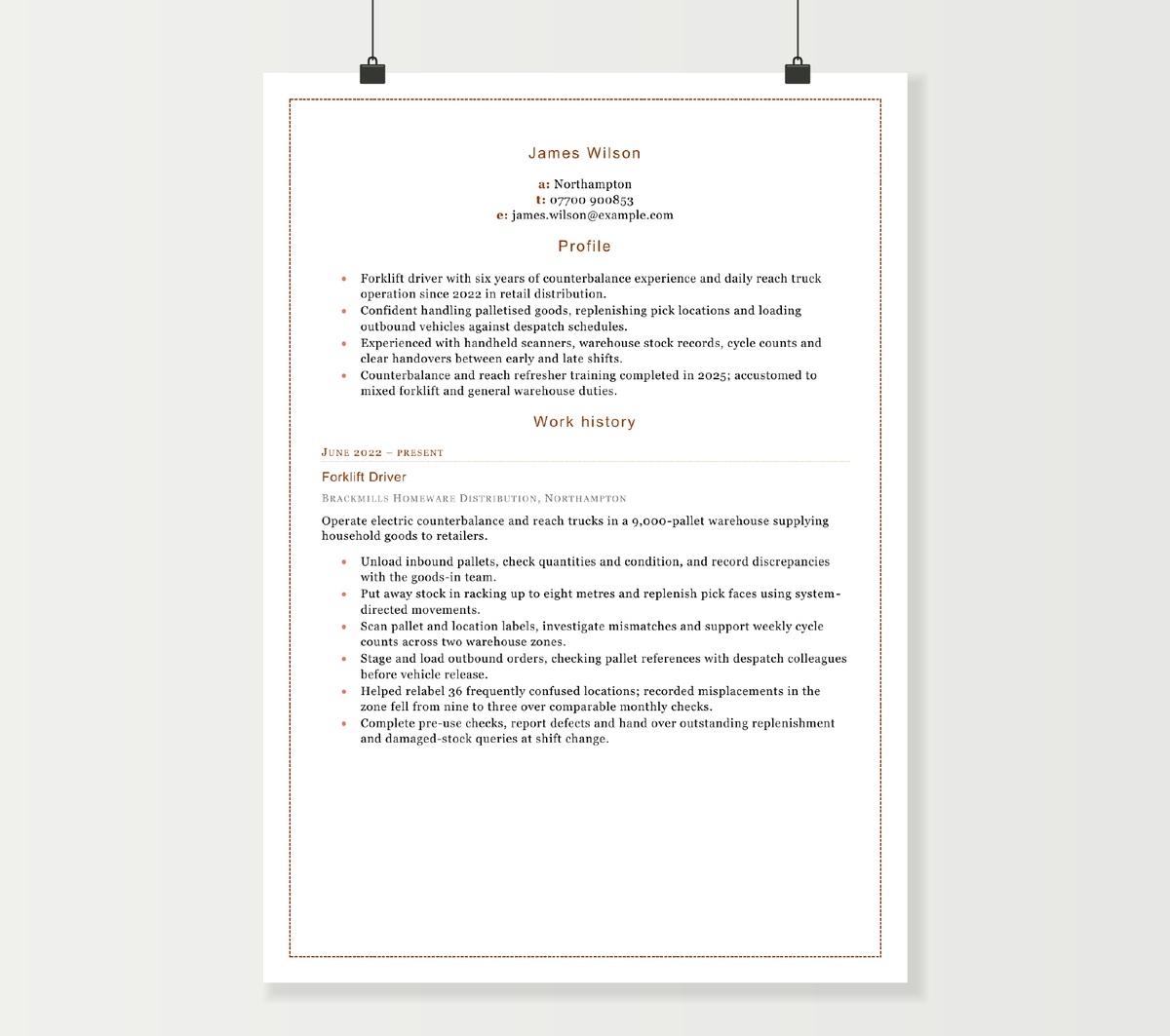
This forklift driver CV template shows progression from warehouse work to daily counterbalance and reach truck operation. The Word example covers goods-in, replenishment, loading, stock records and practical improvements. The guide explains how to make your truck experience and training clear for warehouse, manufacturing and yard-based applications.
Filename: FreeCVDownload_Forklift_Driver.docx
Content of this CV template
James Wilson
a: Northampton
t: 07700 900853
Profile
- Forklift driver with six years of counterbalance experience and daily reach truck operation since 2022 in retail distribution.
- Confident handling palletised goods, replenishing pick locations and loading outbound vehicles against despatch schedules.
- Experienced with handheld scanners, warehouse stock records, cycle counts and clear handovers between early and late shifts.
- Counterbalance and reach refresher training completed in 2025; accustomed to mixed forklift and general warehouse duties.
Work history
June 2022 – present
Forklift Driver
Brackmills Homeware Distribution, Northampton
Operate electric counterbalance and reach trucks in a 9,000-pallet warehouse supplying household goods to retailers.
- Unload inbound pallets, check quantities and condition, and record discrepancies with the goods-in team.
- Put away stock in racking up to eight metres and replenish pick faces using system-directed movements.
- Scan pallet and location labels, investigate mismatches and support weekly cycle counts across two warehouse zones.
- Stage and load outbound orders, checking pallet references with despatch colleagues before vehicle release.
- Helped relabel 36 frequently confused locations; recorded misplacements in the zone fell from nine to three over comparable monthly checks.
- Complete pre-use checks, report defects and hand over outstanding replenishment and damaged-stock queries at shift change.
April 2020 – May 2022
Warehouse Operative / Counterbalance Driver
Nene Packaging Supplies, Wellingborough
Combined forklift work with picking and packing packaging materials for trade customers.
- Loaded palletised cartons and packaging supplies onto collection vehicles.
- Checked supplier deliveries against paperwork and flagged shortages.
- Moved stock between goods-in, bulk storage and packing areas.
- Recorded stock movements and completed scheduled stock counts.
- Reorganised packing supplies with colleagues, freeing four pallet locations.
- Completed counterbalance training and supervised site familiarisation in 2020.
September 2017 – March 2020
Warehouse Operative
Nene Packaging Supplies, Wellingborough
Joined the warehouse team after school and built experience across order preparation and despatch.
- Picked products using handheld scanners and printed order lists.
- Checked quantities and product codes before packing orders.
- Wrapped and labelled pallets ready for carrier collection.
- Reported damaged packaging and separated affected goods.
- Helped with stocktakes and replenished packing materials.
- Supported new starters with scanning and order-checking routines.
Qualifications and training
7 GCSEs including English and Mathematics, 2017.
RTITB-accredited counterbalance training, 2020; reach conversion, 2022; refresher training on both truck types, 2025.
Manual handling and warehouse safety training, refreshed 2026.
Interests
Weekend football, fishing and working on my allotment.
How to write a forklift driver CV
A warehouse manager needs to establish which trucks you operate, how recently you have used them and what you can contribute to the shift. Make those answers easy to find. Your training section establishes the equipment covered; your employment history shows how you use it to move the right goods to the right place, keep records accurate and support loading or production deadlines.
Put truck types and recent experience near the top
“Experienced FLT driver” leaves too much for the recruiter to work out. Name counterbalance, reach, articulated or very narrow aisle trucks as appropriate, then connect them to recent work. A useful opening could be: “Counterbalance driver with four years in a builders’ merchant, loading customer vehicles and handling palletised building materials.” For a reach vacancy, lead with reach experience, the warehouse setting and regular replenishment or put-away work.
If you operate more than one type, distinguish your experience with each. Six years on counterbalance and a recent reach conversion tells a different story from six years using both daily. Include the frequency of operation within your latest role: daily use, regular shift cover or occasional relief. This helps an employer assess the practical fit far more quickly than a long list of general strengths.
Truck capacity, operating height, power type or attachments can add useful detail when they relate to the vacancy. For example, eight-metre racking gives context to reach work, while handling long timber or using a particular attachment may matter in a merchant yard. Select the details that describe the work you know; model numbers seldom need a prominent place unless the employer requests them.
Make training straightforward to check
Give each truck type, the course or assessment, the provider or accreditation shown on your certificate, and the completion date. Separate basic, conversion and refresher training where that makes your history clearer. A compact entry might read: “Counterbalance basic training, 2021; reach conversion, 2023; refresher on both types, 2026.” Add the training organisation or accrediting body alongside it.
Recruiters often use “FLT licence” as shorthand. On your CV, precise training details are more informative than “full forklift licence”. HSE distinguishes training from an employer’s authorisation to operate at a particular site; its lift-truck training guidance explains that distinction. Where training was delivered in-house, describe it as in-house and identify the truck type and date. This gives the next employer useful evidence to discuss.
Place relevant training above school qualifications, especially if you have several years of warehouse experience. Include recent manual handling, food hygiene or other site training when it supports the work you are applying for. A full school-subject list is rarely as useful as clear evidence of current operating experience and relevant assessments.
Describe the stock flow you support
Build your recent employment entry around what happens to the goods. Did you unload inbound vehicles, check deliveries, put pallets away, replenish picking locations, supply a production line or stage outbound loads? This reveals your range of experience without making every bullet a variation of “operated a forklift”.
- Goods-in: identify the deliveries you handled, checks against paperwork and how you dealt with shortages or damaged pallets.
- Storage and replenishment: show the racking environment, location system and how you kept pick faces or production supplied.
- Despatch: describe order staging, pallet-reference checks and coordination with loaders, drivers or the transport office.
- Stock control: include cycle counts, location checks and investigations of routine mismatches.
A strong bullet combines the task with its operational purpose: “Replenished fast-moving pick faces from high-level racking, using scanner tasks to prioritise orders approaching the afternoon despatch cut-off.” It tells the reader how your driving fitted into the warehouse, rather than simply naming a duty.
Where your working day combines truck operation with picking, packing or wrapping, give that combination space. Many jobs need someone who can move between these tasks as the workload changes. For applications where warehouse duties make up most of the role, the warehouse operative example offers another way to organise that experience.
Match the setting as well as the truck
Operating experience becomes more persuasive when the reader can picture the environment. A food manufacturer, a retail distribution centre and a builders’ merchant may all use counterbalance trucks, but their goods, working areas and priorities differ.
For manufacturing, bring forward line feeding, packaging or raw-material movements, batch identification and coordination with production teams. For distribution, focus on system-directed tasks, put-away, replenishment and despatch accuracy. In a merchant or outdoor yard, give more attention to the products handled, customer collections, vehicle loading and working around delivery traffic. Cold-store experience, hygiene-controlled areas or unusual loads are worth naming when relevant.
Use the first line below each employer to establish this setting. “Counterbalance and reach operation in a 9,000-pallet homeware warehouse” does more work than “busy warehouse environment”. It also gives sensible context to the achievements that follow.
Show safety through your responsibilities
“Safety conscious” is easy to write and difficult to assess. Describe the responsibilities that demonstrate it: completing pre-use checks, recording defects, escalating damaged racking or pallets, following site traffic arrangements and providing a clear handover when equipment is unavailable. Select two or three that were a real part of your work.
Explain your part in an improvement where you have one. Reporting recurring damage at a location, helping revise a staging arrangement or supporting a supervisor’s review of pedestrian access can be useful evidence. The CV needs the issue, your contribution and the resulting change; it does not need a detailed explanation of operating procedures.
If you have helped new starters, identify what that involved. Showing a colleague the stock-location system or supporting site familiarisation is valuable experience. Formal operator training or assessment is a distinct responsibility and should have its own description and qualification where applicable.
Include scanners, stock records and handovers
Forklift work often changes a stock record as well as a pallet’s location. Name a warehouse management system when you know it, then explain what you did with it: confirming put-away, scanning moves, checking stock availability or recording count differences. “Handheld scanning for pallet and location confirmation” is useful even where the system was bespoke and its name would mean little to another employer.
Show how you communicated exceptions. A brief bullet about resolving a mismatch with goods-in, notifying despatch of a damaged order or handing over outstanding replenishments demonstrates attention to detail and teamwork in a recognisable setting. Written shift notes, load paperwork and radio communication can also be relevant, particularly when a role crosses departments.
Choose results that reflect good warehouse work
Useful achievements need not involve a dramatic increase in pallets moved. Fewer misplaced pallets, clearer labels, stock discrepancies resolved, space released or an improved loading sequence can all make a strong case. Give the scope and period so the result is understandable.
For example: “Helped relabel 36 confusing locations; misplacements in that zone fell from nine to three across comparable monthly checks.” The reader can see both the contribution and the measure. Where a result belongs to the shift team, describe your part: “Worked with goods-in colleagues to clear a backlog of 42 unallocated pallets before the stocktake.”
Throughput figures work best alongside context such as load type, shift length and the tasks included. A pallet count on its own is difficult to compare between a narrow-aisle store and a yard loading mixed materials. If your workplace did not provide individual performance figures, use concrete scope instead: the zones you covered, products handled, shift responsibilities or a specific problem you helped resolve.
Present agency assignments and availability clearly
Several short assignments can show useful breadth. Group them under the agency where this keeps the timeline readable, then name the placements and dates that matter most. For example: “FLT Driver — agency assignments, January–August 2026”, followed by separate lines for a manufacturing site and a distribution centre. Give each placement’s truck type and main work so the experience remains visible.
A longer assignment or a move into a permanent role deserves its own entry. Show the transition clearly if you stayed at the same site; it can demonstrate continuity even though the employer on your payslip changed.
Practical availability can help with shift-based recruitment. A short line stating the rotating shifts you can work, your notice period and the area you can reliably reach may answer an immediate hiring question. Put a driving licence or access to transport in an additional-information section when it is relevant to reaching the site or required for the job.
If you are newly trained or moving into forklift work
Put your recent training close to the profile, then use warehouse, manufacturing or yard experience to show that you understand the surrounding operation. Picking accuracy, pallet preparation, goods-in checks, stocktakes and despatch routines all help an employer see what you would bring while building operating experience.
Make the difference between training and paid operating work clear through the headings and dates. Your profile might say: “Warehouse operative with three years in goods-in and recently completed counterbalance training, seeking a first dedicated FLT role.” Follow it with evidence of reliable warehouse work and the equipment covered by the course.
For an experienced driver, reverse the emphasis: lead with recent operating work, relevant loads and improvements, then use the training section for quick verification. In either case, the strongest CV lets the employer connect your equipment experience to the work their shift actually needs done.
Forklift Driver CV FAQs
Check the vacancy’s training requirements and give the date of your latest course or assessment, together with your most recent operating work. HSE does not prescribe one fixed refresher interval for every operator. Employers may nevertheless specify their own recency requirements or arrange an assessment or refresher. Clear dates let the recruiter decide how your experience fits their process.
Keep the CV readable and list the relevant certificate details in the training section. Send copies through the recruitment process when requested; an agency may ask for them before submitting you to a client. There is usually no benefit in inserting certificate photographs into the CV itself.
Contact the original training provider, the employer that arranged the course or the relevant accrediting body to request a replacement. HSE does not hold a central register of operators’ certificates. While obtaining the record, give the training details you can establish and explain the position to the recruiter; the employer may arrange an assessment or retest.
It can demonstrate experience with loads, warehouse movements and working around other people, but the recruiter will also need to know your reach training and experience. If you are seeking a conversion opportunity, say so in the profile and prioritise vacancies that offer training. If you have already converted, put the reach course date and subsequent operating work prominently on the CV.
Name the truck types, training provider, course dates and country, then describe the loads and warehouse or yard work in terms a UK recruiter can understand. Include recent operating dates. This gives the employer a basis for discussing the evidence, any assessment they require and familiarisation at their site.
State a car driving licence when the vacancy asks for it, when road driving forms part of the role or when it helps explain how you can reach an early or late shift. For a site-based role, the central evidence is your relevant truck training and operating experience. Treat a car licence and forklift training as separate entries.




