
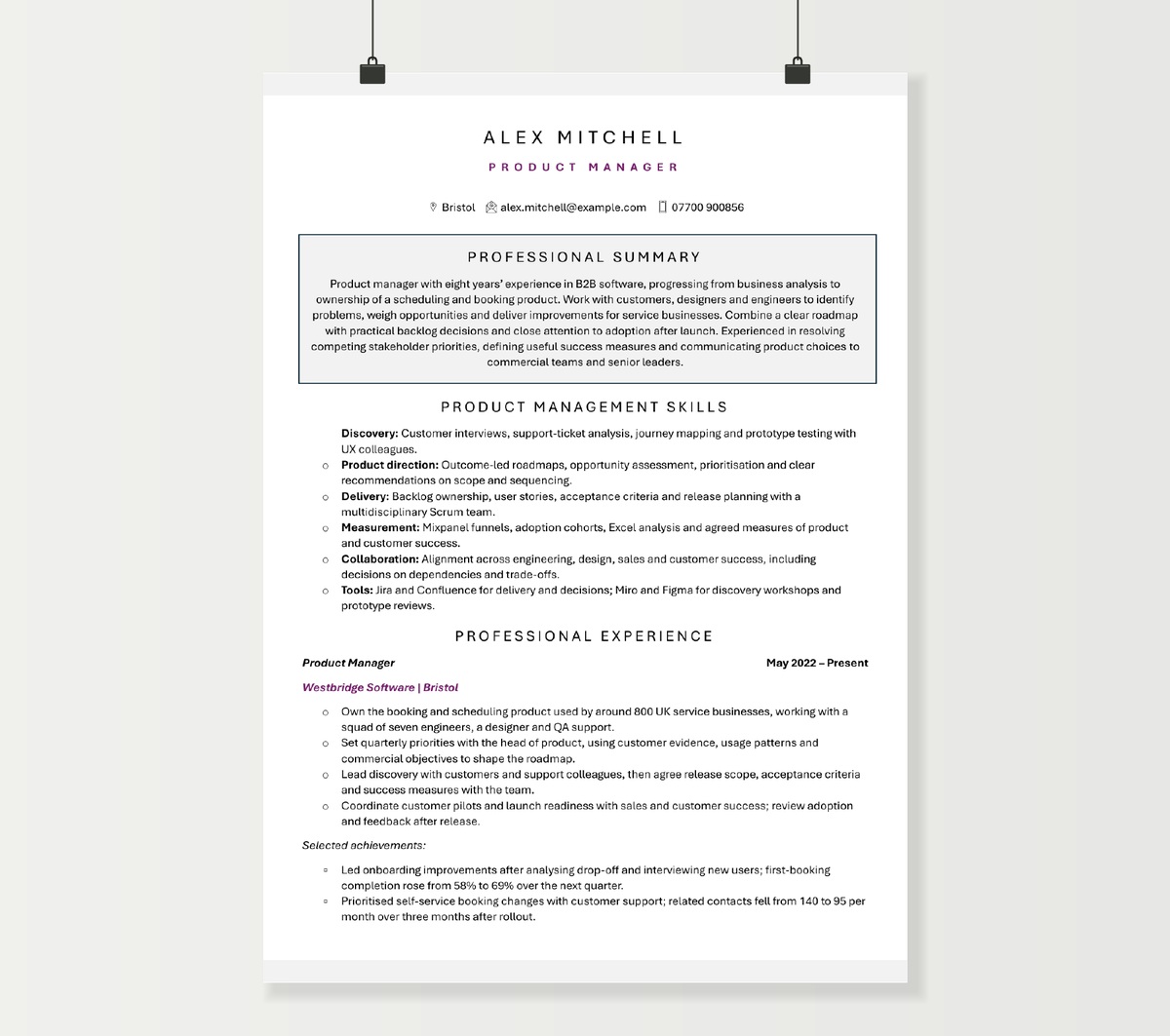
This product manager CV template shows progression from business analysis into ownership of a B2B software product. The Word example connects customer discovery, roadmap decisions and delivery with adoption and service improvements. The guide also covers product owner applications, technical and data products, and the evidence that helps applicants move into their first product role.
Filename: FreeCVDownload_Product_Manager.docx
Content of this CV template
Alex Mitchell
PRODUCT MANAGER
Bristol | [email protected] | 07700 900856
Professional summary
Product manager with eight years’ experience in B2B software, progressing from business analysis to ownership of a scheduling and booking product. Work with customers, designers and engineers to identify problems, weigh opportunities and deliver improvements for service businesses. Combine a clear roadmap with practical backlog decisions and close attention to adoption after launch. Experienced in resolving competing stakeholder priorities, defining useful success measures and communicating product choices to commercial teams and senior leaders.
Product management skills
- Discovery: Customer interviews, support-ticket analysis, journey mapping and prototype testing with UX colleagues.
- Product direction: Outcome-led roadmaps, opportunity assessment, prioritisation and clear recommendations on scope and sequencing.
- Delivery: Backlog ownership, user stories, acceptance criteria and release planning with a multidisciplinary Scrum team.
- Measurement: Mixpanel funnels, adoption cohorts, Excel analysis and agreed measures of product and customer success.
- Collaboration: Alignment across engineering, design, sales and customer success, including decisions on dependencies and trade-offs.
- Tools: Jira and Confluence for delivery and decisions; Miro and Figma for discovery workshops and prototype reviews.
Professional experience
Product Manager | May 2022 – Present
Westbridge Software | Bristol
- Own the booking and scheduling product used by around 800 UK service businesses, working with a squad of seven engineers, a designer and QA support.
- Set quarterly priorities with the head of product, using customer evidence, usage patterns and commercial objectives to shape the roadmap.
- Lead discovery with customers and support colleagues, then agree release scope, acceptance criteria and success measures with the team.
- Coordinate customer pilots and launch readiness with sales and customer success; review adoption and feedback after release.
Selected achievements:
- Led onboarding improvements after analysing drop-off and interviewing new users; first-booking completion rose from 58% to 69% over the next quarter.
- Prioritised self-service booking changes with customer support; related contacts fell from 140 to 95 per month over three months after rollout.
Business Analyst | September 2018 – April 2022
Westbridge Software | Bristol
- Translated booking, payment and reporting needs into process maps, user stories and acceptance criteria for two product squads.
- Ran workshops with customer success, finance and engineering to clarify exceptions and dependencies before development.
- Supported the product manager with backlog refinement, user acceptance testing and feedback from pilot customers.
- Analysed support records and product usage to identify recurring customer problems and inform release priorities.
Selected achievements:
- Mapped cancellation and refund journeys across four payment scenarios, enabling the team to release a consistent workflow for pilot customers.
- Introduced a shared acceptance checklist that reduced returned requirements from nine to four per release across six successive releases.
Qualifications & development
BSc (Hons) Business and Management, 2:1 – University of the West of England, 2018
Professional Scrum Product Owner I (PSPO I) – Scrum.org, 2021
Product discovery and customer interviewing – Employer development programme, 2023
Product analytics and experimentation – Employer workshops, 2024
Additional information
- Product community: Facilitate monthly sessions where colleagues discuss recent discovery work and lessons from releases.
- Technical understanding: Comfortable discussing APIs, event tracking and integration dependencies with engineers.
- Interests: Cycling, cooking and developing small apps for personal projects.
How to write a product manager CV
A product manager CV needs to make your judgement visible. A release list tells an employer what was built; a stronger account explains which customer problem mattered, how you chose an approach and what happened once people used the product. Give the reader enough context to understand those decisions without making them reconstruct your product from a page of internal terminology.
Define the product and the responsibility you held
Begin each recent role with a short description of the product, its users and your area of ownership. A customer-facing subscription app, an internal tax workflow and an insurance data product can all involve product management, but their constraints and measures of success differ. Include the business model or operating setting where it helps explain your work.
Useful scope might include the product area, number or type of customers, markets served, lifecycle stage and the team you worked with. Then identify your decision-making responsibility: setting direction, owning one part of a wider roadmap, prioritising a backlog, managing a portfolio or taking a service into live operation. “Worked with a squad of seven engineers” describes collaboration; “line-managed three product managers” describes a different responsibility. Both can be valuable.
The profile should bring these details together in a few sentences. Lead with your product specialism and level, then the problems you are equipped to solve. “B2B software product manager with experience improving onboarding and self-service journeys” gives an employer more to work with than a list of personal qualities.
Make product manager and product owner experience legible
Titles vary between organisations. A product owner may lead discovery and commercial decisions, while a technical product manager may work mainly on delivery within a strategy set elsewhere. Keep your employment title and use the opening scope statement and achievements to explain what the role involved.
For product-owner vacancies, bring forward backlog decisions, user stories, acceptance criteria, work with engineers and the way you balanced value, risk and dependencies. Add the customer or operational benefit of that work. For broader product-manager vacancies, give more space to opportunity selection, product direction, investment choices, adoption and commercial performance. Where you did both, show the connection from discovery through delivery to the result.
An applicant moving from business analysis can use the business analyst CV example to consider how to describe requirements and process work, then make the emerging product decisions clear. Workshops and documentation become stronger evidence when the reader can see what they helped the team decide.
Select achievements that explain your product choices
Choose a small number of substantial examples for each recent role. Across the CV, aim to show more than one part of product work: identifying an opportunity, making a difficult priority decision, releasing an improvement and learning from its performance. A concise achievement can contain four elements:
- The customer or business problem and its scale.
- The evidence that shaped your choice.
- Your contribution to the decision and the team’s response.
- The result, or the useful learning that changed the next step.
For instance: “Prioritised self-service changes after reviewing cancellation contacts with support; related enquiries fell from 140 to 95 per month in the three months after rollout.” The bullet identifies the reason for the work and the measure used. A neighbouring responsibility can explain your wider ownership, avoiding the need to repeat the whole team structure in every achievement.
A decision to narrow, defer or stop an initiative can also demonstrate product judgement. Explain the evidence and the consequence: a small customer trial that redirected investment, a dependency that changed sequencing, or research that led the team to solve an existing journey before adding another feature. This is particularly useful when your most valuable contribution was choosing the right work.
Show what discovery changed
Customer interviews, journey mapping and prototype testing become persuasive when attached to a decision. State who you needed to understand, the question you investigated and the conclusion that influenced scope or priority. “Interviewed branch managers and tested a revised handover journey, leading to a smaller first release focused on unresolved exceptions” conveys much more than “conducted user research”.
Distinguish your own contribution within research and design partnerships. You might have framed the problem, recruited customers, synthesised support evidence, agreed a hypothesis or used a researcher’s findings to change the roadmap. Each shows a useful part of product practice. For discovery that has not yet led to a launch, describe the decision reached and the next investment or delivery stage secured.
Market and competitor work belongs here when it affected positioning, pricing, distribution or the product proposition. Explain its application to the product, rather than providing a separate list of research activities.
Present prioritisation as a decision, not just a framework
A roadmap bullet should show the competing needs you reconciled. Perhaps a large customer’s integration request competed with onboarding improvements, or a platform migration had to preserve capacity for live-service fixes. State the relevant constraint and the choice you helped make.
Frameworks such as RICE, WSJF or cost-of-delay analysis can sit in a skills section when relevant to the vacancy. An experience bullet should explain what the framework enabled: clearer investment choices, agreement on a smaller release or a changed sequence of work. Similarly, Jira, Azure DevOps and Confluence are useful supporting tools; their value on the CV comes from the decisions, visibility and collaboration they supported.
Include maintenance and technical sustainability where these were part of your remit. Balancing new capability with reliability, accessibility, security or support needs is often central to an established product. Show how you worked with specialists and incorporated those needs into priorities.
Connect delivery with adoption and ongoing performance
Writing stories and attending sprint ceremonies only describes part of the work. Explain how you clarified the intended behaviour, resolved questions during development, agreed acceptance and prepared people to use the change. Customer pilots, sales enablement, support readiness, migration planning and operational handover can all be relevant.
Then follow the product beyond release. Which users adopted it? Which workflow improved? Did support demand, task completion or conversion change? If uptake was lower than expected, a short account of the adjustment you prioritised can show mature product ownership. For a live service, ongoing improvement may deserve more space than the original launch.
Choose measures that match the product
Commercial products may use activation, conversion, retention, revenue, expansion or margin. Internal tools may be better described through task completion, processing time, error rates or usage across the intended teams. Data products may need evidence of adoption, trusted definitions, reduced reconciliation work or reuse by consuming teams. Pick measures that explain the product’s purpose.
Give a baseline and timeframe where they make the result meaningful. Moving completion from 58% to 69% is an eleven-percentage-point increase; stating the two figures avoids ambiguity. For adoption, identify the relevant group: weekly use among eligible advisers says more than a total registration count. For time saved, distinguish a measured reduction per task from a wider estimate.
Describe team results alongside your contribution. “Led discovery and prioritisation for…” or “Worked with engineering and customer success to…” can make ownership clear while reflecting how products are built. An observed change after rollout can be presented as such. If the evidence came from a controlled experiment, mention that where it adds useful confidence.
Give technical and specialist products their own context
For a technical product, explain the users and dependencies behind the technology. An API product might serve external developers; a platform might serve internal engineering teams; a migration might affect publishing staff and readers differently. Include the product decisions you made about capability, reliability, integrations or adoption, with enough technical detail to establish credibility.
A data-product CV should identify the business domain, the consumers of the data and your role in defining scope, quality expectations, ownership and ongoing support. A list of cloud platforms is less informative than an example showing how you aligned finance and engineering on common definitions and a phased release.
For physical products, give space to range or lifecycle decisions, customer requirements, pricing, margin, suppliers and launch channels as appropriate. For regulated or public-service products, show how assurance, accessibility, operational risk and service outcomes influenced decisions. The strongest evidence is the detail that belongs to your product setting.
Adjust the evidence for your career stage
For an associate or first product role, relevant evidence can come from analysis, customer success, operations, design or engineering. Select occasions when you identified a user problem, compared options, influenced a priority or measured an improvement. Make the scope of that contribution clear. A substantial university, volunteer or personal app project can support this evidence if you describe the users, decisions and learning rather than just its features.
Experienced applicants should usually lead with recent product ownership and outcomes. Senior and lead applicants need to show a wider level of judgement: decisions across teams, portfolio priorities, investment discussions, mentoring and the product practices they improved. Include direct reports and budget responsibility where relevant, together with the scope of influence beyond the team.
Qualifications belong in a compact section with the award, provider and date. Product-owner or Agile certifications can help establish a foundation, especially during a transition; experience should show how you applied that learning. A degree, domain qualification or specialist course earns more prominence when it directly supports the product you want to manage.
Use a portfolio to extend one or two strong stories
A portfolio is useful when a short case study can reveal reasoning that will not fit comfortably on the CV. Choose a problem, show the evidence you used, outline the alternatives and explain the decision and result. A short, readable account usually gives a recruiter more than an extensive collection of roadmap screenshots.
Link the portfolio near your contact details or next to a relevant project. An anonymised case study can describe constraints and choices without naming customers or showing internal data. Keep the CV understandable on its own: the product, your contribution and the outcome should still be clear before anyone opens the link.
Product Manager CV FAQs
Yes, if it shows a useful product decision. Explain the problem being explored, your contribution to discovery and what the evidence led the organisation to do. A decision to redirect a team or avoid a poorly supported investment can be strong evidence. If the work ended for unrelated business reasons, describe the stage you reached and the decisions or deliverables completed.
Give each assignment its dates, client or sector, product remit and a concise outcome. For multiple assignments through one consultancy, use the consultancy as the employer and add selected client engagements beneath it. Make the contract status visible so a series of completed engagements reads as a deliberate work pattern.
Retain the formal title and add a short explanation, such as ‘Digital Proposition Lead — product management for the customer app’. That gives recruiters a recognisable description while keeping your employment history clear. The scope statement should then explain your responsibility for direction, priorities, delivery and performance.
They are useful when they establish the scale of your remit or explain a result. Where exact figures are commercially sensitive, use an agreed range, a rounded scale or a percentage with enough context to be meaningful. You can also demonstrate impact through adoption, customer behaviour, service performance or a documented investment decision.
It can be, especially if the learning changed a significant decision. State the hypothesis, the result and the action that followed. A test that led you to change the target audience or stop a planned rollout can show judgement. Give it space when the lesson is relevant to the vacancy and stronger than another routine delivery example.
Describe the decisions and alignment you led across disciplines: resolving conflicting priorities, agreeing a shared outcome, securing support for a roadmap or guiding a team through an uncertain discovery. Name the functions involved and the result. If you also mentored colleagues, include the scope separately so influence and people management are easy to understand.
Include it when it was part of the product or materially affected your work. For an AI-enabled feature, identify the user problem, your role in evaluating usefulness and quality, and the adoption or operational result. If you used AI tools to support research synthesis or documentation, a brief tools or development entry may be enough. The product decision and its effect should determine how much space it receives.




