This sustainability consultant CV template focuses on corporate carbon reporting and decarbonisation advice for commercial clients. The Word example shows progression from graduate analysis into project delivery and client contact. The guide also explains how to present built-environment assessments, whole life carbon work, professional credentials and relevant graduate projects.
Filename: FreeCVDownload_Sustainability_Consultant.docx
Content of this CV template
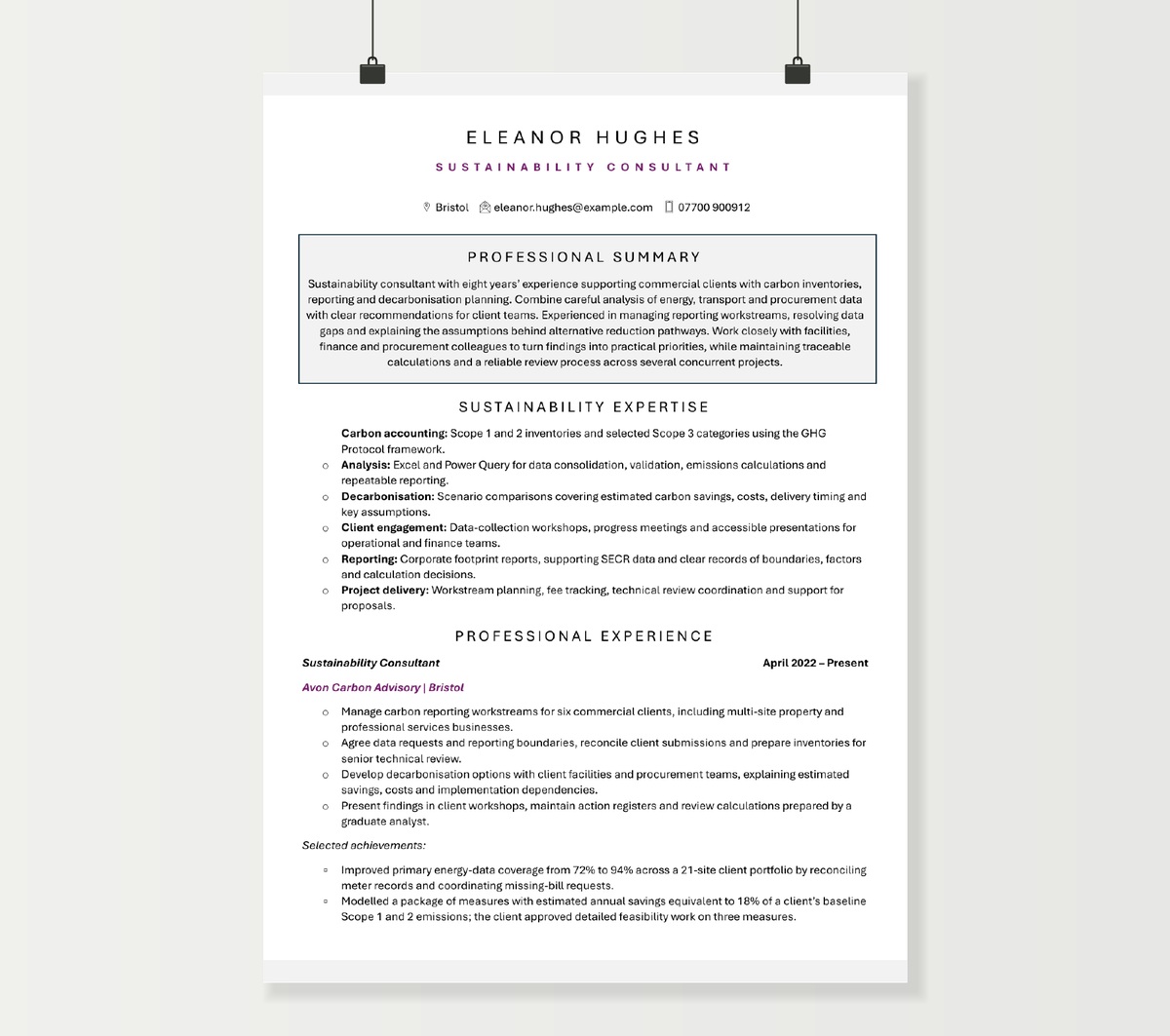
Eleanor Hughes
SUSTAINABILITY CONSULTANT
Bristol | [email protected] | 07700 900912
Professional summary
Sustainability consultant with eight years’ experience supporting commercial clients with carbon inventories, reporting and decarbonisation planning. Combine careful analysis of energy, transport and procurement data with clear recommendations for client teams. Experienced in managing reporting workstreams, resolving data gaps and explaining the assumptions behind alternative reduction pathways. Work closely with facilities, finance and procurement colleagues to turn findings into practical priorities, while maintaining traceable calculations and a reliable review process across several concurrent projects.
Sustainability expertise
- Carbon accounting: Scope 1 and 2 inventories and selected Scope 3 categories using the GHG Protocol framework.
- Analysis: Excel and Power Query for data consolidation, validation, emissions calculations and repeatable reporting.
- Decarbonisation: Scenario comparisons covering estimated carbon savings, costs, delivery timing and key assumptions.
- Client engagement: Data-collection workshops, progress meetings and accessible presentations for operational and finance teams.
- Reporting: Corporate footprint reports, supporting SECR data and clear records of boundaries, factors and calculation decisions.
- Project delivery: Workstream planning, fee tracking, technical review coordination and support for proposals.
Professional experience
Sustainability Consultant | April 2022 – Present
Avon Carbon Advisory | Bristol
- Manage carbon reporting workstreams for six commercial clients, including multi-site property and professional services businesses.
- Agree data requests and reporting boundaries, reconcile client submissions and prepare inventories for senior technical review.
- Develop decarbonisation options with client facilities and procurement teams, explaining estimated savings, costs and implementation dependencies.
- Present findings in client workshops, maintain action registers and review calculations prepared by a graduate analyst.
Selected achievements:
- Improved primary energy-data coverage from 72% to 94% across a 21-site client portfolio by reconciling meter records and coordinating missing-bill requests.
- Modelled a package of measures with estimated annual savings equivalent to 18% of a client’s baseline Scope 1 and 2 emissions; the client approved detailed feasibility work on three measures.
Graduate Sustainability Analyst | September 2018 – March 2022
Avon Carbon Advisory | Bristol
- Collected and checked energy, business travel and waste data for annual corporate carbon reports under consultant supervision.
- Maintained calculation workbooks, source references and emission-factor records, documenting assumptions for review.
- Prepared charts and report sections explaining emissions by source and changes between reporting years.
- Supported client data calls and site visits, recording queries and following up evidence with facilities teams.
Selected achievements:
- Built a Power Query import for recurring utility files, reducing monthly data preparation from one day to three hours across four client workbooks.
- Created a shared evidence checklist that reduced unresolved data queries at first review from 26 to 11 across the next reporting cycle.
Qualifications & membership
MSc Climate Change, Merit – University of East Anglia, 2018
BSc (Hons) Environmental Science, 2:1 – University of Leeds, 2017
Practitioner Member, ISEP (PISEP) – Admitted 2025
Corporate greenhouse gas accounting – Professional development course, 2023
Additional information
- Recent development: Scope 3 data quality and supplier engagement workshops; continued study of carbon-reporting updates.
- Availability: Full UK driving licence; regular client visits across the South West.
- Interests: Swimming, gardening and live music.
How to write a sustainability consultant CV
A sustainability consultant CV needs to explain what you help clients decide and the evidence you use to advise them. Interest in sustainability is a useful starting point, but employers also need to see the assessments, analysis, reports and project work you can deliver. The strongest examples connect a technical output with a practical consequence for a client or design team.
The title covers several specialisms. Corporate carbon accounting, building certification, whole life carbon, sustainability strategy and planning support can sit in different teams or overlap within one consultancy. Choose the experience that matches the vacancy, then make your particular contribution easy to recognise.
Define your area of sustainability work
Open with a short profile that identifies your experience, client or project types and main services. “Sustainability consultant delivering corporate carbon inventories and reduction pathways for multi-site commercial clients” gives a clearer starting point than a general commitment to a greener future.
A built-environment applicant might instead lead with whole life carbon assessments, BREEAM work and advice to design teams. Someone focused on corporate advisory work could emphasise organisational footprints, reporting, target development and engagement with finance or procurement teams. Place adjacent experience underneath the main specialism so the reader can see both your focus and range.
Use each employment introduction to explain the setting: a specialist consultancy, a multidisciplinary design practice or an in-house team delivering advisory work. Add useful scale, such as a client portfolio, building types, geographical coverage or the number of projects you handled concurrently.
Describe a project through your deliverable and the decision it supported
A compact project example can carry more information than a long list of responsibilities. Give the context, your work, the method or evidence and the outcome. In a building project, that might mean a material comparison that informed the design team’s selection. In corporate reporting, it might be a better-quality inventory that gave the client a clearer basis for choosing reduction measures.
For example: “Prepared a whole life carbon comparison for two structural options on an office development, documented the material assumptions and presented the results with the structural engineer to support the client’s option review.” This shows an analytical contribution, collaboration and a purpose for the report.
Keep the project stage visible. Early feasibility advice, a planning submission, a design-stage assessment, construction evidence and operational monitoring demonstrate different experience. A reader can assess your capability more accurately when the CV identifies where you joined the work and what you delivered.
Make carbon-accounting experience specific
For corporate carbon roles, describe the organisational boundary, reporting period and emissions work you handled at a useful level. Scope 1 and 2 inventories, a Scope 3 screening exercise and detailed calculations for particular value-chain categories each involve different tasks. Naming the categories or data sources can be more informative than a broad “Scope 1–3” label.
Show how you obtained and checked data. Energy records, fuel use, business travel, purchased goods and supplier information may require different collection and validation work. A bullet about reconciling inconsistent site records or improving primary-data coverage demonstrates the practical reasoning behind the final number.
Include relevant methods and reporting frameworks in context. You could describe preparing a GHG Protocol inventory, contributing data to a SECR report or supporting the evidence for a client’s target-setting exercise. The CV should make clear whether you prepared the analysis, reviewed it, coordinated the submission or managed the wider project.
Where the calculation basis materially affects a result, include a brief qualifier. The emissions scope, reporting boundary or location-based versus market-based basis can help a technical reader understand what your achievement measures. The full methodology belongs in the underlying report; the CV needs the details that make the result meaningful.
Present building assessments and certification accurately
For BREEAM and similar assessment work, identify the scheme, project type, stage and your responsibility. Relevant evidence might include pre-assessments, workshops, reviewing design-team evidence, maintaining trackers, preparing submissions or responding to assessment queries.
Distinguish the project’s target from the result reached at the stage you worked on. “Coordinated evidence for a design-stage assessment achieving Excellent” tells a different story from “supported a project targeting Excellent”. Both can be useful, particularly when your bullet explains the work you contributed.
Put assessor or advisory credentials in the qualifications section using their specific designation. In the experience section, show how that knowledge influenced delivery: resolving evidence gaps, helping the team understand an assessment requirement or maintaining progress towards a submission deadline.
Where planning work is central, name the outputs you prepared, such as a sustainability statement, circular economy statement or whole life carbon assessment. Add the planning or design context where it explains the work, rather than filling the CV with a list of policies.
Show how analysis influenced design or a reduction pathway
Whole life carbon and decarbonisation roles call for evidence of comparison and judgement. Describe the alternatives assessed, the information used and how you communicated the implications. Building materials, equipment replacement, energy supply and operating practices can involve different assumptions and implementation constraints.
For whole life carbon work, relevant detail includes the life-cycle stages covered, the source of quantities, environmental product declaration data and the assessment tool. Name One Click LCA or another platform alongside the task it supported. This gives substance to the software entry.
For a corporate or estate reduction plan, show how you combined estimated carbon savings with cost, timing and delivery dependencies. A useful outcome might be a client agreeing priorities, funding a feasibility study or allocating responsibility for implementation. These are meaningful advisory results even before a measure is installed.
Make the status of an environmental result easy to understand
Different results deserve different language. A model estimates an opportunity; a client decision commits to a next step; monitoring measures what happened after implementation. State the stage so the achievement explains the value you added.
In this CV, Eleanor’s proposed package has estimated savings equivalent to 18% of a defined baseline, followed by approval for feasibility work. That is a useful consulting result in its own right. If you have measured reductions, give the period, scope and comparison basis that help the reader interpret them.
Other strong achievements may concern data completeness, delivery, assessment progress or client service. Improving coverage from 72% to 94%, reducing review queries or producing a consistent evidence trail can demonstrate important professional value. For a metric expressed in tonnes of CO2e, explain the boundary or project stage; for a percentage, identify what it is a percentage of.
Connect analytical tools with useful outputs
Excel remains worth describing in terms of the work: structured calculation models, scenario comparisons, quality checks or recurring data consolidation. If you used Power Query, Python or another tool, explain what it made more reliable or efficient. A time saving on a repeated reporting task is often easier to assess than the phrase “advanced analytical skills”.
Building-focused applicants may need to show carbon assessment software, energy modelling or other specialist tools. Keep modelling experience tied to the vacancy and your role in the model’s preparation, checking and interpretation. A reviewer should be able to tell whether your strength is producing the analysis, reviewing outputs or translating findings for a project team.
If you are moving from a data-focused role, the data analyst CV guide can help you frame validation and reporting work. On a sustainability application, connect that capability to the environmental question and the client decision it supported.
Demonstrate that you can deliver consultancy work
Client relationships and project discipline deserve space alongside technical expertise. Describe how you agreed a brief, planned work, obtained information, managed reviews and kept stakeholders informed. For experienced consultants, include responsibility for fees, programmes or several concurrent workstreams where relevant.
Show how you communicated across disciplines. Presenting carbon findings to a finance director, discussing material options with engineers and securing data from a facilities team each require a different approach. One concrete example can demonstrate this more effectively than “excellent stakeholder management”.
For senior roles, add evidence of proposals, repeat work, technical review and developing colleagues. Be specific about your contribution to winning a project or strengthening delivery. A consultant who scoped a follow-on study has a different commercial contribution from the person who led the full tender, and both can be valuable.
Choose qualifications and development that support your specialism
List relevant degrees, professional membership and specialist credentials with their full titles and dates or status. Engineering, environmental science, architecture and related disciplines can lead to different sustainability roles. The experience and project sections show how you have applied that background.
Prioritise recent development that supports the work you want to do: carbon accounting, life-cycle assessment, building assessment schemes, energy analysis or client-facing project delivery. Put an active professional membership at its current grade. A small, relevant selection is easier to interpret than an unstructured catalogue of webinars.
Give graduate evidence a professional shape
A graduate CV can use a dissertation, placement or substantial group project to show analytical and communication ability. Explain the question, data or evidence, your method and the conclusion. In a group project, identify the work you handled and how it fitted into the final output.
Useful evidence could include comparing material options, analysing a campus energy dataset, reviewing a building against assessment criteria or presenting a transport-emissions study. The strongest detail is the reasoning and the resulting recommendation, rather than the project title alone.
Relevant work outside consultancy can also help: coordinating people, meeting deadlines, explaining findings or maintaining accurate records. Bring that evidence together with the technical project work, then choose a clear layout from the CV template library that gives the most relevant material room.
Sustainability Consultant CV FAQs
The organisation is now the Institute of Sustainability and Environmental Professionals, or ISEP. Use the current name and current membership suffix, such as PISEP for Practitioner membership. For an older qualification, the title shown on the certificate can remain appropriate. “ISEP, formerly IEMA” can help clarify the connection where it is useful to the reader.
They are different roles. A licensed assessor manages and evaluates an assessment for certification, while a BREEAM Advisory Professional supports the project team in applying the relevant scheme. Give your exact credential and designation. Experience supporting assessments can also be valuable and can be described through the tasks you carried out.
An anonymised description can still be informative: client sector, project scale, assessment stage, your deliverable and an approved outcome. For example, a multi-site retail portfolio or an office refurbishment can provide enough context without identifying the client. Public case studies can be linked when they make your own contribution clear.
Include them when they add useful evidence or a natural personal detail. A community project may demonstrate organisation, engagement or practical data collection; an ordinary interest can simply sit in a short interests section. Professional applications usually benefit most from the work, study and project evidence closest to the advertised services.
Describe the internal stakeholders as an audience with a brief, priorities and delivery needs. Show how you scoped work, gathered data, explained options and supported decisions across departments or sites. Add experience with budgets, external advisers or reporting deadlines where relevant. This helps a consultancy see how your existing delivery skills would transfer to client projects.
A short project sheet can be useful for assessment-heavy or technical roles, particularly when the CV cannot show the range of your work. Choose a few relevant projects and state the brief, your role, methods, deliverables and status. A concise, readable explanation is more useful than a collection of charts without context; follow the application’s requested attachment format.