
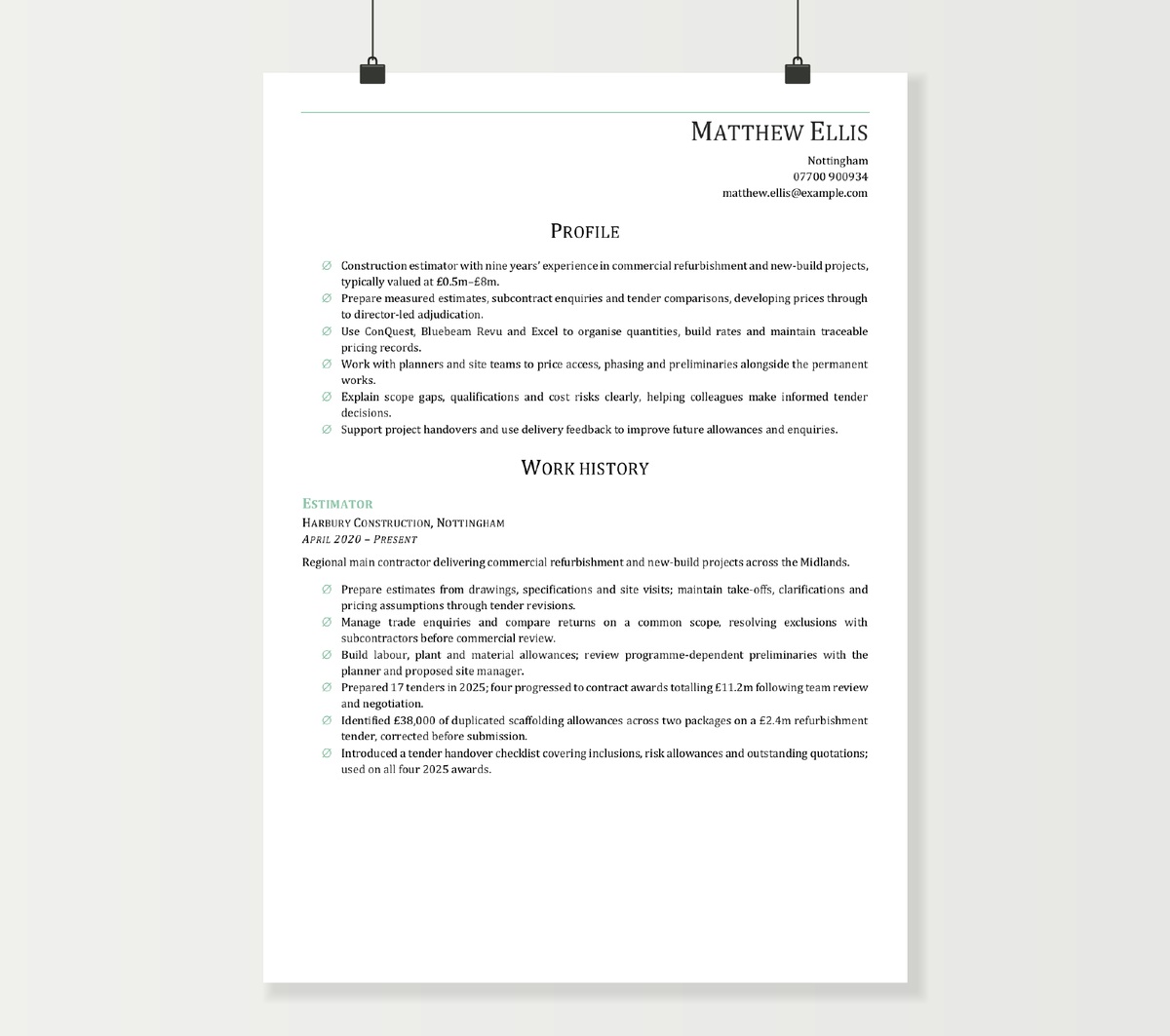
This estimator CV template follows a construction estimator working on commercial refurbishment and new-build tenders. The Word example shows progression from assisting with measurements and enquiries to preparing estimates for commercial review. The guide explains how to present tender responsibility, pricing judgement and the evidence behind your results.
Filename: FreeCVDownload_Estimator.docx
Content of this CV template
Matthew Ellis
Nottingham
07700 900934
Profile
- Construction estimator with nine years’ experience in commercial refurbishment and new-build projects, typically valued at £0.5m–£8m.
- Prepare measured estimates, subcontract enquiries and tender comparisons, developing prices through to director-led adjudication.
- Use ConQuest, Bluebeam Revu and Excel to organise quantities, build rates and maintain traceable pricing records.
- Work with planners and site teams to price access, phasing and preliminaries alongside the permanent works.
- Explain scope gaps, qualifications and cost risks clearly, helping colleagues make informed tender decisions.
- Support project handovers and use delivery feedback to improve future allowances and enquiries.
Work history
Estimator
Harbury Construction, Nottingham
April 2020 – Present
Regional main contractor delivering commercial refurbishment and new-build projects across the Midlands.
- Prepare estimates from drawings, specifications and site visits; maintain take-offs, clarifications and pricing assumptions through tender revisions.
- Manage trade enquiries and compare returns on a common scope, resolving exclusions with subcontractors before commercial review.
- Build labour, plant and material allowances; review programme-dependent preliminaries with the planner and proposed site manager.
- Prepared 17 tenders in 2025; four progressed to contract awards totalling £11.2m following team review and negotiation.
- Identified £38,000 of duplicated scaffolding allowances across two packages on a £2.4m refurbishment tender, corrected before submission.
- Introduced a tender handover checklist covering inclusions, risk allowances and outstanding quotations; used on all four 2025 awards.
Assistant Estimator
Harbury Construction, Nottingham
September 2017 – March 2020
Supported two estimators on commercial projects while developing measurement and pricing experience.
- Measured finishes and external works, checking revised quantities with the lead estimator.
- Tracked subcontract enquiries and highlighted trades with limited quotation returns.
- Compared exclusions, attendance and quotation validity for senior review.
- Updated material and labour rate records using supplier returns and feedback from completed projects.
- Recorded access, occupied areas and temporary works needs during pre-tender site visits.
- Standardised Excel comparison sheets, reducing preparation of a typical six-return package from around 90 to 50 minutes.
- Assembled tender and handover files, checking agreed clarifications against the final issue.
Qualifications and development
BSc (Hons) Quantity Surveying and Commercial Management
Coventry University | 2014 – 2017
2:1. Final project examined the treatment of uncertainty in refurbishment cost estimates.
Estimating systems training
Employer-led training | 2020 – 2025
ConQuest estimate build-up and reporting; Bluebeam measurement and revision comparison; Excel quotation analysis.
Commercial and technical CPD
Internal workshops: tender risk, JCT contract information and refurbishment logistics, 2023 – 2025.
Site experience
Pre-tender visits and handovers: offices, education buildings and light-industrial premises.
Interests
Run with a local club and enjoy walking in the Peak District.
How to write an estimator CV
A strong estimator CV explains the work behind the tender figure. Employers need to understand the projects you can price, the information you work from and the judgement you bring to incomplete scope, subcontract returns and commercial risk.
Start by making your estimating environment clear. A main contractor pricing an occupied refurbishment, a civil engineering contractor building first-principles rates and a specialist subcontractor quoting a defined package will look for different evidence. Your CV should help the reader place your experience in the right context.
Define your sector, project scale and tender responsibility
Use the profile to identify the type of work you estimate: commercial building, housing, fit-out, groundworks, infrastructure, building services or another specialism. Give a useful project or package value range and state whether you prepare complete estimates, own selected trades or support a senior estimator.
Matthew’s example establishes commercial refurbishment and new-build projects, a £0.5m–£8m range and responsibility through to director-led adjudication. That tells a hiring manager much more than a claim to be commercially aware and good with numbers.
For each employment entry, add a short line about the contractor and work mix. Include the procurement route or tender stage when it changes the nature of your contribution: competitive single-stage pricing, negotiated work, two-stage tenders, framework work or early cost planning.
Then show where your responsibility begins and ends. Preparing a first estimate, coordinating a final submission and approving the commercial position are distinct contributions. Clear ownership makes seniority easier to assess and gives the reader useful questions to explore at interview.
Show how you turn project information into a price
Measurement is more persuasive when the CV identifies what you measured and how the output was used. Describe take-offs for particular work packages, preparation or checking of quantities, and the drawings, specifications or schedules involved.
Bring out how you handle revisions and missing information. A concise example might cover a drawing discrepancy, a clarification raised, an assumption recorded and the resulting adjustment to the estimate. This demonstrates control of the pricing basis, rather than simply familiarity with tender documents.
For first-principles estimating, explain your involvement in labour, plant, material and productivity allowances. Connect those activities to the relevant construction work. A civils estimator’s experience of earthworks production rates has a different context from an interiors estimator’s labour allowances for phased work in occupied buildings.
Where your work is predominantly subcontract-based, put greater emphasis on trade coverage, scope definition and the evaluation of returns. The CV can still show technical understanding through the questions you resolved and the allowances you built around those packages.
A useful employment bullet follows the decision: what you examined, what it meant for the price and how the issue was resolved. There is no need to describe the mechanics of measurement or include a tutorial on rate build-ups.
Make quotation analysis and supply-chain knowledge visible
“Obtained subcontractor quotations” is a starting point. Stronger evidence explains how you prepared enquiries, secured coverage, compared returns and dealt with qualifications or exclusions.
Show the extent of your responsibility. You might own enquiries for several trades, maintain a subcontractor database, agree enquiry schedules with procurement or lead discussions on a specialist package. Name the work categories where they are central to the vacancy.
Describe a comparison that required judgement: different attendance assumptions, incomplete design scope, alternative materials, delivery constraints or quotation validity. Explain the clarification or recommendation that followed. This gives negotiation and communication skills a practical setting.
Regional market knowledge can be valuable, particularly in housing, refurbishment and specialist contracting. State the areas and types of supply chain you know, supported by the projects or packages you have worked on. A well-chosen example is more informative than a general claim to have excellent contacts.
Connect programme, logistics and commercial risk to the estimate
Employers need to see that the tender covers the circumstances in which the work will be delivered. Include your contribution to preliminaries, phasing, access, temporary works, welfare, restricted working hours or other project-specific allowances.
Explain collaboration with planners, operations staff and proposed site teams. For example, a revised sequence may affect plant duration, supervision or temporary accommodation. Your CV should show how you incorporated that advice into the estimate and made the assumptions visible.
Risk experience is strongest when tied to an output: a risk register, a quantified allowance, a qualification for review or an issue escalated before submission. Identify the nature of the uncertainty and your part in evaluating it.
Contract knowledge belongs here when it influences your work. Refer to the forms and project information you use, then describe the pricing or review activity. Experience identifying tender obligations for commercial review is different from administering the contract after award.
For senior roles, include adjudication or settlement meetings, presentation of options and resolution of review actions. Make it clear how you helped decision-makers understand the tender position, including the information still outstanding at the point of approval.
Choose results that explain the quality of your estimating
Award values and tender success can provide context, but they work best alongside evidence about pricing quality, risk visibility and delivery. State the period, number of tenders or relevant project so that the scale is understandable.
Matthew’s CV gives 17 tenders in one year and four subsequent awards totalling £11.2m, with team review and negotiation included in the description. The separate scaffolding example shows a specific pricing issue he identified and corrected.
Other useful results include closing a significant scope gap before submission, improving quotation coverage, reducing the time needed to prepare a comparison, or introducing a handover record that delivery teams subsequently use. Include the measure and the change that produced it.
Value engineering needs a little context. Identify the option you costed, your contribution and the stage reached: recommended, accepted in the tender or implemented on the project. A priced alternative and a realised project saving describe different outcomes.
If you discuss estimate-to-actual performance, explain the comparison basis. Project changes, buying decisions and delivery conditions can affect the final cost. A review of a defined work package or unchanged scope is often clearer than a broad accuracy percentage covering an entire project.
Include the handover and the feedback loop
The estimator’s contribution often continues after the tender is submitted. Include clarifications during negotiation, updates to the estimate and the information passed to the project team following an award.
Explain what a useful handover contains in your work: agreed scope, rates, subcontract returns, exclusions, programme assumptions, risk allowances or unresolved items. Show your role in explaining those records to quantity surveyors, project managers and site staff.
Feedback from completed work can strengthen the CV too. Describe how you reviewed actual costs or production information and used it to update a rate library, future enquiry or allowance. This demonstrates that your estimating experience develops through contact with delivery.
If your role combines estimating with post-contract duties, separate the two clearly. The quantity surveyor CV example may help you present the valuation, cost-control or final-account side of that experience.
Give software and qualifications a practical context
Name the estimating and measurement tools relevant to your work, such as ConQuest, Candy, Causeway, Bluebeam, CostX or another package. State what you do with them: take-offs, rate build-ups, quotation analysis, estimate reporting, revision comparison or cost databases.
Excel deserves similar detail where it is a substantial part of your workflow. A comparison model, linked pricing workbook or reporting improvement can show capability more effectively than a proficiency rating. Support the skills section with one or two examples in the career history.
List your degree, HNC, HND, apprenticeship or other relevant qualification with the subject, provider and date. Construction, quantity surveying, civil engineering and building-services routes can all be relevant, depending on the role. Experienced applicants can give more space to their sector knowledge and delivered work.
Keep training selective. Software development, measurement, contract awareness, specialist construction knowledge or commercial review training can be useful where it supports your current responsibilities. Professional membership or registration should appear under its precise designation.
Show progression at the right level
An assistant estimator can demonstrate readiness through reliable measurements, enquiry administration, comparison sheets, document control and increasing ownership of packages. A placement or course project is useful when it explains the scope measured, the pricing work completed and the review received.
Applicants moving from a trade or site role can foreground construction-method knowledge, materials, productivity, sequencing and supplier contact. Add examples of quotations, measurements or commercial support to connect that experience to estimating responsibilities.
Senior and managing estimators should show how their remit extends beyond preparing individual prices: allocating tender workloads, reviewing others’ estimates, developing supply-chain coverage, setting review standards and advising on commercial decisions. Keep examples of hands-on judgement alongside leadership evidence.
Use the CV template library if you want a different layout for a project-heavy or more senior application.
Estimator CV FAQs
Yes. A tender can demonstrate substantial measurement, pricing and commercial judgement regardless of the award decision. Describe your responsibility, the challenge and the completed output. Where useful, include feedback or an improvement carried into later bids; an employment history does not need to be a list of successful awards.
Use the figure that explains your responsibility. If you priced a £600,000 package within a £12m project, state both with those labels. Where you prepared the complete estimate, the overall tender value is appropriate. A value range can summarise repeated work without turning the CV into a long project schedule.
Use a project description, sector, approximate value band and your contribution where those details can be shared. You can explain an access constraint, scope review or pricing decision without including a client name, subcontractor rate or tender document. The CV should communicate your judgement and level of responsibility.
A short project sheet can help for roles that ask for detailed examples, especially when your work spans several sectors or package types. Use concise descriptions of scope, value, responsibility and outcomes. The main CV should still contain enough evidence to assess your experience without an attachment or external link.
Describe the estimating work you carry out in your current system and the outputs you produce. Measurement, structured rate build-ups, scope comparisons and reporting provide useful evidence of transferable experience. Include any training or practical use of the requested package separately so that the reader can see both your current capability and familiarity with their tools.
Bring forward the relevant trade knowledge, package quantities, labour allowances, supplier relationships and design or installation constraints. Explain how much of that package you priced yourself and how you dealt with the main contractor’s scope and programme. The most useful evidence is depth in the specialist work, rather than the headline value of the wider project.
Retain your employment title and use a short description to explain the split. For an estimating application, lead with tender preparation and pre-contract responsibility, then summarise post-contract work that adds relevant commercial understanding. A profile such as “quantity surveyor with substantial estimating responsibility” can make the transition clear.




