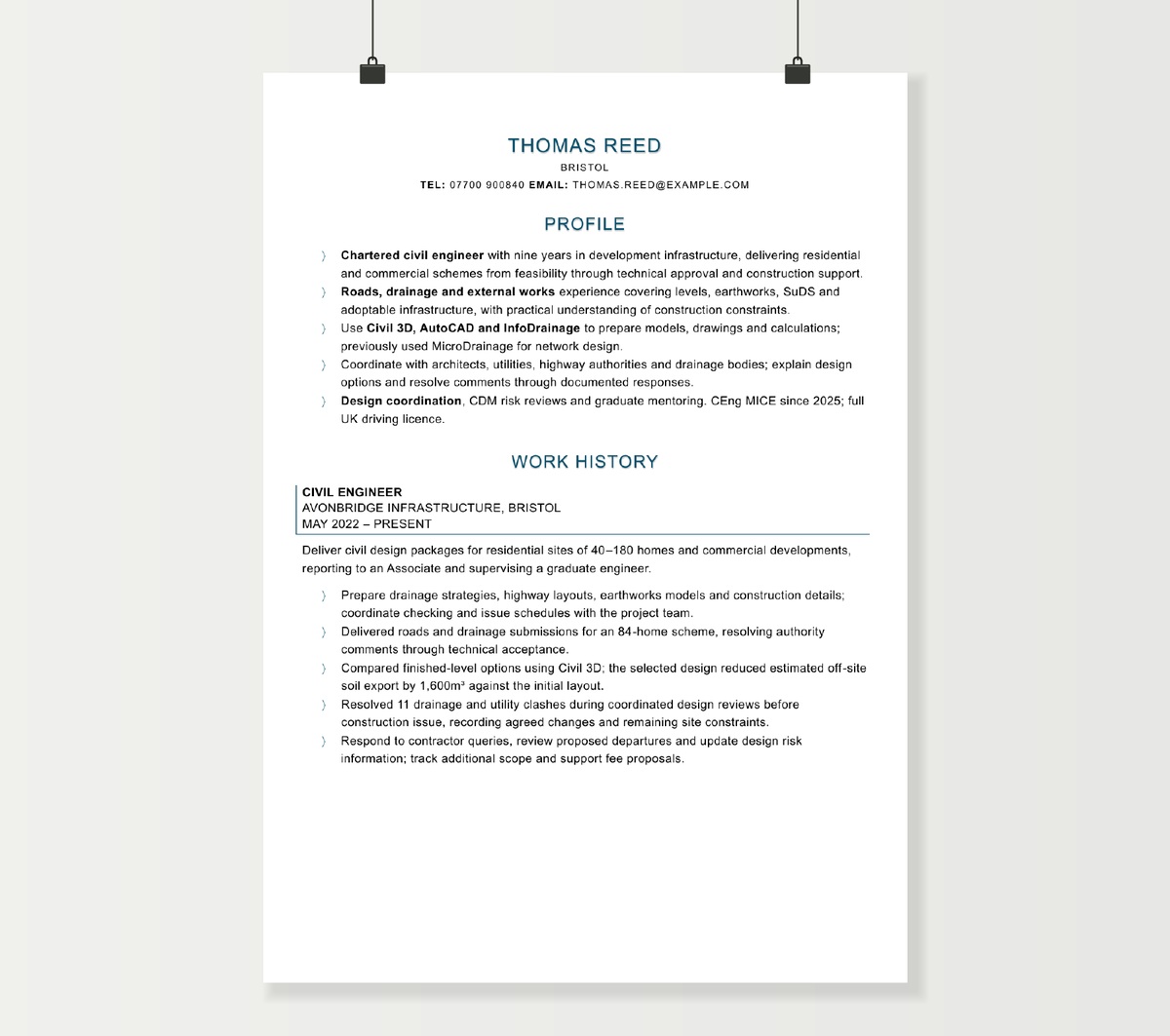
This civil engineer CV template follows an engineer from graduate development into responsibility for roads, drainage and external works packages. The Word example shows how to combine project scope, technical work, professional status and outcomes. The guide covers both consultancy and site engineering applications, including graduate and experienced roles.
Filename: FreeCVDownload_Civil_Engineer.docx
Content of this CV template
THOMAS REED
BRISTOL
tel: 07700 900840 email: [email protected]
PROFILE
- Chartered civil engineer with nine years in development infrastructure, delivering residential and commercial schemes from feasibility through technical approval and construction support.
- Roads, drainage and external works experience covering levels, earthworks, SuDS and adoptable infrastructure, with practical understanding of construction constraints.
- Use Civil 3D, AutoCAD and InfoDrainage to prepare models, drawings and calculations; previously used MicroDrainage for network design.
- Coordinate with architects, utilities, highway authorities and drainage bodies; explain design options and resolve comments through documented responses.
- Design coordination, CDM risk reviews and graduate mentoring. CEng MICE since 2025; full UK driving licence.
WORK HISTORY
CIVIL ENGINEER
AVONBRIDGE INFRASTRUCTURE, BRISTOL
MAY 2022 – PRESENT
Deliver civil design packages for residential sites of 40–180 homes and commercial developments, reporting to an Associate and supervising a graduate engineer.
- Prepare drainage strategies, highway layouts, earthworks models and construction details; coordinate checking and issue schedules with the project team.
- Delivered roads and drainage submissions for an 84-home scheme, resolving authority comments through technical acceptance.
- Compared finished-level options using Civil 3D; the selected design reduced estimated off-site soil export by 1,600m³ against the initial layout.
- Resolved 11 drainage and utility clashes during coordinated design reviews before construction issue, recording agreed changes and remaining site constraints.
- Respond to contractor queries, review proposed departures and update design risk information; track additional scope and support fee proposals.
GRADUATE CIVIL ENGINEER → CIVIL ENGINEER
WESTMOOR DESIGN PARTNERSHIP, BRISTOL
SEPTEMBER 2017 – APRIL 2022
Joined as a Graduate Civil Engineer and progressed to Civil Engineer in 2020, working on housing, school and small commercial projects.
- Prepared drainage calculations, long sections and external levels under senior review, developing detailed design experience alongside site visits.
- Produced drawing and calculation packages for Section 38, 278 and 104 submissions, maintaining comment schedules and revision records.
- Completed a three-month construction support secondment, recording drainage installation observations and coordinating responses to technical queries.
- Built a standard drawing-check register used across six live projects to track review comments, owners and issue readiness.
QUALIFICATIONS & DEVELOPMENT
CEng MICE — CHARTERED CIVIL ENGINEER
INSTITUTION OF CIVIL ENGINEERS — 2025
Achieved Chartered Civil Engineer status following professional review in 2025.
MEng CIVIL ENGINEERING — 2:1
UNIVERSITY OF LIVERPOOL — 2017
RECENT PROFESSIONAL DEVELOPMENT
INFODRAINAGE, SuDS DESIGN & CDM DESIGN RISK — 2024–2026
INTERESTS
Hill walking, photography and playing badminton in a local club.
How to write a civil engineer CV
A civil engineer CV should make three things easy to understand: the infrastructure you have worked on, the engineering responsibility you carried and the stage each project reached. A £200m scheme can provide valuable experience, but the hiring manager still needs to know whether you designed a drainage network, set out a structure, checked a package or managed the engineering team.
Start with your engineering specialism and the work you want to continue. Development infrastructure, highways, water, structures and geotechnics share professional foundations, but they call for different evidence. Give the most space to projects and decisions that resemble the vacancy.
Make your profile a clear statement of engineering scope
Use your opening paragraph to connect experience, technical focus and level of responsibility. For a consultancy role, this might be roads and drainage design from feasibility to construction, authority liaison and responsibility for a graduate engineer. For a contractor, it might be setting out and quality control on utilities packages, working with supervisors and subcontractors under a senior engineer.
Include professional status prominently when it is relevant: CEng MICE, IEng MICE or graduate membership, alongside your current role. A profile also gives you room to explain a deliberate move, such as a site engineer bringing construction knowledge into a design team. Support that move with relevant work in the experience section.
Describe projects through the package you delivered
Under each employer, introduce the types and scale of projects before giving detailed examples. An engineer handling several small developments needs a different description from someone spending two years on one major infrastructure contract. Either can demonstrate substantial responsibility.
A useful project entry brings together the following details:
- Context: the asset or development, approximate scale and constraints, such as a live site, constrained outfall or phased occupation.
- Your package: the drainage network, earthworks model, highway geometry, reinforced concrete element or defined site section.
- Your involvement: design, checking, coordination, supervision or delivery, with the stage and reporting relationship clear.
- Evidence of progress: an accepted submission, resolved interface, issued construction package, completed inspection record or decision supported by your analysis.
For example: “Produced the drainage design and authority response schedule for an 84-home development, coordinating revised levels with the architect through technical acceptance.” That conveys more than “worked on residential projects”. For a large scheme, state the overall value as context and identify the smaller package you handled in the same entry.
Show the engineering behind your design output
Drawing production is part of the story. A design employer will also want to see the judgement behind the drawings: options considered, constraints reconciled and information checked. Describe how you developed a solution, what you coordinated and what moved forward as a result.
A drainage engineer might use one bullet for network calculations and attenuation options, another for external levels and exceedance routes, and a third for responses to the relevant approval body. A highways engineer might highlight alignment, junction or pavement work and how the design fitted existing services or a staged construction sequence. Water-sector candidates can identify the specific asset and interfaces with process, mechanical and electrical teams.
Differentiate design preparation, independent checking and approval responsibility through your verbs. “Prepared calculations for senior review”, “checked drainage calculations” and “led the design review” describe different levels of contribution. This helps the reader place you within the technical team and understand your progression.
Give site engineering its own evidence
For a site role, set out the work packages you supported and how you maintained dimensional accuracy, quality and usable records. Name relevant total-station, GNSS or survey-processing experience alongside the work it enabled. An equipment list alone does little to explain whether you established control, set out duct routes or completed as-built surveys.
Choose examples from inspection and test plans, hold points, concrete or earthworks records, drawing queries, non-conformance resolution and handover information where these formed part of your role. Explain how you worked with the section engineer, foreman and subcontractors. Evidence of a discrepancy identified and resolved before the next stage can be as persuasive as a large quantity of work delivered.
Include current site cards and relevant training in a compact section, with the exact qualification or card type. Candidates progressing into broader site leadership can add examples of coordinating resources, planning upcoming work and supporting less experienced engineers.
Connect software and standards to work you can discuss
Group technical skills around their purpose. Civil 3D might support surfaces, corridors, grading and earthworks; InfoDrainage or MicroDrainage might support network modelling; AutoCAD might support detailed drawings. For each important tool, give a brief indication of the tasks you use it for. Include comparable software where that is your practical experience.
Show how models and drawings reach the wider project team. Coordinated model reviews, revision control, shared information environments and resolved interfaces make BIM experience tangible. A short project example often communicates more than a standalone “BIM” skill.
Standards deserve the same treatment. Relate them to the asset, design decision or submission concerned. If you have prepared Section 38, 278 or 104 packages, identify your contribution to the drawings, calculations and responses. Set this in the correct jurisdiction: approval processes and terminology differ across the UK and Ireland. State the authorities or geographic experience that is relevant to the role.
Present safety and sustainability as engineering contributions
A CV can show how you considered construction, use and maintenance within your design work. A concise example might describe changing an access arrangement, reducing a difficult excavation or communicating a residual risk through coordinated design information. State the contribution you made and the people you worked with.
For CDM experience, distinguish your work as a designer from a formally appointed principal designer role. The useful CV detail is the design review, risk decision or information you produced, supported by the scope of your responsibility.
Sustainability evidence is strongest when attached to a specific comparison: earthwork balance, material quantities, reuse opportunities or an assessed carbon option. Explain the basis of an estimate and the project stage. “Reduced estimated export by 1,600m³ against the initial levels layout” gives a clear engineering result; a delivered saving belongs with an outcome verified later in the project.
Choose measures that reflect your contribution
Project size establishes context; achievements show what changed through your work. Useful measures can include the length of a network, number of coordinated packages, quantity reduction, review turnaround, resolved interfaces or programme milestone. Include enough context to make the figure meaningful.
Separate technical acceptance, construction completion and final adoption in your wording. They are different milestones. Equally, a design option recommended to a client is a worthwhile contribution even when construction has yet to start. State the decision supported and the evidence behind it.
Senior engineers should show how their decisions affected delivery as well as the technical solution. Examples could cover managing a design change within an agreed fee, explaining additional scope, coordinating checking resources or helping a junior colleague take ownership of a package. Where responsibility includes wider budgets and programme control, the project manager CV example offers a useful comparison.
Make professional development and progression visible
List the exact degree, institution and completion date, followed by professional registration or membership. For engineers working towards professional qualification, describe the current stage briefly: structured initial professional development, an agreed development plan or preparation for review. This gives an employer a clearer picture than “chartership pending”.
Select recent CPD that connects to the advertised work, such as drainage modelling, design risk, contract administration or a relevant technical discipline. The employment history should show the associated responsibility developing: from producing work under review to managing packages, checking others’ work or leading client discussions.
If you progressed within one company, show the role changes and dates beneath that employer. Long service then reads as increasing capability, rather than one undifferentiated period.
Build a graduate CV around engineering evidence
Graduates can bring education and selected projects above a shorter employment history. Choose a dissertation, group design project or placement that relates to the role. Describe the brief, your own part, calculations or software used and the output you presented. A team project becomes much more informative when the reader can identify your contribution.
Use placements to show exposure to drawings, site records, design meetings, surveys or checking processes. Other employment can contribute evidence of organising work, communicating with customers or taking responsibility for safety, but the civil engineering material should remain easy to find.
As professional experience grows, reduce the academic detail and give that space to delivered projects. An experienced CV normally benefits from a small number of well-chosen project examples within the employment history, supported by a separate project sheet when the application asks for one. You can browse the Word CV library for another layout if your project history needs a different balance of space.
Civil Engineer CV FAQs
Follow the application requirements first. A short project sheet can be useful for design roles, with a small selection of permitted drawings or diagrams and a caption explaining your contribution. Choose material that demonstrates a relevant engineering problem and outcome. An ordinary CV can instead name the deliverables and project scope, with further examples available for interview.
Keep the original qualification and employer details, then make the project scale, design duties and construction context understandable to a UK reader. Identify the standards and approval bodies you worked with, plus any UK experience or professional recognition you have completed. A concise account of transferable engineering work is more useful than translating every job title into a UK grade.
Yes. Rebalance the profile and project bullets towards drawing interpretation, design queries, surveys, buildability and coordination with designers. Include any calculations, modelling or design development you have undertaken, together with relevant study. Your understanding of how designs are built is a strong part of the application when it is connected to the consultancy’s work.
Show the contracting employer or agency, your role and the dates, then name the client project as context. Where several short assignments formed one continuous period of similar work, a grouped contract section can keep the CV readable while preserving the employer and date information. Give the most detail to the packages that demonstrate a change in responsibility.
They are useful when the role involves site visits, surveys or work across several locations. A short line stating licence status and the travel or relocation arrangements you can accommodate is enough. For a predominantly office-based role, engineering experience and project responsibility usually deserve the more prominent space.
Use the milestones it has reached: feasibility options presented, a planning submission completed, technical comments resolved or a design package issued. Describe any assessed benefits as forecasts or estimates and explain the comparison. A clear account of design-stage responsibility still gives an employer strong evidence of your capability.