This DevOps engineer CV template follows an engineer who moved from Linux infrastructure support into an AWS platform team. The example connects Terraform, delivery pipelines and monitoring with the improvements they supported, including faster releases and more useful alerts. Download the Word CV, then use the guide to present your own infrastructure experience, production responsibilities and technical projects.
Filename: FreeCVDownload_DevOps_Engineer.docx
Content of this CV template
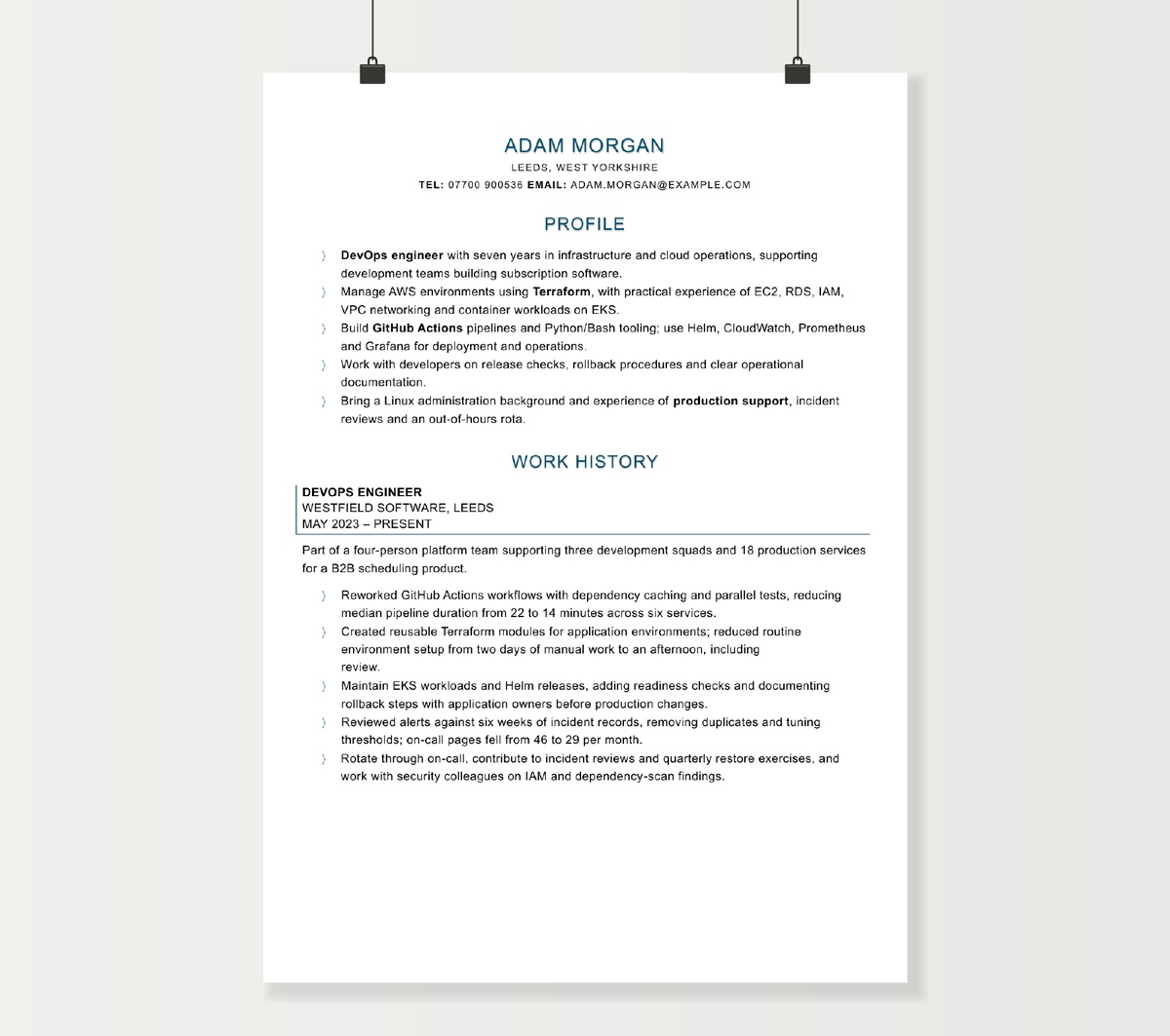
ADAM MORGAN
LEEDS, WEST YORKSHIRE
tel: 07700 900536 email: [email protected]
PROFILE
- DevOps engineer with seven years in infrastructure and cloud operations, supporting development teams building subscription software.
- Manage AWS environments using Terraform, with practical experience of EC2, RDS, IAM, VPC networking and container workloads on EKS.
- Build GitHub Actions pipelines and Python/Bash tooling; use Helm, CloudWatch, Prometheus and Grafana for deployment and operations.
- Work with developers on release checks, rollback procedures and clear operational documentation.
- Bring a Linux administration background and experience of production support, incident reviews and an out-of-hours rota.
WORK HISTORY
DEVOPS ENGINEER
WESTFIELD SOFTWARE, LEEDS
MAY 2023 – PRESENT
Part of a four-person platform team supporting three development squads and 18 production services for a B2B scheduling product.
- Reworked GitHub Actions workflows with dependency caching and parallel tests, reducing median pipeline duration from 22 to 14 minutes across six services.
- Created reusable Terraform modules for application environments; reduced routine environment setup from two days of manual work to an afternoon, including review.
- Maintain EKS workloads and Helm releases, adding readiness checks and documenting rollback steps with application owners before production changes.
- Reviewed alerts against six weeks of incident records, removing duplicates and tuning thresholds; on-call pages fell from 46 to 29 per month.
- Rotate through on-call, contribute to incident reviews and quarterly restore exercises, and work with security colleagues on IAM and dependency-scan findings.
INFRASTRUCTURE ENGINEER
PENNINE MANAGED SERVICES, BRADFORD
SEPTEMBER 2019 – APRIL 2023
Supported Linux servers and AWS-hosted applications for a managed services provider, progressing from junior engineer in July 2021.
- Automated routine server configuration with Ansible and Bash, replacing a manual checklist used for approximately ten new hosts each month.
- Investigated application, DNS and certificate issues alongside developers, recording diagnosis and recovery steps in shared support runbooks.
- Helped move eight customer applications from single servers to load-balanced AWS environments, testing backups and deployment procedures before handover.
- Scheduled patching with customer contacts, checked monitoring after changes and coached two new starters through common Linux support tasks.
QUALIFICATIONS & DEVELOPMENT
BSC (HONS) COMPUTER SCIENCE, 2:1
LEEDS BECKETT UNIVERSITY – 2019
Final-year project: a web-based room-booking system with automated testing and deployment to a Linux server.
AWS CERTIFIED SOLUTIONS ARCHITECT – ASSOCIATE
ACHIEVED JUNE 2025
KUBERNETES OPERATIONS AND INCIDENT RESPONSE
WESTFIELD SOFTWARE, INTERNAL WORKSHOPS – 2024–2026
OUTSIDE WORK
I enjoy cycling, board games and building small apps for everyday problems, most recently a shared meal planner for friends.
How to write a DevOps engineer CV
A strong DevOps CV lets a hiring manager picture the systems you worked on, the decisions you made and what became better as a result. The most useful details often sit behind the tool names: who used your pipelines, how infrastructure changes reached production, what happened when a release failed, and how you helped the next engineer diagnose a problem.
Start with the kind of role you want. A cloud infrastructure vacancy may emphasise networking, identity and environment provisioning. A platform team may need reusable services for developers. A release engineering post may centre on build systems, application promotion and controlled deployments. Use the opening profile and the order of your experience to make the relevant part of your background easy to find.
Give the reader a picture of your platform
Open each recent job with a short description of the environment. Include the product or service, the team you worked in and a useful indication of scale. Three development squads, a fleet of Linux hosts, several customer environments or a regulated release process can all establish context. Choose the measure that explains the work; a count of containers alone may reveal little about responsibility.
The example CV identifies a four-person platform team supporting 18 services. That makes the following achievements easier to assess. An engineer maintaining deployment templates used by several teams has different scope from someone creating a pipeline for one application, even when both use GitHub Actions.
Then make your contribution visible. “Built and maintained the Terraform modules used for application environments” describes ownership. “Supported the migration, testing backup restores and documenting operational handover” gives a clear supporting role. Both are useful evidence. Separate the wider programme from the part you delivered, especially for migrations that involved architects, security specialists and application teams.
Present technical skills with enough depth to be meaningful
A compact skills section can help a recruiter find the relevant technologies, but the employment section should explain how you used them. Group tools by the work they support: cloud and operating systems; infrastructure automation; build and deployment; observability; programming. This is easier to read than a long line containing every product from every job.
For a cloud platform, name the services that define your experience. AWS becomes more informative when accompanied by VPC networking, IAM, EC2, RDS or EKS and a responsibility such as managing production environments. For Azure, the relevant detail might be AKS, virtual networking, managed identities and Azure Monitor. Give your strongest platform the most space. Experience with one cloud, supported by sound networking and operational knowledge, is a coherent proposition.
Distinguish regular production work from project exposure through simple context. “AWS and Terraform — production infrastructure since 2023” and “Azure — personal deployment project” communicate more than a four-star proficiency rating. Put older technology under the role where it was used if it is no longer central to your application.
Explain what you changed in CI/CD
“Maintained pipelines” leaves several questions unanswered. What did the pipeline build? What checks did it run? Which environments did it deploy to? What did you improve? A strong bullet connects a specific change to delivery: adding parallel tests, standardising reusable workflows, improving artefact handling, introducing release approvals or making failed deployments easier to recover.
Choose results that match the intervention. Build caching may reduce pipeline duration; automated environment setup may reduce waiting time; a consistent promotion process may reduce manual release steps. These are different outcomes and should be described separately. Pipeline run time is not the same as the time between a developer committing code and a change reaching users.
For example: “Introduced shared GitLab CI templates for four services, bringing security checks and artefact promotion into the same release process.” That remains useful without a percentage. Where you have a measured result, add its scope: the example CV gives a median duration before and after the change, across six services.
Include the maintenance behind a successful rollout where it shows judgement: working with developers to resolve flaky tests, keeping runners healthy, dealing with dependency changes, or agreeing recovery procedures. This helps an employer see that you can keep delivery working after the initial implementation.
Show infrastructure as code as engineering work
Terraform, CloudFormation, Pulumi and configuration-management tools deserve more than a tick in a skills list. Describe the infrastructure they controlled and the practices around changes. Reusable modules, peer review, validation, managed state, environment separation and migration from manually configured resources can each demonstrate a different level of experience.
Select the details relevant to your contribution. Someone who created modules and agreed their interface with application teams should show that design work. Someone who maintained existing modules and resolved drift can explain the operational improvement. A short bullet about standardised environments and a second about review or testing usually communicates more than a catalogue of resource types.
Automation is strongest when the reader understands the task it replaced. State how often the task occurred and who benefited. “Automated configuration for around ten new hosts a month” establishes recurring value; “automated infrastructure” does not. If the work required approval or a manual verification step, include that in the timing so the result describes the whole usable process.
Make reliability and incident experience visible
DevOps CVs can become dominated by things the candidate built. Employers also need to know how those things were operated. Include on-call responsibilities, troubleshooting, monitoring, recovery testing and incident follow-up where they formed part of your role.
Monitoring evidence should explain what became easier to detect or act on. A dashboard may have brought service health into one place; revised alerts may have reduced duplicate pages; distributed tracing may have helped teams locate delays between services. Name the operational use before adding the tool. The number of Grafana dashboards is rarely the most valuable result.
For an incident, a concise account can cover your role, the diagnosis or recovery work and the subsequent improvement. “Investigated recurring certificate failures, added expiry alerts and documented the renewal procedure for the support rota” gives the reader both technical and operational evidence. Major-incident leadership, incident participation and follow-up engineering can be presented as distinct responsibilities.
Recovery exercises are also valuable. Specify whether you tested restoration, updated runbooks, checked recovered data with service owners or helped meet an agreed recovery target. If availability is central to your achievements, define the service and measurement period. A service-level result is much easier to interpret than an unqualified claim of platform uptime.
Connect security and cloud cost work to your responsibilities
Security often appears in DevOps adverts because engineers control deployment paths, infrastructure and access. Use the CV to show the part you handled: tightening IAM permissions, integrating dependency or container scanning, improving secrets handling, applying patching schedules, or supplying change evidence for an audit. Explain collaboration with the security team when it helps define the work.
Cost improvements need similar context. Identify the resources or workload affected, the action taken and the period used for comparison. Removing idle development environments is different from reducing the cost of a growing production service. If usage changed substantially, a measure such as cost per workload may explain the result better than the total monthly bill.
For work in a controlled environment, describe relevant release approvals, documentation and traceability. A general CV needs the engineering experience; individual applications can carry any additional information requested for the employer’s recruitment or vetting process.
Show that developers could use what you built
A platform improvement has more value when other engineers can adopt it. Include evidence of onboarding, documentation, troubleshooting sessions and feedback from the teams using your tools. A self-service environment that reduced support requests, or a deployment pattern adopted by several squads, shows the connection between infrastructure work and delivery.
For senior applications, explain decisions as well as implementation. You might have compared migration options, agreed standards with security and architecture teams, prioritised reliability work or mentored colleagues through design reviews. Give the extent of your leadership: technical direction for a project, coaching junior engineers, or line management of a team. These are different contributions and each can be valuable.
Where you influenced a change without formal authority, describe how it was adopted. “Worked with three squads to replace separate deployment scripts with a shared workflow” shows cross-team work much more clearly than “excellent stakeholder management”.
Choose DevOps projects that reveal your thinking
A useful project gives you something concrete to discuss about deployment and operation. An application deployed through a pipeline can demonstrate infrastructure configuration, tests, secrets handling, monitoring and recovery. The application itself can be small; the interesting evidence is how you made it reproducible and supportable.
On the CV, describe the purpose, your engineering decisions and the result in two or three lines. Add a repository or short write-up when it helps a reviewer explore further. A README that explains the architecture, setup, trade-offs and a problem you resolved is more useful than a collection of files without context. Include how you checked that the deployment worked and what you would improve next if those points distinguish the project.
Choose a small number of substantial examples. A pipeline with meaningful tests and a documented recovery exercise can be stronger evidence than several nearly identical deployments. For an experienced engineer, recent production work will normally deserve more space; a personal project earns its place when it demonstrates a relevant capability beyond that work.
Adapt the CV to your route into DevOps
If you are moving from infrastructure support, lead with Linux administration, networking, troubleshooting, repeatable configuration and operational handovers. Then show where you introduced code, source control or deployment automation. Preserve your actual job titles and use the descriptions to make the progression visible.
If you are moving from software development, bring forward build systems, automated testing, deployment ownership and experience diagnosing production behaviour. Explain any work with infrastructure or release engineering colleagues. The bridge to DevOps is the delivery and operation of software, rather than simply adding cloud tools to the top of a developer CV.
For a first role, put relevant projects, placements or apprenticeship experience near the opening. Make the tasks and outcomes specific enough to discuss at interview. A degree, training course or certification can establish a foundation; the project section shows how you applied it. For an established engineer, employment evidence should lead, with education and selected development taking less space.
Include qualifications and development selectively
List the full name of a relevant cloud or infrastructure certification, the awarding organisation and the date achieved or renewed. Where a qualification has a validity period, a current status or expiry date makes it easy to interpret. A completed certification and preparation for an exam can sit separately under qualifications and current learning.
A computing degree or apprenticeship may be relevant, but the value of the education section changes with experience. A recent graduate can include a deployment-focused final project; an engineer with years of production responsibility can keep the degree to a line or two. Internal training also belongs when it explains useful development, such as incident response, Kubernetes operations or secure delivery practices.
Read the final CV from the perspective of the team hiring you: can they see what you could take responsibility for, which technologies you have used in that context and how your work helped delivery or reliability? Keep those connections clear. You can explore other layouts in the Word CV template library if a different design suits the amount of project or employment evidence you need to present.
DevOps Engineer CV FAQs
Yes, where your responsibilities fit the vacancy. Keep the title your employer used, then bring forward scripting, version-controlled configuration, deployment work and production troubleshooting. A profile can describe the direction of your experience, while the employment entries show the evidence behind it. This also helps recruiters understand a progression that job titles alone may obscure.
Use a description of the service and engineering scope that can be shared publicly: the sector, type of workload, approximate scale and your responsibilities. You can explain an improvement to releases, monitoring or recovery without publishing internal architecture, customer names or sensitive configuration. A concise account of your decisions and contribution can stand on its own without a repository link.
Public activity is one way to demonstrate work, but much DevOps engineering happens in private repositories. Strong employment evidence can cover the systems you operated, changes you delivered and problems you resolved. If you have a public technical write-up, talk or small project that adds something relevant, include it; a profile link with little to inspect is less useful than a clear account of recent engineering work.
Yes. Build troubleshooting, release controls, Linux operations, networking and automation can transfer to a different environment. Give the strongest relevant work its proper space, then distinguish any container experience you have gained alongside it. If the role requires ownership of production Kubernetes clusters, your CV should make the extent of that particular experience easy to assess rather than leaving the reader to infer it from Docker.
Include it when it produced a useful engineering outcome and is relevant to the vacancy. Describe the workflow you improved, the part you designed or integrated and how the output was reviewed or tested. For example, an internal tool that helps engineers find the appropriate runbook is more informative than a general statement that you use AI. Routine use of a coding assistant rarely needs a separate achievement bullet.
Give each engagement its dates, sector or client description, and specific delivery scope. A migration, platform upgrade or release-system replacement can make the reason for a short contract clear. Keep repeated tools in a compact skills section so each contract entry can focus on what changed. Where several assignments were through one employer, grouping them beneath that employer can show continuity while preserving the individual project evidence.