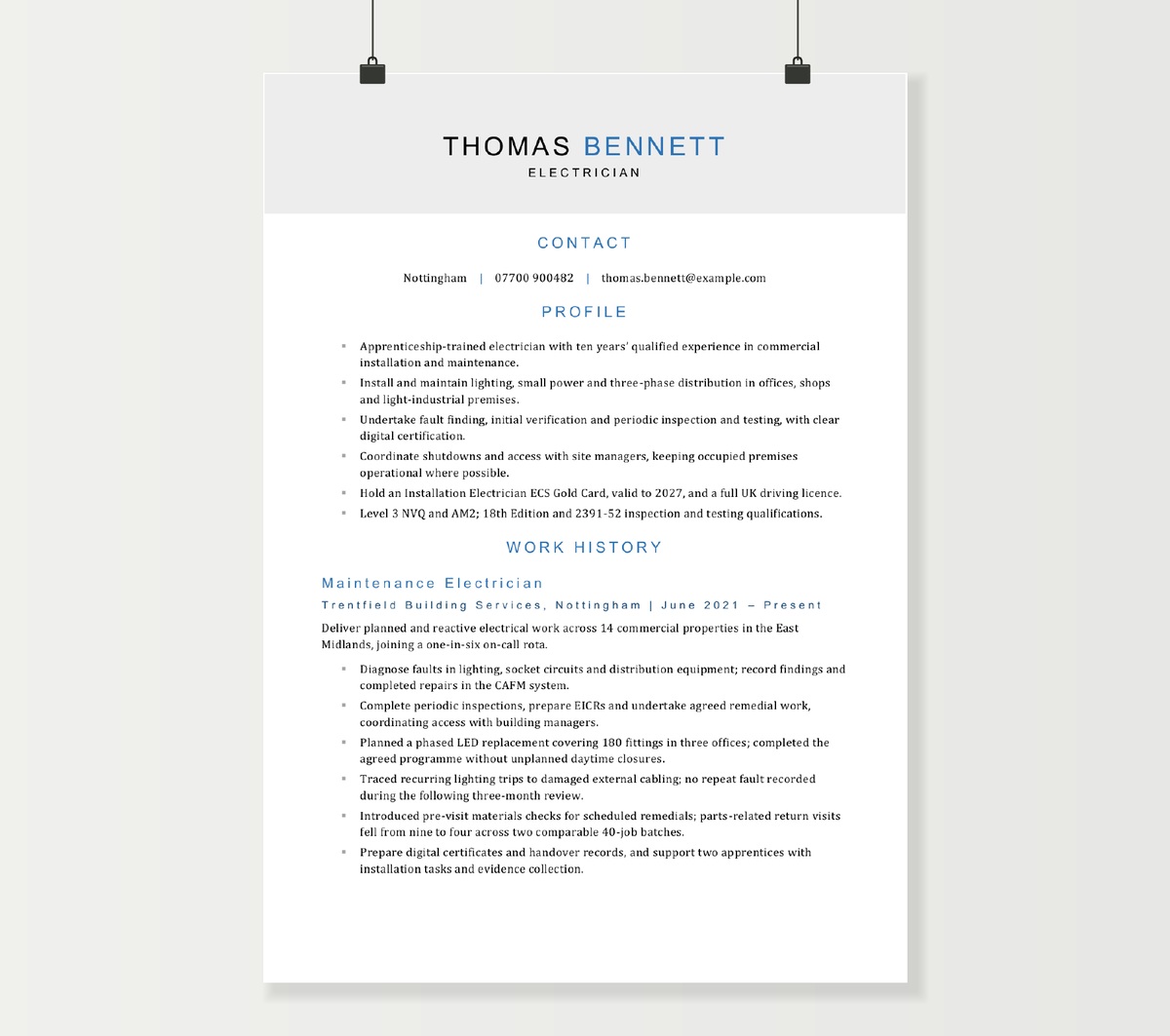
This electrician CV template follows an apprenticeship-trained electrician with commercial installation and maintenance experience. The Word example sets out his qualifications, inspection and testing work, fault finding and progression from apprentice to experienced site electrician. The guide explains how to adapt the emphasis for installation, facilities maintenance, housing repairs or a first qualified role.
Filename: FreeCVDownload_Electrician.docx
Content of this CV template
Thomas Bennett
Electrician
Contact
Nottingham | 07700 900482 | [email protected]
Profile
- Apprenticeship-trained electrician with ten years’ qualified experience in commercial installation and maintenance.
- Install and maintain lighting, small power and three-phase distribution in offices, shops and light-industrial premises.
- Undertake fault finding, initial verification and periodic inspection and testing, with clear digital certification.
- Coordinate shutdowns and access with site managers, keeping occupied premises operational where possible.
- Hold an Installation Electrician ECS Gold Card, valid to 2027, and a full UK driving licence.
- Level 3 NVQ and AM2; 18th Edition and 2391-52 inspection and testing qualifications.
Work history
Maintenance Electrician
Trentfield Building Services, Nottingham | June 2021 – Present
Deliver planned and reactive electrical work across 14 commercial properties in the East Midlands, joining a one-in-six on-call rota.
- Diagnose faults in lighting, socket circuits and distribution equipment; record findings and completed repairs in the CAFM system.
- Complete periodic inspections, prepare EICRs and undertake agreed remedial work, coordinating access with building managers.
- Planned a phased LED replacement covering 180 fittings in three offices; completed the agreed programme without unplanned daytime closures.
- Traced recurring lighting trips to damaged external cabling; no repeat fault recorded during the following three-month review.
- Introduced pre-visit materials checks for scheduled remedials; parts-related return visits fell from nine to four across two comparable 40-job batches.
- Prepare digital certificates and handover records, and support two apprentices with installation tasks and evidence collection.
Electrician
Harrowgate Electrical, Nottingham | September 2016 – May 2021
Installed electrical services on commercial refurbishments and small industrial projects, working from drawings and site instructions.
- Installed containment, lighting, small power and three-phase circuits in shops, offices and workshops.
- Carried out initial verification and completed test schedules and installation certificates for supervisor review.
- Coordinated cable routes with other trades and marked up changes for as-built records.
- Delivered the electrical installation for four shop refits through agreed evening and weekend access periods.
Apprentice Electrician
Harrowgate Electrical, Nottingham | Sep 2012 – Aug 2016
Completed a four-year apprenticeship combining college study with supervised site work.
- Assisted with containment, cabling, terminations and testing across commercial projects.
- Built a workplace evidence portfolio and completed the AM2 assessment in 2016.
Qualifications and training
Level 3 NVQ Diploma in Installing Electrotechnical Systems and Equipment
City & Guilds 2357-13 | 2016; AM2 | 2016
Electrical qualifications and updates
City & Guilds 2382-18 (2019); 2391-52 Initial and Periodic Inspection and Testing (2020); BS 7671 Amendment 4 update (2026); asbestos awareness refresher (2026).
Hobbies and interests
I enjoy cycling, restoring old furniture and watching cricket.
How to write an electrician CV
An electrical contractor needs to know what you can install and hand over. A facilities employer needs to understand the plant and buildings you maintain, how you deal with faults and how you record completed work. A housing repairs team will also care about appointments, resident contact and working in occupied homes. Your CV should make the relevant experience visible before the reader reaches a long list of certificates.
Start with the kind of electrician you are and the work you want to continue doing. “Maintenance electrician with commercial offices and light-industrial experience” gives a clearer starting point than “experienced electrical professional”. Follow it with the strongest matching evidence: your qualification route, inspection and testing work, installation background or responsibility for a group of sites.
Make your qualifications and card status easy to find
Electrical qualifications often determine whether an application can progress, so give them a clearly labelled section. For an experienced electrician, a short summary near the top can establish your Level 3 route, relevant card and testing qualification; the full entries can sit later in the CV. A newly qualified applicant may benefit from placing that section immediately after the profile.
Use the qualification title, awarding body, code where helpful and completion year. A reader should be able to distinguish a competency-based NVQ or apprenticeship from a classroom diploma, a wiring regulations award and a short update course. Keep these as separate entries even when they were completed through the same training provider.
- Apprenticeship or vocational qualification: give the completed award and route, with the AM2 or relevant assessment recorded separately where applicable.
- Wiring regulations: identify the award you received and its date. Put later amendment training or CPD on its own line so the history remains clear.
- Inspection and testing: give the precise qualification, such as initial verification, periodic inspection or a combined award. The work-history section can then show where you have used it.
- ECS or other relevant card: state the card category and validity date. “Installation Electrician ECS Gold Card” is more informative than “CSCS card”.
- Additional training: select what matters to the job, such as asbestos awareness, access equipment or a relevant specialist installation course, and include dates where currency matters.
Exact wording is especially useful when a recruiter is comparing different qualification routes. Your existing award retains its identity when standards are updated; a separate CPD entry shows how you have kept your knowledge current. Where a vacancy specifies a particular grading or card, make the status you hold easy to locate.
Describe the installations you have actually delivered
For installation roles, organise experience around the environments, systems and stages of work you have covered. A shop refurbishment, a new warehouse and an occupied office upgrade involve different coordination and access demands. Name the setting, then explain your contribution to the installation.
Useful details include containment types, lighting and small power, single- or three-phase distribution, reading drawings, cable installation and termination, initial verification and handover documents. Choose the details that identify the work; a catalogue of every accessory fitted will make the important experience harder to see.
A project bullet could read: “Installed lighting and small power for four retail refits, coordinating evening access with store managers and completing test schedules for handover.” This establishes a setting, a repeatable scope of work and a practical constraint. If you worked within a larger team, naming your package of work gives the reader a useful picture of your responsibility.
For larger projects, a short selected-project entry can sit beneath the relevant employer. Give the project type, your package, team or subcontractor responsibility and completion evidence. Project value helps only when it explains scale; the value of the entire development may say little about the electrical work you delivered.
Show how you handle maintenance and fault finding
Maintenance employers need more than “PPM and reactive maintenance”. State the estate you cover, the equipment you maintain and how jobs reach you. A static office site, a mobile portfolio of shops and a secure estate are different working environments, even when some of the electrical systems overlap.
Describe your use of the maintenance system through the work it supports: accepting jobs, recording diagnosis, requesting parts, updating asset histories and closing tasks with test results or follow-up actions. If you have used a named CAFM or CMMS package, include it in that context. “Used Maximo to record faults and follow-on work across a hospital estate” is more useful than a software name in isolation.
Choose a fault-finding example with a clear conclusion. Explain the affected system, what you identified and what changed after the repair. You might have traced an intermittent lighting fault, identified a recurring component failure or corrected an inaccurate circuit record that was slowing subsequent call-outs. The CV needs the scope and outcome, rather than a step-by-step account of your diagnostic method.
For on-call work, mention the rota and your level of responsibility where relevant. Employers can then see experience of prioritising urgent jobs, arranging follow-up repairs and giving a useful handover to the daytime team.
Give inspection, testing and certification enough substance
Testing experience deserves more precision than “test and inspect”. Distinguish initial verification on new installations from periodic inspection of existing premises, and identify the buildings or systems involved. Add the documentation you produce, such as electrical installation certificates, minor works certificates or electrical installation condition reports.
Show the connection between inspection and the next stage of work. For example, an electrician in housing may arrange access, complete reports and return for authorised remedials. A commercial contractor may coordinate testing with a shutdown and supply schedules and marked-up drawings for handover. These details demonstrate how your work fits the employer’s service.
If reporting software is a significant part of the job, name the package and explain your use of it. A concise reference to producing digital reports, attaching supporting records and resolving review queries is stronger than a claim to be “computer literate”. Where certificates are checked by a supervisor or qualifying supervisor, describe that handover naturally.
Volume can be useful, but building type and scope matter alongside it. A number of inspections per week means little without knowing whether these were small dwellings or substantial commercial installations. Use a representative workload with enough context for the reader to understand it.
Include the coordination that makes site work possible
Electrical work often depends on access, shutdowns and other people’s programmes. Show how you have coordinated with building managers, tenants, other trades, subcontractors or the client’s representative. This is particularly valuable in occupied buildings, where the quality of the service includes how well disruption is managed.
Bring safety-related responsibilities into those examples: working under permits, documenting isolations, attending site briefings, preparing task records or arranging an authorised shutdown. The employer can then see how those responsibilities operate in your normal work. A long standalone list of safety abbreviations adds less.
Housing applicants can show experience of scheduled appointments, explaining the work to residents, leaving clear follow-up information and escalating access problems. Facilities applicants may emphasise site logbooks, contractor coordination and communication with the helpdesk. Installation applicants may have stronger evidence in drawing queries, programme changes and handover meetings.
For supervisory vacancies, add the size and makeup of the team, how work was allocated and what you checked. Supporting an apprentice, coordinating a pair of electricians and managing several subcontractor teams demonstrate different levels of responsibility; make your level apparent.
Choose results an electrical employer can assess
Strong outcomes do not have to be dramatic. A completed programme, fewer parts-related return visits, a recurring fault resolved or a handover accepted without outstanding electrical snags can all be useful evidence. Connect the result to your contribution and give a period or project boundary.
The example CV uses two comparable batches of remedial jobs to describe a reduction in return visits. The denominator makes the comparison meaningful. It also describes an LED replacement by the number of fittings, the sites covered and the access outcome. That explains the work without needing an estimated energy-saving claim.
Other useful evidence may come from job records, snagging lists, maintenance reports or programme milestones. If a result belongs to the whole team, explain which part you organised or delivered. For example: “Coordinated testing and remedial work for the second-floor handover, clearing the electrical snag list before tenant occupation.”
Where figures are unavailable, specify the difficulty and the completed outcome. A precise example of restoring a troublesome circuit and updating the records may be more persuasive than a percentage with little explanation.
Handle apprenticeships, contracts and self-employment clearly
Apprentices and newly qualified electricians
Show your training stage, completed assessments and the site experience you have gained. For ongoing training, include the expected completion date and the qualification being worked towards. Under the employer, distinguish work completed under supervision from tasks you now undertake with greater independence.
Give practical evidence from placements or projects: containment and cabling, reading drawings, maintaining site records, assisting with testing or preparing a portfolio. A newly qualified electrician can give the apprenticeship substantial space because it represents several years of relevant work. Progression within that period is more valuable than an extensive list of school subjects.
Agency and project-based work
A run of short contracts is normal in parts of the trade. Label them as contracts and give dates, contractor or agency, site type and the package of work. Similar consecutive assignments can sit under one agency heading, with selected projects beneath it, so the reader can follow the timeline without reading the same installation duties repeatedly.
Self-employed electricians
Use a clear business or self-employed heading and describe the customer base and work mix. Include quoting, materials planning, scheduling or client handover when those responsibilities support the role you are seeking. An employed maintenance application will usually benefit from more detail on diagnosis and service delivery than on how you marketed the business.
Where your work crosses electrical and mechanical building services, distinguish your electrical scope from the equipment you supported alongside other specialists. The mechanical engineer example may help with presenting broader engineering project experience. For alternative document layouts, browse the CV template collection.
Use specialist experience to sharpen the application
EV charging, solar PV, battery storage, controls and industrial plant can give a CV a useful focus when they match the vacancy. Pair the relevant training with the installations or equipment you have worked on, your part in commissioning or maintenance, and the scale of your involvement.
A general commercial electrician applying for a specialist role can lead with the closest transferable work, then identify completed specialist training and any supervised project experience. An established specialist should give recent projects enough space to show depth. The same principle applies to access equipment, testing instruments and design software: include the tools that help explain the work you can contribute to this employer.
Finish the practical picture with travel area, driving licence and availability for the working pattern where these are relevant. A recruiter arranging a mobile service team or a nationwide rollout should be able to understand your fit without searching the rest of the CV for clues.
Electrician CV FAQs
The card category and expiry date usually give the reader the useful information at application stage. The number can be supplied through the employer’s checking process when requested. If the application form has a separate field for it, complete that field rather than making the CV carry every verification detail.
Give the original qualification title, awarding body, country and completion date, followed by any completed UK recognition, assessment or additional training. Put your current UK card status separately. This lets the employer distinguish your overseas training and experience from the UK requirements already met. A concise description of the installations you worked on also helps explain the practical relevance of your background.
Working for a registered contractor and holding a role within that business are different from a business’s scheme membership. An employed applicant can describe work completed within the contractor’s certification procedures and any formal qualifying-supervisor responsibility held. A self-employed applicant can identify the business’s relevant scheme membership. Use the description that explains your actual role in the organisation.
Yes. Use the title and code of the qualification awarded to you, with its completion date. Add subsequent qualifications and update training separately. That gives the recruiter a readable training history and makes it easier to assess an established qualification route alongside a vacancy’s requirements.
State the type of appointment, the organisation or site context and the period in which you held it, together with the responsibilities relevant to the new role. If you have completed an authorised-person course, list that under training. Keeping the appointment and the course in separate entries makes your experience easy to assess, particularly where the new employer will carry out its own assessment and appointment process.
A standard CV normally gives enough space to summarise the work. If an employer asks for project evidence, a short, separate selection of installation photographs or an anonymised project summary can be useful where sharing is permitted. Explain your contribution and the project context. Customer addresses, certificate identifiers and detailed site information are better handled through the employer’s agreed evidence process than embedded in a general CV.