
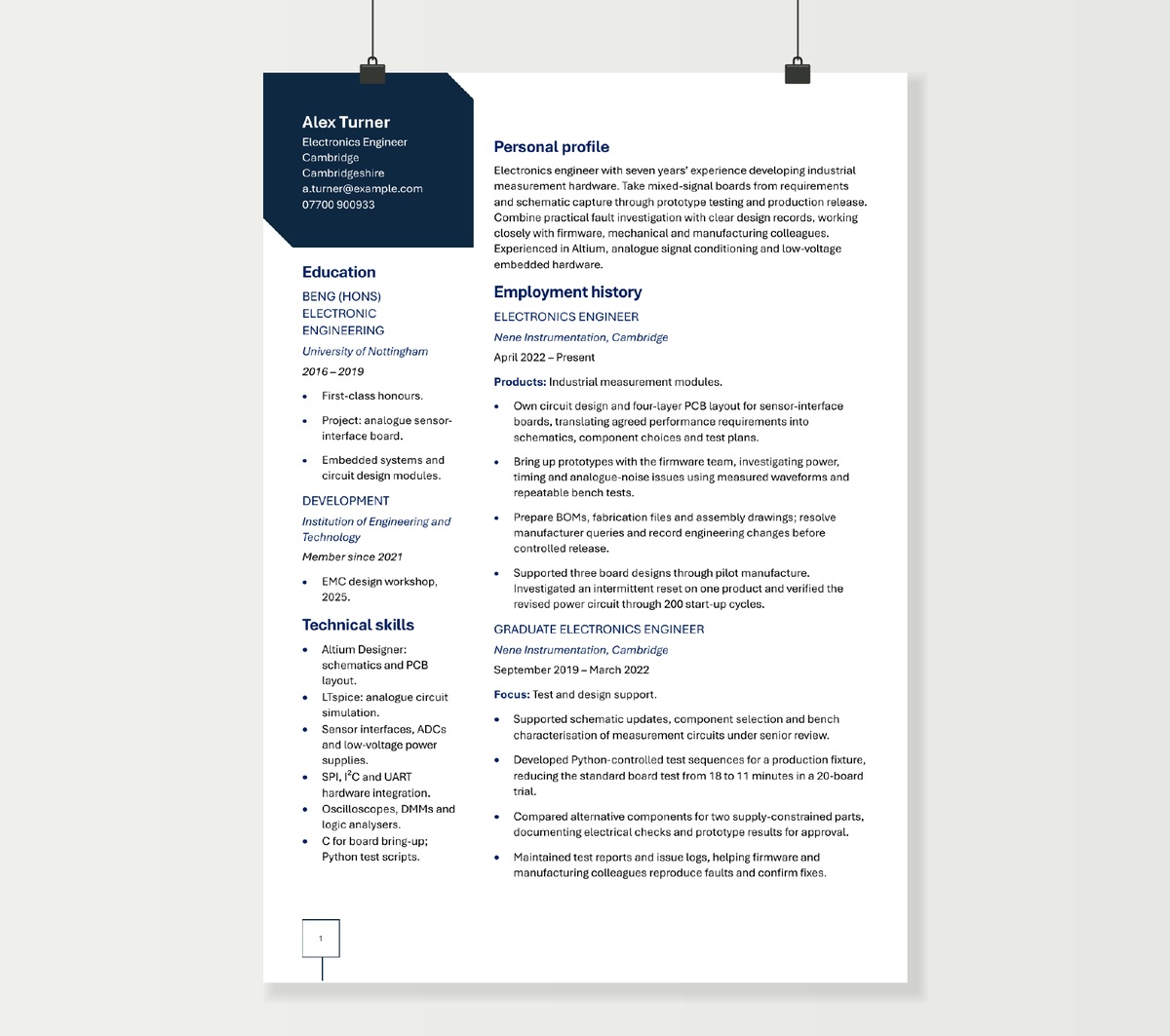
This electronics engineer CV template follows a hardware engineer working on industrial measurement products, from graduate design support to owning circuit-board developments. The Word example shows technical scope, practical testing and production improvements. The guide explains how to present your particular electronics specialism and the evidence behind your design work.
Filename: FreeCVDownload_Electronics_Engineer.docx
Content of this CV template
Alex Turner
Electronics Engineer
Cambridge
Cambridgeshire
07700 900933
Education
BEng (Hons) Electronic Engineering
University of Nottingham
2016 – 2019
- First-class honours.
- Project: analogue sensor-interface board.
- Embedded systems and circuit design modules.
Development
Institution of Engineering and Technology
Member since 2021
- EMC design workshop, 2025.
Technical skills
- Altium Designer: schematics and PCB layout.
- LTspice: analogue circuit simulation.
- Sensor interfaces, ADCs and low-voltage power supplies.
- SPI, I²C and UART hardware integration.
- Oscilloscopes, DMMs and logic analysers.
- C for board bring-up; Python test scripts.
Personal profile
Electronics engineer with seven years’ experience developing industrial measurement hardware. Take mixed-signal boards from requirements and schematic capture through prototype testing and production release. Combine practical fault investigation with clear design records, working closely with firmware, mechanical and manufacturing colleagues. Experienced in Altium, analogue signal conditioning and low-voltage embedded hardware.
Employment history
Electronics Engineer
Nene Instrumentation, Cambridge
April 2022 – Present
Products: Industrial measurement modules.
- Own circuit design and four-layer PCB layout for sensor-interface boards, translating agreed performance requirements into schematics, component choices and test plans.
- Bring up prototypes with the firmware team, investigating power, timing and analogue-noise issues using measured waveforms and repeatable bench tests.
- Prepare BOMs, fabrication files and assembly drawings; resolve manufacturer queries and record engineering changes before controlled release.
- Supported three board designs through pilot manufacture. Investigated an intermittent reset on one product and verified the revised power circuit through 200 start-up cycles.
Graduate Electronics Engineer
Nene Instrumentation, Cambridge
September 2019 – March 2022
Focus: Test and design support.
- Supported schematic updates, component selection and bench characterisation of measurement circuits under senior review.
- Developed Python-controlled test sequences for a production fixture, reducing the standard board test from 18 to 11 minutes in a 20-board trial.
- Compared alternative components for two supply-constrained parts, documenting electrical checks and prototype results for approval.
- Maintained test reports and issue logs, helping firmware and manufacturing colleagues reproduce faults and confirm fixes.
Selected engineering work
- Sensor-interface board, 2025: traced excess input noise to a switching-supply coupling path. Compared bench measurements with simulation, revised filtering and layout, and met the agreed noise limit on all ten pilot boards.
- Production handover, 2024: added accessible test points and revised the assembly drawing after a manufacturer review. First-pass test yield rose from 88% to 96% across the next two 50-board pilot lots.
- EMC investigation, 2023: supported pre-compliance testing, recorded failing operating modes and evaluated grounding and filter changes. Compiled the evidence used by the lead engineer to prepare the external laboratory retest.
Training and interests
- Internal training in design reviews and engineering change control, 2024.
- Regularly share bench-test findings and practical debugging methods with graduate colleagues.
- Cycle with a local weekend group.
- Play piano and enjoy live music.
How to write an electronics engineer CV
An electronics engineer CV needs to connect technical knowledge with hardware that you have designed, tested or improved. A recruiter should be able to identify your specialism quickly, while an engineering manager should find enough detail to understand the decisions and practical work behind it.
The most useful evidence often follows a product through development: what it needed to do, which part you owned, how you tested it and what happened next. This gives tools, interfaces and standards a purpose within the CV.
Establish the kind of electronics you work on
Open with your main area of work: analogue or mixed-signal circuits, digital hardware, RF, power electronics, embedded boards, instrumentation or another relevant specialism. Include the product environment and the level of responsibility you hold.
Alex’s profile identifies industrial measurement hardware and mixed-signal boards. That is a more useful starting point than a broad claim to be experienced in electronics. A power specialist might instead foreground converter design and relevant power ranges; an RF engineer might identify the systems, frequency ranges and measurement work central to their experience.
Use the target role to decide what comes first. A prototype-development role may prioritise practical bring-up and rapid investigation. A role supporting established products may need stronger evidence of component changes, reliability, manufacturing support and controlled documentation.
Show what you owned in a circuit or PCB design
Separate schematic design, component selection, PCB layout and layout review. Some engineers carry out all of these; others work with a dedicated PCB designer. Clear descriptions help the reader understand your contribution and the decisions you can discuss at interview.
For a substantial board, give enough context to explain the engineering challenge. Useful details might include analogue front ends, ADCs, microcontrollers, power rails, board layers, interfaces or size constraints. Select the details that matter to the vacancy rather than describing every component.
Connect the design to an output: approved schematics, a released board revision, a prototype meeting its performance requirement or a design transferred to manufacture. “Used Altium” is much stronger when the employment entry explains what you produced in it.
Where you made a trade-off, briefly identify it. Balancing noise performance with cost, choosing a component with better availability or changing a layout to support assembly can reveal the judgement behind the design. The CV needs the decision and result, not a circuit-design tutorial.
Use testing and debugging to demonstrate engineering judgement
Describe a fault or uncertainty you investigated, the evidence you collected and the change or conclusion that followed. This is especially valuable where a job combines design with hands-on laboratory work.
Give test equipment a role in the story. Oscilloscopes, logic analysers, spectrum analysers, programmable supplies and electronic loads mean more when connected to timing checks, signal characterisation, power measurements or fault isolation. Mention specialist instruments where they distinguish your experience.
The sensor-interface example in this CV identifies a noise issue, a coupling path, simulation and bench measurements, then a revised design tested on ten pilot boards. Those details show a structured investigation and a defined result.
Include the conditions that make a figure meaningful. Start-up cycles, temperature range, sample size, operating mode or an agreed acceptance limit may be useful context. For broader verification work, describe test planning, requirements traceability, results recording and resolution of outstanding issues.
Explain your contribution to EMC and product assurance
EMC experience can range from considering emissions during layout to investigating a failed test or coordinating a formal laboratory programme. State the work you performed and the stage of development.
A concise example might describe pre-compliance measurements, a layout or filter revision, support for an external retest and the evidence prepared. Alex’s example makes his supporting role clear while showing useful practical involvement.
Include standards and assurance processes when they belong to your product experience and the target vacancy. Explain whether you worked on requirements, design evidence, verification, documentation or review. Medical, aerospace, defence and other regulated products can call for different evidence, so the CV should reflect the relevant environment.
Reliability work also deserves a concrete explanation. Component derating, tolerance analysis, thermal investigation, environmental testing or recurring field-failure analysis can be presented through the design risk addressed and the resulting decision.
Make manufacturing and lifecycle work visible
Employers need engineers who can help a design become a repeatable product. Include work with manufacturers on assembly, test access, fabrication information, calibration, component substitutions or production faults.
State the records you create or control where they show ownership: BOMs, manufacturing packs, assembly drawings, test specifications, engineering-change records or product-lifecycle-system entries. Describe how these support a release, a build or an approved change.
Component availability and obsolescence can provide strong examples. Explain the alternative you assessed, the checks or redesign required and how the change progressed through review and validation. This demonstrates more than purchasing familiarity.
For results, use measures relevant to the work: first-pass test yield, test duration, repeat failures, assembly effort or a defined BOM saving. Include the build size or comparison period where helpful. Alex’s yield example identifies two 50-board pilot lots, making the improvement easier to assess than an unexplained percentage.
Organise technical skills around the work you can discuss
Group skills into a few meaningful areas, such as circuit and PCB design, laboratory work, embedded interfaces and development tools. Keep the most relevant capabilities easy to scan, then support them through employment or project evidence.
For CAD and simulation packages, indicate the activity: schematic capture, multilayer layout, library work, circuit simulation or review. For interfaces such as SPI, I²C, UART, CAN or Ethernet, explain the integration or debugging involved where it is central to the role.
Distinguish hardware work from firmware development. C used for board bring-up and test routines is useful experience, but it describes a different remit from owning production firmware. FPGA or HDL work, embedded software and test automation each deserve their own context when relevant.
Python, LabVIEW or another automation tool can strengthen the CV through a specific output. Describe the fixture, instrument control, result capture or analysis it supports, along with the benefit and validation. A long software list gives less information than a short, well-supported skills section.
Select projects that reveal your strongest contribution
Choose projects for the evidence they provide, rather than simply for size or novelty. A small board that you designed and verified can demonstrate more ownership than a major programme on which your contribution was limited to one task.
A compact project entry can cover the requirement, your responsibility, the main technical challenge and the result. Make the personal contribution clear within a team project, and identify collaboration with firmware, mechanical, systems, test or manufacturing colleagues where it affected the outcome.
For early-career applicants, a dissertation, placement, student-team project or substantial personal build can supply this evidence. Include what you physically built or measured, how you assessed performance and what you learned from an iteration. Simulation work is valuable when its purpose and stage are clear.
A portfolio can add depth through a short case study, block diagram, appropriate board photographs, test plots or a well-documented repository. Link to selected material that helps a reviewer understand the engineering; the CV should still explain the project without requiring a click.
Show qualifications and progression in proportion
Give the qualification, subject, institution and date. A degree, HNC, HND or apprenticeship route can provide relevant foundations, and some vacancies also recognise equivalent practical experience. Use the specific entry requirements to decide which evidence deserves prominence.
Graduates can include a relevant final project and selected modules. Experienced applicants usually gain more from space devoted to design ownership, technical decisions, production experience and completed developments.
Professional membership, registration and focused training can support the application. State the precise designation or development stage, and connect recent training to the work where helpful. EMC, specialist design methods, assurance or relevant product standards may be more useful than a broad catalogue of courses.
For senior applications, show how your remit has expanded: defining requirements, reviewing designs, resolving technical risk, estimating work, guiding colleagues or coordinating delivery across disciplines. Technical depth and the ability to help others deliver should both be visible.
The CV template library offers other editable layouts if your project evidence would work better in a different arrangement.
Electronics Engineer CV FAQs
Both forms are used by UK employers. Use the title that best matches the vacancy in your heading, while retaining your actual employment titles in the career history. A brief specialism, such as mixed-signal hardware or power electronics, can make either title more informative.
Describe the product category, development stage, technical responsibility and permitted level of complexity. You can explain requirements work, investigation, review or testing without identifying a customer or disclosing restricted design detail. A concise account of your engineering contribution can stand on its own without a public portfolio.
For a vacancy that asks about it, use a brief additional-information entry giving the relevant status at an appropriate level of detail. Distinguish an existing clearance from willingness to undergo vetting. Leave clearance reference numbers and sensitive project information to the employer’s designated process.
Relevant practical experience can support the move, particularly where the vacancy accepts equivalent experience or HNC/HND routes. Bring forward circuit investigation, approved modifications, test development, schematic work and component assessment. Add design projects or further study that demonstrate the specific responsibilities you want to take on.
It depends on the role. Many design vacancies focus on relevant qualifications and delivery experience, while some senior or specialist positions value professional registration. Give your current status clearly; candidates working towards registration can include that development alongside their engineering evidence.
Name your package and describe the work completed, including schematic capture, layout complexity, design rules, libraries and manufacturing outputs where relevant. This helps the reader assess transferable design experience. If you have also used the requested package in a course or project, identify that context separately.
Yes, when it provides relevant evidence. State the stage reached, such as simulated concept, assembled prototype or completed bench verification, and explain the work and findings. A technically strong prototype or investigation can be useful even when a wider programme has not proceeded to production.




