
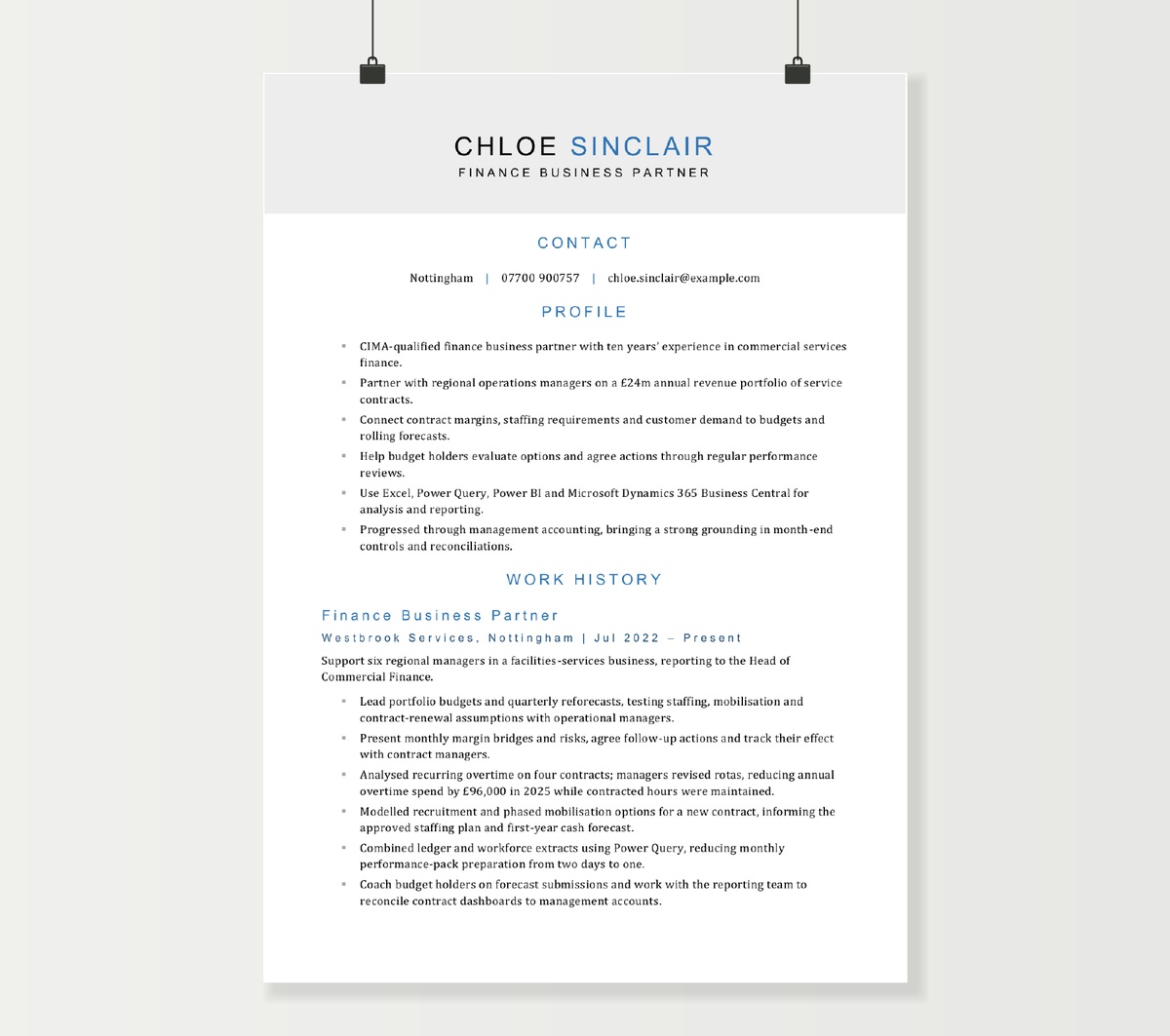
This finance business partner CV template follows a CIMA-qualified accountant who progressed from management accounts into supporting regional operations. The Word example connects forecasts, contract analysis and reporting improvements to practical business decisions. The guide covers established partners and accountants moving into their first partnering role, including commercial, project and public-sector applications.
Filename: FreeCVDownload_Finance_Business_Partner.docx
Content of this CV template
Chloe Sinclair
Finance Business Partner
Contact
Nottingham | 07700 900757 | [email protected]
Profile
- CIMA-qualified finance business partner with ten years’ experience in commercial services finance.
- Partner with regional operations managers on a £24m annual revenue portfolio of service contracts.
- Connect contract margins, staffing requirements and customer demand to budgets and rolling forecasts.
- Help budget holders evaluate options and agree actions through regular performance reviews.
- Use Excel, Power Query, Power BI and Microsoft Dynamics 365 Business Central for analysis and reporting.
- Progressed through management accounting, bringing a strong grounding in month-end controls and reconciliations.
Work history
Finance Business Partner
Westbrook Services, Nottingham | Jul 2022 – Present
Support six regional managers in a facilities-services business, reporting to the Head of Commercial Finance.
- Lead portfolio budgets and quarterly reforecasts, testing staffing, mobilisation and contract-renewal assumptions with operational managers.
- Present monthly margin bridges and risks, agree follow-up actions and track their effect with contract managers.
- Analysed recurring overtime on four contracts; managers revised rotas, reducing annual overtime spend by £96,000 in 2025 while contracted hours were maintained.
- Modelled recruitment and phased mobilisation options for a new contract, informing the approved staffing plan and first-year cash forecast.
- Combined ledger and workforce extracts using Power Query, reducing monthly performance-pack preparation from two days to one.
- Coach budget holders on forecast submissions and work with the reporting team to reconcile contract dashboards to management accounts.
Management Accountant
Westbrook Services, Nottingham | Sep 2019 – Jun 2022
Prepared management accounts for three operating regions while completing CIMA qualification.
- Reviewed accruals, prepayments and balance sheet reconciliations, resolving differences with payroll and accounts payable.
- Explained labour-cost and revenue variances to regional managers and incorporated agreed changes into forecasts.
- Introduced a monthly review of unbilled completed work with operations, clearing £42,000 of overdue billing items over three months.
- Prepared supporting schedules for year-end audit and helped document contract-reporting processes.
Assistant Management Accountant
Eastwell Support, Derby | Aug 2016 – Aug 2019
Supported monthly reporting for a regional business-services provider.
- Maintained cost-centre schedules, prepared journals and reconciled bank and supplier control accounts.
- Built Excel schedules for departmental spend and followed up coding queries with budget holders.
Qualifications
CIMA qualified — ACMA, CGMA
Membership admitted in 2020; continuing professional development maintained.
BA (Hons) Accounting and Finance, 2:1
Nottingham Trent University | 2016
Hobbies and interests
I enjoy badminton, baking and walking in the Peak District.
How to write a finance business partner CV
A finance business partner CV needs to show what happened after you understood the numbers. A variance report, forecast or model becomes a strong example when the reader can see who used it, which choices it clarified and how you helped the business respond. Your accounting experience provides the foundation; the employment section should also make your contribution to decisions visible.
The role varies considerably between employers. One partner may support customer services and its workforce budget, another may advise project directors on margins and work in progress, and another may work with a public-sector technology directorate on investment plans. Start by making your own business area understandable. That gives the detail which follows a useful frame.
Put the business you support into the opening lines
Use the profile to establish your qualification status, sector, partnering experience and the kind of responsibility you are ready to take on. A short description of your portfolio is more informative than a series of claims about being strategic or commercially minded. Relevant scope might be annual revenue, operating expenditure, a capital programme, the number of regions or the mix of contracts.
Be precise about what a financial amount represents. Supporting a £24m revenue portfolio, advising on a £24m cost budget and appraising a £24m investment describe different jobs. Identify the stakeholders too: regional managers, a sales director, project leaders or service heads. The combination lets a recruiter judge both financial scale and the level at which you work.
In the example, Chloe’s profile introduces service contracts, regional operations and the link between staffing and margin. Her current role then explains the six-manager remit and reporting line. This is enough context to make a rota review or mobilisation model meaningful without a lengthy description of the employer.
Make the decision the centre of your strongest examples
Choose employment bullets that connect a business question, your analysis and the resulting action. A useful sequence is: what was being decided, what you contributed, how you worked with the decision-makers, and the outcome or next step. You can spread a substantial example across two bullets if one sentence becomes crowded.
For example, an unexplained margin decline might lead you to separate price, volume, mix and labour effects. The CV becomes more persuasive when it then explains that you reviewed the findings with regional managers and helped agree a change to staffing or contract delivery. The reader can see both analytical ability and a working relationship.
Select a range of decisions that fits the vacancy. A commercial role may benefit from a pricing, product-mix or renewal example. An operations partner may give more space to capacity, recruitment and service costs. A project partner may foreground resource plans, cost-to-complete forecasts or the commercial implications of scope changes. Two well-explained decisions can reveal more than a long list of reports produced.
Chloe’s overtime example names the analysis and the managers’ action before giving the measured result. Her new-contract example ends with an approved staffing plan and cash forecast. Both are useful outcomes, even though only one is expressed as a saving.
Show what you contributed to planning and forecasting
“Responsible for budgeting and forecasting” leaves a great deal unanswered. Explain the business area covered, the planning horizon and your contribution. Did you coordinate submissions, build the model, review assumptions with budget holders, consolidate the plan or present options to a leadership team? Give the reader a clear sense of your ownership.
Describe the important business drivers behind your work. In a labour-intensive service, these may include headcount, pay rates, vacancies, utilisation and contract starts. For a consultancy, project progress, fee income and resource requirements may be central. For a technology function, supplier commitments, programme timing and recurring costs may matter more. A few relevant drivers demonstrate that you understand the operation behind the spreadsheet.
Good forecasting examples can show how you handled a change in conditions: a delayed mobilisation, revised demand, a funding change or a supplier-cost increase. Explain how you brought the forecast up to date and helped stakeholders assess the implications. This makes your forward-looking judgement visible alongside the regular reporting cycle.
If forecast quality is one of your achievements, give the measure a clear basis. State the period, the business area and whether you are discussing revenue, costs or another item. Comparing the same forecast horizon across periods helps the reader interpret the result. A faster submission process or better visibility of risks may be the more useful outcome where conditions changed substantially.
Demonstrate influence through a specific exchange
Stakeholder management is central to this job, but “excellent communicator” offers little evidence on its own. Describe who you worked with and what your involvement achieved. You might have helped an operational manager understand a cost trend, tested a director’s growth assumptions, or brought finance into a contract discussion before the commercial terms were settled.
Constructive challenge reads well when the CV explains the substance. For instance, you could describe comparing a proposed recruitment timetable with expected contract income, presenting two staffing options and agreeing a phased approach with operations. That shows commercial judgement and collaboration in the same example.
Include how you made financial information usable. A concise monthly commentary, a visual margin bridge, a workshop for new budget holders or a shared action tracker can all support the story. The strongest detail is what colleagues were able to do with the information: resolve a question, prioritise work, revise a plan or monitor an agreed action.
Senior applicants should show the breadth and sensitivity of their relationships. Advising one cost-centre manager differs from coordinating several directors with competing priorities. Board or committee exposure is valuable when you explain the paper, recommendation or financial issue you contributed to.
Present business cases as evidence of judgement
For investment, pricing or service-change work, identify the proposal and the part you played in evaluating it. Useful detail includes comparing delivery options, building a cash-flow model, testing demand assumptions, assessing the cost of implementation or presenting the financial implications of a recommendation.
State how far the work progressed. A proposal may have reached approval, been revised, moved into delivery or completed a benefits review. Each stage demonstrates something different. An approved business case supports a claim about decision support; a later review can show whether the expected benefit was achieved.
Where relevant, name the evaluation methods you used, such as discounted cash-flow analysis or sensitivity modelling, and connect them to the decision. The CV does not need the calculation itself. A clear explanation of the uncertainty you explored is often more informative than a list of modelling techniques.
Keep financial control visible without letting it dominate
Many partnering jobs still include management accounts, reconciliations, income recognition or responsibility for a cost centre. Include enough detail to show that your advice rests on reliable information. The balance depends on the vacancy: an end-to-end finance role needs more accounting evidence than a dedicated commercial-partner position supported by a separate reporting team.
Connect control work to the decisions it supported. Reconciling workforce data to the ledger may have made regional labour comparisons reliable. Reviewing unbilled work may have clarified both revenue and cash expectations. Resolving a recurring allocation issue may have improved contract-margin reviews. These examples combine accounting discipline with a practical business purpose.
If your main remit is running the finance function, the finance manager CV example offers a useful comparison. For a business partnering application, make space for the people, choices and operational drivers behind your reports.
Give systems and reporting improvements a purpose
Present Excel through work you have actually delivered: a driver-based forecast, an option appraisal, a reusable analysis or a controlled reporting process. Power Query is useful evidence where you combined and refreshed data; Power BI is useful where you developed or maintained reporting that budget holders used. Explain your contribution and the reporting audience.
Include relevant finance and planning systems by name, together with the work performed in them. Experience extracting actuals from an ERP, maintaining a planning model and administering a system are different strengths. Employers may use Dynamics, Oracle, SAP, Workday, Adaptive, TM1 or other platforms. A clear description of your work helps them recognise transferable experience when the product differs.
When describing automation, retain the financial purpose. Chloe’s pack improvement gives a before-and-after preparation time, while her dashboard bullet explains reconciliation to management accounts. Together they show that the reporting became easier to produce and remained usable for decisions.
Explain results in terms the business would recognise
Useful outcomes extend beyond cost reduction. Depending on your remit, you may be able to show improved contract margins, earlier identification of a funding gap, a better staffing decision, faster billing, clearer investment choices or a shorter planning cycle. Select measures that illuminate the work rather than giving every bullet a percentage.
Make the basis of a result easy to follow. A saving can be described as an annual amount, an in-year result or an expected benefit in an approved plan. A margin movement is clearer with its period and scope, and percentage-point changes are distinct from percentage increases. A time saving is strongest when attached to a recurring task with a consistent workload.
Use verbs that describe your contribution to joint results: modelled, recommended, negotiated, challenged, agreed, implemented or reviewed. A business partner often enables operational colleagues to act. Naming both contributions gives the reader a convincing account of how the outcome was achieved.
Show progression into partnering, or the next level of it
For a first partnering application, draw out the business-facing work already present in management accounting. Regular budget-holder meetings, explanation of variances, involvement in forecasts, and analysis used in a staffing or pricing decision are all relevant. Keep your employment titles and let the descriptions show how the remit developed.
For an experienced partner, distinguish later roles through greater complexity or autonomy. This might mean broader directorate coverage, earlier involvement in strategic plans, responsibility for major business cases, a more demanding project portfolio or development of other finance colleagues. A promotion should reveal a change in responsibility as well as a change in title.
When moving sectors, translate the economics of your previous work. Experience with labour-intensive contracts can be relevant to another service operation; project forecasting can transfer where resource use and delivery milestones drive performance. Explain the connection through your examples, while giving the target sector’s priorities enough space.
For public-sector or charitable roles, useful evidence may include budget-holder support, restricted funding, service affordability, business-case scrutiny or delivery within an agreed spending envelope. Commercial experience can still be valuable, but the CV should make the outcome relevant to the organisation’s purpose.
Make qualification status easy to understand
Give the professional qualification or membership, the date achieved and any current study clearly. For an experienced qualified accountant, put this near the beginning of the CV and keep the education section compact. For a part-qualified applicant, state the completed stage and next planned milestone alongside the experience that supports the application.
Choose recent development for its relevance to the role. Financial modelling, systems implementation, presenting to senior colleagues or a sector-specific reporting topic may add useful evidence. A long catalogue of routine courses can be condensed so the employment examples remain prominent.
The example uses a two-page layout to show a current partnering role, the management-accounting progression behind it and a short earlier position. The Word template library provides other layouts if your experience needs a different balance of project detail, qualifications and employment history.
Finance Business Partner CV FAQs
Yes, although the application needs to make your business-facing evidence clear. Client discussions about trading performance, working capital, controls or financial risks can show commercial understanding, particularly where you helped managers evaluate a response. Explain your exposure to the client's operations and the recommendations you discussed. If your experience is mainly statutory audit, a management-accounting or commercial-analyst role may also provide a useful route into regular budgeting and forecasting responsibility.
It depends on the vacancy. Some partners manage accountants or analysts; others influence an operational area without direct reports. Where people management is required, give the team size and examples of reviewing work, coaching or developing colleagues. For an individual-contributor role, leading a planning exercise or coordinating budget holders can demonstrate leadership through influence. Presenting those responsibilities clearly helps the recruiter match your experience to the role's structure.
Use the application's specified fields and anonymisation instructions. The employment and qualification evidence can usually be adapted from your CV, while the separate statement gives room to explain how you meet the advertised criteria. Allocate the statement space to examples that need context, such as challenging a senior stakeholder or improving a financial plan. Keep the CV focused on the scope, responsibilities and outcomes of each role, so the two parts complement one another.
A concise description of the model or paper is normally sufficient at application stage: its purpose, your contribution, the audience and the decision it supported. If an employer requests a work sample, agree an appropriate format with them; a short exercise using a new set of figures can demonstrate your approach without relying on an employer's working papers. Keep any requested sample separate from the CV so the career evidence remains easy to scan.
The CV should establish the relevant experience rather than explain how you would answer a test. A forecasting model, investment appraisal or performance presentation can each provide a useful reference point. During recruitment, the employer may ask you to analyse unfamiliar figures and present a recommendation. Prepare to discuss the assumptions you made, the information you would seek and how you would explain the result to a non-finance manager; those are natural extensions of the examples on your CV.




