This fire engineer CV template shows progression from graduate consultancy work to delivering fire strategies and technical analysis for building projects. The Word example combines project responsibilities, modelling, design coordination and professional development. The guide covers how to present consultancy experience, specialist work and graduate evidence.
Filename: FreeCVDownload_Fire_Engineer.docx
Content of this CV template
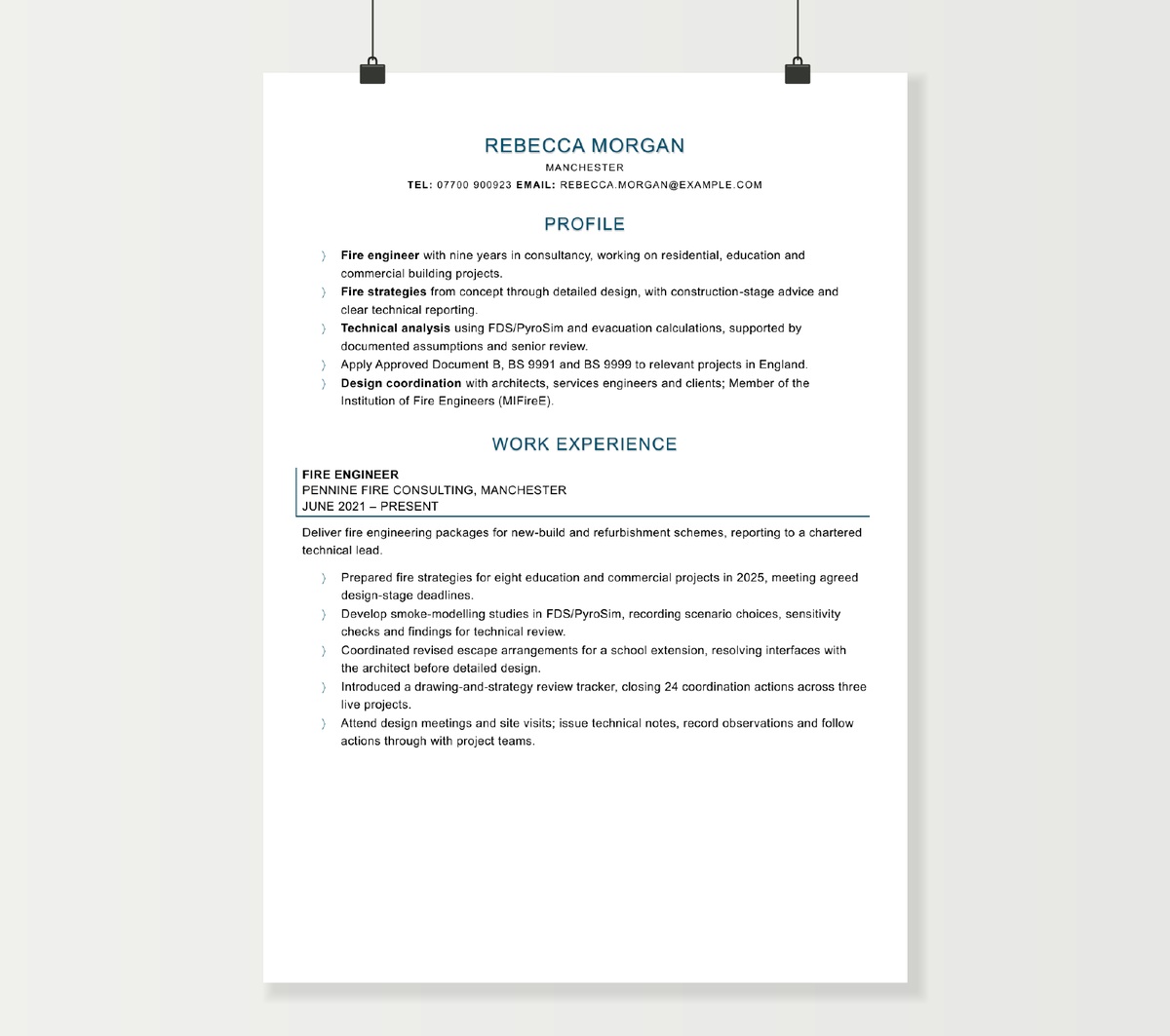
REBECCA MORGAN
MANCHESTER
tel: 07700 900923 email: [email protected]
PROFILE
- Fire engineer with nine years in consultancy, working on residential, education and commercial building projects.
- Fire strategies from concept through detailed design, with construction-stage advice and clear technical reporting.
- Technical analysis using FDS/PyroSim and evacuation calculations, supported by documented assumptions and senior review.
- Apply Approved Document B, BS 9991 and BS 9999 to relevant projects in England.
- Design coordination with architects, services engineers and clients; Member of the Institution of Fire Engineers (MIFireE).
WORK EXPERIENCE
FIRE ENGINEER
PENNINE FIRE CONSULTING, MANCHESTER
JUNE 2021 – PRESENT
Deliver fire engineering packages for new-build and refurbishment schemes, reporting to a chartered technical lead.
- Prepared fire strategies for eight education and commercial projects in 2025, meeting agreed design-stage deadlines.
- Develop smoke-modelling studies in FDS/PyroSim, recording scenario choices, sensitivity checks and findings for technical review.
- Coordinated revised escape arrangements for a school extension, resolving interfaces with the architect before detailed design.
- Introduced a drawing-and-strategy review tracker, closing 24 coordination actions across three live projects.
- Attend design meetings and site visits; issue technical notes, record observations and follow actions through with project teams.
GRADUATE FIRE ENGINEER
NORTHFIELD DESIGN CONSULTANTS, LEEDS
SEPTEMBER 2017 – MAY 2021
Supported fire strategy development and analysis for residential and commercial projects under senior supervision.
- Prepared strategy mark-ups and report sections from drawings, site information and agreed design assumptions.
- Completed evacuation calculations and assisted with smoke-modelling inputs and output checks.
- Maintained revision records and responses to design-team queries through successive project stages.
- Helped standardise calculation-review sheets, improving the traceability of inputs and checking comments.
QUALIFICATIONS & DEVELOPMENT
BEng (Hons) FIRE ENGINEERING — 2:1
UNIVERSITY OF CENTRAL LANCASHIRE — 2017
Final-year project: comparison of evacuation assumptions for a teaching building.
PROFESSIONAL MEMBERSHIP
MIFireE — 2024; WORKING TOWARDS CEng
RECENT PROFESSIONAL DEVELOPMENT
SMOKE MODELLING REVIEW AND DESIGN COORDINATION — 2025–2026
INTERESTS
Hillwalking, playing the piano and visiting local theatre.
How to write a fire engineer CV
A fire engineer CV should show how you apply technical knowledge to projects and communicate the resulting decisions. Employers need to understand the buildings or infrastructure you know, the analyses and deliverables you have produced, and the responsibility you held within the project team.
Give project evidence enough space to reveal your engineering contribution. A list of standards, software and building types is useful for orientation, but the stronger evidence explains how you used that knowledge and what the work enabled the team to do.
Define your area of fire engineering
Open with the work that best describes your practice: building fire strategies, performance-based analysis, structural fire engineering, smoke control, transport infrastructure or another specialism. Add the project sectors and stages in which you have experience.
The title “fire engineer” appears in vacancies with different remits. Read the responsibilities closely and bring the relevant part of your background forward. A design-consultancy application will need a different balance of evidence from a role centred on existing-building assessments, remediation or a particular protection system.
Rebecca’s example follows a building-consultancy route. It identifies strategies, modelling, technical reporting and design coordination, then places those skills within residential, education and commercial projects. This gives the reader a clear professional context.
Select projects that demonstrate your level of responsibility
Choose projects because they reveal useful experience, rather than relying on their size or prestige. A smaller refurbishment on which you developed a substantial package may show more than a major development where your involvement was limited to one calculation.
For each selected example, give four pieces of information:
- The project type and the fire-engineering issue that mattered.
- The stage of the work, from early design to construction or handover.
- Your responsibility, technical contribution and review arrangements.
- The deliverable or decision that resulted.
These details can sit within employment bullets or in a short selected-projects section. A senior applicant may use the latter to show range without repeating long project descriptions under every employer. A graduate may give more space to one academic or placement project with a clear analytical contribution.
Explain what you did within a fire strategy
“Prepared fire strategies” is a starting point. Add the aspects you worked on, such as means of escape, compartmentation, smoke control concepts, fire service access or coordination of structural fire resistance requirements. Select the matters relevant to the vacancy and your experience.
Make the stage and deliverable clear. A concept-stage options note, a detailed strategy with coordinated drawings and a construction-stage response to a design change demonstrate different work. The CV can show how your responsibility developed across those stages.
For existing buildings, explain the information available and the assessment or advisory output you produced. Refurbishment and remediation work may involve reviewing records, coordinating investigations or translating findings into a design response. Keep the account focused on your engineering contribution.
Present analytical methods beyond the software name
For modelling or calculations, identify the question the analysis addressed and your role in answering it. Relevant evidence might include smoke movement, evacuation, radiation, tenability or structural response. Name the tool when it helps the employer understand your experience.
A useful entry explains whether you developed the model, selected inputs, carried out sensitivity checks, reviewed outputs or interpreted a specialist study. Those are distinct contributions. Rebecca’s CV describes FDS/PyroSim work with scenario choices, checks and technical review, giving context to the software claim.
Include how the analysis was communicated. A report explaining assumptions, limitations and implications for the design team can be as important as producing the model itself. This shows that you can connect technical work with a project decision.
For graduate applications, academic modelling is valuable when labelled with its project context. Explain the objective, method and findings, with a brief account of the checks used. A clear description of one substantial study is more informative than listing several packages encountered briefly during a course.
Show regulatory and standards knowledge in project context
Identify the jurisdictions and guidance relevant to your work. Experience on projects in England, Scotland, Wales, Northern Ireland or overseas should be clear from the project descriptions. This helps a recruiter understand the framework in which you developed your experience.
Bring important standards into the skills section or project entries where they explain your work. For example, a strategy-development responsibility can identify the guidance applied and the building context. A specialist transport or healthcare role may call for a different set of references from general building consultancy.
Where you have contributed to submissions, design-change records or evidence packages under a particular building-safety process, describe the documents and responsibility you held. The CV is stronger when it shows practical involvement, while a detailed explanation of the regulatory process belongs elsewhere.
Use coordination examples to show professional judgement
Fire engineering involves decisions that affect other disciplines. Describe a situation in which you worked with architects, structural engineers, building-services teams, contractors or clients to resolve an interface or develop an option.
Rebecca’s school-extension example connects escape arrangements with the architect’s design before the detailed stage. Other examples could involve aligning a smoke-control concept with the services design, clarifying a compartmentation detail or responding to a change in building use.
Explain how you communicated the issue: a technical note, marked-up drawing, workshop, meeting or written response. Where you dealt with reviewing or approving bodies, identify your role in that exchange and the information you prepared. The reader should understand both the technical work and how it progressed through the team.
Include construction-stage experience where it adds evidence
Site work can show how you connect design intent with what is being built. State the purpose of visits and the outputs you produced, such as observations, technical queries, review comments or records for a wider project team.
Keep different responsibilities identifiable. Reviewing a detail, recording an installation concern, witnessing a test and managing a package of remedial work each demonstrate different experience. The wording should help an employer understand the scope of your involvement.
Following actions through is useful evidence too. Describe how observations were recorded, discussed and brought back into the project information. This can demonstrate dependable coordination as well as technical awareness.
Choose outcomes that fit engineering work
Achievements can include a resolved design interface, a clear analytical recommendation, an improved review record, a coordinated submission or delivery of an agreed package. Numbers are useful where they explain scale or progress.
Rebecca’s CV gives the number of strategies delivered and the coordination actions closed across three projects. These measures support a practical account of her work. A project description can also show a successful outcome without a percentage, especially when the value lies in resolving a complex technical question.
For senior roles, include evidence of scope, fee and programme management. Preparing proposals, agreeing variations, allocating technical work and mentoring colleagues can demonstrate readiness for wider responsibility. Connect commercial management with the quality and delivery of the engineering service.
Separate qualifications, membership and professional registration
Give degree titles, institutions, dates and relevant results. A postgraduate fire-engineering qualification can be particularly useful to show alongside an earlier engineering or architecture degree. Recent technical development can sit in a short CPD entry.
List professional membership with its grade and post-nominals. Engineering Council registration, such as CEng, is a separate detail and should have its own clear entry. If you are working towards registration, a brief statement of that progress can explain your current development, especially where the employer offers support.
For an experienced applicant, selected CPD should relate to the work sought: analytical review, changing design guidance, specialist construction issues or another area of practice. Where learning has influenced your work, an employment example can demonstrate that connection more effectively than a long course list.
Adjust the evidence for graduate and senior applications
Graduates can lead with relevant study, placements and projects. Show the question you investigated, your use of engineering principles, the report or presentation produced and how you worked with others. A dissertation or design project can provide several useful examples when the contribution is explained clearly.
Applicants moving from another discipline can identify the relevant foundation and subsequent fire-engineering development. Structural analysis, building design, operational fire-safety work or technical reporting may provide useful evidence, depending on the vacancy. Explain the progression so the recruiter can see how those experiences connect.
Senior applicants should give greater weight to technical leadership, review, client responsibility, mentoring and delivery across a portfolio. Show where you shaped an approach or helped colleagues resolve a difficult issue. Keep enough project detail to demonstrate the engineering behind the leadership.
Use the CV template library to compare layouts if you need more room for selected projects. The final structure should make your specialism, responsibility and strongest evidence easy to follow.
Fire Engineer CV FAQs
Include it when it is relevant to the vacancy, with the building types, assessment scope and your responsibilities. Keep it identifiable alongside strategy, design or analytical work so the employer can understand the balance of your practice. A role focused on existing buildings may give that evidence particular weight.
The requirement depends on the post. Some roles support candidates working towards registration, while others specify it for the level of responsibility involved. State your current registration and development position clearly, then use project evidence to show the work you are ready to undertake.
It can be useful when several projects demonstrate distinct technical capabilities. Keep the main CV complete, then use a short supplementary sheet for the building context, engineering issue, contribution and outcome. Select projects that support the target role, and follow any application limit on supporting documents.
Use a general description that still explains the engineering context, such as a university refurbishment or a mixed-use development in a named region. Give the project stage, relevant complexity and your contribution. Those details can demonstrate experience without naming the client or sharing restricted project information.
Identify the country, project sectors and codes or frameworks used, then explain the technical and coordination work that transfers to the vacancy. Add any UK project experience or subsequent development separately. This gives the recruiter a clear view of your background and the framework in which you have worked.
Include a selected entry when it demonstrates expertise relevant to the role. Give the title, venue or publication and year, with your contribution where it was joint work. A short selection usually works within a consultancy CV; a research-focused application may benefit from a fuller publication list.
Present that review experience directly. Explain the type of study, the assumptions or outputs you assessed and how your interpretation informed the project. Commissioning, reviewing and communicating specialist analysis can be valuable responsibilities, and clear wording helps an employer recognise them.