This hospital doctor CV template follows a doctor from foundation training into an acute-medicine clinical fellow post. The Word example brings together clinical responsibilities, qualifications, quality improvement and teaching. The guide explains how to present medical experience for hospital appointments, from early-career applications to more senior posts.
Filename: FreeCVDownload_Hospital_Doctor.docx
Content of this CV template
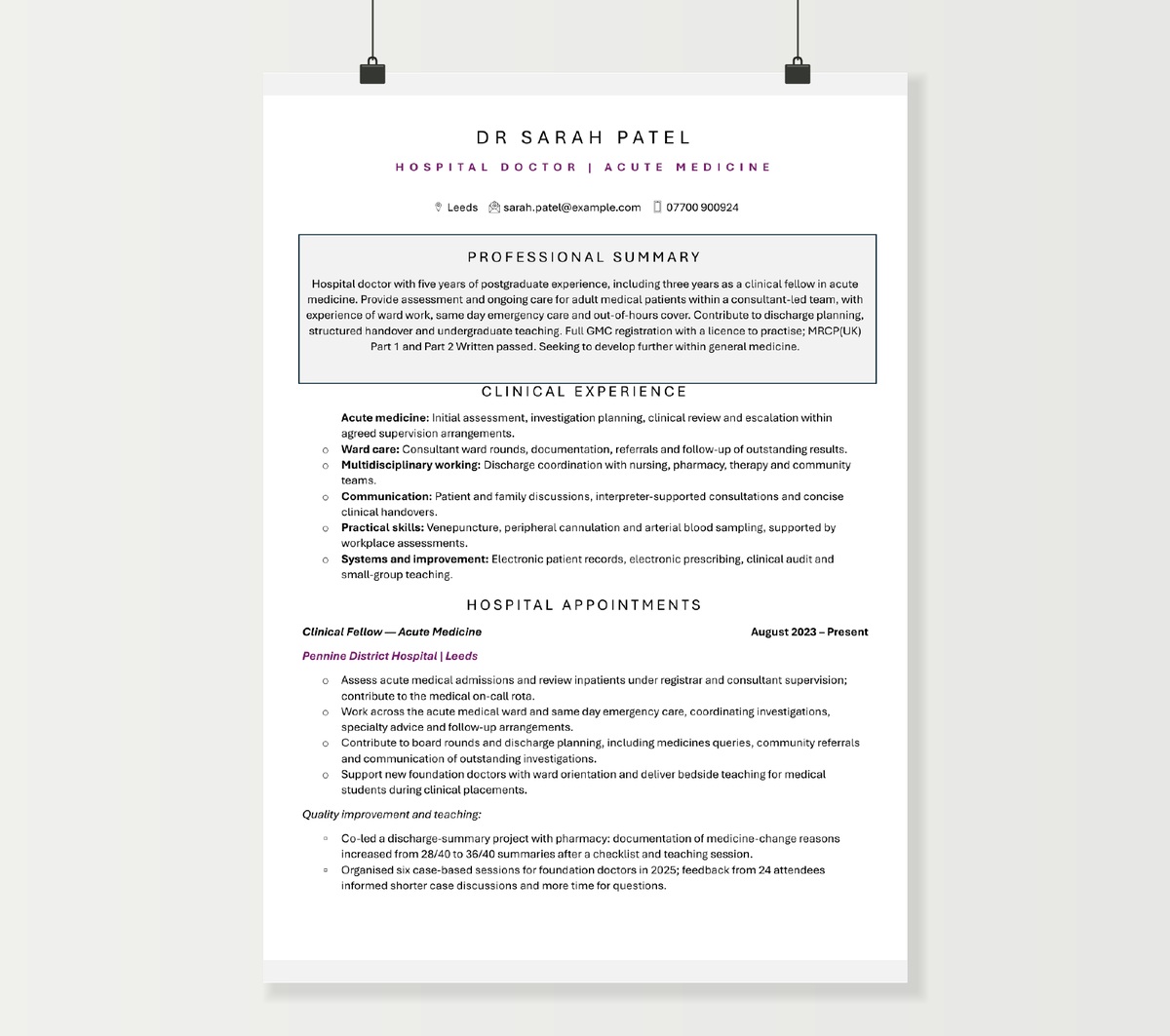
Dr Sarah Patel
HOSPITAL DOCTOR | ACUTE MEDICINE
Leeds | [email protected] | 07700 900924
Professional summary
Hospital doctor with five years of postgraduate experience, including three years as a clinical fellow in acute medicine. Provide assessment and ongoing care for adult medical patients within a consultant-led team, with experience of ward work, same day emergency care and out-of-hours cover. Contribute to discharge planning, structured handover and undergraduate teaching. Full GMC registration with a licence to practise; MRCP(UK) Part 1 and Part 2 Written passed. Seeking to develop further within general medicine.
Clinical experience
- Acute medicine: Initial assessment, investigation planning, clinical review and escalation within agreed supervision arrangements.
- Ward care: Consultant ward rounds, documentation, referrals and follow-up of outstanding results.
- Multidisciplinary working: Discharge coordination with nursing, pharmacy, therapy and community teams.
- Communication: Patient and family discussions, interpreter-supported consultations and concise clinical handovers.
- Practical skills: Venepuncture, peripheral cannulation and arterial blood sampling, supported by workplace assessments.
- Systems and improvement: Electronic patient records, electronic prescribing, clinical audit and small-group teaching.
Hospital appointments
Clinical Fellow — Acute Medicine | August 2023 – Present
Pennine District Hospital | Leeds
- Assess acute medical admissions and review inpatients under registrar and consultant supervision; contribute to the medical on-call rota.
- Work across the acute medical ward and same day emergency care, coordinating investigations, specialty advice and follow-up arrangements.
- Contribute to board rounds and discharge planning, including medicines queries, community referrals and communication of outstanding investigations.
- Support new foundation doctors with ward orientation and deliver bedside teaching for medical students during clinical placements.
Quality improvement and teaching:
- Co-led a discharge-summary project with pharmacy: documentation of medicine-change reasons increased from 28/40 to 36/40 summaries after a checklist and teaching session.
- Organised six case-based sessions for foundation doctors in 2025; feedback from 24 attendees informed shorter case discussions and more time for questions.
Foundation Doctor — F1 and F2 | August 2021 – July 2023
Westfield University Hospital | Yorkshire Foundation Programme
- F1, August 2021–July 2022: four-month rotations in respiratory medicine, general surgery and older people’s medicine.
- F2, August 2022–July 2023: four-month rotations in acute medicine, emergency medicine and psychiatry.
- Clerked patients, prepared investigations and supported ward rounds, with responsibility developing through supervised practice and workplace assessment.
- Completed the Foundation Programme in July 2023, with experience of acute assessment, discharge documentation and multidisciplinary handover.
Selected contributions:
- Collected and presented data from 30 surgical discharge summaries, supporting a ward review of follow-up instructions and responsibility for pending results.
- Delivered four bedside teaching sessions for third-year medical students, using tutor observation and learner feedback to improve session structure.
Qualifications & examinations
MBChB Medicine and Surgery – University of Leeds, 2021
MRCP(UK) Part 1 – Passed, 2024
MRCP(UK) Part 2 Written – Passed, 2025; preparing for PACES
Advanced Life Support Provider – Resuscitation Council UK, May 2025; valid to May 2029
Professional details & interests
- Registration: Full GMC registration with a licence to practise.
- Development: Regular acute-medicine teaching and simulation; annual appraisal completed in June 2026.
- Interests: Running, cooking and singing in a community choir.
How to write a hospital doctor CV
A hospital doctor CV needs to make your level of practice easy to understand. The reader should be able to identify your current appointment, clinical scope, qualifications and progression, then find the evidence relevant to the post. A foundation-level appointment, a clinical fellowship and a consultant vacancy each call for a different balance of detail.
Start with the person specification and the work described in the job description. Build your CV around the clinical, educational, academic and service contributions that matter for that appointment. The strongest medical CVs connect a clear chronology with selected evidence of what the doctor actually contributed.
Put grade, specialty and professional status near the top
Use your current job title and specialty beneath your name, followed by a short profile. State your postgraduate experience, principal clinical settings and the direction of the application. “Clinical fellow in acute medicine with experience of assessment-unit and ward work” gives the reader more useful information than a string of personal attributes.
Make registration and licence status easy to locate, with your GMC reference number in the version submitted to employers. Where relevant to the appointment, identify your Specialist Register entry and specialty separately. Qualifications, registration and employment grade describe different aspects of your background and each deserves a clear label.
For a locally employed doctor, the contractual title and a brief description of the clinical level help the reader interpret the post. For an overseas appointment, retain the original title and explain its responsibilities, supervision and setting. That context is often more informative than attempting to translate the title into a UK grade.
Make rotations readable without losing the chronology
Give each appointment its hospital or organisation, title, specialty and month-and-year dates. Foundation rotations can sit beneath one programme heading, with F1 and F2 periods clearly separated. Later training rotations can be grouped under their programme where that makes the progression easier to follow.
Within each group, identify the specialties and duration of the placements. Sarah’s example lists the three four-month rotations in each foundation year. The reader can see both the continuity of training and the relevant medical experience without six repetitive descriptions of routine ward duties.
Give greater space to recent or particularly relevant posts. A respiratory fellowship application may warrant extra detail on a respiratory rotation even when it predates your current appointment. Keep the surrounding chronology intact, including periods of research, teaching, parental leave or other career activity where needed to explain the sequence.
Include less-than-full-time working or the proportion of clinical and academic time when it helps explain your experience. For a mixed post, “60% clinical medicine, 40% medical education” is more useful than leaving the reader to infer how the time was spent.
Describe clinical scope and responsibility
Choose details that distinguish your work: unselected medical take, a specialty ward, outpatient clinics, theatre, same day emergency care, critical care or community-linked discharge work. Explain the patient group and your place within the team, including the supervision appropriate to the role.
A useful clinical bullet brings together setting, contribution and responsibility. For example, an acute-medicine doctor might describe assessment of new admissions, review of investigations, discussion with the registrar and communication of the resulting plan. A surgical applicant might emphasise perioperative care, theatre participation and the level of responsibility recorded in their operative logbook.
On-call experience deserves a specific line when relevant. Identify the service covered and whether you provided ward cover, participated in the take or supported less experienced colleagues. Rota frequency can add context, but the nature of the work usually matters more than the number alone.
For procedures, select those relevant to the vacancy and make the level of experience interpretable. Recency, assessed competence, supervised experience and first-operator experience can be useful distinctions. A short summary can sit in the CV, with a fuller logbook or evidence portfolio available through the application’s requested route.
Use audit and improvement work to show your contribution
Give each selected project a subject, setting and date, followed by your role. Explain whether you helped collect data, designed the measurement, coordinated an intervention, analysed results or presented findings. This lets the panel understand your contribution within a team project.
Where you completed a further measurement cycle, include it. In Sarah’s discharge-summary project, the CV names the documentation measure, the checklist and teaching intervention, and the change from 28 of 40 to 36 of 40 summaries. The denominator makes the scale clear, while the wording stays close to the outcome actually measured.
A project can also earn space before a second cycle is complete. State the stage reached and the next step: baseline review completed, recommendations agreed, intervention introduced or remeasurement scheduled. This gives the reader a concrete account of progress.
Clinical outcomes, process measures and service measures answer different questions. Choose the measure that fits the work and explain the period and population. Team involvement, local context and follow-up are often more helpful than presenting a percentage in isolation.
Show the substance of teaching
Identify the learners, format, frequency and your role. Bedside sessions for medical students, simulation for foundation doctors, departmental teaching and a formally organised programme provide different kinds of evidence. Describe what you designed or delivered and how you evaluated it.
Feedback is strongest when connected to an improvement in the teaching. You might explain that learner feedback led to shorter presentations, more case discussion or a revised induction session. A teaching qualification or educator course can support this evidence, alongside the practical work.
For an education fellowship, teaching may deserve its own substantial section near the clinical appointments. Include curriculum design, assessment, faculty coordination or educational research where relevant. For a predominantly clinical appointment, a few well-chosen examples may be sufficient.
Keep research and publications easy to assess
Use a separate research section when it contributes materially to the application. Give the study topic, setting, dates and your role, such as recruitment, data collection, analysis or manuscript preparation. Include relevant research training and responsibilities where they help explain what you can bring to the post.
Present publications in a consistent citation format, with authorship, title, journal and year. Group accepted papers, published work, presentations and work in progress under clear headings. For presentations, identify whether the contribution was oral or poster, the meeting and whether you presented it.
A specialist academic fellowship may need a detailed publication record. An early clinical application can give selected relevant items more prominence and place the complete list in an appendix if the application permits. The organising principle is how readily the reader can assess your work.
Connect communication and leadership to clinical work
Show communication through the situations in which you use it: explaining plans to patients and relatives, interpreter-supported discussions, multidisciplinary meetings, discharge coordination or handover between services. The clinical context makes the evidence more persuasive than “excellent communication skills”.
Leadership can involve formal supervision, organising teaching, improving induction, coordinating a service change or representing colleagues. Give the remit and result. For senior posts, include responsibility for clinical governance, service development, team supervision and operational decisions where these form part of your work.
Digital systems belong in the CV when they clarify relevant experience. Electronic prescribing, patient records, clinical databases and audit tools are useful examples. Link them to clinical documentation, information transfer or analysis rather than allowing software names to dominate the profile.
Arrange qualifications around the appointment
List your primary medical qualification with institution and year, followed by relevant postgraduate qualifications and examinations. For examinations taken in stages, identify the components completed and their dates. Sarah’s CV separates the MRCP(UK) written passes from preparation for PACES, making her current position immediately clear.
Include relevant life-support certification with the provider and validity dates. Select further courses and professional development that support the target role: a recent specialty course, educational qualification or procedural training may merit more space than a long list of routine learning modules.
Training progression, appraisal or other evidence of development can be summarised where useful. Detailed certificates and assessment records can sit in the supporting portfolio requested by the employer.
Match the document to the career stage and application route
Early-career doctors should make rotations, relevant clinical exposure, assessed skills and a small number of developed projects easy to find. Locally employed doctors can show continuing development through appointments, supervised experience, examinations, teaching and improvement work. More senior applicants need space for specialist scope, supervision, service responsibilities and academic or educational contributions.
The two-page example is a concise early-career CV. An established medical career may need more pages to provide a usable clinical history and evidence record. Use clear headings and selective detail; the reader should be able to navigate the document without losing the chronology.
Check how the employer collects applications. Where an NHS application form asks for employment history and supporting information, use the CV as your organised evidence record and develop the requested answers against the person specification. A CV attachment and a supporting statement serve different purposes when both are requested.
Other editable layouts are available in the CV template library. Choose a layout that leaves your appointments, professional status and strongest evidence easy to find.
Hospital Doctor CV FAQs
Group a continuous period of locum work under a clear heading, giving the dates, hospitals or services, grades and principal specialties. Expand particularly relevant placements. If the application form requests a more detailed employment history, provide that detail there; a grouped CV entry can still give the panel a readable overview.
Give it its own labelled entry with the hospital, specialty, dates and activities observed or undertaken. An attachment can show familiarity with a service, multidisciplinary working and local systems. Keeping its format distinct helps the reader understand how it complements your employed clinical experience.
A normal qualifications section records awards and completed examination components, with dates. If an application form specifically asks for examination attempts or a complete examination history, answer that question in the form. Booked examinations can be listed separately with the expected sitting date when useful.
Use a clearly labelled research or work-in-progress entry with the project title, your role and the current stage, such as data collection, analysis, submitted manuscript or accepted paper. This allows the work to support your application before publication while keeping the publication list easy to interpret.
Follow the vacancy instructions. If referees are requested on the CV, include their professional role, organisation and contact details, along with how they know your work. When the application system has a separate referee section, use that space and keep the CV focused on your experience.
A specialist-registration application has its own detailed evidence and CV requirements. Use the GMC’s current guidance for that route and build a complete professional history in the requested format. A concise employment CV can provide a starting record, but the registration application needs a document prepared for that specific purpose.
Keep the dates clear and include the relevant activity during that period, followed by recent experience, professional development or return-to-practice preparation. Give the reader enough context to understand the chronology, then concentrate detail on the evidence relevant to the appointment you are seeking.