
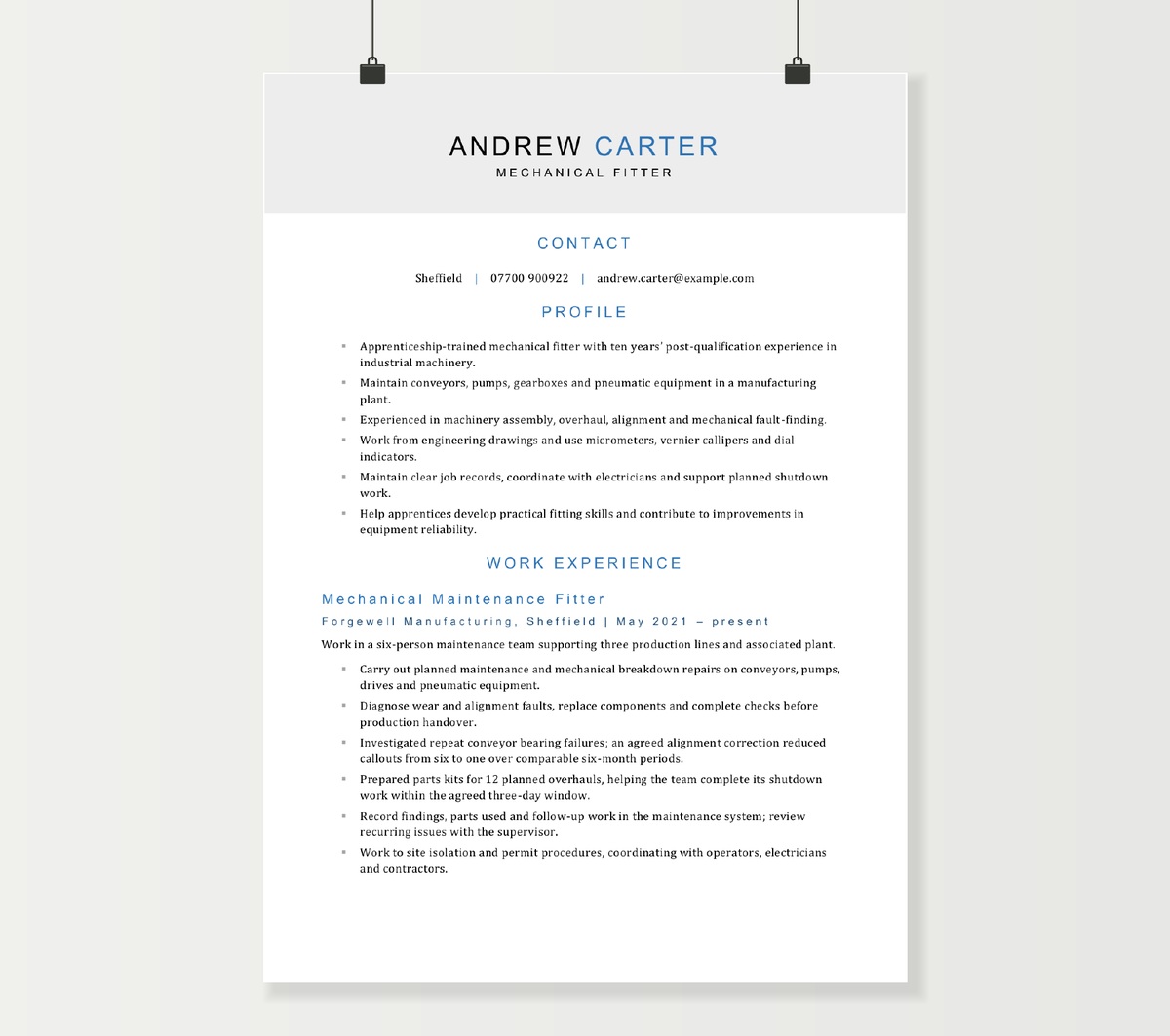
This mechanical fitter CV template shows an apprenticeship followed by machinery assembly, overhaul and manufacturing maintenance. The Word example presents practical skills alongside equipment experience, job records and improvements. The guide covers workshop, plant and site roles, with advice for experienced fitters and applicants completing their training.
Filename: FreeCVDownload_Mechanical_Fitter.docx
Content of this CV template
Andrew Carter
Mechanical Fitter
Contact
Sheffield | 07700 900922 | [email protected]
Profile
- Apprenticeship-trained mechanical fitter with ten years’ post-qualification experience in industrial machinery.
- Maintain conveyors, pumps, gearboxes and pneumatic equipment in a manufacturing plant.
- Experienced in machinery assembly, overhaul, alignment and mechanical fault-finding.
- Work from engineering drawings and use micrometers, vernier callipers and dial indicators.
- Maintain clear job records, coordinate with electricians and support planned shutdown work.
- Help apprentices develop practical fitting skills and contribute to improvements in equipment reliability.
Work experience
Mechanical Maintenance Fitter
Forgewell Manufacturing, Sheffield | May 2021 – present
Work in a six-person maintenance team supporting three production lines and associated plant.
- Carry out planned maintenance and mechanical breakdown repairs on conveyors, pumps, drives and pneumatic equipment.
- Diagnose wear and alignment faults, replace components and complete checks before production handover.
- Investigated repeat conveyor bearing failures; an agreed alignment correction reduced callouts from six to one over comparable six-month periods.
- Prepared parts kits for 12 planned overhauls, helping the team complete its shutdown work within the agreed three-day window.
- Record findings, parts used and follow-up work in the maintenance system; review recurring issues with the supervisor.
- Work to site isolation and permit procedures, coordinating with operators, electricians and contractors.
Mechanical Fitter
Pennine Machinery Services, Sheffield | Sep 2016 – Apr 2021
Assembled and overhauled industrial machinery in the workshop and supported customer installations.
- Built conveyor and drive assemblies from drawings, fitting bearings, shafts, couplings and guards.
- Measured clearances and alignment, recording inspection results against job specifications.
- Worked with the test engineer to investigate mechanical snags before dispatch.
- Helped revise a build checklist; repeat guard-fitting defects fell from eight to two across successive batches of 20 assemblies.
Apprentice Mechanical Fitter
Pennine Machinery Services | Sep 2012 – Aug 2016
Completed a four-year apprenticeship combining workshop training and college study.
- Developed bench-fitting, drilling, tapping, measurement and machinery-overhaul skills.
- Assisted experienced fitters with component inspection, assembly and job documentation.
Qualifications & training
Level 3 NVQ Diploma in Engineering Maintenance (Mechanical)
City & Guilds | 2016; mechanical apprenticeship completed 2016
Workplace technical development
Bearing alignment, 2024; isolation and permit-to-work refresher, 2026
Interests
Cycling, restoring an old motorbike and walking in the Peak District.
How to write a mechanical fitter CV
A mechanical fitter CV needs to show the machinery you know and the quality of the work you can carry out on it. “Mechanical fitting” can mean building new equipment, overhauling machinery, maintaining a production plant or installing systems at customer sites. Your first task is to make that background clear.
Recruiters should be able to connect your practical skills with the equipment in their vacancy. Give them a concise picture of your trade training, recent work and the fitting or maintenance problems you have helped solve.
Start with your trade background and equipment
Use the profile to establish your training route, relevant experience and main area of work. A fitter who builds precision assemblies and a fitter who maintains quarry plant may share core skills, but their strongest opening evidence will differ.
Name the equipment or systems that best match the application. Conveyors, pumps, gearboxes, machine tools, hydraulic systems or pneumatic equipment are more informative than “a wide range of machinery”. Add the setting, such as a production plant, an overhaul workshop or field installation work.
Andrew’s example identifies apprenticeship training, manufacturing maintenance and earlier assembly experience. The employment history then explains the equipment and tasks in more detail. This gives the reader both an immediate overview and evidence to assess.
Make assembly, maintenance and overhaul experience distinct
Within each role, explain what kind of work occupied most of your time. For assembly, describe the units you built, the drawings or instructions used and the inspection or testing involved. For maintenance, distinguish planned tasks, breakdown response and longer shutdown work.
Overhaul experience can show a valuable combination of inspection, judgement and practical rebuilding. Identify the machinery, the components examined or replaced and the checks that supported return to service. A short account is enough to reveal the substance of the work.
Where you worked across several areas, organise the bullets so the most relevant experience comes first. A workshop application may lead with accurate builds and resolving assembly snags. A plant-maintenance application may lead with diagnosis, reliability and production handovers.
Present practical skills as evidence of completed work
A skills section can make core capabilities easy to scan, but the employment history should show their application. Fitting bearings and couplings, aligning drives, measuring clearances or installing pneumatic components becomes stronger evidence when connected to a real type of assembly or repair.
Give precision work enough context. Mention the measuring equipment you used and the purpose of the checks, such as recording clearances during an overhaul or confirming alignment against a specification. Relevant instruments may include micrometers, vernier callipers, dial indicators or specialist alignment equipment.
Workshop machining, fabrication or welding can be useful supporting skills when the vacancy requires them. Describe the operations and materials involved, and include relevant qualifications where they add information. Keep the main fitting experience prominent so the reader can see the trade you are applying to practise.
Show that you can use drawings and resolve discrepancies
Reading drawings is a common requirement, but a stronger CV explains how you used them. You might have assembled from general arrangements and detail drawings, checked a bill of materials, followed revision-controlled work instructions or raised a mismatch before a build progressed.
For bespoke machinery, explain whether you worked on complete machines, major sub-assemblies or repeat components. Where you helped with prototype builds, show how you fed practical findings back to engineering or production colleagues.
Digital drawing access and job systems may also matter. Include the system when it is relevant, with the task it supported. Viewing models or drawings for assembly is useful experience in its own right; the CV can describe that clearly alongside any separate design responsibilities.
Use a fault-finding example to show your judgement
Select an example that reveals how you approached a mechanical problem. Briefly identify the symptom or recurring issue, the investigation you contributed to and the repair or improvement that followed. Include the operational result where it can be explained clearly.
Andrew’s bearing-failure example identifies a recurring conveyor problem, an alignment correction and a reduction in callouts over comparable periods. It gives a reader more insight than “excellent fault-finding skills”.
Other useful examples might involve a leaking seal, excessive wear, a sticking mechanism or an assembly that failed its initial checks. Focus on the evidence you gathered and the contribution you made. The CV should demonstrate your reasoning and practical result without becoming a repair procedure.
Connect maintenance work with reliability and production needs
For maintenance roles, explain how you worked with production colleagues to plan access, respond to faults and hand equipment back. The ability to coordinate a repair and leave a clear record is part of the role, alongside the mechanical work itself.
Include planned-maintenance schedules, shutdown preparation or equipment-history records where these were part of your responsibilities. If you used a computerised maintenance management system, name it and describe the information you recorded or reviewed.
Improvements can involve better parts preparation, clearer inspection records, a revised maintenance task or a useful contribution to a recurring-fault review. These details show how your experience helped the team maintain dependable equipment, rather than simply responding to the next breakdown.
Choose results that a workshop or maintenance manager can interpret
Useful measures include repeat defects, rework, unplanned callouts, completion of planned work or time saved in a defined process. Give the period, batch or equipment scope so the result has meaning.
For downtime, explain which machine or line was affected and how your work contributed to the change. For assembly quality, a comparison between similar batches can be more helpful than a broad percentage without context. Andrew’s checklist example uses two batches of 20 assemblies, making the improvement easy to follow.
Successful fitting work also produces achievements that are not naturally percentages. Completing a difficult overhaul, supporting a customer installation or helping an apprentice work independently can all be worth including. Describe the challenge, your contribution and the useful outcome.
Give safety, quality and handover a practical place
Show experience of the working arrangements relevant to the role: isolation procedures, permits, lifting operations, risk assessments, tool control or controlled work areas. Connect them with the work you carried out, such as shutdown maintenance or installation on a customer site.
Quality evidence can include self-inspection, recorded measurements, traceability, test sheets and reporting defects. These activities help an employer understand how you know a job is complete and ready for the next stage.
For team working, identify the people and the purpose. Coordinating with electricians, discussing a recurring fault with operators, handing a snag to a test engineer or explaining completed work to a customer each shows a different contribution. Specific examples give these skills more weight than a list of personal attributes.
Set out your apprenticeship and qualifications clearly
Give the full qualification title, awarding body and completion date. For an apprenticeship, add the employer and dates, either in education or as an employment entry. This allows the recruiter to understand both the formal award and the practical training behind it.
Older trade qualifications remain part of your history. Use the title on the certificate, with its level or grade where relevant. Recent workplace development can sit alongside it, particularly for equipment, alignment, hydraulics, lifting or site procedures used in the target role.
For an experienced fitter whose route was mainly through work, lead with the machinery, responsibilities and results that demonstrate your capability, then list the training and qualifications completed. Where a vacancy specifies a particular trade award, make the relevant evidence easy to locate.
Adapt the CV for site work, contracts or a first qualified role
Site and field roles can benefit from details of installations, customer contact, travel and working away. Include a driving licence or relevant site credentials when the vacancy calls for them. State the credential and current details clearly, alongside the practical work it supported.
For contract or shutdown work, group short assignments in a way that makes the employment relationship and dates clear. Give the plant, project or equipment context and highlight the responsibilities that changed between assignments. This shows a coherent trade history even when individual jobs were brief.
Applicants finishing an apprenticeship can describe workshop rotations, supervised builds, maintenance tasks and a substantial project. Explain what you completed, the tools and drawings used, and how the work was checked. Evidence of increasing independence is especially useful at this stage.
If your next move is towards a broader maintenance position, the maintenance engineer CV example can help you decide which additional responsibilities deserve space. Keep this CV centred on the mechanical fitting experience that makes you a strong match for the particular vacancy.
Mechanical Fitter CV FAQs
Keep your actual titles in the employment history and use the profile to explain the work. Employers use these titles differently, so the equipment, responsibilities and training provide the clearest comparison. A heading aligned with the vacancy can help the reader understand the role you are seeking.
Bring forward the overlap: component fitting, drawings, measurement, alignment, overhaul and checking completed work. Add any new-build or installation experience and explain the equipment involved. The employer can then see the practical foundation you would bring to assembly, even where your recent job title emphasised maintenance.
Include the electrical activities that are relevant to the vacancy and describe their scope, such as cable routing, working alongside electricians or a separately assessed electrical task. List any related training clearly. This helps a recruiter understand the breadth of your experience within the mechanical role.
Select the credentials relevant to the work advertised and give their current details. A site-based contract may need particular access or safety training, while a workshop role may place more weight on trade qualifications and machinery experience. A short, organised training section is easier to assess than a long list of unrelated inductions.
Use its full original title, awarding institution, country and date, with an English description where helpful. Add any formal UK comparison or recognition you have obtained as a separate detail. Your employment history should explain the machinery and level of responsibility so the recruiter can assess the practical experience alongside the award.
They can support an application when an employer asks for examples or when a small portfolio helps explain bespoke work. Use images that are suitable to share and add a short description of your contribution. The CV itself should still communicate the equipment, fitting work and result clearly without relying on photographs.
A brief additional-information line is suitable when those arrangements matter to the vacancy. Your employment history can show previous shift, shutdown or customer-site experience. Keep current availability separate from that history so the employer can distinguish what you have done from the arrangements you can offer now.




