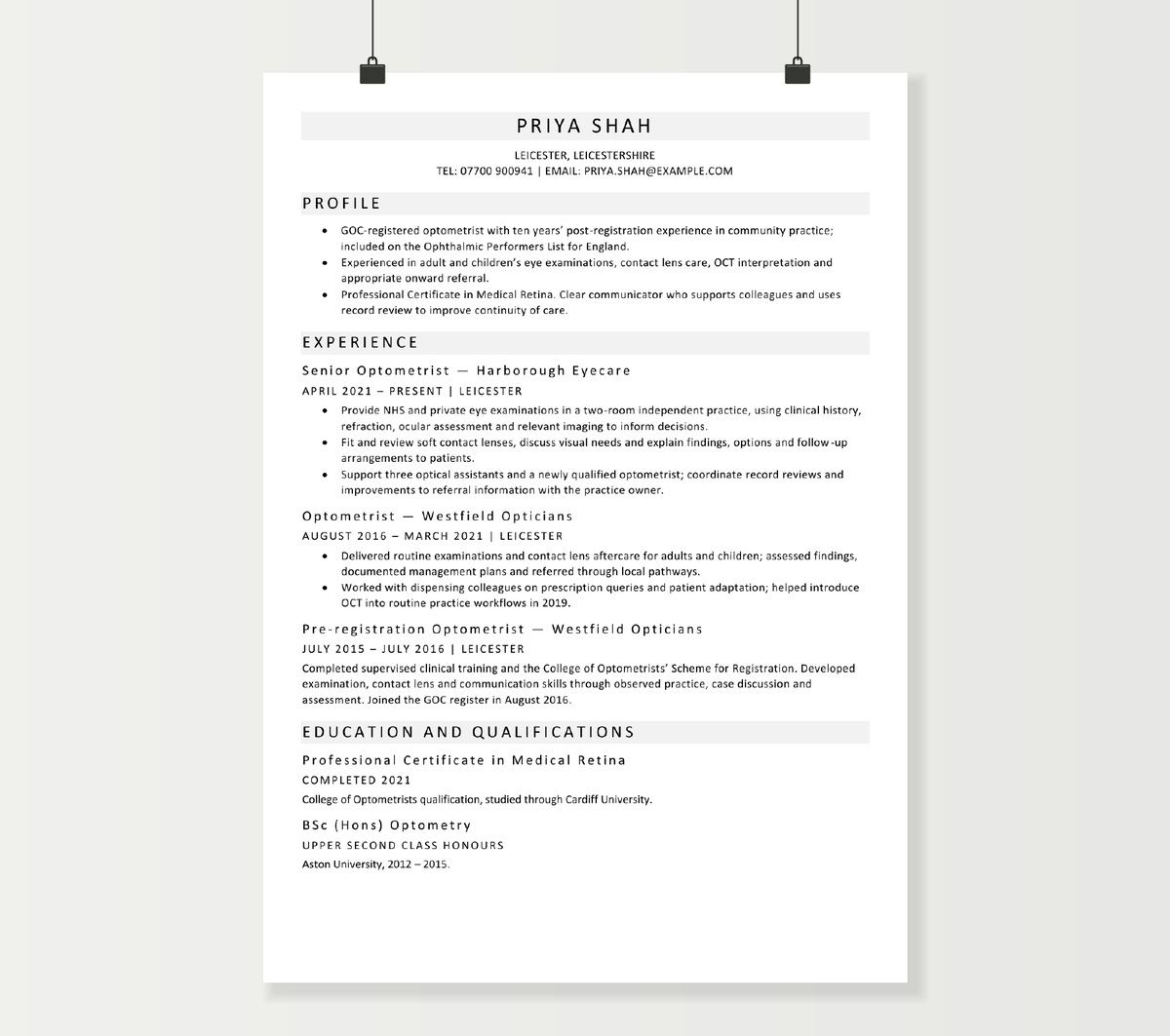
This optometrist CV template follows a community practitioner who progressed into a senior practice role. The Word example combines clinical experience, professional development and practical improvements in referral records and patient support. The guide helps applicants present their strengths for community, hospital and domiciliary optometry roles.
Filename: FreeCVDownload_Optometrist.docx
Content of this CV template
Priya Shah
Leicester, Leicestershire
tel: 07700 900941 | email: [email protected]
Profile
- GOC-registered optometrist with ten years’ post-registration experience in community practice; included on the Ophthalmic Performers List for England.
- Experienced in adult and children’s eye examinations, contact lens care, OCT interpretation and appropriate onward referral.
- Professional Certificate in Medical Retina. Clear communicator who supports colleagues and uses record review to improve continuity of care.
Experience
Senior Optometrist — Harborough Eyecare
April 2021 – present | Leicester
- Provide NHS and private eye examinations in a two-room independent practice, using clinical history, refraction, ocular assessment and relevant imaging to inform decisions.
- Fit and review soft contact lenses, discuss visual needs and explain findings, options and follow-up arrangements to patients.
- Support three optical assistants and a newly qualified optometrist; coordinate record reviews and improvements to referral information with the practice owner.
Optometrist — Westfield Opticians
August 2016 – March 2021 | Leicester
- Delivered routine examinations and contact lens aftercare for adults and children; assessed findings, documented management plans and referred through local pathways.
- Worked with dispensing colleagues on prescription queries and patient adaptation; helped introduce OCT into routine practice workflows in 2019.
Pre-registration Optometrist — Westfield Opticians
July 2015 – July 2016 | Leicester
Completed supervised clinical training and the College of Optometrists’ Scheme for Registration. Developed examination, contact lens and communication skills through observed practice, case discussion and assessment. Joined the GOC register in August 2016.
Education and qualifications
Professional Certificate in Medical Retina
Completed 2021
College of Optometrists qualification, studied through Cardiff University.
BSc (Hons) Optometry
Upper Second Class Honours
Aston University, 2012 – 2015.
Continuing professional development
Recent learning: 2025 – 2026
OCT interpretation, referral decisions, safeguarding and patient communication; regular peer discussion and reflection.
Selected contributions and skills
Referral record improvement
- Reviewed 40 outgoing referral records against the practice’s agreed information checklist in early 2025.
- Worked with colleagues to add a structured prompt for relevant findings, history and the reason for referral.
- A repeat review found 37 of 40 records complete against the checklist, compared with 29 of 40 initially; shared the findings at a team meeting.
Supporting patients and colleagues
- Developed a contact lens aftercare discussion prompt with the dispensing team, covering patient questions and agreed next steps.
- Delivered four short team sessions on recording patient concerns and handing clinical queries to the optometrist.
- Adapt explanations for patients with hearing or communication needs, checking understanding and involving an agreed supporter where helpful.
- Discuss cases with the practice team and local healthcare colleagues to support clear handovers and follow-up.
Clinical tools and records
- Use OCT, fundus imaging, visual fields and slit-lamp examination alongside clinical history and other findings. Maintain electronic examination, consent, referral and follow-up records in Optix.
Hobbies and interests
- Swimming, gardening and visiting art exhibitions.
How to write an optometrist CV
An optometrist CV should make your clinical scope and professional status easy to understand. The reader needs to see the patients and settings you know, the decisions you take and the contribution you make beyond completing an examination.
The emphasis changes with the post. Community practice may combine clinical care, patient experience and support for the wider store team. A hospital role may place more weight on particular clinics, supervised development and multidisciplinary working. Domiciliary work adds the challenge of assessing and communicating effectively in a patient’s own environment.
Put registration and relevant scope near the top
State your General Optical Council registration status prominently, alongside your current role and relevant experience. Include your registration number where requested by the employer. A short professional-status section can also hold relevant performer-list inclusion and a prescribing specialty.
For NHS primary care work in England, ophthalmic performers-list inclusion is separate from GOC registration. Give the status that applies to the role and location. England’s arrangements do not automatically describe practice elsewhere in the UK, and hospital-only work has different requirements. The ophthalmic performers guidance is useful when preparing an England application.
Make the stages of further development easy to distinguish. A completed higher qualification, current study, a prescribing specialty and local service accreditation each tell an employer something different. Give the exact award or service, date and status, then show relevant use in your experience.
Priya’s profile establishes community experience, GOC status, England performers-list inclusion and a Professional Certificate in Medical Retina. It gives a clear starting point for understanding the clinical work described below.
Describe the practice and the patients you work with
Start each substantial role with its setting and scope. A two-room independent practice, a large multiple, a hospital clinic and a home-visiting service create different working contexts. Give enough information to make your responsibilities intelligible.
Identify the patient groups and services most relevant to the vacancy. These might include adult and paediatric examinations, contact lens fitting and aftercare, low vision, medical contact lenses or a particular enhanced service. Connect specialist experience to the setting, training and responsibility involved.
For an experienced community optometrist, a concise clinical overview can leave space for selected examples of referral judgement, patient communication and team contribution. For a specialist hospital application, the clinic mix and depth of relevant experience may deserve more detail.
Where workload helps explain the role, include it with context: sessions per week, appointment mix, home visits or a shared clinic arrangement. The useful question is how you managed the work and patient needs, rather than how many tests you could fit into a day.
Show clinical judgement behind equipment and procedures
List clinical tools in relation to the work you perform. OCT, visual fields, fundus imaging and slit-lamp examination become meaningful evidence when the CV explains how you use findings within an assessment or referral decision.
Distinguish acquiring a result from interpreting it and taking responsibility for the next step. A candidate moving into a specialist clinic can show the experience already gained, relevant supervision and development completed. This gives the employer a useful picture of readiness for that particular post.
For contact lens work, describe the type of fitting or aftercare and the patient needs involved. Routine soft-lens practice, complex medical lenses and specialist paediatric work demonstrate different experience. Use the detail that matches your background and the vacancy.
Clinical systems also belong in context. Name the system you use for examination records, referrals or shared-care documentation, then give an example of accurate recording or continuity. A software list alone says little about the quality of the information you maintain.
Present referrals and enhanced services clearly
Referral experience can demonstrate judgement, communication and follow-through. Explain the types of pathways you work within, your role in deciding or arranging the referral and how you document the relevant findings and next steps.
For enhanced services, identify the service and the local setting. If the employer is recruiting across regions, expand abbreviations and explain the work briefly. Similar labels can cover different commissioning arrangements and responsibilities.
Evidence might include improving referral completeness, coordinating a handover or contributing to a review of a pathway. State what changed and how the team assessed it. Priya’s example uses a repeat record review, with the same checklist and sample size, to make the improvement easy to evaluate.
Independent prescribing should appear as a specific professional capability where relevant, supported by specialty status and examples of practice within the role. A certificate in a clinical subject can support specialist development while representing a different qualification from prescribing.
Make patient communication a substantive strength
Choose examples that show what your communication achieved. Explaining an unexpected finding, discussing visual options, supporting a first contact lens wearer or clarifying the reason for onward referral can all demonstrate your approach.
Show how you adapt to the person. You may have changed the pace of an explanation, used a suitable format, involved a supporter with the patient’s agreement or checked understanding before agreeing the next step. The CV can describe that professional action without recounting an identifiable patient’s history.
For a domiciliary application, explain experience with mobility, hearing or communication needs and the practical environment of home visits. Relevant evidence includes adapting the assessment, maintaining clear records, coordinating with carers or care-home staff and obtaining support when needed.
For community practice, communication also includes handovers to dispensing colleagues. An example of resolving a prescription query or explaining the patient’s priorities can show how you contribute to the whole experience of care.
Balance clinical quality with contribution to the practice
Commercially aware optometrists can demonstrate how good clinical service supports a sustainable practice. Useful examples include clearer handovers, fewer avoidable repeat appointments, improved aftercare follow-up or better coordination between the diary and the clinical team.
Explain your responsibility for any operational measure. If you helped improve attendance, contact lens retention or a patient-experience score, give the period and the specific change you contributed. Where the result belongs to the practice team, show your part within it.
Record quality, service access and patient feedback can be strong achievements alongside commercial outcomes. A small audit with a defined standard is often more informative than a broad statement about exceptional care.
For a senior or store-lead role, add the people and decisions within your remit: coaching assistants, supporting newly qualified colleagues, organising clinical discussions or contributing to service planning. Specify whether you held formal supervision responsibility or provided day-to-day support.
Use qualifications and CPD to explain your direction
Give the original title of your optometry qualification, institution, result and completion date. For established practitioners, the route taken at the time remains the clearest account of their training. Current students can give the exact programme and expected completion date, together with their placement stage.
Prioritise further qualifications relevant to the post, such as a professional certificate, higher certificate, diploma or prescribing qualification. Make the awarding body and study provider clear where they differ. A short line on the practical relevance can help the reader connect the award to your experience.
Select recent CPD that explains a current interest or improvement in practice. A focused account of learning, peer discussion and application is more useful than listing every event attended or presenting a points total without context.
Teaching and supervision deserve evidence of their own. Give the group supported, your responsibility and an example of what you delivered. Formal trainee supervision, a team briefing and informal mentoring each offer something useful when described precisely.
Adapt the evidence for the next stage of your career
For a pre-registration or placement application, bring clinical training and relevant optical experience forward. Describe supervised patient work, feedback, case discussion and what you have learnt about communication and record keeping. Earlier optical-assistant employment can demonstrate understanding of the practice and patient journey.
A newly qualified applicant can give the registration stage, recent training and the areas in which they have built confidence. Choose a few well-developed examples rather than trying to resemble a long-established specialist.
For a move into hospital optometry, map your evidence to the person specification and clinic mix. Community experience can offer sound examination, communication and referral skills. Add specialist placements, higher study and supervised experience that support the transition, with the level of responsibility made clear.
For locum work, use a dated locum heading with the settings, regions and recurring responsibilities beneath it. Select assignments that demonstrate range or specialist experience. Availability, travel area and a driving licence can answer practical questions where relevant.
Choose a layout that leaves room for the clinical evidence the vacancy needs. This example uses separate sections for employment, qualifications and selected contributions; the CV template library offers other arrangements for applicants whose experience is organised around specialist clinics or shorter assignments.
Optometrist CV FAQs
Include it when the employer asks for it, and make your registration status easy to find. If the application form has a dedicated registration field, complete that as well. Students and applicants awaiting registration can give their current stage and expected timing clearly.
The underlying requirements are separate: GOC registration is professional registration, while performers-list inclusion relates to the relevant NHS primary care arrangements. In England, an included ophthalmic performer now uses their GOC number rather than an old separate OPL-number format. State the list and inclusion status applicable to the vacancy; hospital-only optometry in England does not require that performers-list inclusion.
Give the course or award title, provider, current stage and expected completion date. Where it involves a clinical placement or further assessment, make that stage clear. Completed awards can sit above current study so the employer can quickly understand both existing capability and development.
It is a different qualification. The certificate develops relevant medical-retina knowledge and clinical reasoning; independent prescribing has its own training and GOC specialty-registration requirements. On the CV, list each completed qualification and any prescribing specialty separately.
Use the original qualification title, institution, country and dates, followed by your UK registration status or progress through the applicable route. Explain the setting and scope of overseas practice in terms a UK employer can understand. The GOC determines the registration route for the individual applicant.
Yes. Give the dates briefly, then make recent practice, relevant development and current registration status clear. For a return to practice, include completed refresher activity, supervised experience or restoration progress where relevant. Earlier specialist experience remains useful when its dates and subsequent development are easy to follow.
Use concise examples in the CV to explain clinical responsibility, communication or improvement. If a portfolio or case discussion is requested, prepare material in the format specified by the employer, with patient details appropriately anonymised. A routine CV usually needs the contribution and outcome rather than a full clinical account.
A grouped locum entry is usually easier to read than a separate role for every day or week. Give the overall dates, types of practice and relevant systems or services. Separate a substantial recurring assignment where it adds distinct experience, and retain the full assignment history for any recruitment checks that request it.