
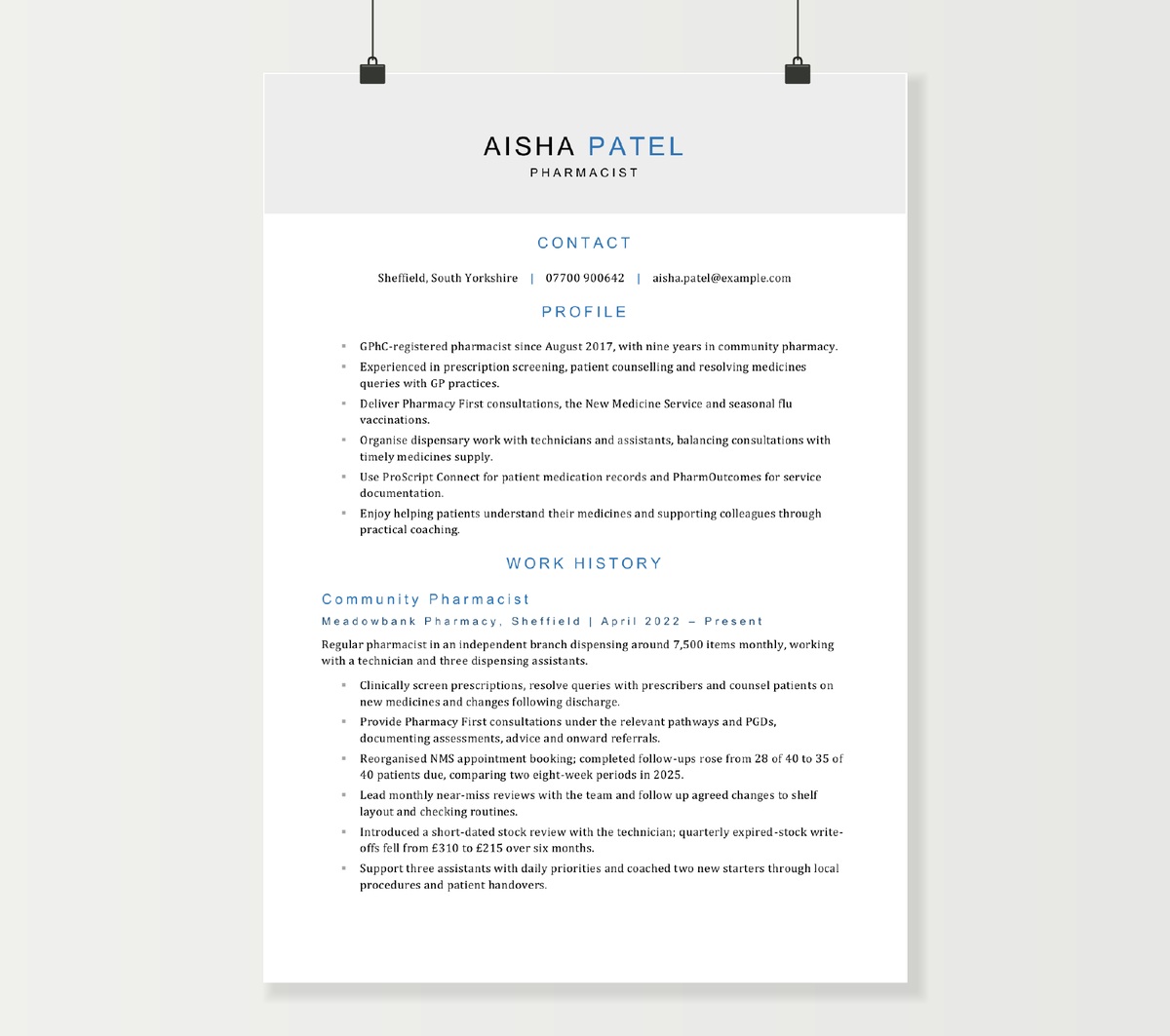
This pharmacist CV template follows a community pharmacist with experience in regular and relief roles. The Word example brings together patient consultations, medicines supply, team support and practical service improvements. Use the complete CV and guide to shape an application for community, hospital or primary-care pharmacy.
Filename: FreeCVDownload_Pharmacist.docx
Content of this CV template
Aisha Patel
Pharmacist
Contact
Sheffield, South Yorkshire | 07700 900642 | [email protected]
Profile
- GPhC-registered pharmacist since August 2017, with nine years in community pharmacy.
- Experienced in prescription screening, patient counselling and resolving medicines queries with GP practices.
- Deliver Pharmacy First consultations, the New Medicine Service and seasonal flu vaccinations.
- Organise dispensary work with technicians and assistants, balancing consultations with timely medicines supply.
- Use ProScript Connect for patient medication records and PharmOutcomes for service documentation.
- Enjoy helping patients understand their medicines and supporting colleagues through practical coaching.
Work history
Community Pharmacist
Meadowbank Pharmacy, Sheffield | April 2022 – Present
Regular pharmacist in an independent branch dispensing around 7,500 items monthly, working with a technician and three dispensing assistants.
- Clinically screen prescriptions, resolve queries with prescribers and counsel patients on new medicines and changes following discharge.
- Provide Pharmacy First consultations under the relevant pathways and PGDs, documenting assessments, advice and onward referrals.
- Reorganised NMS appointment booking; completed follow-ups rose from 28 of 40 to 35 of 40 patients due, comparing two eight-week periods in 2025.
- Lead monthly near-miss reviews with the team and follow up agreed changes to shelf layout and checking routines.
- Introduced a short-dated stock review with the technician; quarterly expired-stock write-offs fell from £310 to £215 over six months.
- Support three assistants with daily priorities and coached two new starters through local procedures and patient handovers.
Relief Pharmacist
Northbridge Pharmacies, South Yorkshire | August 2017 – March 2022
Covered six community branches, adapting to different teams, service demand and local procedures.
- Undertook responsible pharmacist duties, clinical and accuracy checks, and patient consultations during planned and short-notice cover.
- Delivered NMS consultations and flu vaccinations, recording follow-up needs for the regular pharmacist.
- Worked with surgery teams to resolve prescription discrepancies and arrange continuity of supply during stock shortages.
- Created a branch handover checklist covering outstanding queries, service appointments and stock issues; adopted across the six-branch relief rota.
Pre-registration Pharmacist
Northbridge Pharmacies, Sheffield | August 2016 – July 2017
Completed supervised training in a community pharmacy before joining the GPhC register.
- Built experience in dispensing, medicines information and patient counselling, with regular tutor feedback.
- Completed a 50-prescription documentation audit and presented findings to the pharmacy team.
Qualifications and training
MPharm Pharmacy — Upper Second Class Honours
University of Bradford | 2016
Recent professional development
Pharmacy First clinical updates (2026); vaccination and basic life support refresher (2026); safeguarding update (2025).
Hobbies and interests
I enjoy swimming, trying new recipes and visiting the Peak District with friends.
How to write a pharmacist CV
A pharmacist CV needs to show the kind of practice you bring, the decisions you make and the people who benefit from your work. Registration and qualifications establish your professional background. Your employment examples explain how you use that background in consultations, medicines supply, clinical review and service improvement.
The emphasis changes with the vacancy. A community pharmacy may need someone who can organise a busy dispensary and develop its clinical services. A hospital team may be looking for experience in particular rotations, medicines reconciliation and multidisciplinary working. A GP practice may want an independent prescriber who can take responsibility for a defined group of patients. Choose your strongest evidence with that setting in mind.
Make registration and prescribing status easy to find
Put your current professional registration near the top of the CV, either in the profile or in a short registration section. State the regulator and, where requested or useful for verification, your registration number. The General Pharmaceutical Council covers Great Britain; pharmacists practising in Northern Ireland register with the Pharmaceutical Society of Northern Ireland. A professional membership belongs in a separate line from statutory registration.
Give independent prescribing its own clear description when relevant. State your register annotation and the clinical area in which you prescribe, then support it with experience later in the CV. “Independent prescriber with experience of hypertension reviews in general practice” gives more useful information than “IP qualified” on its own. A completed course, an annotation and current prescribing practice are different pieces of evidence, so give each its appropriate place.
If you are undertaking prescribing training, list the course and anticipated completion date under professional development. If your prescribing preparation formed part of your initial education and training, describe your current registration status and the supervised clinical experience that prepared you for the role. The reader should be able to see both your qualification and your level of practical experience.
Check the person specification for the particular post. Prescribing may be essential for one primary-care vacancy and a supported development opportunity in another role. The same applies to a clinical diploma or completion of a primary-care education pathway. Bring essential evidence forward, then use the rest of the application to show what you would contribute to the service.
Choose the right clinical and operational emphasis
Community pharmacy
Begin each recent role with the branch context: regular or relief work, the approximate volume of prescription items, the team and the services provided. This helps an employer understand the environment in which you worked. State dispensing volume as a branch figure when that is what it measures, then explain your own responsibilities within the operation.
Give space to the work behind safe, timely supply. Clinical screening, resolving prescription queries, managing shortages, counselling patients after a medicine change and coordinating with GP practices all provide stronger evidence than a broad statement about dispensing. Responsible pharmacist duties, controlled-drug processes and supervision are relevant where they formed part of your role.
Describe the services you actually delivered and your involvement in them. Pharmacy First, the New Medicine Service, vaccinations, contraception or blood-pressure services may deserve a place, depending on the vacancy and your experience. Service names and commissioning arrangements differ across the UK, so use the terminology of the country and setting in which you worked. Add a brief account of consultations, documentation, referral or follow-up rather than leaving the employer with a list of service names.
For a pharmacist manager application, explain the management scope as well as clinical work. Useful details include the number and roles of colleagues, rota responsibility, recruitment, training, stock control, service capacity and relationships with local practices. Give an example of how you balanced those responsibilities, such as arranging dispensary cover that enabled planned consultation appointments.
Hospital pharmacy
Make rotations and clinical exposure visible. Group them beneath the relevant employer, identifying the areas most useful for the vacancy: medical admissions, surgery, frailty, cardiology, medicines information or another specialty. Give dates or rotation lengths where they help distinguish sustained practice from a short placement.
Choose examples that show what you contributed to patient care. Medicines reconciliation on admission, clinical screening, resolving discrepancies, discharge counselling and communication with the receiving care team can form a coherent account of your work across a patient’s stay. Add the level of responsibility and the colleagues involved so the employer can understand your role in the multidisciplinary team.
A specialist application needs depth as well as breadth. Describe the patient group, recurring clinical issues, advice you provided and any improvement, teaching or guideline work you took forward. For rotational posts, breadth, prioritisation and readiness to develop may be more important. Include weekend or on-call experience where the advertised rota makes it relevant.
A hospital address alone does not explain a pharmacy role. Specify whether you worked in outpatient dispensing, on wards, in technical services or across several areas. This gives the recruiter an accurate picture of the experience you would bring to their service.
General practice and primary care
Describe the practices or network you supported, the patient groups you worked with and the clinical responsibilities you held. Structured medication reviews, long-term-condition clinics, repeat-prescribing work, reconciliation after discharge and monitoring of high-risk medicines may all be relevant. Select the parts that align with the advertised service.
Explain how your work connected with GPs, nurses, care homes, community pharmacies and secondary care. An example of resolving a medicines issue across those boundaries can show clinical reasoning, communication and follow-through in one short account. If you prescribed, identify the area of practice and the arrangements in which you worked.
For posts asking for the primary care pharmacy education pathway or an equivalent, give the exact programme title, provider and completion status. Your practice examples should then show how the learning translates into consultations, medicines optimisation and service development.
Show clinical judgement through a concise example
“Provided patient-centred care” is a useful intention, but an employer needs to see what it looked like. Choose an intervention or recurring responsibility that demonstrates your contribution. A strong CV bullet usually contains the clinical or service issue, your action, the professional communication involved and the resulting change.
For example, an account of reconciling a discharge prescription can explain that you identified a discrepancy, clarified the intended regimen with the discharging team and updated the handover to the patient’s usual pharmacy. The value lies in the sequence of decisions and communication. The CV does not need a detailed case history.
Consultation examples can show how you explored a patient’s concerns, explained options, agreed a practical next step and arranged follow-up. Where relevant, mention adapting communication for a carer, using an interpreter service or helping someone manage a change in their medicines. This gives substance to interpersonal skills without turning the CV into a description of consultation technique.
Keep the account centred on your contribution and use an anonymised description of the setting or patient group. The same approach works for medicines-information enquiries: identify the nature of the enquiry, how you evaluated the evidence and how your advice supported a clinical decision. One well-chosen example can demonstrate more than several broad claims about attention to detail.
Present audit and improvement work with a meaningful result
Pharmacy improvements often involve documentation, follow-up, stock, prescribing processes or the coordination of care. Give the problem, the change you helped introduce and what the follow-up measurement showed. If the work was shared, make your contribution clear: designing the data collection, reviewing records, presenting findings, introducing a change or completing the re-audit.
Use denominators and time periods where they help the reader assess a result. Aisha’s CV describes NMS follow-up completion moving from 28 of 40 patients due to 35 of 40 across two eight-week periods. The counts explain the size of the comparison and the appointment outcome being measured. They also connect the improvement to a specific action: changing how follow-ups were booked.
Other useful measures depend on the setting. You might describe the proportion of medicines reconciliations completed within the local target, the number of outstanding monitoring actions resolved, the completeness of discharge documentation or a reduction in expired stock. Explain what was measured, rather than relying on a percentage whose meaning is unclear.
Patient benefit can also be described through a concrete change in the service. A clearer handover, an agreed referral route, improved access to consultations or a teaching session adopted by the team may be a strong result even without a numerical measure. The purpose is to show why your work mattered and how the improvement became part of practice.
For more senior applications, add the reach of the work. Was a change used by one dispensary, several wards or a network of practices? Did you present it to a governance group, revise a procedure or support colleagues through implementation? Those details help distinguish participation in a project from leading a wider change.
Connect pharmacy systems with the work you do
Name relevant systems and explain their use briefly. In community pharmacy, this might include a patient medication record system such as ProScript Connect, electronic prescription workflows and a platform used to record clinical services. In general practice, EMIS Web or SystmOne may be relevant. Hospital applications may call for experience with electronic prescribing and medicines administration, the electronic patient record or a specialist pharmacy system.
A description such as “used the clinical system to identify patients due for monitoring and record agreed follow-up” tells the reader more than a software list. Similarly, explain whether you used a reporting tool to review prescribing data, supported a system rollout, trained colleagues or helped resolve a recurring record-quality issue.
Keep the level of detail proportionate to the role. Routine user experience can sit in a short skills line. Configuration, testing, reporting or implementation work deserves a fuller example for an informatics or service-development post. This distinction helps an employer understand both familiarity with the system and the responsibility you held.
Make leadership and professional development specific
Pharmacy leadership can include formal line management, professional supervision, teaching and coordination across a clinical team. Identify which you have done. Give the team’s size and roles, then describe an example of allocating work, developing a colleague, improving a handover or responding to an operational problem.
Teaching evidence is stronger when it names the audience and purpose. A session for ward nurses on a recurring medicines issue, coaching for new dispensary staff or supervision of a trainee pharmacist each shows a different contribution. Include a formal supervisor or tutor role where held, alongside the practical support you provided.
List qualifications using their full titles, institutions and completion dates. After your pharmacy degree, prioritise relevant postgraduate study, prescribing qualifications and specialist training. For an experienced applicant, recent clinical development usually deserves more space than school subjects. A short selection of training linked to the vacancy is easier to assess than an extensive catalogue of online modules.
CPD is most persuasive when its effect appears in your work examples. You might connect learning on consultation skills with a new approach to follow-up, or a clinical update with a teaching session or review of local practice. Keep the full learning record available separately; the CV can highlight the evidence that best supports this application.
Adapt the CV for your stage of practice
Foundation trainees and newly registered pharmacists
Give education, training placements and registration status enough prominence for an employer to understand where you are in the transition to practice. If registration is pending, state the stage reached and expected timing. This makes the application useful to employers recruiting for a future start date.
Choose examples from your foundation year that show growing responsibility under supervision. These could include a medicines-reconciliation activity, patient consultation, audit, medicines-information enquiry or team presentation. State the setting and your contribution, with a useful outcome or learning point. A small completed project is often more informative than a list of every placement task.
University research can support an application when it demonstrates relevant evaluation, analysis or presentation skills. Give the question, your method and the result in a few lines, particularly where it connects with the service. Earlier pharmacy assistant or customer-facing work can also show familiarity with patients, workflow and teamwork, while the clinical training remains the main focus.
Experienced pharmacists and moves between sectors
Use more space for recent clinical practice, service improvement and leadership. Shorten repeated duties from earlier posts and bring out the progression in responsibility. If you have worked for the same employer in several roles, show each title and date range so the promotion or change of scope is visible.
For a sector move, identify the experience that travels well and explain its relevance. A community pharmacist may bring strong consultation skills, medicines-supply knowledge and relationships with local practices. A hospital pharmacist may bring reconciliation, discharge and multidisciplinary experience. Place those examples alongside any relevant placement, course or supervised experience in the new setting.
The profile can then make the direction clear in two or three sentences: your current area of practice, the evidence most relevant to the vacancy and the kind of contribution you want to make. This creates a focused application without trying to give every part of your career equal weight.
Use the CV as the evidence base for the application
Where an NHS employer uses a structured application and supporting statement, take the strongest examples from your CV and map them to the person specification. The statement can expand on clinical reasoning, teamwork and improvement work that the CV summarises. Qualification and employment details should be consistent across both.
For an employer accepting a CV directly, make the first page answer the most important questions about setting, registration, recent practice and suitability for the post. Follow with the employment detail, qualifications and development that support those points. If you want to compare another presentation, the Word CV template library contains the site’s other downloadable designs.
Pharmacist CV FAQs
Group similar assignments under a dated locum entry, naming the agencies or pharmacy groups where useful. Summarise the area covered, types of branch, systems and services, then give one or two examples of adapting to different teams. A longer placement with distinct responsibilities can have its own entry. This shows the breadth and continuity of your work without making a long list of individual shifts.
Describe the consultations and the framework you worked within, for example assessment, advice, referral and supply under the relevant clinical pathways and patient group directions. Give independent prescribing a separate description when it is part of your role and registration. Pharmacy First services vary between UK nations and continue to develop, so naming the service, location and nature of your involvement is more informative than treating all Pharmacy First work as prescribing.
Yes, if it demonstrates useful evaluation and follow-through. Explain your contribution, the finding and what the team did next. You may have identified a barrier, revised the data collection or recommended a different approach. If the project is still underway, state the completed stage and the next review point. That can show sound improvement work without relying on a successful headline result.
Keep the original role title and explain the practice setting, clinical responsibilities and scale in terms a UK employer can understand. List the awarding institution and country for qualifications, and give your current UK registration or application stage separately. Relevant conversion study, supervised UK experience and familiarity with local systems can then show the transition into UK practice. This lets your previous experience retain its value while making your current position clear.
Usually the CV needs selected evidence rather than the whole portfolio. Include relevant development and a few examples of how you applied it. If an employer requests additional evidence, provide the specified material in the requested format. A teaching record, audit summary or postgraduate project may be more useful for a particular role than a large collection of course certificates.
It is valuable professional responsibility, but a manager vacancy may also involve line management, rotas, recruitment, budgets and service planning. Describe your responsible pharmacist duties and any of those additional responsibilities separately. If you covered the manager’s absence, give the period and what you took on. The employer can then assess both your professional leadership and your experience of running the wider operation.




