This plant operator CV template follows a groundworker who progressed into operating tracked excavators on housing and commercial sites. The Word example presents machine experience, current card details and practical evidence of accurate work. The guide covers construction and mobile plant applications, from a first operating role to an experienced operator’s next contract.
Filename: FreeCVDownload_Plant_Operator.docx
Content of this CV template
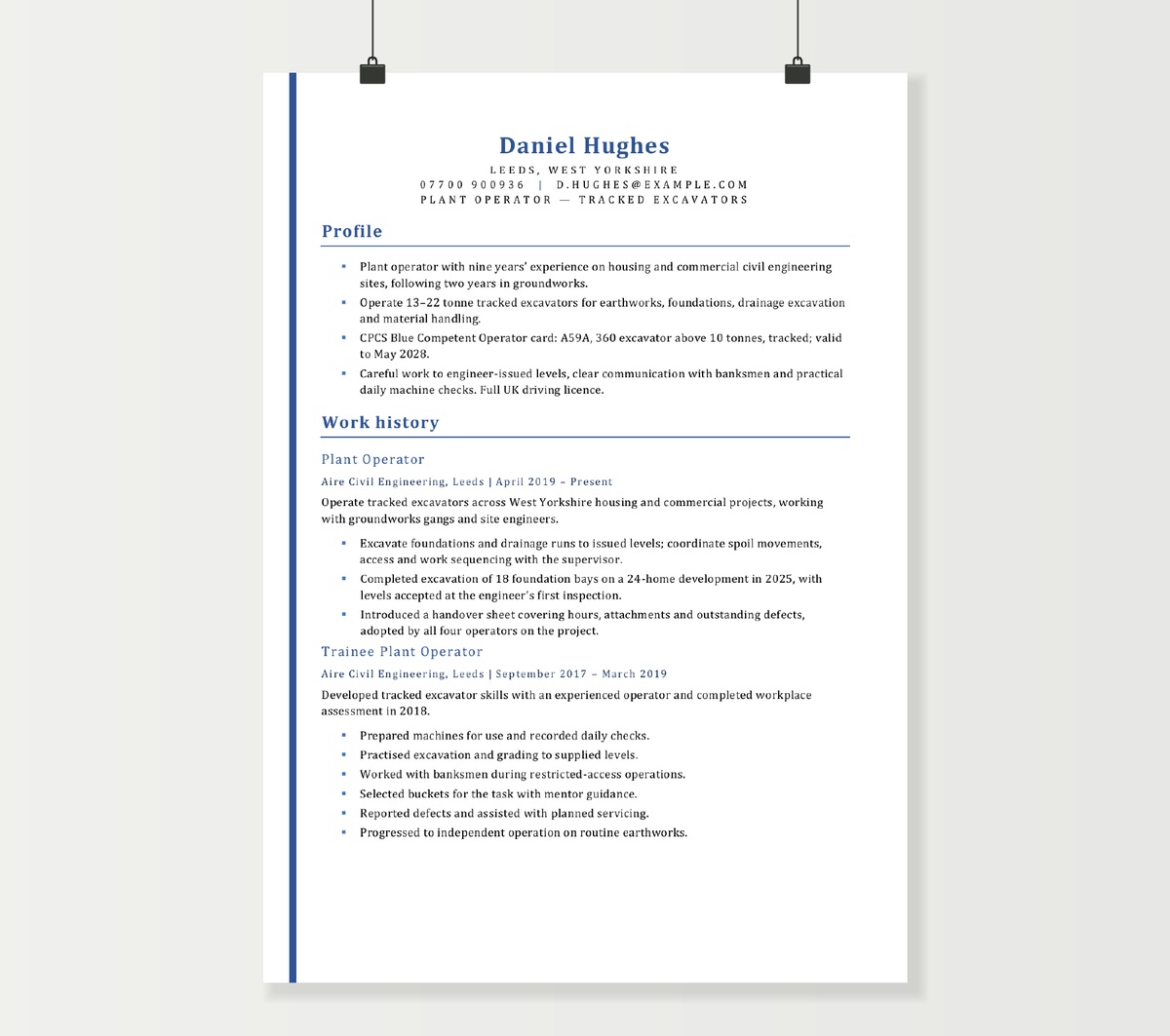
Daniel Hughes
Leeds, West Yorkshire
07700 900936 | [email protected]
Plant Operator — Tracked Excavators
Profile
- Plant operator with nine years’ experience on housing and commercial civil engineering sites, following two years in groundworks.
- Operate 13–22 tonne tracked excavators for earthworks, foundations, drainage excavation and material handling.
- CPCS Blue Competent Operator card: A59A, 360 excavator above 10 tonnes, tracked; valid to May 2028.
- Careful work to engineer-issued levels, clear communication with banksmen and practical daily machine checks. Full UK driving licence.
Work history
Plant Operator
Aire Civil Engineering, Leeds | April 2019 – Present
Operate tracked excavators across West Yorkshire housing and commercial projects, working with groundworks gangs and site engineers.
- Excavate foundations and drainage runs to issued levels; coordinate spoil movements, access and work sequencing with the supervisor.
- Completed excavation of 18 foundation bays on a 24-home development in 2025, with levels accepted at the engineer’s first inspection.
- Introduced a handover sheet covering hours, attachments and outstanding defects, adopted by all four operators on the project.
Trainee Plant Operator
Aire Civil Engineering, Leeds | September 2017 – March 2019
Developed tracked excavator skills with an experienced operator and completed workplace assessment in 2018.
- Prepared machines for use and recorded daily checks.
- Practised excavation and grading to supplied levels.
- Worked with banksmen during restricted-access operations.
- Selected buckets for the task with mentor guidance.
- Reported defects and assisted with planned servicing.
- Progressed to independent operation on routine earthworks.
Groundworker
Bramley Groundworks, Leeds | July 2015 – August 2017
Supported drainage and foundation gangs on residential sites.
- Prepared bedding and helped install drainage runs.
- Assisted with kerbs, sub-base and concrete preparation.
- Kept access routes and work areas clear.
- Read site instructions and coordinated materials with the gang.
Qualifications & training
Level 2 NVQ Diploma in Plant Operations (Construction) — Excavating
Workplace assessment | 2018
360-degree tracked excavator above 10 tonnes. CPCS blue card renewed May 2023.
Employer training and site briefings
2024–2026: buried services awareness, spill response and plant–pedestrian segregation.
Interests
Fishing, five-a-side football and walking in the Yorkshire Dales.
How to write a plant operator CV
A plant operator CV needs to answer a practical question quickly: which machines can you operate, and what work have you completed with them? Your card details establish the relevant categories, while your employment history shows how you use that capability on a real site.
Make the type of plant clear at the start. Construction excavators, loading shovels at a recycling facility and fixed process plant involve different work. This example focuses on a tracked excavator operator. If your background is in a factory or treatment plant, the process operator CV offers a closer model for presenting control systems, process monitoring and production duties.
Put machine experience where it can be found immediately
Use your profile or a short plant-and-cards section to identify your main machines. Include the type, relevant size range and configuration. “13–22 tonne tracked excavators on housing and commercial civils projects” gives an employer much more information than “experienced plant operator”.
Match the level of detail to the vacancy. A role seeking an above-10-tonne 360 operator will benefit from that category appearing early. A mixed fleet role may need a compact list of excavators, dumpers, rollers or loading shovels, with the current categories and recent experience alongside each.
Separate the machine category from the work you perform. Excavation, grading, stockpile management, wagon loading, demolition support and lifting operations are not interchangeable descriptions. Where attachments are significant, identify them and the tasks you have undertaken with them.
Manufacturer names can help when an advert specifies a fleet, but the CV’s strongest evidence is the machine range, work setting and standard of work. A long list of brands adds little if the reader still cannot tell what you operated regularly.
Make CPCS, NPORS and qualifications easy to interpret
Give the scheme, card type or status, relevant category and expiry date. Include the category description as well as its code so that both the recruiter and the site team can understand it. Daniel’s example states CPCS Blue Competent Operator, A59A, tracked 360 excavator above 10 tonnes, followed by the expiry date.
For NPORS, use the wording and status shown on your card, including the CSCS-logo route where applicable. Employers and projects specify different card requirements, so organise this section around the vacancy’s requested categories and supporting evidence.
List particular endorsements, such as lifting operations, when relevant to the work sought. Keeping them beside the appropriate machine category helps the employer understand the scope of your operating experience.
Your NVQ or SVQ belongs in the qualifications section with the level, full title, pathway and completion year. The machine or activity assessed can be useful if the title is broad. Keep course attendance, workplace assessment and current card status distinct so the progression is clear.
Include relevant site training selectively. Water-sector work may call for particular safety or hygiene credentials; rail, highways and other environments have their own requirements. Give the credential and validity where applicable, then use the employment history to explain your experience in that setting.
Describe the job behind the machine
Start each employment entry with the setting and scope: housing infrastructure, commercial groundworks, utilities, quarrying, waste transfer, landscaping or another area. Then choose tasks that show the kind of operator you are.
For an excavator operator, useful details might include foundation excavation, drainage runs, bulk earthworks, battering, final trimming or working in restricted areas. Explain how you worked with the engineer, supervisor and groundworks gang to achieve the required finish.
For a loading shovel operator, the stronger evidence may be material segregation, loading vehicles, stockpile organisation and maintaining a reliable supply to the next stage of the operation. A recycling-site CV can also show coordination with weighbridge staff and awareness of vehicle and pedestrian movements.
Environmental and landscaping projects may benefit from details about low-ground-pressure machines, access constraints, sensitive ground and work alongside planting or fencing teams. Choose the details that explain why experience on that project is useful to the next employer.
Daniel’s foundation-bay example gives a defined output and an inspection result. It helps the reader picture both the work and its standard. His earlier groundworks role also explains why he understands what the gang needs from the machine operator.
Show accuracy, communication and judgement
“Safety conscious” is more persuasive when supported by a normal part of your work. You might describe carrying out and recording pre-use checks, reporting a defect promptly, confirming a changed work area with the supervisor or coordinating movements with a banksman.
The CV needs a concise account of your contribution, rather than instructions for operating the machine. For example, explain that you worked to the agreed excavation sequence and engineer-issued levels, or that you raised a discrepancy before the next stage began.
Buried services, overhead restrictions, access routes and nearby workers can make otherwise similar jobs very different. Relevant experience of these conditions belongs in a project bullet, with your role and the people you coordinated with.
Daily inspection records, defect reporting and handovers also demonstrate reliability. Daniel’s handover sheet is a modest improvement with a clear purpose: the next operator could see the machine’s hours, attachments and outstanding issues.
If you support trainees, describe the scope of that support. Familiarisation, demonstrating a site routine and helping someone keep a logbook can all be useful evidence. Formal assessment or supervisory responsibility should appear under the title and remit in which you performed it.
Present machine control and site technology in context
GPS or 3D machine control experience is useful when the role calls for it. Name the system where relevant and describe the tasks you carried out, such as following a loaded design, checking cut-and-fill information or reporting a discrepancy to the engineer.
Explain your level of responsibility through the wording. Operating with an engineer-supplied model, carrying out routine checks and preparing survey or design information are different contributions. A short practical example tells the employer more than a software name alone.
Other systems may include digital inspection forms, telematics, weighbridge software or electronic timesheets. Include the ones you use meaningfully and connect them to the record, decision or handover they support.
Choose results that reflect the work
Plant work offers several useful forms of evidence: an accepted finish, work ready for the next gang, reliable loading across a shift, fewer repeat defects or a clearer handover. A result can be strong without a percentage attached.
Where figures help, provide their context. State the number of foundation bays, the length and type of drainage run, a typical loading workload or the period covered by an improvement. The reader should understand what the figure measures and your part in achieving it.
Productivity figures are most informative alongside the conditions and quality requirements. A daily output on open bulk earthworks means something different from work around live services or in a tight urban site. Select a measure that makes the difficulty and value of your work understandable.
For experienced operators, two or three well-chosen results usually add more than repeating the same duties under every contract. Use older roles to show additional plant, settings or progression.
Organise agency work and short contracts clearly
If one agency has placed you on several projects, you can use the agency and overall dates as the main entry, followed by selected assignments. Give each project’s location or type, machine and work performed. This keeps a busy contracting history readable.
For separate employers or self-employed engagements, retain clear dates and identify the relevant contractor or project where appropriate. Group similar short assignments when that makes the operating experience easier to follow, while keeping the employment arrangement understandable.
Make practical availability easy to find. Your base location, travel area, driving licence, shift availability and willingness to work away can matter directly to mobilisation. Include the details relevant to the vacancy and use a separate application note for a start date that changes frequently.
Build a useful CV for a first operating role
Put training, card status and supervised operating experience before a long list of unrelated jobs. Describe the machines used, practical tasks completed and the setting in which you were assessed or gained experience.
Groundworks, labouring, agricultural, yard and maintenance roles can provide valuable evidence. Select examples involving site communication, checks, material handling, following work instructions or coordinating with other operators. Explain the connection through the task itself.
Experienced applicants can give less space to early training and more to recent machines and projects. In both cases, the aim is a clear account of what you can contribute to the particular operation. You can compare alternative layouts in the CV template library.
Plant Operator CV FAQs
The scheme, card status, categories and expiry dates normally give the recruiter the information needed for an initial review. You can provide the card number or a copy through the employer’s requested verification process when progressing the application. This also keeps a widely circulated CV focused on your experience.
State the trained-operator status and relevant category clearly, then describe practical training and supervised operating experience. Add your workplace qualification or assessment progress with its current stage. That gives an employer considering developing operators a useful picture of both preparation and next steps.
Keep the same career record, but change the emphasis. Construction applications may centre on excavation, levels and coordination with groundworks gangs. Waste-site roles may place more weight on loading shovels, material segregation, vehicle movements, inspections and shift handovers. Bring the most relevant machines and setting to the top.
Keep the current card category in the credentials section and give the dates or period of practical use in your employment history. Put regularly operated machines first. This lets the employer see both your category coverage and the experience most likely to transfer immediately to the vacancy.
For an owner-operator engagement, machine type, size, available attachments and the area you cover can be relevant, alongside your operating experience. For an employed operator vacancy, lead with your skills and current categories. Commercial equipment details can sit in a separate capability sheet when they are central to the contract.
A photograph is not normally needed to assess an operator CV. Clear machine categories, project details and recent experience do that job more effectively. If an employer asks for project evidence, a short separately supplied record can complement the CV, with permission for any site photographs.
Label fixed-term or seasonal assignments clearly and keep dates easy to follow. A brief phrase such as “seasonal earthworks contract” explains the arrangement without taking attention away from the work. Relevant training or another job between assignments can appear in the same chronological record.