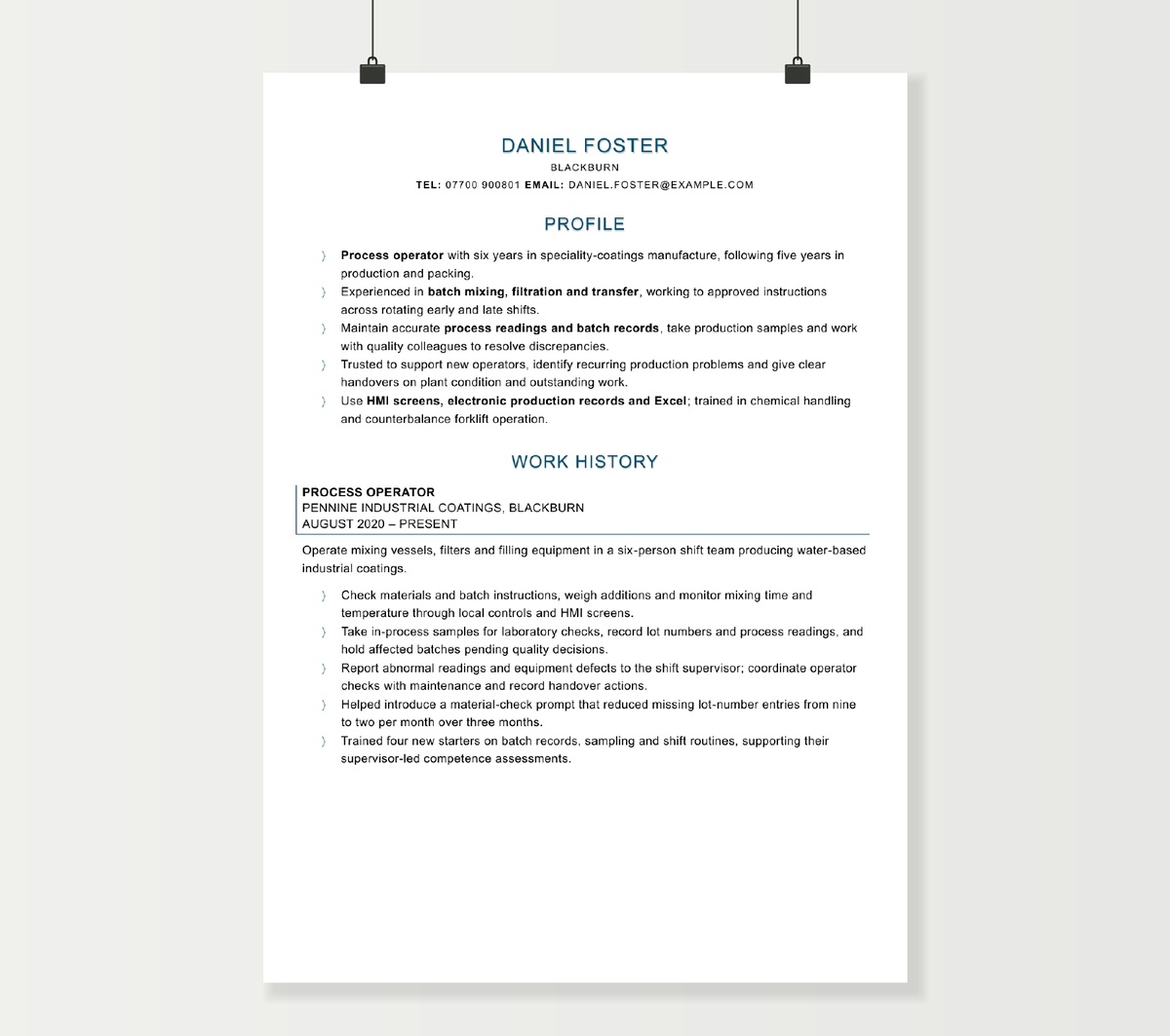
This process operator CV template shows a candidate who progressed from production work into batch manufacturing. The Word example covers mixing and transfer equipment, process monitoring, quality checks and shift handovers. The guide explains how to present this experience for chemical, continuous-process and water treatment roles, with advice for applicants moving into process operations.
Filename: FreeCVDownload_Process_Operator.docx
Content of this CV template
DANIEL FOSTER
BLACKBURN
tel: 07700 900801 email: [email protected]
PROFILE
- Process operator with six years in speciality-coatings manufacture, following five years in production and packing.
- Experienced in batch mixing, filtration and transfer, working to approved instructions across rotating early and late shifts.
- Maintain accurate process readings and batch records, take production samples and work with quality colleagues to resolve discrepancies.
- Trusted to support new operators, identify recurring production problems and give clear handovers on plant condition and outstanding work.
- Use HMI screens, electronic production records and Excel; trained in chemical handling and counterbalance forklift operation.
WORK HISTORY
PROCESS OPERATOR
PENNINE INDUSTRIAL COATINGS, BLACKBURN
AUGUST 2020 – PRESENT
Operate mixing vessels, filters and filling equipment in a six-person shift team producing water-based industrial coatings.
- Check materials and batch instructions, weigh additions and monitor mixing time and temperature through local controls and HMI screens.
- Take in-process samples for laboratory checks, record lot numbers and process readings, and hold affected batches pending quality decisions.
- Report abnormal readings and equipment defects to the shift supervisor; coordinate operator checks with maintenance and record handover actions.
- Helped introduce a material-check prompt that reduced missing lot-number entries from nine to two per month over three months.
- Trained four new starters on batch records, sampling and shift routines, supporting their supervisor-led competence assessments.
PRODUCTION OPERATIVE
RIBBLE CLEANING PRODUCTS, PRESTON
JULY 2015 – JULY 2020
Worked on filling and packing lines for household cleaning products, gaining experience in material handling, checks and production records.
- Set up labels and packaging against work orders, completed line-clearance checks and recorded hourly output and stoppages.
- Carried out fill-weight and pack checks, isolated non-conforming stock and referred discrepancies to the line leader.
- Progressed to relieving the mixing-room operator, preparing materials and completing supervised batch tasks alongside a Level 2 qualification.
- Reorganised labelled packaging locations with the line team, cutting average changeover searches from 12 minutes to five in a four-week check.
QUALIFICATIONS & TRAINING
LEVEL 2 NVQ DIPLOMA IN PERFORMING MANUFACTURING OPERATIONS
CITY & GUILDS – 2019
Workplace-assessed qualification covering production operations, quality checks and effective working practices.
GCSES
EIGHT A*–C GRADES, INCLUDING ENGLISH, MATHS AND SCIENCE – 2015
RECENT TRAINING
CHEMICAL HANDLING – 2025; COUNTERBALANCE REFRESHER – 2024
INTERESTS
Five-a-side football, walking in the Ribble Valley and home cooking.
How to write a process operator CV
A process operator CV should make it easy to picture the plant you have worked on and the responsibility you carried during a shift. “Operated machinery and met targets” leaves too much unanswered. An employer needs to know whether you handled batch ingredients, monitored a continuous process, took field readings, worked through a control system or combined several of these tasks.
Build the CV around that operating experience. Your strongest evidence may be consistent batches, useful fault reports, clear records or a well-managed changeover. Give those things the same attention as production volumes.
Identify your type of process experience early
Use the opening profile to establish your sector, the process you know and your level of responsibility. A coatings operator might mention batch mixing, filtration and filling. Someone in energy or thermal processing could lead with continuous plant, field inspections and control-room work. A water operator may need to foreground treatment assets, sampling and work across several sites.
The example CV gives a clear route from production and packing into speciality-coatings manufacture. Its profile connects the candidate’s six years of process work with the equipment and records involved. That is more informative than a long string of personal qualities.
Match the emphasis to the next role. If a vacancy combines plant rounds with SCADA monitoring, make both aspects visible. If it centres on weighing and charging materials, prioritise batch accuracy, material identification and the stages you have operated. A short description beneath each job title can explain the environment before the achievement bullets begin.
Describe the plant at a useful level of detail
Equipment names help when they show relevant experience. Group them into a process the reader can follow: mixing vessels and transfer pumps; drying and packing equipment; or treatment assets and associated monitoring systems. Add scale where it explains responsibility, such as the number of units covered, normal batch sizes or the size of the shift team.
Choose details that distinguish your work. “Operated mixing vessels, filters and filling equipment in a six-person shift team producing water-based coatings” establishes the product, plant and team context in one sentence. A separate bullet can then explain the monitoring or checks you performed.
For a site with unusual equipment, use an understandable description alongside its name. Internal line codes mean little outside your employer. Product types and process stages usually travel better, particularly when applying to a different industry.
Make control-system experience concrete
HMI, SCADA and DCS experience becomes useful evidence when the CV explains how you used the system. Relevant tasks could include checking trends, monitoring operating conditions, acknowledging and investigating alarms, entering authorised settings or recording events for the incoming shift.
Give the system name if it is relevant and familiar to the recruiting employer, then connect it to the work. For example: “Monitored vessel temperature and mixing time through local HMI screens, recording deviations and referring abnormal conditions to the shift supervisor.” This shows both practical use and the route for decisions.
Make the scope equally clear if you have worked in a control room, relieved a panel operator or supported commissioning. State which duties you covered and how often. Where you have separate controls-engineering experience, describe that as its own responsibility; operating a process through a screen and modifying its control logic are different forms of experience.
Show how you respond when production changes
Good process experience includes noticing when conditions differ from the expected pattern. Give a concise example of your part in handling a recurring stoppage, unusual reading, inconsistent batch or equipment defect. The useful CV story is what you observed, what you recorded or checked, who you involved and what happened next.
A bullet might explain that you identified a repeated pressure fluctuation, supplied time-stamped readings to maintenance and helped verify normal operation after repair. Another could describe holding a batch while quality colleagues reviewed a sample. These examples demonstrate judgement and communication without requiring a detailed operating procedure.
Maintenance-related experience benefits from precise verbs. “Completed operator checks”, “raised defect reports”, “supported isolation under site authorisation” and “assisted maintenance during a planned shutdown” convey different responsibilities. Use the description that makes your contribution clear. If you held a formal permit or isolation role, include its scope and relevant training.
Give quality checks and traceability enough space
Production records are part of the work, not an administrative afterthought. Show what you recorded and why it mattered: material lot numbers, additions, readings, sample references, packaging checks, deviations or waste movements. Name the electronic production or work-order system where useful; otherwise explain the records themselves.
Distinguish the stages of quality work in your account. Taking a representative sample, completing a routine in-process check, investigating a discrepancy and authorising product release each tell an employer something different. If the laboratory made the release decision, describe how you provided samples, held material or responded to its findings.
For food or pharmaceutical applications, relevant hygiene, cleaning, line-clearance or controlled-document experience may deserve greater prominence. For water treatment, sampling schedules, asset readings and accurate performance reporting can be central. Use the terminology of the work you have done and connect it to the requirements of the post.
Turn shift teamwork into evidence
A handover bullet should explain what the next operator needed to know. Outstanding defects, batch status, equipment restrictions, pending samples and planned maintenance are more useful details than “excellent communication skills”. Mention the handover log or reporting system if that shows how information was kept available.
Cooperation with maintenance, quality, stores and the shift supervisor also deserves a place where it affected the work. You might have coordinated material availability, helped trace a batch discrepancy or supplied a clear defect history that supported a repair. Keep the focus on the contribution and its effect.
Training colleagues can demonstrate progression even when your job title has stayed the same. State the tasks covered, the number of people supported and your part in their development. In the example, Daniel trained four new starters on records, sampling and shift routines while their supervisor led competence assessments. That gives useful detail about both experience and responsibility.
Choose results an operations manager can interpret
Useful process-operator achievements often concern consistency, losses, preparation time or record quality. Choose a measure linked to work you influenced and give enough context for it to mean something.
- Quality: fewer missing entries, fewer packing errors or a reduction in repeat checks, with the period measured.
- Changeovers: time saved through better preparation, material locations or a clearer handover, specifying the type of changeover.
- Reliability: a recurring problem you helped identify, the evidence you supplied and the resulting improvement.
- Production: output, yield or waste figures linked to a particular line, product range or improvement activity.
- People: operators coached, additional plant areas signed off or responsibilities gained.
The example’s reduction from nine missing lot-number entries to two per month gives a baseline, result and three-month period. Its changeover improvement explains that the time saved was time spent searching for packaging. Both are easier to assess than an unexplained percentage.
For a team result, say what you contributed. If product mix or operating hours changed during the period, use a comparable measure such as rejects per batch or waste per tonne. When reliable figures are unavailable, describe the outcome in operational terms: a recurring fault traced, an audit action completed or a new area of the plant added to your competence record.
Present qualifications and site training separately
Give the full title, level, awarding body and completion year for an apprenticeship, NVQ or technical qualification. Relevant manufacturing or process training can be valuable evidence alongside work experience. Applicants early in their career can also include English, maths and science results where those subjects form part of the vacancy’s entry requirements.
Use a compact second group for recent practical training. Depending on the post, that could cover chemical handling, counterbalance or telehandler operation, permit systems, confined spaces, water hygiene or emergency-response duties. Include the category and date where those details help the employer understand current relevance.
Site authorisations are particularly useful when their scope is clear. State the plant area or duty covered rather than presenting an internal sign-off as a general qualification. A refresher date and the equipment category are more informative than a bare “forklift licence” entry.
Moving into process work or changing sectors
For a first process-operator role, draw out the parts of your previous work that already depend on controlled routines and accurate checks. Production, packing, warehousing or laboratory support may give you evidence of material identification, work instructions, sampling support, record keeping, equipment checks and reporting problems.
Give any supervised process duties a clear place in the experience section. Describe the tasks you learned and the responsibility you subsequently gained. A workplace qualification or apprenticeship can sit near the top of the CV if it is your strongest evidence of preparation.
Experienced applicants moving from chemicals into water, food or another process sector should explain the transferable operating experience first, then make sector-specific training visible. Monitoring conditions, recording changes and working with maintenance may transfer well; the receiving employer still needs to understand the plant and standards behind that experience.
If your next move is towards engineering design, calculations or plant modification responsibility, the process engineer CV example shows how that evidence can be organised. For an operating role, keep the main emphasis on what you have run, monitored, checked and improved. You can also browse the CV template library for other layouts.
Process Operator CV FAQs
Yes, where the duties are a close match. Employers use both titles for plant and production work. Keep your employment titles as they appeared in those jobs, and use the profile to connect your experience with the advertised role. The process, equipment and level of responsibility are more useful guides to suitability than the title alone.
A single entry headed with the agency employer and host site can keep a series of related assignments readable. Give the overall dates and note that the work was carried out through successive assignments. Show a later permanent appointment separately if it brought different responsibilities. For assignments at different plants, use short subentries where the process experience adds something relevant.
A brief additional-information line works well when shift availability is an important requirement of the vacancy. Previous shift experience can also appear in the role description. Keep practical availability separate from your employment history so the reader can distinguish shifts you have worked from the pattern you can now accept.
Use the product family and type of process, such as speciality coatings, formulated cleaning products or continuous thermal processing. Describe equipment, operating responsibilities and quality checks at that level. Team size, the areas you covered and the nature of an improvement often provide useful context without requiring product formulations or customer names.
It is useful for roles involving travel between treatment sites, mobile plant support or a stated driving requirement. Put it in a short additional-information section and specify the relevant licence category if the job asks for one. For a single-site manufacturing post, its value depends on the duties rather than the process-operator title itself.
Keep your contracted job title and add a bullet explaining the cover: its frequency, team size and duties such as allocating work or leading handovers. If there was a formal acting appointment, give its dates as a subentry. This makes progression visible and helps an employer assess readiness for a lead role.