
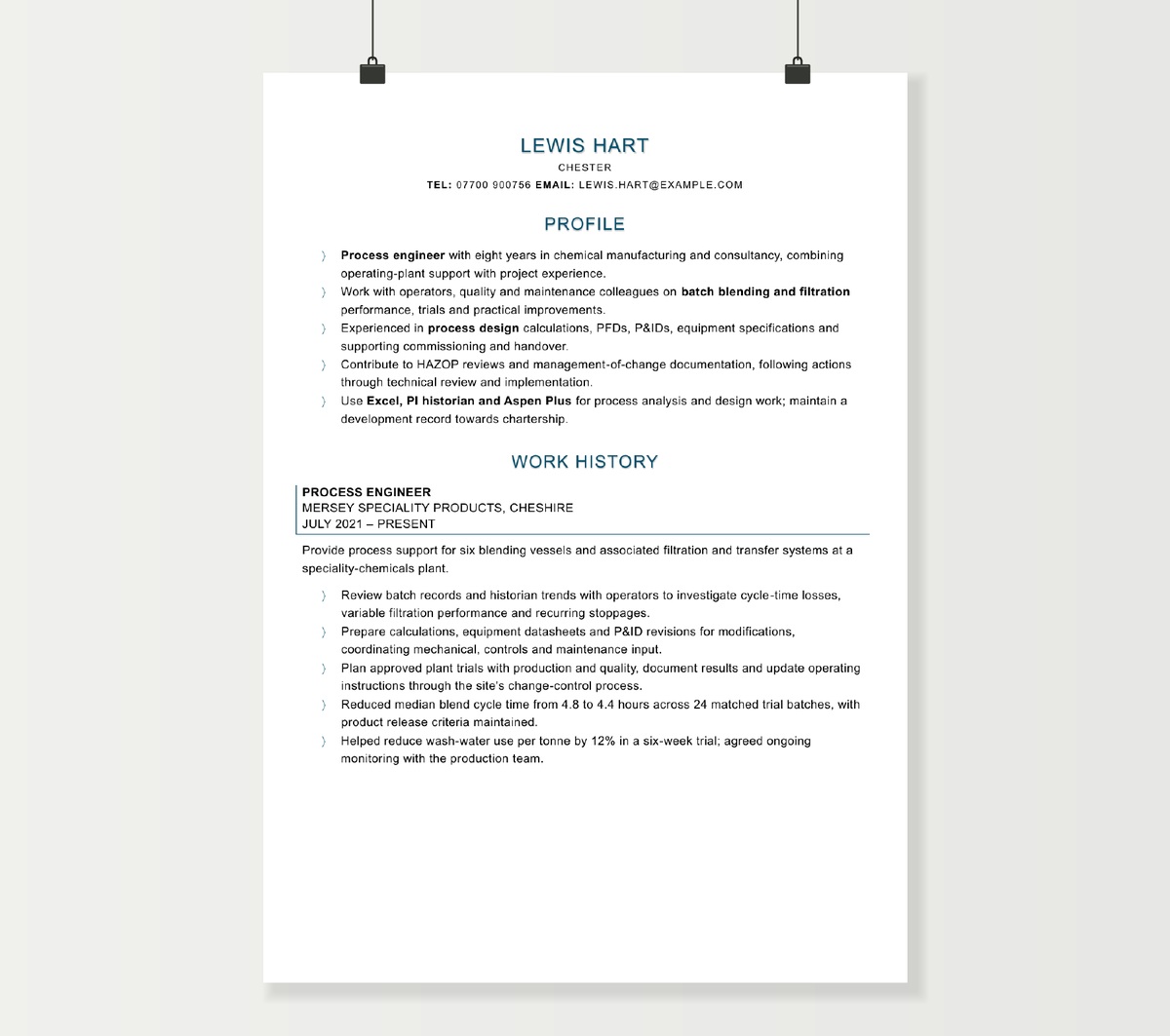
This process engineer CV template follows a chemical engineer working in batch manufacturing after a graduate role in process design. The Word example combines plant support, improvement trials, engineering documentation and project delivery. The guide explains how to present operating-plant or design experience, with advice for water, chemical and manufacturing applications.
Filename: FreeCVDownload_Process_Engineer.docx
Content of this CV template
LEWIS HART
CHESTER
tel: 07700 900756 email: [email protected]
PROFILE
- Process engineer with eight years in chemical manufacturing and consultancy, combining operating-plant support with project experience.
- Work with operators, quality and maintenance colleagues on batch blending and filtration performance, trials and practical improvements.
- Experienced in process design calculations, PFDs, P&IDs, equipment specifications and supporting commissioning and handover.
- Contribute to HAZOP reviews and management-of-change documentation, following actions through technical review and implementation.
- Use Excel, PI historian and Aspen Plus for process analysis and design work; maintain a development record towards chartership.
WORK HISTORY
PROCESS ENGINEER
MERSEY SPECIALITY PRODUCTS, CHESHIRE
JULY 2021 – PRESENT
Provide process support for six blending vessels and associated filtration and transfer systems at a speciality-chemicals plant.
- Review batch records and historian trends with operators to investigate cycle-time losses, variable filtration performance and recurring stoppages.
- Prepare calculations, equipment datasheets and P&ID revisions for modifications, coordinating mechanical, controls and maintenance input.
- Plan approved plant trials with production and quality, document results and update operating instructions through the site's change-control process.
- Reduced median blend cycle time from 4.8 to 4.4 hours across 24 matched trial batches, with product release criteria maintained.
- Helped reduce wash-water use per tonne by 12% in a six-week trial; agreed ongoing monitoring with the production team.
GRADUATE PROCESS ENGINEER
CALDER PROCESS DESIGN, WARRINGTON
SEPTEMBER 2018 – JUNE 2021
Supported senior engineers delivering small process-plant projects for chemical and food-sector clients, progressing from calculations to defined design packages.
- Prepared heat and mass balances, pump-duty calculations and equipment schedules under senior-engineer review.
- Used Aspen Plus for steady-state modelling and Excel for design calculations, recording assumptions and checking results against supplier data.
- Updated PFDs and P&IDs following design reviews and site surveys; tracked technical queries with equipment suppliers.
- Supported commissioning of a liquid-transfer skid, completing test records and closing assigned handover actions with the project engineer.
EDUCATION & DEVELOPMENT
MENG (HONS) CHEMICAL ENGINEERING, 2:1
UNIVERSITY OF SHEFFIELD – 2018
Final-year design project: process design and economic assessment of a bioethanol plant.
PROFESSIONAL DEVELOPMENT
ASSOCIATE MEMBER, ICHEME; WORKING TOWARDS CHARTERSHIP
RECENT TRAINING
HAZOP PARTICIPATION – 2024; MANAGEMENT OF CHANGE – 2025
INTERESTS
Cycling, indoor climbing and playing guitar.
How to write a process engineer CV
A process engineer CV should make the engineering setting clear before introducing the technical detail. A chemical plant, a clean-water design project and an assembly line may all employ process engineers, but the equipment, methods and evidence expected from applicants differ considerably. State your sector, the processes you work with and whether your experience centres on design, plant support, improvement or a combination.
The strongest examples connect an engineering contribution to a practical result: a design package progressed, an operating problem understood, a trial completed, a process made more consistent or equipment handed over successfully. Software and methods support that account. They are most useful when the reader can see what you used them to produce.
Define the plant, process or project behind the title
Give each recent role a short context line. For an operating site, identify the type of production and the assets or unit operations within your remit. Batch blending, filtration, drying, distillation, water treatment and machining tell the reader much more than “busy manufacturing environment”. Include scale where it helps explain your responsibility, such as the number of lines, vessels or sites.
For a design role, name the sector and project stages: feasibility, concept, front-end engineering design, detailed design, commissioning or operational support. Show where you joined and what you delivered before handover. Someone who developed the process basis has different evidence from an engineer brought in to resolve site queries during installation.
Use the employer’s terminology to judge relevance. A manufacturing process vacancy may prioritise tooling, process capability, NPI and operator instructions. A chemical-process role may emphasise balances, equipment specifications, PFDs, P&IDs and process-safety work. Your CV can show transferable experience while keeping the main technical identity coherent.
In the profile, combine that identity with your level and contribution. The example describes an engineer who moved from consultancy into batch manufacturing. It gives the recruiter a clear reason why both design calculations and plant troubleshooting appear in the work history.
Choose a few engineering examples with enough depth
Use your recent employment entries to show the work you can take responsibility for. A useful project example identifies the problem or requirement, your engineering output, the people or disciplines involved and the result or stage reached. That structure can fit into two or three bullets without becoming a project report.
For a modification, you might describe the process calculations and equipment specification you prepared, your coordination with mechanical and controls colleagues, and your contribution to commissioning. For an operating problem, explain the evidence you reviewed, the trial or change you supported and how the outcome was assessed.
Choose examples that demonstrate different strengths. Three similar cycle-time improvements may leave design or implementation experience hidden. A better selection could include one troubleshooting investigation, one capital or modification project and one piece of sustained process improvement. The appropriate balance depends on the job rather than a fixed project count.
For longer projects, give the current stage. A completed design package, an approved recommendation, equipment ordered or a commissioning milestone can each be a meaningful outcome. Your contribution remains valuable even when the whole plant or programme is still being delivered.
Keep ownership clear through precise verbs: prepared, checked, specified, reviewed, coordinated, tested or led. The CV should show where you made engineering decisions, where work was reviewed and how your responsibility grew. For senior posts, add evidence of reviewing others’ work, resolving interfaces or guiding junior engineers.
Make design deliverables and software meaningful
A technical skills section is useful, but connect the main capabilities to work-history evidence. PFDs and P&IDs, heat and mass balances, hydraulic calculations, equipment datasheets, utility schedules and design reports each serve different parts of a project. Select the deliverables you have worked on and describe the project context in which you produced or reviewed them.
For simulation, name the tool and the application. Aspen Plus or HYSYS experience becomes more informative when linked to a process model, comparison of options or equipment-duty assessment. Explain whether this was industrial work, a placement or a university project. That context helps an employer understand how you could contribute and what further development might be useful.
For plant analysis, identify the data and output: historian trends, batch records, laboratory results, production losses or trial measurements. Excel, Python, statistical software and historian tools can all be relevant. A bullet explaining that you combined plant trends and quality data to investigate a recurring loss gives the software a clear purpose.
Include the review around an engineering output where it is significant. Recording assumptions, checking against supplier information, reconciling a model with plant data or responding to a design review can demonstrate judgement and care. Keep this to your contribution; the CV does not need a tutorial on the calculation or tool.
When a vacancy names an unfamiliar package, closely related experience can still be useful. Describe the modelling or analysis you already perform and its output. The recruiter can then assess the transferability of that experience more easily than from a general claim to learn software quickly.
Present process safety and change control at the level you contributed
Safety-related work is strongest when you identify your role in a defined activity. You might have prepared information for a HAZOP, participated as the process engineer, assessed assigned actions, updated design documents or supported management-of-change approval. Those are substantial contributions that can be described directly.
If you chaired a study, reviewed a specialist calculation or held a formal technical-authority responsibility, state that role and its scope. Participation, facilitation and approval carry different expectations. Clear wording helps a prospective employer understand the experience you bring to its review arrangements.
For an operating plant, show how modifications moved through the site’s process: engineering documentation, multidisciplinary review, approved trials, updated instructions and handover. For a project role, design reviews, action close-out and interfaces with safety specialists may be more relevant.
Name sector-specific frameworks or environments where they are material to your experience, such as a COMAH site or pharmaceutical GMP work. Explain the relevant activity rather than listing regulations in isolation. In manufacturing, risk and control evidence may instead centre on PFMEAs, control plans, validation or capability studies. Match the evidence to your engineering setting.
Give improvement results a useful basis of comparison
Results should let another engineer understand what improved and under what conditions. A cycle-time change needs a starting point and a period or trial basis. Yield needs the product or process context. Water or energy consumption is often clearer per unit of output than as a total that may simply reflect changes in production volume.
The example CV gives a median cycle-time reduction across 24 matched trial batches, with product release criteria maintained. It also describes wash-water use per tonne over a six-week trial and the monitoring agreed afterwards. These details make the scope of each result understandable without filling the CV with raw data.
- Throughput and cycle time: identify the process, baseline and conditions compared.
- Quality and consistency: name the measure, such as reject rate, rework or variability, and the period observed.
- Resource use: state whether the change concerns energy, water, material or time, with the production basis where relevant.
- Reliability: connect downtime or recurring-fault improvement to a defined asset and period.
- Project delivery: describe the package, test, commissioning or handover milestone achieved.
Distinguish a modelled opportunity from a trial result and a sustained operating improvement. Each can be useful evidence. A proposed saving belongs with the analysis and decision it supported; a sustained improvement can include the follow-up period and the team that maintained it.
Cost figures are helpful when the basis is understood. State whether a value is an estimate, an annualised calculation or a realised saving over a stated period. If the engineering outcome is already clear in hours, tonnes or units of consumption, it may not need a monetary conversion.
Where a result came from a team, describe your contribution alongside the outcome. Working with operators, production, quality and maintenance is central to process engineering. Showing that collaboration strengthens the achievement and explains how the change reached the plant floor.
Show implementation, not only analysis
Employers need engineers who can help a recommendation become a workable change. Include evidence of trial planning, supplier discussions, design queries, site checks, commissioning support, operator involvement and handover when these were part of your role.
Be specific about interfaces. “Worked in a multidisciplinary team” is more useful when followed by the issue you coordinated: process duties passed to mechanical engineers, instrumentation requirements discussed with controls, or equipment information resolved with a vendor. The mechanical engineer CV example offers a related view of equipment and project responsibilities.
For a plant-support role, show how you work with the people who operate the process. Gathering observations, agreeing trial arrangements, reviewing results and updating instructions can be as important as the initial calculation. For a consultancy role, client reviews, technical correspondence and explanations of design choices may deserve more space.
Commissioning experience benefits from a precise description. State the equipment or system, the tests or records you contributed to and your role in resolving outstanding actions. This makes a short period of site work much more meaningful than simply adding “commissioning” to a skills list.
Adjust the balance for graduate, experienced and senior applications
For a graduate role, use a placement, final-year design project or dissertation to demonstrate engineering thinking. Name the objective, your personal contribution, the methods or tools used and the output. In a group design project, a clear account of your package is useful: process selection, a model, equipment sizing, economic assessment or a safety-review contribution. Include relevant degree details and project experience before less relevant part-time work.
For an experienced role, prioritise industrial deliverables and outcomes. Keep education concise and select training that supports the work you want to do. A recent improvement, completed design package or implementation example should be easier to find than a long list of university modules.
For a senior role, show how you organise and review engineering work as well as produce it. Examples might include defining a design basis, coordinating work packages, managing technical interfaces, reviewing deliverables, supporting estimates or mentoring engineers. Give the scope of the responsibility and the decisions you helped resolve.
Professional membership and registration can sit in a short qualifications section. State the current grade or registration, or describe progress towards chartership with a concrete development step such as a mentored competence record. Include the relevant degree, HNC or other route into your particular field. Different process-engineering settings recruit through different routes, so the vacancy determines which qualifications deserve prominence.
A two-page CV can usually hold a coherent recent history and several substantial examples. If you have extensive project experience, select the work most relevant to the vacancy and keep a separate project list available. Compare the designs in the CV template library if you need a layout with more space for project detail.
Process Engineer CV FAQs
Yes, where the responsibilities fit the vacancy. Keep the employment title used by your employer and make the relevant process work clear in the profile and role description. A production engineer with experience in process capability, tooling and improvement may fit a manufacturing process role closely; a chemical-process design vacancy may ask for a different set of calculations and deliverables.
The CV can normally describe the deliverables without attaching drawings. If an employer requests work samples, agree what can be shared and use authorised, suitably redacted material. A brief project summary showing the engineering problem, your responsibility and the outcome is often enough for the initial application and gives the interviewer a useful starting point.
Label each as a contract and state the project stage or work package. Group them under a contracting heading if that makes the chronology clearer, while retaining the client sector, dates and contribution for each substantial assignment. A completed design phase or handover explains the natural end of an assignment better than a bare list of short dates.
Describe the outcome reached so far: a completed study, recommendation accepted, design approved or trial scheduled. Include the expected benefit as an estimate if it is useful, together with the basis of the assessment. Your analysis and decision support can be strong evidence even before operational results are available.
Its value depends on the role. It can be relevant to manufacturing improvement, particularly when supported by a completed project. Chemical-process design or plant-support vacancies may place more weight on sector knowledge, engineering deliverables and process-safety experience. Give the training and applied work appropriate space for the vacancy rather than making one qualification the centre of every application.




