This sales manager CV template shows how to present commercial results alongside the work of leading a sales team. The example follows a regional B2B sales manager in packaging, with a clear revenue budget, five direct reports and experience of account development, forecasting and coaching. Download the Word CV below, then use the guide to choose the evidence that best fits your sales role.
Filename: FreeCVDownload_Sales_Manager.docx
Content of this CV template
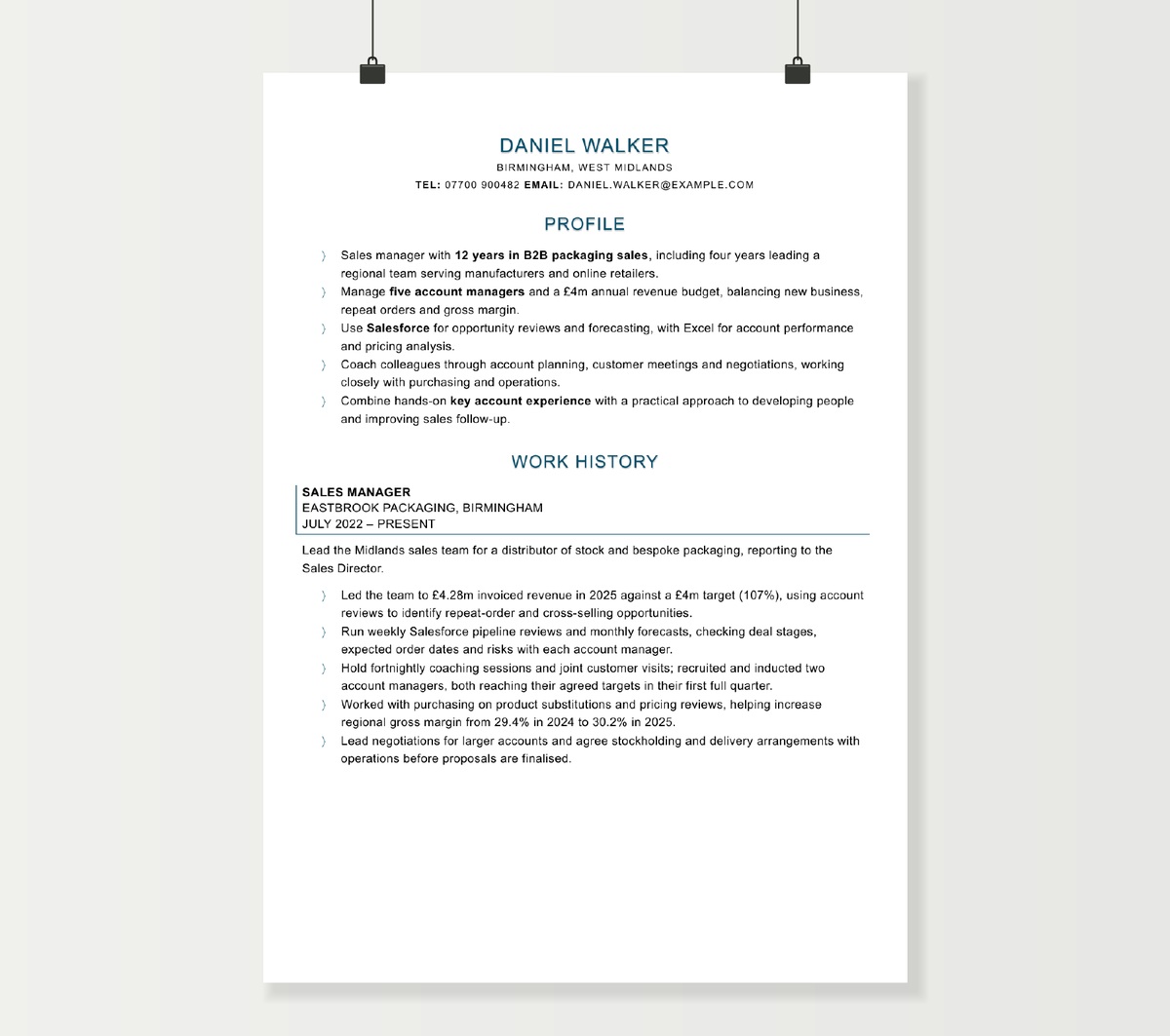
DANIEL WALKER
BIRMINGHAM, WEST MIDLANDS
tel: 07700 900482 email: [email protected]
PROFILE
- Sales manager with 12 years in B2B packaging sales, including four years leading a regional team serving manufacturers and online retailers.
- Manage five account managers and a £4m annual revenue budget, balancing new business, repeat orders and gross margin.
- Use Salesforce for opportunity reviews and forecasting, with Excel for account performance and pricing analysis.
- Coach colleagues through account planning, customer meetings and negotiations, working closely with purchasing and operations.
- Combine hands-on key account experience with a practical approach to developing people and improving sales follow-up.
WORK HISTORY
SALES MANAGER
EASTBROOK PACKAGING, BIRMINGHAM
JULY 2022 – PRESENT
Lead the Midlands sales team for a distributor of stock and bespoke packaging, reporting to the Sales Director.
- Led the team to £4.28m invoiced revenue in 2025 against a £4m target (107%), using account reviews to identify repeat-order and cross-selling opportunities.
- Run weekly Salesforce pipeline reviews and monthly forecasts, checking deal stages, expected order dates and risks with each account manager.
- Hold fortnightly coaching sessions and joint customer visits; recruited and inducted two account managers, both reaching their agreed targets in their first full quarter.
- Worked with purchasing on product substitutions and pricing reviews, helping increase regional gross margin from 29.4% in 2024 to 30.2% in 2025.
- Lead negotiations for larger accounts and agree stockholding and delivery arrangements with operations before proposals are finalised.
ACCOUNT MANAGER / SALES EXECUTIVE
WELLINGTON PACK SUPPLIES, COVENTRY
SEPTEMBER 2014 – JUNE 2022
Joined as a Sales Executive in September 2014 and progressed to Account Manager in January 2017, managing manufacturing and e-commerce customers.
- Grew an assigned portfolio from £720k to £890k annual invoiced sales between 2019 and 2021 through account development and additional product lines.
- Managed enquiries from specification and samples through quotation and order, coordinating bespoke packaging requirements with suppliers.
- Won six new manufacturing accounts in 2021, generating £96k invoiced sales that year; maintained contact with purchasing and production teams after delivery.
- Kept Salesforce records current, reviewed repeat-order patterns and helped two junior colleagues prepare quotations and customer follow-up plans.
QUALIFICATIONS & TRAINING
BA (HONS) BUSINESS, 2:1
NOTTINGHAM TRENT UNIVERSITY – 2014
Studied business strategy, marketing and finance, with a final-year project on customer retention in small businesses.
SALES COACHING AND PERFORMANCE REVIEWS
EASTBROOK PACKAGING, IN-HOUSE TRAINING – 2024
COMMERCIAL NEGOTIATION
EASTBROOK PACKAGING, IN-HOUSE TRAINING – 2025
ADDITIONAL INFORMATION
Full UK driving licence; regular travel across the Midlands. Outside work, I enjoy five-a-side football, cooking and live music.
How to write a sales manager CV
A sales manager CV needs to make the commercial context of your results clear. An employer wants to know what you sold, who bought it, the scale of your responsibility and how you helped the business grow. For a role with direct reports, they also need evidence that you can build a team’s performance beyond your own sales.
The most useful CV connects those things. A revenue figure becomes more persuasive when the reader can see the target, period and action behind it. A claim about leadership becomes more concrete when it describes the people you developed and the improvement that followed.
Establish what kind of sales manager you are
The same job title can describe a regional team leader, an enterprise salesperson with no direct reports, a manager of a venue’s sales office or someone building a distributor network. Make your own role recognisable in the opening profile and the first line of each recent job.
Useful context includes your product or service, B2B or B2C market, customer types, territory and route to market. Add the team size and revenue or gross profit responsibility where these are central to the vacancy. A technical equipment manufacturer needs to understand your experience of specifications and tender decisions; a software business may be more interested in subscription revenue, sales cycles and the team’s quota attainment.
For example, “Sales manager leading five account managers across the Midlands, with a £4m revenue budget in B2B packaging” establishes more than “Dynamic sales professional with excellent leadership skills”. It gives the reader a basis for interpreting the results that follow.
Use the vacancy to decide which part of your experience leads. For a new-business team, give prominence to prospecting, qualification, conversion and hiring. For an account-led role, lead with retention, customer development, margin and the quality of your commercial relationships. If you personally carry a target as well as managing colleagues, explain both responsibilities.
Present sales results with enough context to mean something
Start with the measures the employer actually uses to judge the role. These may include revenue, gross profit, new accounts, renewal rate, expansion revenue, bookings or annual recurring revenue. Choose a small number that give a rounded picture of your contribution.
A strong result usually identifies the outcome, its basis and your contribution. In the example CV, £4.28m is invoiced revenue for the team in 2025, measured against a £4m target. The account reviews and cross-selling explain part of the work behind the result. The reader can distinguish that from an individual sales target or the value of orders still awaiting delivery.
- Target attainment: state the period and whether it is an individual, team or regional result. “Team achieved 107% of its 2025 revenue target” has a clear denominator and owner.
- Growth: give a starting point and end point, or a percentage with a defined comparison. Briefly explain the source of growth, such as new accounts, additional product lines, expansion within customers or improved retention.
- New business: distinguish accounts won from their subsequent sales. Six new customers and £96k invoiced in the same year describe both acquisition and realised value.
- Recurring revenue: use the measure familiar to your market, with enough context to separate new annual recurring revenue from renewals, expansion or total contract value.
- Conversion and retention: identify what is being converted or retained. Opportunity-to-win conversion, customer retention and revenue retention answer different questions.
You do not need a number in every bullet. A substantial tender, a new distribution agreement or a complex contract renewal can be useful evidence when described through its scope, your role and the commercial outcome. Select achievements that help the employer assess the work you would be doing for them.
Show how you protected profit as well as increased sales
For many sales management roles, profitable growth is more informative than turnover alone. If you have responsibility for pricing, discounts, product mix or account profitability, give this visible space in your recent experience.
Explain the commercial decisions involved. You might have negotiated a revised price agreement, introduced a more suitable product mix, recovered freight costs, improved the quality of quotations or worked with purchasing to find alternatives for customers. Connect the action to an outcome the business could observe.
The example CV describes working with purchasing on product substitutions and pricing reviews, helping regional gross margin move from 29.4% to 30.2%. That is an increase of 0.8 percentage points. The wording also makes the shared contribution clear: sales and purchasing worked together.
When a role involves major accounts, add the operational conditions behind the agreement. Stockholding, delivery schedules, payment terms, service levels and implementation commitments can all affect whether a deal works commercially. Evidence that you involved the right colleagues before agreeing those commitments is valuable for employers selling complex products or services.
Demonstrate leadership through changes in team performance
“Managed a team” tells the reader about your position. The rest of the evidence should show what you did with that responsibility. Start with the number and type of direct reports: account executives, territory representatives, account managers, business development colleagues or a mixed team. If you managed through team leaders, explain that structure briefly.
Choose examples from the people work most relevant to the vacancy. These might include recruiting into a growing region, developing new starters, preparing an experienced salesperson for promotion, improving deal reviews or helping a team respond to a change in market conditions.
Make coaching specific. Joint visits, call reviews, account planning and negotiation preparation tell an employer more than “motivated staff”. Add an outcome where one is available: a shorter ramp-up period, more consistent attainment, progression into larger accounts or stronger renewal performance. In this CV, the two new account managers reaching their agreed targets in their first full quarter gives the induction work a useful result.
Keep the scale proportionate to the role. Leading five account managers calls for different evidence from running several regional managers. A larger leadership role may need more on organisation design, capacity planning, budgets and succession. A first-line manager’s CV benefits from showing how regularly they work with people and how that changes day-to-day selling.
Make pipeline, forecasting and CRM experience concrete
Employers often ask for a manager who can explain what is likely to close, where the risks sit and what the team needs to do next. Present forecasting as a management responsibility, with enough detail to show your involvement.
Describe the rhythm and scope: weekly opportunity reviews, monthly regional forecasts, quarterly account planning or annual territory budgets. Then explain what you assessed, such as decision-makers, purchasing dates, deal stages, implementation dependencies or outstanding commercial terms. This conveys judgement as well as familiarity with a reporting system.
Name the CRM you used and connect it to the work. “Salesforce: pipeline reviews, opportunity reporting and monthly forecasts for a five-person team” is more useful than a detached list of software. HubSpot, Microsoft Dynamics or another system can be presented in the same way. Where you built reports, dashboards or a revised process, include that contribution separately from routine record use.
If forecasting accuracy is one of your strongest results, explain the comparison briefly. A forecast measured against invoiced revenue at month-end is different from one measured against signed bookings. Giving the basis helps the employer understand the improvement without turning the CV into a reporting manual.
Sales methodologies also work best in context. Where a vacancy asks for MEDDPICC, SPICED, Challenger or another approach, describe how you used it in qualification, deal coaching or account strategy. Formal training belongs in the training section; evidence of applying it belongs in your employment history.
Explain your contribution to important accounts and deals
A sales manager’s strongest work often spans several teams. Choose one or two examples that show how you moved an opportunity forward and kept the eventual agreement deliverable.
For enterprise sales, identify the customer type, approximate contract scale where useful, sales-cycle length and buying group. Explain your contribution to discovery, proposals, negotiation and handover. For technical or specification-led sales, show how you worked with engineering, product specialists or the customer’s procurement team. For distribution and wholesale, relationships with branch teams, suppliers and operational colleagues may deserve more attention.
Give account development the same care as acquisition. Expanding into another site, earning preferred-supplier status, introducing a new product category or coordinating a difficult renewal can demonstrate valuable sales management skills. Explain why the account changed and what you did to support that change.
A compact achievement can follow the sequence of commercial challenge, action and result. If you find it difficult to reduce a long deal story to a CV bullet, the CAR method for writing achievements can help you select the essential evidence.
Show the step from salesperson to manager
If you are applying for your first management role, organise your evidence around the responsibilities you are ready to take on. Strong personal results establish sales credibility. Add the work that demonstrates influence on other people’s performance: onboarding a colleague, leading a sales meeting, supporting joint calls, sharing an effective account plan or coordinating a bid.
Describe the size and duration of those responsibilities. “Mentored two new sales executives through quotation preparation and customer follow-up” gives a prospective employer a more useful starting point than a broad claim to leadership. Acting-manager cover, project leadership and involvement in interviews can also be relevant, with the scope made clear.
For an established manager, make progression easy to follow. Promotions within one employer can sit under a single company heading, with separate role titles and dates. Give your most recent management work the most space, while retaining enough earlier selling experience to explain your knowledge of customers and the sales cycle.
Where a Sales Manager title describes an individual contributor role, state that commercial scope directly. Managing a territory or a portfolio of enterprise opportunities is substantial experience in its own right. An employer can then assess your fit for a role with a similar structure or understand the people leadership you would be adding next.
Adapt the evidence when moving between sales sectors
A sector change is easier to understand when the CV shows the similarities in the sales work. Selling through a multi-stage procurement process, building relationships with owner-managed businesses, managing recurring contracts or developing channel partners may transfer more directly than the product itself.
Translate specialist context into terms the new employer can assess. Give the customer type, complexity, typical buying process and commercial responsibility. Retain the industry knowledge that remains relevant, but explain unfamiliar product or market abbreviations on first use.
Some vacancies depend on particular technical knowledge or professional experience. A role selling electrical infrastructure, for example, may place greater weight on an engineering background and specification knowledge than a general business degree. Put directly relevant qualifications and product training near the evidence they support. For other roles, your record of leading a comparable sales operation may carry most of the application.
Select qualifications, training and practical details that support the application
For an experienced sales manager, employment achievements will usually lead, followed by relevant education and training. Include your degree or highest useful qualification and selected development in areas such as sales coaching, negotiation, account management or the employer’s required methodology.
Make the nature of training clear: a professional qualification, an assessed certification and an internal workshop each tell the reader something different. Include the provider and date, and prioritise courses that connect to responsibilities in the vacancy. The example CV uses two recent internal courses because they support Daniel’s transition into people management and larger negotiations.
Where the position involves regional travel or customer visits, include your base and driving licence if relevant. Territory coverage, language skills or experience working across time zones may also help an employer assess practical fit. These details can sit in a short additional information section, leaving the main employment section for the commercial and leadership evidence.
Sales Manager CV FAQs
Describe the customer by sector, size or buying situation, such as a multi-site food manufacturer or a UK enterprise software customer. Where appropriate, use an approved rounded value, a value band or percentage target attainment. You can also explain the scope of the agreement, the length of the sales cycle and your part in securing it. This gives the employer useful commercial context while respecting the confidentiality attached to the account.
Choose the evidence that best explains your management contribution during that period. That might be retention through a difficult renewal cycle, a recovery in the second half, improved gross profit or rebuilding an understaffed territory. If the target result is central to the story, pair it with the relevant context and the action you took. A short, specific account of how performance changed is more useful than a long explanation of market conditions.
Yes. Label them as year-to-date and state the cut-off month, together with the corresponding year-to-date target or comparison period. For example, a January-to-August result can be compared with the target for those eight months. Signed business due to start later can be presented separately as bookings or contracted value, using the terminology relevant to your market.
Give the result for the period and scope you actually managed. A brief phrase such as ‘from taking over the North West region in April’ or ‘across the revised territory introduced in July’ may be enough. For growth figures, explain whether the comparison covers the same accounts or a changed portfolio when that affects how the result should be read. If your role expanded significantly, that increase in responsibility can be an achievement alongside the sales outcome.
These details usually fit better in the recruiter’s screening conversation or the employer’s requested application fields. The CV’s commercial figures are more useful when they describe the business you managed and the results you achieved. If an application explicitly requests remuneration information in the CV, follow its format and separate that information from your sales performance.
It can be useful at interview, especially for a senior or complex sales role. A short document with an anonymised account-development case, a team performance example and a territory plan can give you concrete material to discuss. Keep the CV self-contained and follow the employer’s instructions about additional attachments. Customer presentations, pipeline exports and commercially sensitive account records belong within the permissions that apply to that material.