
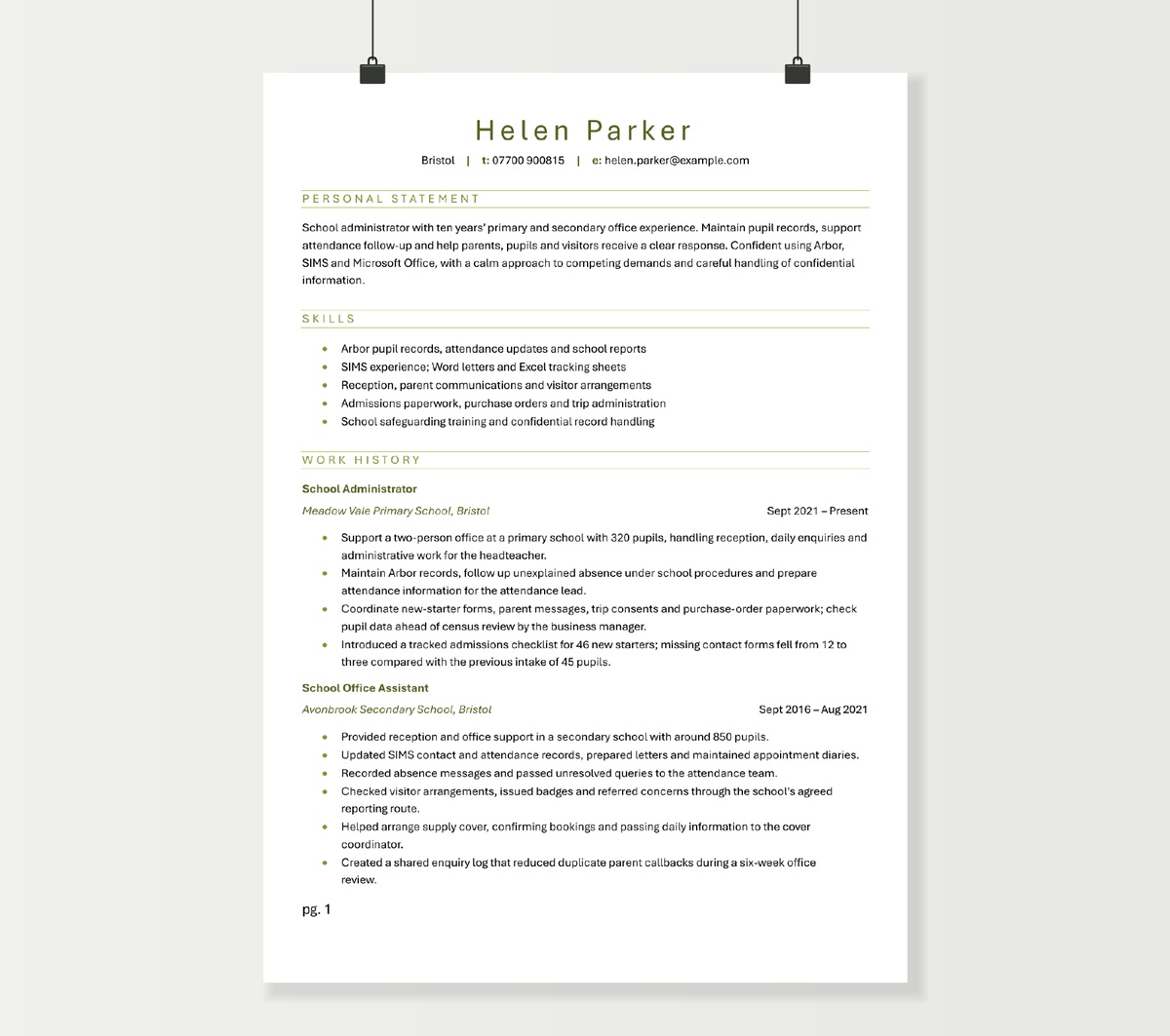
This school administrator CV template follows an experienced primary-school office colleague with earlier secondary-school and business-administration experience. The Word example covers pupil records, attendance, parent enquiries and practical office improvements. The guide explains how to present school systems, safeguarding-related responsibilities and transferable administration skills for school-office applications.
Filename: FreeCVDownload_School_Administrator.docx
Content of this CV template
Helen Parker
Bristol | t: 07700 900815 | e: [email protected]
Personal statement
School administrator with ten years’ primary and secondary office experience. Maintain pupil records, support attendance follow-up and help parents, pupils and visitors receive a clear response. Confident using Arbor, SIMS and Microsoft Office, with a calm approach to competing demands and careful handling of confidential information.
Skills
- Arbor pupil records, attendance updates and school reports
- SIMS experience; Word letters and Excel tracking sheets
- Reception, parent communications and visitor arrangements
- Admissions paperwork, purchase orders and trip administration
- School safeguarding training and confidential record handling
Work history
School Administrator
Meadow Vale Primary School, Bristol
Sept 2021 – Present
- Support a two-person office at a primary school with 320 pupils, handling reception, daily enquiries and administrative work for the headteacher.
- Maintain Arbor records, follow up unexplained absence under school procedures and prepare attendance information for the attendance lead.
- Coordinate new-starter forms, parent messages, trip consents and purchase-order paperwork; check pupil data ahead of census review by the business manager.
- Introduced a tracked admissions checklist for 46 new starters; missing contact forms fell from 12 to three compared with the previous intake of 45 pupils.
School Office Assistant
Avonbrook Secondary School, Bristol
Sept 2016 – Aug 2021
- Provided reception and office support in a secondary school with around 850 pupils.
- Updated SIMS contact and attendance records, prepared letters and maintained appointment diaries.
- Recorded absence messages and passed unresolved queries to the attendance team.
- Checked visitor arrangements, issued badges and referred concerns through the school’s agreed reporting route.
- Helped arrange supply cover, confirming bookings and passing daily information to the cover coordinator.
- Created a shared enquiry log that reduced duplicate parent callbacks during a six-week office review.
Business Administration Apprentice
West Bristol Community Partnership
Sept 2014 – Aug 2016
- Completed an apprenticeship while supporting a community organisation’s office and reception.
- Booked rooms, maintained contact lists and prepared meeting papers.
- Processed invoice paperwork and checked booking details against the diary.
- Handled telephone enquiries and directed visitors to the appropriate colleague.
Qualifications
Level 3 Diploma in Business Administration
Workplace apprenticeship
2016
- City & Guilds qualification completed through a workplace apprenticeship.
- 8 GCSEs, including English and Mathematics at grade C or above, 2014.
- Emergency First Aid at Work training, 2025.
School-office development
School and trust training
2024 – 2026
- Arbor pupil records and reporting, 2024; annual safeguarding and data-protection updates, most recently September 2026.
Hobbies and interests
- Gardening: Growing vegetables at home.
- Reading: Taking part in a local book group.
- Swimming: Regular sessions at the community pool.
Additional information
Experienced in term-time working, including INSET days and preparation before pupils return.
How to write a school administrator CV
A school administrator CV should show how you keep information, communication and office work moving through a busy school day. The strongest examples make the school setting clear and explain your contribution to pupil records, attendance, reception, admissions or finance. They give a headteacher or business manager a practical picture of the support you can provide.
Explain the school and your place in its office
Start each school role with the phase, approximate pupil numbers and your main responsibilities. A small primary-school office may combine reception, finance paperwork and pupil administration, while a larger secondary school may have separate attendance, cover and data teams. That context helps the reader understand both the breadth and the depth of your work.
State who you support or work alongside where it clarifies the role: the headteacher, school business manager, office manager, attendance lead or a central trust team. If you work across several schools, give the number of sites and explain which duties are shared.
Your profile can then bring together the most relevant parts of that experience. An experienced school administrator might lead with the school phases, principal systems and two strong areas of responsibility. An administrator entering education can lead with public-facing office work, accurate records and experience managing sensitive enquiries.
Describe what you do in the school’s systems
SIMS, Arbor, Bromcom and other management information systems are important because of the work they support. Name the systems you have used and connect them to tasks: updating pupil contacts, recording attendance information, preparing reports, processing admissions or checking data before a return.
“Use Arbor to maintain pupil records, update attendance information and prepare reports for the attendance lead” gives a stronger account than “excellent IT skills”. Where you have used more than one system, distinguish current experience from earlier use. This is particularly helpful when a recruiter needs someone who can quickly cover an existing office role.
Include other tools only when they add useful evidence. Word may support letters and mail merges; Excel may support trackers, reconciliations or checking lists. Parent communication, payments and visitor systems can also be relevant. A brief explanation of their use is generally more valuable than presenting every system you have encountered.
Make attendance and pupil administration specific
Attendance duties can range from recording messages to producing reports and coordinating follow-up. Describe your part in that process. You may check for missing information, contact families under the school’s arrangements, update records or pass unresolved concerns to the attendance or safeguarding team.
The distinction matters on a CV because an office administrator, attendance officer and senior attendance lead have different responsibilities. Strong administrative evidence includes timely follow-up, accurate records and clear handovers. If you contributed to a wider attendance initiative, explain the administrative change you made and how it supported the team.
Admissions and pupil movements offer another useful area of evidence. Describe collecting and checking forms, maintaining contact information, arranging new-starter packs, processing leavers or coordinating records with other schools. For census work, identify whether you prepared data, investigated queries, ran checks or completed the submission as part of your role.
Show how you handle the front office
School reception involves several audiences and frequent changes of priority. Give examples of handling parent enquiries, welcoming visitors, passing urgent messages and supporting pupils who arrive at the office. This makes communication and organisation visible through the work.
A useful bullet might explain how you maintained an enquiry log, coordinated appointments or ensured an unresolved matter reached the right colleague. If you helped improve the response to families, describe the practical change: clearer messages, a shared follow-up record or a more reliable handover between part-time colleagues.
Experience with parents and carers may also include arranging interpreters, adapting communications or helping families navigate forms and school processes. Where relevant, include that contribution in a straightforward way. It can demonstrate considerate service without turning the CV into a statement of personal values.
Present safeguarding and confidentiality through your role
Give relevant safeguarding training a clear title and date, alongside the school responsibilities in which it is applied. For an administrator, useful examples may include visitor arrangements, recording concerns through the agreed route, handling sensitive correspondence or supporting the designated safeguarding lead with administration.
Confidentiality is more convincing when linked to the records you manage and the people you support. You can describe maintaining controlled pupil files, preparing confidential meeting papers or routing sensitive enquiries appropriately. The CV needs enough detail to show your responsibilities; individual pupil or family circumstances are not needed to explain the work.
Different schools divide these duties differently. If you maintain recruitment records or support the single central record, specify the checks and administration you undertake and the person who reviews the work. That makes your experience useful to the reader without blurring it with a leadership role.
Give specialist office responsibilities the right prominence
Look closely at the vacancy’s emphasis. A cover administrator needs evidence of coordinating staff absence, booking supply staff, updating the cover diary and communicating changes promptly. A finance-focused post needs a clearer account of orders, invoices, payments, reconciliations and work with the school or trust finance team.
Other roles may focus on admissions, examinations, SEND administration or support to senior leaders. Choose the parts of your experience that match that work. For SEND administration, for example, organising review appointments and maintaining paperwork for the SENCO can be stronger evidence than a broad list of general office duties.
Keep the level of responsibility clear. Processing an invoice, checking it against an order and authorising expenditure are different tasks. Likewise, arranging supply cover is different from teaching the lesson. Precise descriptions help the school identify where your experience fits its team.
Use practical improvements and scale as achievements
School-office achievements often involve making a process easier to complete or less likely to be missed. A new admissions checklist, clearer trip-consent tracking, a shared diary or a better handover can all provide useful evidence. Explain the original difficulty, your change and the result.
Numbers are helpful when they describe a meaningful comparison. The example CV identifies the size of each intake alongside the number of missing contact forms. That makes the improvement easier to understand than a percentage alone. Other useful measures include the number of pupils supported, sites covered, applications processed or events coordinated.
A result can also be qualitative. A tracking sheet adopted by the office, a more dependable handover or a recurring data query resolved before a deadline can show good work without an elaborate statistic. Choose evidence that reflects the contribution of an administrator to the school’s daily operation.
Connect experience from outside education
Previous office, healthcare, customer-service or community work can demonstrate many of the practical skills a school needs. Bring forward handling confidential records, dealing with the public, coordinating diaries, checking payments, meeting reporting deadlines and responding calmly to changing demands.
Keep the original setting clear and explain the relevant task. Managing appointments and sensitive enquiries in a clinic, for instance, can provide strong evidence for reception and record-handling duties. A broad claim of transferable skills is less useful than two or three well-chosen examples.
If you have school volunteering or temporary school-office experience, give it an identifiable entry with dates and duties. An office-based contribution may be more relevant to an administration vacancy than a long account of unrelated classroom activities. The administrator CV example can help you select evidence from a general office background, while the receptionist example gives more attention to front-desk responsibilities.
Make qualifications, dates and application evidence easy to use
Include relevant administration or business qualifications and English and maths where requested. Add recent school-system, safeguarding, data-protection or first-aid training when it supports the advertised duties. Give the qualification or course title rather than grouping everything under a vague training heading.
Use month and year dates so the sequence of employment and placements is easy to follow. If several short school assignments were through one agency, a grouped entry can show the overall period with the main schools or phases underneath. Include the working pattern when it helps explain a part-time or term-time role.
Many schools use an application form and supporting statement, while agencies may ask for a CV. The CV is a useful record of your strongest evidence in either case. For a supporting statement, develop the examples that answer the school’s person specification, and enter the full history requested by its form. This keeps the application focused on the particular office role.
School Administrator CV FAQs
It depends on how quickly the school needs you to work independently and whether that system is an essential requirement. Describe your existing MIS tasks and any experience learning a new platform. Record maintenance, attendance administration and reporting provide a useful foundation, while training or recent practical use of the target system gives the school a clearer view of your starting point.
Complete the form and use your CV as a source of evidence. If the school also invites a CV, it can accompany the requested documents. The form may ask for a fuller history or specific information, and the supporting statement is your opportunity to connect your experience with the school’s criteria.
Identify the duties that transfer directly, then show how you would fit a more specialised office structure. Reception, pupil records, attendance messages and parent communication remain useful. Highlight any cover coordination, examination support, larger data sets or work with several pastoral teams, and give the size of the school you have supported.
Yes, when first-aid or welfare cover forms part of the post. Give the exact course and completion date, and briefly describe any relevant responsibility in your employment entry. This lets the school distinguish your training from other first-aid qualifications and decide how it fits its arrangements.
A CV usually does not need salary details. If an application form asks, distinguish your actual annual pay from the full-time-equivalent figure and state the contracted hours or working weeks as requested. On the CV, the working pattern can be useful context without adding pay information.
Give the trust as your employer where appropriate, identify the number and phases of the schools, and explain how your time or responsibilities are divided. Use examples showing coordination between sites, shared systems or support to different headteachers. This makes the breadth of the role visible without repeating the same duties under each school.




