
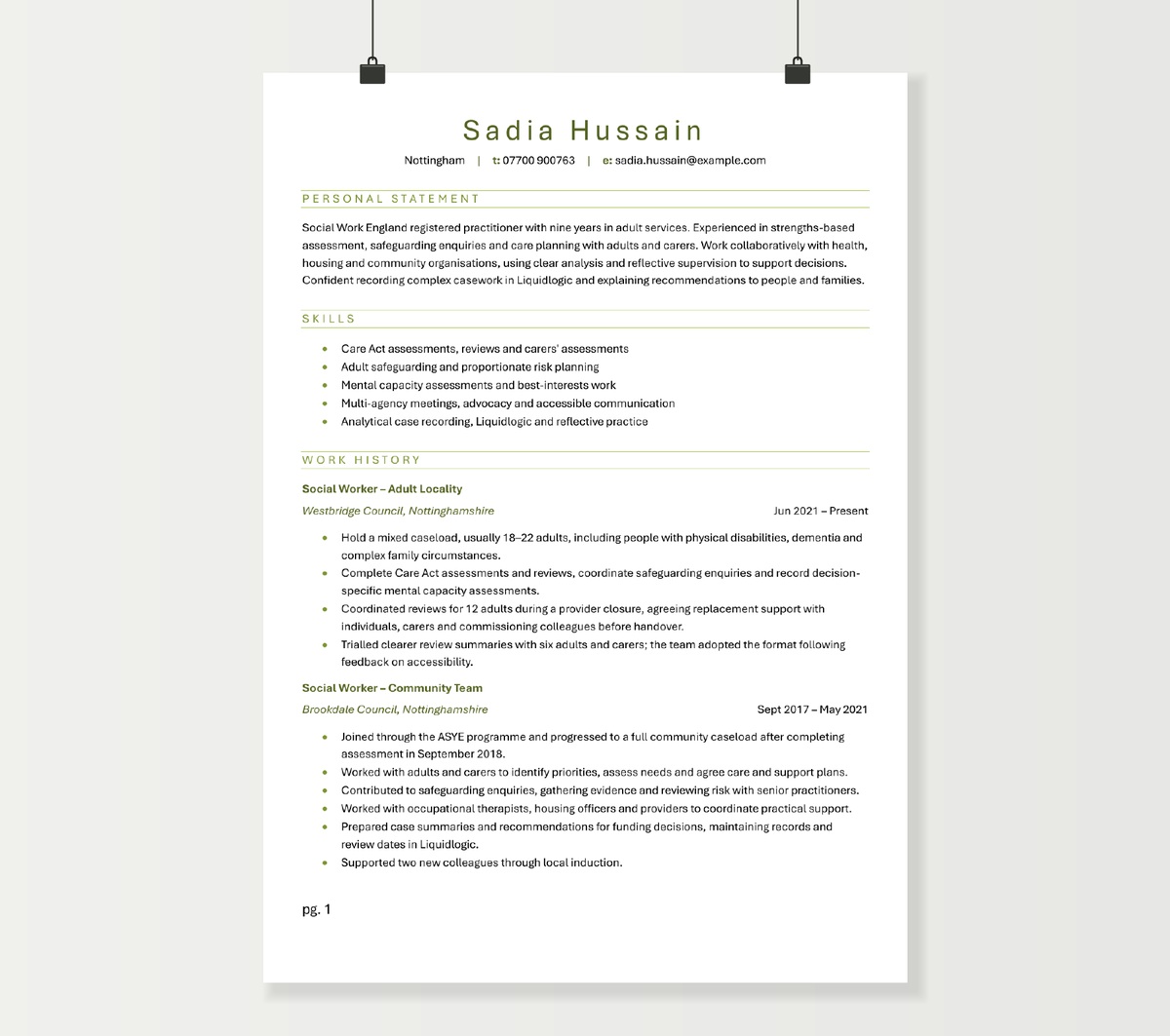
This social worker CV template follows a registered practitioner in adult services in England, with experience of community assessment, safeguarding and care planning. The Word example shows professional judgement, collaboration and service improvements. The guide also covers children's services, newly qualified applicants and presenting experience across different social work settings.
Filename: FreeCVDownload_Social_Worker.docx
Content of this CV template
Sadia Hussain
Nottingham | t: 07700 900763 | e: [email protected]
Personal statement
Social Work England registered practitioner with nine years in adult services. Experienced in strengths-based assessment, safeguarding enquiries and care planning with adults and carers. Work collaboratively with health, housing and community organisations, using clear analysis and reflective supervision to support decisions. Confident recording complex casework in Liquidlogic and explaining recommendations to people and families.
Skills
- Care Act assessments, reviews and carers' assessments
- Adult safeguarding and proportionate risk planning
- Mental capacity assessments and best-interests work
- Multi-agency meetings, advocacy and accessible communication
- Analytical case recording, Liquidlogic and reflective practice
Work history
Social Worker – Adult Locality
Westbridge Council, Nottinghamshire
Jun 2021 – Present
- Hold a mixed caseload, usually 18–22 adults, including people with physical disabilities, dementia and complex family circumstances.
- Complete Care Act assessments and reviews, coordinate safeguarding enquiries and record decision-specific mental capacity assessments.
- Coordinated reviews for 12 adults during a provider closure, agreeing replacement support with individuals, carers and commissioning colleagues before handover.
- Trialled clearer review summaries with six adults and carers; the team adopted the format following feedback on accessibility.
Social Worker – Community Team
Brookdale Council, Nottinghamshire
Sept 2017 – May 2021
- Joined through the ASYE programme and progressed to a full community caseload after completing assessment in September 2018.
- Worked with adults and carers to identify priorities, assess needs and agree care and support plans.
- Contributed to safeguarding enquiries, gathering evidence and reviewing risk with senior practitioners.
- Worked with occupational therapists, housing officers and providers to coordinate practical support.
- Prepared case summaries and recommendations for funding decisions, maintaining records and review dates in Liquidlogic.
- Supported two new colleagues through local induction.
Student Social Worker
Eastfield Council, Sussex
Oct 2016 – Apr 2017
- Completed a 100-day final placement in an adult community team.
- Undertook supervised assessments and visits with adults and carers.
- Contributed to multi-agency meetings and recorded agreed actions.
- Used supervision to develop assessment analysis and professional judgement.
Qualifications
BA (Hons) Social Work, 2:1
University of Sussex
2017
- Current Social Work England registration.
- Assessed and Supported Year in Employment completed — 2018.
- Adult safeguarding and self-neglect CPD — 2026.
Professional development
Employer-led training and peer learning
2025 – 2026
- Mental capacity recording and supported decision-making; applied learning through case discussion and supervision.
Hobbies and interests
- Walking: Weekend walks in the Peak District.
- Reading: Contemporary fiction and a local book group.
- Cooking: Trying new recipes with friends.
Additional information
Full UK driving licence; available for community visits across the locality.
How to write a social worker CV
A strong social worker CV makes your professional judgement visible. It explains the people and communities you have worked with, the responsibilities you held, how you reached decisions and what your involvement helped achieve. Qualifications and registration establish your professional standing; the casework evidence shows how you practise.
The example on this page concerns adult social work in England. Children’s services, mental health, hospital teams and specialist services will need a different balance of evidence. The most useful starting point is the actual service you are applying to: its remit, the stage at which it becomes involved and the responsibilities described in the person specification.
Put registration and your practice area near the top
State your social work qualification and current registration clearly. Name the regulator relevant to your practice: Social Work England, the Scottish Social Services Council, Social Care Wales or the Northern Ireland Social Care Council. Include your registration number where the application asks for it. Your CV can also identify completed early-career support or specialist qualifications when these are relevant to the post.
Use the profile to define your experience. “Social worker with experience in adult locality services, safeguarding enquiries and work with carers” gives the reader a more useful starting point than a broad statement about helping people. For children’s work, the equivalent might identify assessment, child protection, children in care, fostering or adolescent services.
Add one or two strengths that the rest of the CV demonstrates: analytical assessment, direct work, coordination of complex plans or supporting colleagues. Sadia’s profile connects adult casework with multi-agency working, recording and reflective supervision. An applicant for a newly qualified role would give more prominence to their degree, placements and developing practice interests.
Explain the service and your level of responsibility
Each employment entry should identify the employer, team, role and dates. A short opening line can explain whether you worked at the front door, in a short-term intervention team or with longer-term cases. Include the relevant age range or population and the main types of work. These details help a recruiter understand the complexity behind the job title.
Give caseload information when it adds context, with a typical range if the number changed. Pair it with the nature of the work: duty cover, assessments, ongoing plans, court deadlines, reviews or safeguarding activity. A small caseload in an intensive adolescent service can involve a very different commitment from a larger set of scheduled adult reviews.
Be clear about the responsibility within each activity. Preparing evidence, contributing to a meeting, coordinating an enquiry and supervising another practitioner demonstrate different experience. Use the wording that lets the reader see your actual part and how your responsibility developed over time.
Choose adult-services evidence that shows assessment and planning
For adult social work, show how you brought together the person’s priorities, their strengths, information from others and your assessment of needs and risk. Relevant CV evidence may include assessments and reviews, work with carers, safeguarding enquiries, mental capacity work, support planning and coordination with health or housing services.
Name the legal framework where it helps explain your work, and connect it to an action. In an England-based role, “completed Care Act assessments and reviews, involving adults and carers in agreed support plans” is more informative than “knowledge of the Care Act”. Use the legislation and terminology applicable to the jurisdiction and service in which you worked.
Different adult teams will value different examples. A hospital role may call for evidence of discharge coordination, family discussions and continuity of support. A learning disability team may particularly value accessible communication, advocacy and work around transitions. A mental health role may need evidence of social circumstances, recovery goals, housing and collaboration with clinical colleagues.
Give specialist responsibilities their own clear line when relevant. An Approved Mental Health Professional qualification and current approval, for example, should be identifiable separately from general experience in a mental health team. This helps an employer match your professional scope to the vacancy.
Give children’s services its own emphasis
Children’s social work entries should make the child’s experience and your direct work visible alongside assessment and statutory processes. Describe how you established their views, brought together family and professional information, analysed concerns and contributed to the plan. A list of meetings attended leaves much of that work unexplained.
Select evidence for the particular team. Assessment roles may place more weight on gathering information and reaching timely, reasoned recommendations. Child protection work may call for planning, purposeful visits and reviewing changing risks. Children-in-care and permanence roles may need evidence of placement stability, life-story work, family relationships and progressing plans. Adolescent services may focus on sustained engagement and work across home, school, community and youth services.
If you have court experience, identify the reports or assessments you prepared and your role in proceedings. If you worked in a Scottish children’s service, describe that system’s plans and hearings using its own terminology. The CV should help the recruiter recognise your experience without having to translate an unexplained collection of acronyms.
Use casework examples to show reasoning
A compact casework example can follow a simple sequence: the issue you needed to understand, the action you took and the progress or decision it supported. Keep the circumstances broad and anonymised so the space is used for your professional contribution. “Worked with an adult, an advocate and housing colleagues to clarify priorities and agree a sustainable support arrangement” has a clear focus even without personal case details.
Choose examples that show more than one dimension of practice. One might demonstrate how you adapted communication; another, how you reviewed conflicting information or coordinated a plan across agencies. In a more senior application, include work where you supported another practitioner to develop their analysis or helped a team improve a process.
The CV version usually needs only the essential context. A supporting statement gives you room to explain the evidence you considered, the options discussed, how supervision informed your thinking and what you learnt. Keeping a fuller version of each example makes it easier to answer the employer’s questions directly.
Describe meaningful outcomes and improvements
Useful outcomes in social work are often about participation, continuity, understanding or progress towards an agreed plan. You might show that an adult could take a fuller part in a review, that a transition was coordinated with the family, or that a child understood what would happen next. Explain the contribution you made and the change that followed.
Numbers can establish scale without becoming the whole achievement. Sadia’s CV uses 12 adults to show the extent of a provider transition, then explains that replacement support was agreed before handover. The six-person review-summary trial connects feedback to a concrete improvement in communication.
Other evidence could include clearer assessments following a recording review, a more reliable handover between teams, or an accessible information sheet developed with people using the service. If a piece of work was still ongoing, describe the stage reached and the next agreed action. This can show useful progress in circumstances where outcomes develop over a long period.
Where several agencies contributed, explain your coordination, analysis or direct work within the joint outcome. This gives a manager a realistic picture of how you work with others and where you could add value to their team.
Make relationships and inclusive practice concrete
Show how you enabled people to participate. Relevant examples include working with an interpreter, using an advocate, adapting the pace or format of a meeting, or arranging direct work in a setting where someone could engage more comfortably. Connect the approach to what it made possible, such as a clearer account of preferences or a plan the person could understand and use.
Multi-agency working is stronger when the CV names the professional contribution. Describe how you worked with occupational therapists on practical support, with housing officers around accommodation, or with education and health colleagues on a child’s plan. Include how you brought differing views together or progressed an action that depended on several services.
Anti-discriminatory practice can be evidenced through the same concrete approach. An example might show how you recognised a barrier to accessing a service, sought a different way to involve someone or challenged an assumption through assessment and supervision. The action carries more meaning than a standalone statement of values.
Include recording, prioritisation and reflective learning
Case recording is part of professional practice, so describe its substance as well as the system. Name Liquidlogic, Mosaic or another relevant platform alongside assessments, chronologies, plans, review records or reports you produced. Show that the records supported decisions, continuity and follow-up.
For roles involving duty or competing deadlines, include how you prioritised work with the team and kept important actions visible. A concise example of organising a complex handover or coordinating reviews can demonstrate this more effectively than “excellent time management”.
Use the development section selectively. List the qualification, provider and date for substantial awards, then a few relevant learning activities. Explain one change to practice where it adds value: training in supported decision-making followed by a clearer approach to recording the person’s views, for instance.
Reflective supervision can also appear in an experience bullet when it helped you reconsider an assessment or develop a piece of work. Social work employers need to understand how you learn and use professional support as well as what you can already do independently.
Build a newly qualified CV around placements
For a first qualified post, placements are central evidence. Give each one a heading with the service, dates, duration and student role. Describe the people you worked with, the assessments or direct work you undertook, the supervision arrangement and the skills you developed. A final statutory placement may deserve more space than several earlier unrelated jobs.
Show movement from observation towards greater responsibility within the placement. Examples could include planning a supervised visit, gathering information for an assessment, contributing to a multi-agency meeting or producing a record reviewed by your practice educator. Include feedback or a change in your approach when it demonstrates development.
Earlier support work, community work or another career can still add useful evidence. Select the parts that connect to social work: relationship building, advocacy, communicating with families or working alongside services. Keep the professional qualification, placements and registration status easy to find.
For experienced applicants, give recent practice the most space. A short earlier placement entry can explain the start of a career, as it does in this example, but substantial qualified experience should carry the application. If you are applying for a senior role, add evidence of mentoring, practice education, supervision or service improvement according to the post’s remit.
Use the CV alongside the employer’s application
Many social work employers assess a CV together with an application form or supporting statement. Use the CV for a clear career history and selected evidence, then use the statement to answer the specific criteria in more depth. Follow any requested format, including anonymised submissions or separate questions.
Keep dates and role descriptions consistent across the documents. A chronological record with clearly labelled placements, permanent posts and agency assignments makes your experience straightforward to assess. You can compare other layouts in the CV template library, choosing one that gives your strongest practice examples enough space.
Social Worker CV FAQs
Identify the transferable practice clearly: assessment, direct work, risk analysis, advocacy and multi-agency planning. Add any relevant children's placement, recent learning or supervised experience, and explain the service you are seeking to move into. The supporting statement is a useful place to connect this evidence to the new team's criteria and discuss the development that would support the transition.
Make both the agency and the host service clear, for example an agency assignment within a named council's adult locality team. Give the dates and remit of each substantial assignment. Where several short assignments sit under one agency, group them beneath that heading with individual service names and dates. Highlight the work completed or handed over so the reader can see the purpose of each assignment.
List the original qualification title, institution and country, alongside your registration status with the regulator for the UK nation where you intend to work. Describe your previous service and responsibilities in terms the recruiting team can understand, while retaining the names of the legal frameworks you actually used. Relevant UK practice learning, supervised experience or adaptation work can sit in a separate development section.
Some newly qualified vacancies accept applications from students approaching qualification. State the expected qualification date and the current stage of your registration application, then check the vacancy's requirements for appointment and starting work. This lets the employer assess your placement evidence and likely availability together. A student or newly qualified heading can make your career stage clear.
Use a brief dated career-break entry, followed by the recent preparation most relevant to returning: updated learning, supervised practice, refresher work and current registration or restoration status. Give your earlier practice enough detail to show its scope. The employer and relevant regulator's current return-to-practice requirements will determine what preparation is needed; the CV records where you are in that process.
A short anonymised account of your practice is usually more useful at the CV stage. If an employer requests written work or a portfolio, agree the format and use material suitable for sharing, such as a prepared assessment exercise or an approved, anonymised learning summary. A CPD or placement portfolio can help you select strong evidence without being submitted in full.




