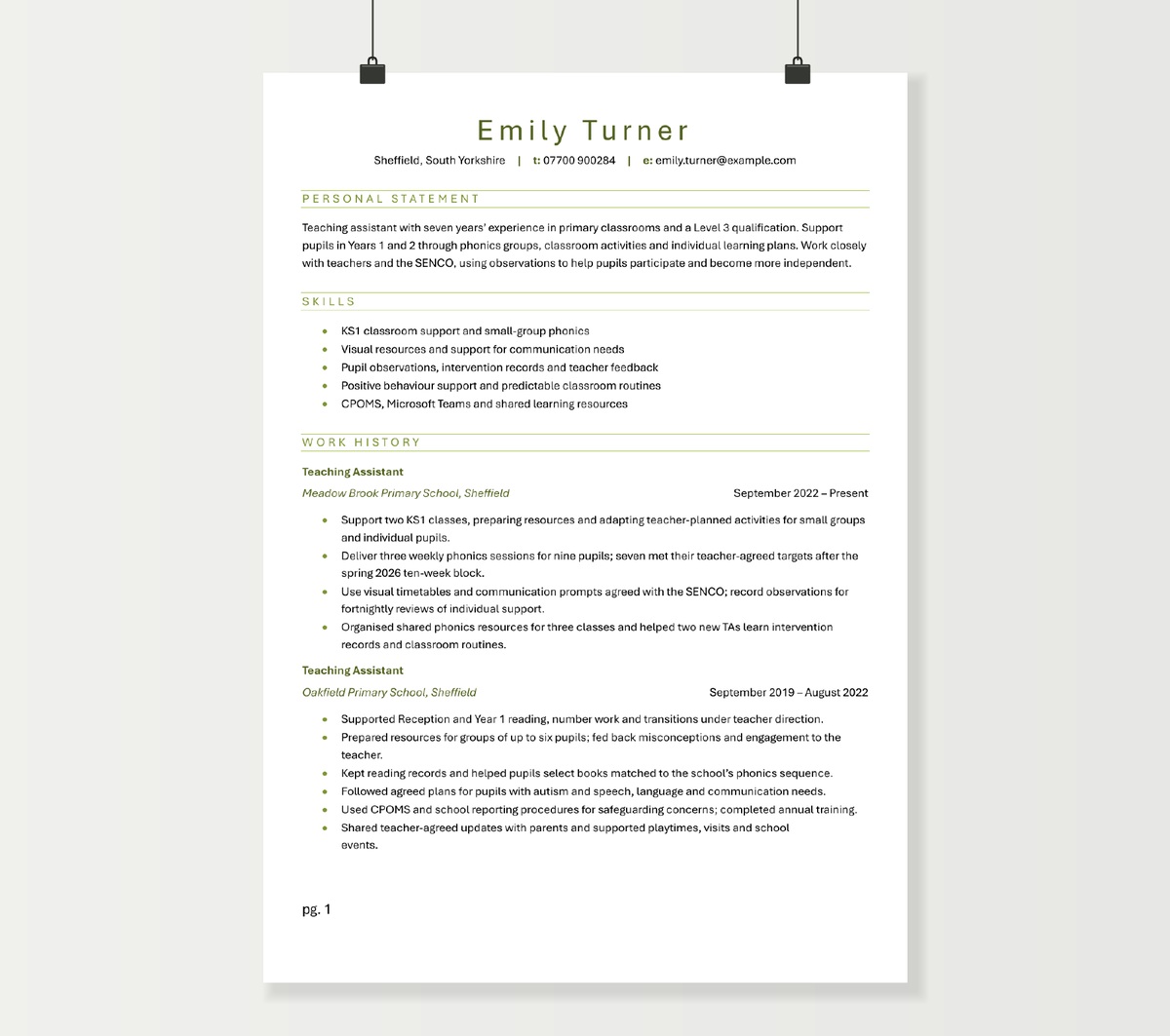
This teaching assistant CV template follows a primary-school TA with experience in Years 1 and 2, phonics groups and individual learning support. The Word example shows a progression from volunteering to paid classroom roles, with practical evidence of pupil support and collaboration. The guide also covers secondary schools, SEND settings, first applications and higher-level responsibilities.
Filename: FreeCVDownload_Teaching_Assistant.docx
Content of this CV template
Emily Turner
Sheffield, South Yorkshire | t: 07700 900284 | e: [email protected]
Personal statement
Teaching assistant with seven years’ experience in primary classrooms and a Level 3 qualification. Support pupils in Years 1 and 2 through phonics groups, classroom activities and individual learning plans. Work closely with teachers and the SENCO, using observations to help pupils participate and become more independent.
Skills
- KS1 classroom support and small-group phonics
- Visual resources and support for communication needs
- Pupil observations, intervention records and teacher feedback
- Positive behaviour support and predictable classroom routines
- CPOMS, Microsoft Teams and shared learning resources
Work history
Teaching Assistant
Meadow Brook Primary School, Sheffield
September 2022 – Present
- Support two KS1 classes, preparing resources and adapting teacher-planned activities for small groups and individual pupils.
- Deliver three weekly phonics sessions for nine pupils; seven met their teacher-agreed targets after the spring 2026 ten-week block.
- Use visual timetables and communication prompts agreed with the SENCO; record observations for fortnightly reviews of individual support.
- Organised shared phonics resources for three classes and helped two new TAs learn intervention records and classroom routines.
Teaching Assistant
Oakfield Primary School, Sheffield
September 2019 – August 2022
- Supported Reception and Year 1 reading, number work and transitions under teacher direction.
- Prepared resources for groups of up to six pupils; fed back misconceptions and engagement to the teacher.
- Kept reading records and helped pupils select books matched to the school’s phonics sequence.
- Followed agreed plans for pupils with autism and speech, language and communication needs.
- Used CPOMS and school reporting procedures for safeguarding concerns; completed annual training.
- Shared teacher-agreed updates with parents and supported playtimes, visits and school events.
Classroom Volunteer
Oakfield Primary School, Sheffield
September 2017 – July 2019
- Volunteered two mornings a week in a Year 1 class alongside college study.
- Heard individual readers and recorded observations for the class teacher.
- Prepared maths resources and helped small groups take part in practical activities.
- Supported classroom routines and school trips under staff supervision.
Education and training
Qualifications
Sheffield College
2019
- NCFE CACHE Level 3 Diploma in Supporting Teaching and Learning.
- A levels: English Literature and Sociology — 2017.
- Seven GCSEs at grades A–C, including English and Mathematics — 2015.
School-based training
Meadow Brook Primary School
2025 – 2026
- Safeguarding and Prevent updates; phonics delivery; autism and communication support.
Hobbies and interests
- Reading: Contemporary fiction and a local book group.
- Walking: Weekend walks in the Peak District.
- Crafts: Sewing and making small gifts for friends.
Additional information
Based in Sheffield; available for a term-time school role.
How to write a teaching assistant CV
A teaching assistant CV needs to show what happens when you work alongside a teacher and a group of pupils. The age range, learning needs, activities you support and feedback you provide make your experience meaningful. A school should be able to see both the practical help you offer in a classroom and the care you take over each pupil’s participation.
Emily’s example brings together mainstream primary support, phonics groups and work with individual learning plans. Your strongest evidence may come from a secondary classroom, a specialist provision, a placement or a regular volunteer role. Build the CV around that setting and the responsibilities of the post you want.
Start with the school phase and the support you can offer
A profile such as “enthusiastic individual with a passion for education” leaves the school to work out where you would fit. Give it something more useful: your experience of particular year groups, your qualification and the type of support you have provided. For a primary post, early reading, phonics, number work and classroom routines may be the strongest opening. For a secondary role, subject access, organisation, communication and support for young people across lessons may matter more.
You can name a specialism without making the whole profile a list. A TA with experience of autism support might explain that they use agreed visual resources and communication approaches to help pupils take part in lessons. A first-time applicant can lead with a relevant placement, youth-work experience or a qualification that included school practice.
Use the person specification to decide the emphasis. A resource-base vacancy, a general classroom post and a role attached to a particular pupil can share the same job title while asking for quite different experience.
Describe your place in teaching and learning
Start each school entry with your job title, school, dates and the phase or year groups supported. Then show the relationship between the teacher’s plans and your own work. Preparing materials, explaining instructions, adapting resources with guidance, checking understanding and feeding back observations are useful responsibilities in their own right.
“Supported the class teacher” is too broad to carry an employment entry. A more informative bullet might read: “Prepared number resources for a Year 2 class and supported groups of up to six pupils, reporting common misconceptions to the teacher.” It establishes the setting, group size, task and feedback without turning the CV into a lesson plan.
Separate regular classroom work from additional responsibilities. You may also have run a lunchtime activity, supported educational visits, prepared accessible resources or helped a new colleague learn school systems. These details show how you contribute to the school, particularly when the vacancy includes supervision beyond lessons.
For secondary experience, make subject coverage visible. Supporting reading across the curriculum, helping pupils organise extended writing, using practical resources in maths or supporting access arrangements in examinations can each deserve a line. The school needs to understand what you did and the training or direction involved.
Make intervention experience easy to assess
An intervention entry is strongest when it explains the pupils’ starting need, the support you delivered, its frequency and how progress was reviewed. A programme name can help a school recognise relevant experience, but the name alone says little about your contribution.
Include the details that distinguish the work:
- The learning area, such as phonics, reading fluency, number understanding or communication.
- The age group and whether you supported individuals or a small group.
- Your part in delivering teacher-planned sessions, adapting resources and keeping records.
- The review period and the progress evidence shared with the teacher or SENCO.
Emily’s CV states that she delivered three weekly phonics sessions for nine pupils, with seven meeting teacher-agreed targets after a ten-week block. The scale and period give the result context, while the reference to agreed targets keeps the link to classroom planning visible.
For your own CV, useful outcomes may include a pupil using a communication aid more independently, joining a group activity for longer or completing a familiar task with fewer prompts. Where you have recorded figures, explain what they measure. Where the evidence is observational, a precise description of the change can be more informative than a percentage. A sentence such as “Contributed observations to weekly reviews that led to a revised reading group” also shows professional value when there is no simple attainment result.
Present SEND experience through the support provided
Schools need to understand how your experience relates to their pupils. Include the needs you have supported, but give equal attention to your practical role. Visual timetables, communication resources, adapted materials, structured transitions and support for participation are more informative when attached to a particular setting and purpose.
For example: “Supported pupils with speech, language and communication needs during teacher-planned activities, using agreed visual prompts and recording responses for the SENCO.” This gives the reader a picture of your work and the team around it.
If you have contributed to support linked to an education, health and care plan (EHCP), describe your part in delivering or reviewing that support. Relevant evidence could include observation notes, contributions to review meetings or preparing resources around agreed targets. Use the terminology appropriate to the education system and setting in which you worked.
A specialist-school applicant may also have relevant personal-care, moving-and-handling, communication or medical-support experience. Give the training and the responsibility enough space to be understood, where these are part of the advertised role. Keep descriptions focused on your professional work; pupils’ names and individual histories are unnecessary to explain it.
Independence is an especially useful theme. Explain how you helped a pupil start a task, use resources or participate with classmates, and how you fed back what was becoming easier. This shows attention to learning and development beyond completing an activity.
Show how you support behaviour and relationships
“Good behaviour management” can mean many things. Describe the setting and your role in the school’s agreed approach: supporting predictable routines, helping pupils manage transitions, reinforcing expectations or recording patterns for review with teaching staff.
If your experience includes social, emotional and mental health needs, select an example that shows calm communication and constructive teamwork. A useful bullet might explain how you supported an agreed return-to-class routine and kept staff informed of the pupil’s response. This is enough to demonstrate relevant experience; the CV does not need an account of an individual incident.
Relationships with parents and carers also deserve specific treatment. Distinguish everyday handovers, sharing teacher-agreed updates, contributing to meetings and translating or interpreting where that was part of your work. These are different responsibilities, and the detail helps a school see how you communicate within its team.
Give safeguarding and school systems a clear, practical place
List recent safeguarding training with its date, along with relevant updates such as Prevent where applicable to your school context. In employment history, a short line about recording concerns and following the school’s reporting arrangements can show how that training sits within your work.
School software is worth including when it explains something useful. CPOMS experience can support a point about recording and reporting; a learning platform may relate to sharing resources; an assessment tracker may show how you maintain intervention records. A short skills list can name the systems, while an employment bullet explains what you used them for.
For a role involving technology to support access to learning, mention the relevant devices, communication software or accessibility tools and the pupils’ tasks they supported. General confidence with computers is less informative than evidence of using a tool in a classroom.
Make qualifications and recent training easy to find
Give the full qualification title, level, awarding organisation and completion year. “Level 3” on its own leaves a school guessing whether you mean a qualification, a job grade or a particular employer’s role structure. Award, Certificate and Diploma titles also communicate different courses, so the full title is useful.
Include English and mathematics qualifications clearly when they are part of the entry requirements. Experienced applicants can usually group their other school qualifications, while someone moving into the role may give more space to relevant study and placement work.
Use a separate, compact training section for development that supports the vacancy: phonics programmes, communication approaches, autism support, emotional literacy, first aid or specific care responsibilities. Include the provider and date when useful. A school-based update can be labelled as school training, and a qualification in progress can show its expected completion date.
For an HLTA application, bring the higher-level evidence forward: planning and preparing activities, whole-class responsibility, PPA cover, evaluating learning and supporting other TAs. State HLTA status or the relevant qualification precisely. A reader applying for a teaching post can also compare the emphasis in our teacher CV example, where the responsibility for planning, assessment and class teaching is different.
Build a first TA application around work with children
School placements and regular volunteering can sit in a relevant-experience section even when you have not yet held a paid TA post. Give the school or organisation, dates, frequency, age range and activities. “Two mornings a week in a Year 1 class” makes the extent of a placement much clearer than “classroom experience”.
Draw out evidence of supporting learning, explaining tasks, encouraging participation and working with staff. After-school clubs, sports coaching, youth groups and childcare can provide useful examples, especially when you explain the bridge to the school role. An activity you organised for a group, an adjustment that helped a child participate or a clear handover to a colleague is stronger evidence than a list of personal qualities.
Career changers can retain earlier employment in a concise form and select the parts relevant to school work: communication, organisation, record keeping or adapting an explanation for different people. The main emphasis should still fall on your experience with children and preparation for the classroom.
For experienced TAs, show progression through greater responsibility or a broader contribution. This could be moving from general classroom support into interventions, gaining specialist training, supporting more than one year group or helping colleagues. A new job title is only one way that development can appear.
Use the CV as a foundation for school application forms
Many schools ask for their own application form and supporting statement. Check the application route early: the CV can organise your evidence even when the school requests that it be submitted in a different format.
Use the person specification to choose examples for the supporting statement. If it asks about working with teachers, supporting pupils’ independence and keeping records, give each requirement a concrete example drawn from your experience. Expand the most relevant CV bullets into short accounts of the situation, your contribution and what the teacher or team could see afterwards.
Keep a complete record of employment, education, placements and other periods alongside the concise CV so the dates are ready for a school’s form. This is particularly helpful after agency work, concurrent part-time roles or a career break. The CV presents the most useful evidence; the form can then supply the full chronology requested by the school.
Choose a layout that gives classroom experience and qualifications enough room. The Word CV template library includes alternatives if a different balance of experience and training would suit your application.
Teaching Assistant CV FAQs
Requirements vary by post. Some schools ask for a particular qualification; others accept relevant experience, a Level 2 qualification or a willingness to train. Compare your background with the essential criteria, then make your literacy, numeracy, work with children and relevant study easy to find. A job advertised as Level 3 may refer to the employer’s role or grading structure, so read the qualification requirement separately.
Use the agency as the main employer entry and give the overall dates. Under it, summarise the phases and settings covered, then pick out longer or especially relevant placements with their own dates and responsibilities. This shows continuity without repeating the same duties for every school. Keep a separate full placement record for application forms that ask for it.
Yes, where your experience meets the vacancy’s requirements. Bring forward support for reading, independence, communication and access to tasks, then add any subject knowledge or experience with older children. Explain the year groups you have supported so the school can see both your existing strengths and the change of setting you are seeking.
State the original teaching qualification, country and classroom experience clearly, together with any formal UK comparison or recognition you already hold. Then focus the profile and examples on the advertised support role: collaboration with teachers, individual or group support and adapting resources. Language skills and experience of pupils learning in an additional language can be useful evidence where relevant to the school.
For an England or Wales school application, a brief additional-information line can be useful if you hold a relevant enhanced check and subscribe to the Update Service. The school will still arrange its own recruitment checks and decide whether your existing check is suitable. Scotland and Northern Ireland use separate disclosure systems. Detailed certificate information can be supplied through the school’s checking process.
A teacher, placement supervisor or volunteer coordinator who directly supervised your work can give useful evidence of your contribution. Check the application form’s requirements: a school may also ask for a current or most recent employer. If your experience was arranged through a college or agency, establish who can confirm the placement and who can comment on your day-to-day work.