This support worker CV template follows an experienced applicant moving from day services into supported living. The Word example brings together practical support, communication, key-worker responsibilities and professional development. The guide explains how to present experience for learning-disability, autism and mental-health services, including applications for a first support role.
Filename: FreeCVDownload_Support_Worker.docx
Content of this CV template
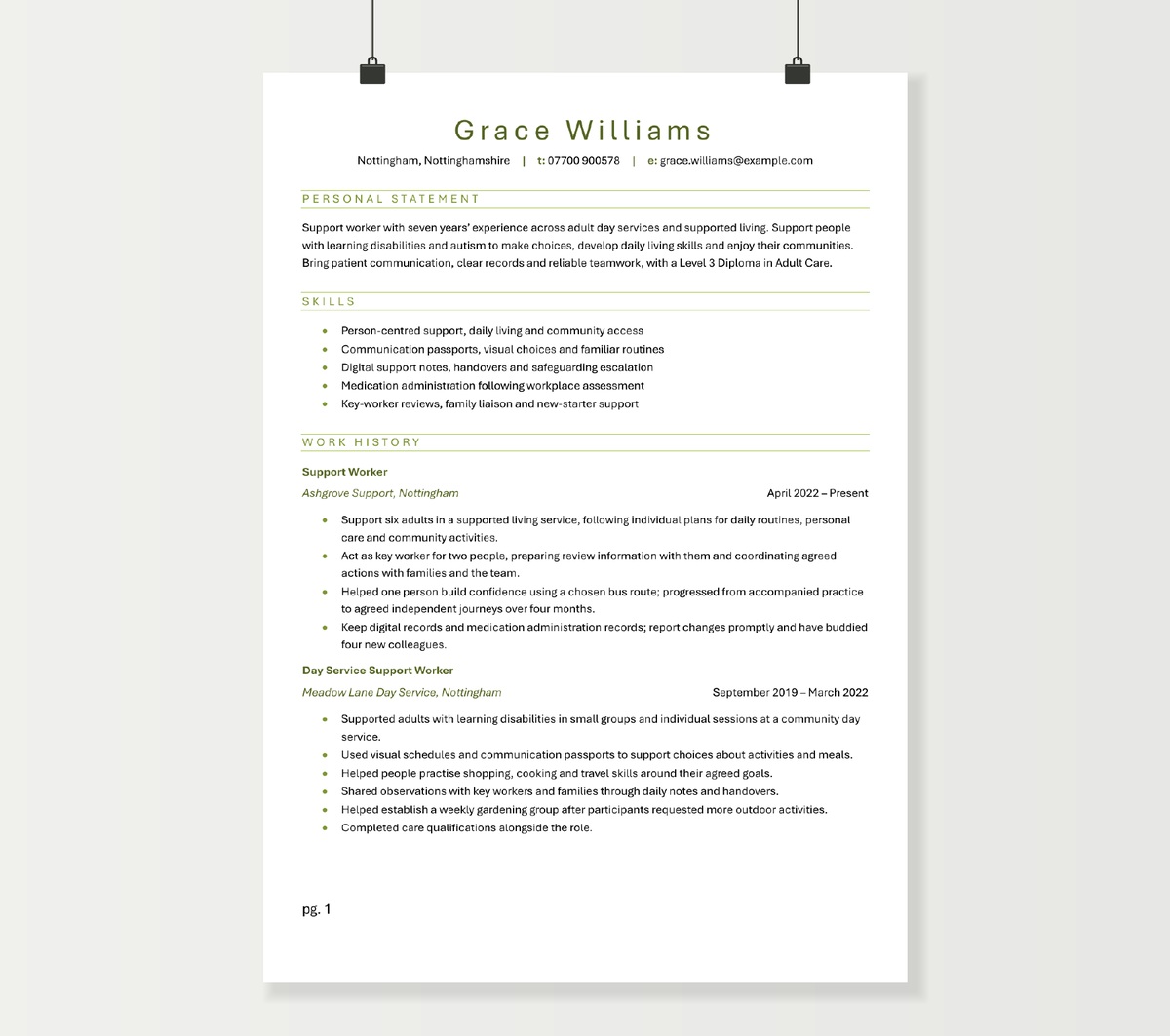
Grace Williams
Nottingham, Nottinghamshire | t: 07700 900578 | e: [email protected]
Personal statement
Support worker with seven years’ experience across adult day services and supported living. Support people with learning disabilities and autism to make choices, develop daily living skills and enjoy their communities. Bring patient communication, clear records and reliable teamwork, with a Level 3 Diploma in Adult Care.
Skills
- Person-centred support, daily living and community access
- Communication passports, visual choices and familiar routines
- Digital support notes, handovers and safeguarding escalation
- Medication administration following workplace assessment
- Key-worker reviews, family liaison and new-starter support
Work history
Support Worker
Ashgrove Support, Nottingham
April 2022 – Present
- Support six adults in a supported living service, following individual plans for daily routines, personal care and community activities.
- Act as key worker for two people, preparing review information with them and coordinating agreed actions with families and the team.
- Helped one person build confidence using a chosen bus route; progressed from accompanied practice to agreed independent journeys over four months.
- Keep digital records and medication administration records; report changes promptly and have buddied four new colleagues.
Day Service Support Worker
Meadow Lane Day Service, Nottingham
September 2019 – March 2022
- Supported adults with learning disabilities in small groups and individual sessions at a community day service.
- Used visual schedules and communication passports to support choices about activities and meals.
- Helped people practise shopping, cooking and travel skills around their agreed goals.
- Shared observations with key workers and families through daily notes and handovers.
- Helped establish a weekly gardening group after participants requested more outdoor activities.
- Completed care qualifications alongside the role.
Retail Assistant
Cedar Home, Nottingham
August 2016 – August 2019
- Served customers, handled payments and helped resolve enquiries in a busy homeware shop.
- Adapted explanations for customers needing more time or practical assistance.
- Worked with colleagues to keep aisles accessible and replenish stock.
- Balanced the till and recorded outstanding queries for the next shift.
Qualifications
Professional development
Work-based learning and employer training
2019 – 2026
- Level 3 Diploma in Adult Care — 2022; Care Certificate — 2019.
- Safeguarding adults and medication competency review — 2026.
- Positive behaviour support and autism communication training — 2025.
Education
Nottingham sixth-form college
2016
- A levels: Sociology and English Language. Eight GCSEs A–C including English and Maths (2014).
Hobbies and interests
- Walking: Weekend walks with friends.
- Gardening: Growing herbs and vegetables.
- Music: Singing in a community choir.
Additional information
Full UK driving licence; available for early, late and weekend shifts.
How to write a support worker CV
A strong support worker CV helps an employer picture how you work alongside people. It shows whose needs you understand, how you support choice and independence, and how you contribute to a dependable service. The most persuasive details are often ordinary but important: recognising a change, making information easier to understand, following through on an agreed goal or giving the next shift a clear handover.
The title covers very different jobs. A supported living service for autistic adults, a mental-health step-down service and an NHS residential unit may all recruit support workers, but they need different evidence. Start with the setting and person specification, then select the experience that best explains your fit.
Make the kind of support you offer clear
Your profile should establish the people you have supported, the service environment and two or three relevant strengths. “Seven years across adult day services and supported living” is more informative than “experienced in the care sector”. Add the qualification or specialist experience that helps the employer place you, such as a Level 3 Diploma in Adult Care, community mental-health experience or communication support for people with profound and multiple learning disabilities.
Use the wording of your actual experience to give the profile substance. An experienced applicant might write: “Support worker with four years in supported living for adults with learning disabilities. Experienced in key-worker reviews, visual communication and supporting daily living goals, with clear digital records and dependable shift handovers.” The work history can then show how those strengths operate in practice.
For a first support role, lead with relevant experience from paid work, volunteering or caring responsibilities, followed by your reason for choosing the service. A customer-service background can demonstrate patient explanations and calm responses to distress; a community role might show that you help people take part at their own pace. Choose a specific example rather than building the profile around a list of personal qualities.
Describe the service before listing your duties
Give each recent role a short context line. Include the setting, broad support needs and working arrangement: a six-person supported living service, outreach visits to people in their own homes, a day service or a residential setting with nursing input. This makes the following bullets easier to assess. Where relevant, state whether you worked one to one, supported groups, held key-worker responsibilities or covered waking nights.
The size of a service is useful context, but distinguish it from your own allocation. Supporting a service with twelve residents does not explain whether your shift involved one-to-one support, shared responsibilities or a small caseload. A clear account of how your work was organised is more valuable than the largest number you can put in a sentence.
Build the role around a few complementary examples: daily support, communication, a person’s goal, recording and team working. This gives a fuller picture than six bullets that all describe accompanying people to activities. Earlier jobs can be shorter, while retaining evidence of a different setting or progression in responsibility.
Show person-centred support through someone’s choices
“Person-centred” becomes convincing when the reader can see what changed because you listened. Describe how you found out what mattered to someone and helped turn that preference into practical support. This could involve choosing meals, preparing for an appointment, maintaining a friendship, using local facilities or trying a new activity.
A useful bullet might be: “Worked with a person and their key worker to break a chosen shopping trip into manageable stages, using a visual list and reviewing the support needed after each visit.” It demonstrates collaboration, communication and a purposeful approach without turning the CV into a case study.
Give the person a clear role in the result. “Supported a person to plan and prepare a weekly meal of their choice” communicates something different from “prepared meals for residents”. Both may describe legitimate responsibilities, but the first gives evidence of enabling participation. Where personal care forms part of your job, include it clearly alongside the support you provide with decisions and daily life.
Choose outcomes that suit support work
Progress may be a new routine, greater confidence, participation in a preferred activity or a goal sustained over time. The bus-route example in this CV gives a timescale and describes a change in support. It does not need a percentage to be meaningful. Qualitative evidence can be equally strong when it identifies the goal, your contribution and the outcome.
Numbers are helpful for responsibilities such as key-working for two people, buddying four colleagues or coordinating weekly reviews. Use measures that explain your contribution to continuity and quality. Where a result came from shared work, name the collaboration: “Contributed observations to a revised support plan, helping the team provide a more consistent morning routine.”
Bring communication skills to life
Communication in support work includes understanding how someone expresses a preference, recognising when an approach is not working and sharing information with others. Name the approaches you use in context: communication passports, objects of reference, visual choices, accessible information, signing or giving someone additional processing time.
Explain what the approach helped achieve. “Used a visual sequence agreed with the person to make unfamiliar appointments easier to prepare for” tells an employer more than “excellent non-verbal communication”. If you have formal training in a particular approach, put its title and date in the training section; the work history shows how you use it.
Include communication with families, advocates and professionals when it is part of your role. Good evidence might be preparing key-worker review notes with the person, sharing agreed updates with family members, or recording observations for a visiting occupational therapist. Make the purpose of the contact visible, rather than listing everyone you have ever worked with.
Explain your part in safe, consistent support
Employers need to understand how you work with support plans, risk assessments, observations and escalation. Select examples that show attentive practice: noticing a change in usual behaviour, recording relevant observations and passing the concern to the appropriate colleague. A concise account of the action and follow-up is usually enough.
For positive behaviour support, describe the work you actually contribute to the agreed approach. You might use consistent routines, recognise early signs of distress, record patterns or share observations during reviews. Training can support this evidence, but the phrase “behaviour management” on its own leaves the reader unsure what you do.
Present practical responsibilities at the right level of detail. Medication prompting, assistance and administration are different forms of support; use the description that fits your role. Where you have completed workplace competency assessments, connect them to the task. The same approach works for moving and assisting, eating and drinking support or delegated health-related activities. Relevant training and assessed practice help an employer understand how your experience could transfer to their service.
Give recording and handovers their proper weight
Digital recording deserves more than “IT literate”. Explain what you record: daily support notes, goal progress, appointments, medication records or incident information. Name a system if it is relevant to the vacancy, then describe the work it supports. A hiring manager can assess experience with accurate, timely records even if their organisation uses different software.
Handovers can demonstrate judgement and teamwork. A bullet about passing on changes, outstanding actions and agreed follow-up shows why your records matter. For a senior post, add experience checking records, supporting colleagues with recording quality or ensuring actions reach the right person.
Adjust the emphasis for the service you want to join
Learning-disability and autism services
Prioritise communication preferences, choice, familiar routines and participation in everyday life. Show how you support skills and interests alongside any personal-care or mobility responsibilities. If the service supports people with more complex needs, make relevant training and practical experience easy to find. A diagnosis list is less useful than a clear explanation of the support you can provide.
Mental-health and recovery services
Bring forward relationship building, agreed recovery goals, calm responses to distress and coordination with other services. Community roles may involve appointments, tenancy-related tasks, education, employment or rebuilding local connections. Describe these activities in relation to the person’s goals and your support role. Inpatient applications need a different emphasis, including experience of ward teams, observations and the responsibilities specified for that post.
Moving towards senior support work
Show what has expanded beyond your own daily allocation. Useful evidence includes coordinating a shift, allocating tasks, preparing reviews, inducting colleagues, contributing to risk-plan reviews or following up incidents with a manager. Keep your job title and explain additional responsibilities underneath it. This allows experience gained through deputising or acting-up arrangements to count even before a permanent promotion.
Organise qualifications and training so they are easy to assess
List your main care qualification with its exact title, level and completion year. If you are studying, add the expected completion date and, where useful, your current stage. Place recent, relevant workplace training together, grouping related subjects so that the section remains readable. Safeguarding, medication, moving and assisting, autism communication and positive behaviour support may deserve space depending on the vacancy.
Keep the Care Certificate and formal qualifications as separate entries. The Care Certificate is an induction framework; the Level 2 Adult Social Care Certificate is a distinct regulated qualification. An earlier award keeps its original title. For an experienced applicant, this clarity is more useful than a long list of individual course modules.
Dates help employers understand when training or a competency review took place. Include the provider or employer where it adds context. For specialist support, a recent practical assessment may be particularly relevant. For a first role, relevant learning and supervised experience can sit above unrelated employment, while still allowing the reader to follow your work history.
Use transferable experience and practical details well
If you are entering support work, look for evidence of listening, reliability, respectful assistance and following agreed procedures. Volunteering at a community group might show how you helped someone join an activity. Retail or hospitality experience can show patient service, clear handovers and teamwork during busy periods. Explain the action, then let the employer see the connection to support work.
Education support can also offer relevant experience of communication and participation. If that is your background, the teaching assistant CV example shows another way to describe individual support and collaboration. Keep the emphasis on the adult or community setting you are now applying to.
Finish with practical information that helps match you to the rota or service: driving licence, access to transport where relevant, locality and available shift patterns. A short, precise line is enough. You can compare other layouts in the CV template collection; whichever design you choose, give your strongest examples of support and communication the most space.
Support Worker CV FAQs
Yes. Give it a clear heading such as Family caring responsibilities, with dates and a short description of the relevant experience. Appointment coordination, adapting communication, practical assistance and keeping track of agreed routines can all help explain your suitability. Describe your own contribution in broad terms; the reader needs to understand your experience rather than the other person’s medical history. Keep this separate from paid employment so the chronology is easy to follow.
For a role explicitly built around peer support, lived experience may be relevant to the person specification. You can describe the perspective it brings, relevant peer-support training and how you use that understanding in a purposeful support relationship. The amount of personal detail is your choice. A CV can establish relevance briefly, with the supporting statement giving more space to your approach and motivation.
Use the bank or agency as the main employer entry, with the overall dates and your role. Under it, summarise the settings you worked in and highlight any substantial placements that demonstrate different experience. This gives a clear employment history without making every short booking look like a separate job. If bank work overlapped with a permanent position, label it as additional or occasional work.
Yes. They describe different working arrangements. State which you have worked and what responsibility you held, such as overnight records, agreed checks, responding to calls or handing over to the day team. If you have worked both, a short line can say so. This helps employers assess your experience against the specific rota they are filling.
It can provide the evidence and employment chronology, but use the application format requested by the employer. NHS vacancies commonly ask for a supporting-information section mapped to the person specification. Develop your strongest CV examples there, explaining your actions and relevant outcomes in more detail. Check the role carefully: a healthcare support worker post may involve responsibilities and competency requirements that differ from a community support role.
Where registration applies to your role and UK nation, put the register and your current status alongside qualifications or in a short professional details section. Requirements depend on the service and jurisdiction, so match the information to the vacancy rather than treating registration as identical across the UK. If an application or registration is in progress, state that stage clearly. Registration details can be supplied through the employer’s recruitment process when requested.