
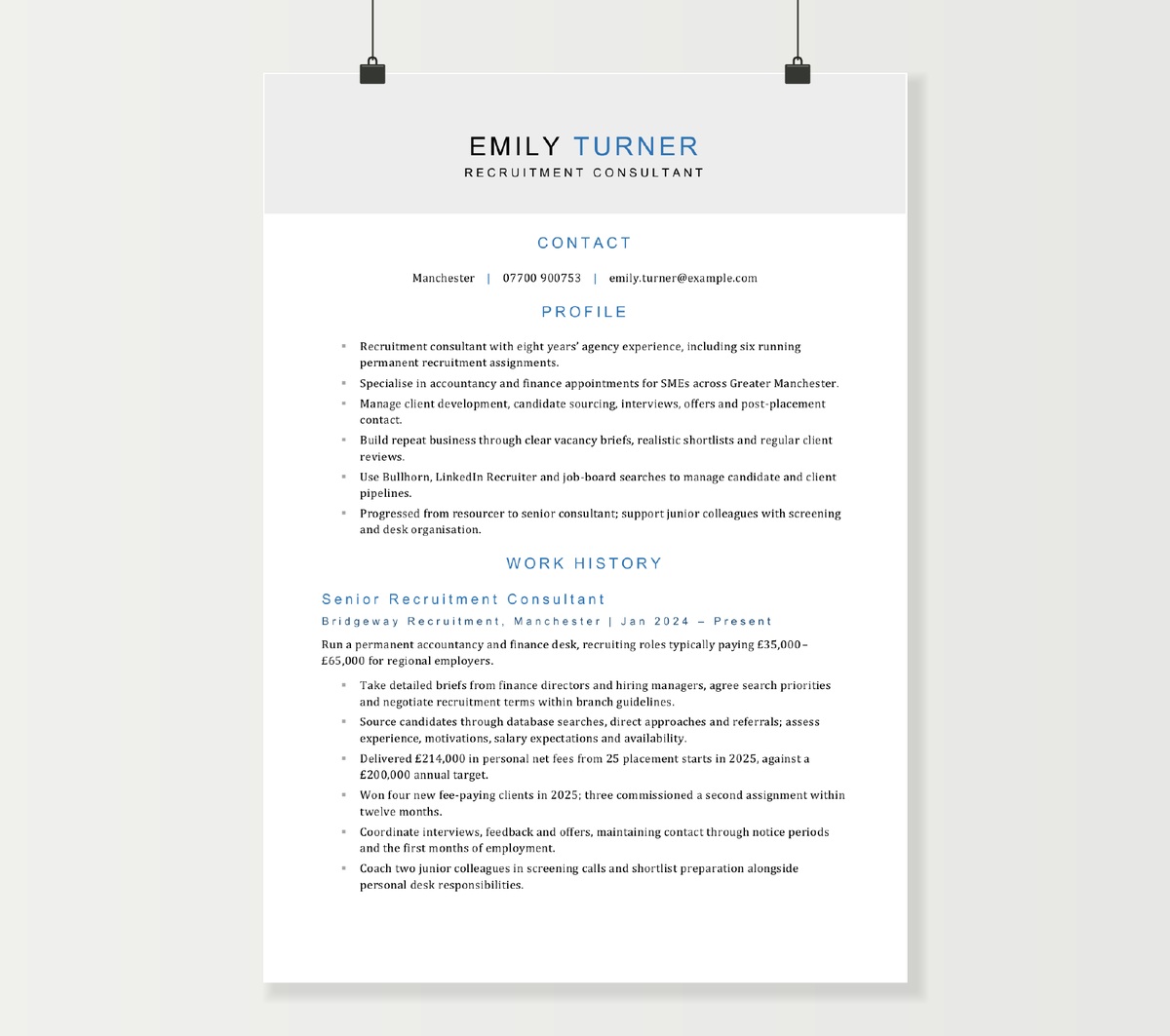
This recruitment consultant CV template follows a permanent recruiter who progressed from resourcing to running an accountancy and finance desk. The Word example shows billings, new client development, candidate work and progression. The guide covers full-cycle consultants, delivery specialists and first recruitment roles, with separate advice for permanent, temporary and contract desks.
Filename: FreeCVDownload_Recruitment_Consultant.docx
Content of this CV template
Emily Turner
Recruitment Consultant
Contact
Manchester | 07700 900753 | [email protected]
Profile
- Recruitment consultant with eight years’ agency experience, including six running permanent recruitment assignments.
- Specialise in accountancy and finance appointments for SMEs across Greater Manchester.
- Manage client development, candidate sourcing, interviews, offers and post-placement contact.
- Build repeat business through clear vacancy briefs, realistic shortlists and regular client reviews.
- Use Bullhorn, LinkedIn Recruiter and job-board searches to manage candidate and client pipelines.
- Progressed from resourcer to senior consultant; support junior colleagues with screening and desk organisation.
Work history
Senior Recruitment Consultant
Bridgeway Recruitment, Manchester | Jan 2024 – Present
Run a permanent accountancy and finance desk, recruiting roles typically paying £35,000–£65,000 for regional employers.
- Take detailed briefs from finance directors and hiring managers, agree search priorities and negotiate recruitment terms within branch guidelines.
- Source candidates through database searches, direct approaches and referrals; assess experience, motivations, salary expectations and availability.
- Delivered £214,000 in personal net fees from 25 placement starts in 2025, against a £200,000 annual target.
- Won four new fee-paying clients in 2025; three commissioned a second assignment within twelve months.
- Coordinate interviews, feedback and offers, maintaining contact through notice periods and the first months of employment.
- Coach two junior colleagues in screening calls and shortlist preparation alongside personal desk responsibilities.
Recruitment Consultant
Bridgeway Recruitment, Manchester | September 2020 – December 2023
Developed a permanent transactional-finance desk from an allocated client base and new business activity.
- Managed searches for accounts assistants, credit controllers and payroll staff, working with hiring managers on role requirements.
- Built candidate networks through targeted searches, referrals and regular conversations about upcoming moves.
- Achieved £168,000 personal net fees against a £160,000 target in 2023, with repeat assignments from nine clients.
- Maintained Bullhorn records and weekly forecasts, following outstanding interview feedback and confirming agreed offer details.
Recruitment Resourcer
Northbank People, Manchester | August 2018 – August 2020
Supported three consultants recruiting office-support staff for permanent roles.
- Screened applicants, booked interviews and kept candidate records and availability up to date.
- Prepared candidate summaries and coordinated document collection with the compliance administrator.
Qualifications and development
BA (Hons) Business Management, 2:1
Manchester Metropolitan University | 2018
Recent professional development
Agency workshops: consultative client meetings and fee negotiation (2025); candidate interviewing and inclusive shortlisting (2026).
Hobbies and interests
I enjoy netball, city breaks and going to comedy nights.
How to write a recruitment consultant CV
A recruitment consultant CV has two audiences in mind: the manager assessing your commercial performance and the colleagues who will rely on the quality of your recruitment work. Give both enough evidence. Billings and targets help explain the desk you can run; client development, candidate assessment and management of the hiring process show how you achieve those results.
Start by making your market and responsibilities clear. An established permanent finance desk, a high-volume temporary workforce and a delivery role supporting key accounts are different propositions. Your CV will be stronger when the reader can understand yours before reaching the numbers.
Describe your desk before describing your performance
In your profile and the opening line of each recruitment job, identify the sector, geography, typical roles and recruitment model. For example, “Permanent accountancy and finance recruitment for SMEs across Greater Manchester, covering appointments at £35,000–£65,000.” That immediately gives context to Emily’s placement and fee figures.
Explain the part of the recruitment cycle you own. A 360 consultant normally combines client development with candidate delivery, but the balance varies between agencies. Spell out your responsibilities for winning vacancies, agreeing terms, sourcing, assessment, interview coordination and offers. For a delivery or resourcing role, identify the client accounts or consultant team you support and the candidate work for which you are accountable.
The starting position of the desk also matters. Building a new specialism, taking over established accounts and expanding a mature desk each call for different evidence. A brief description such as “Built a new permanent procurement desk within an established regional branch” helps a manager interpret the pace of growth. If you inherited a desk, show what you developed within it: additional hiring managers, new role categories, better delivery or repeat assignments.
For a specialist market, give enough detail to show where your knowledge lies. Recruiting transactional finance staff differs from executive finance appointments; day-to-day school cover differs from permanent leadership recruitment. Specify the part of the market in which you work and the relationships you have developed there.
Use the right commercial measures for the recruitment model
Choose the measures your agency uses to assess your desk and explain their basis. A reader should be able to tell whether a figure represents your own fees, a shared desk result, temporary gross profit or company turnover. Include the reporting period and, where helpful, the target.
Permanent recruitment. Personal net fees, placement starts, average fees, target attainment and repeat business can give a useful picture. Emily’s example reports £214,000 in personal net fees from 25 starts against a £200,000 annual target. The salary range elsewhere on the CV helps explain the level of those placements. A further bullet shows new clients becoming repeat clients, so the result has a commercial story behind it.
Temporary recruitment. Gross profit, average weekly workers, hours supplied, fill rates and client retention may be more informative. Explain whether a worker figure is an average, a peak or a current active book. A peak-week number and a sustained weekly average describe different achievements. If you report margin, give enough context to distinguish it from a mark-up on pay.
Contract recruitment. Consider the size and value of the active contractor book, extensions, new starts and gross profit, alongside any new-business target. An extension can be commercially important even when it is not counted as a new placement. State the measure that captures your responsibility and keep recurring contract performance distinct from one-off permanent fees.
Delivery and resourcing. Shortlist quality, successful starts, candidate conversion, coverage of difficult requirements and worker utilisation can be useful. Show how your candidate work contributes to the account. A delivery consultant need not force their achievements into a new-business billing model if that was not how the role was measured.
Select a small set of complementary results. A strong period of billings, new client development and a useful delivery improvement may say more than twelve months of separate sales totals. If your business uses terms such as net fee income or gross profit in a particular way, a clear label keeps the figure easy to interpret across agencies.
Show how you generate and develop client business
For a full-cycle consultant, give business development enough space. Describe the market you targeted, the conversations or relationships you developed and the work that followed. “Won four new fee-paying clients, three of which commissioned a second assignment within twelve months” connects acquisition with repeat business.
Activity can help explain an early-stage desk, but outcomes give it meaning. Meetings with new hiring managers, agreed terms, qualified vacancies and first placements form a more useful story than call volumes alone. Where you are still building a market, describe the stage reached and the period involved. A new consultant’s first retained client or an agreed exclusive search can be worth including even before it produces a long billing history.
Client work also includes taking an effective brief. Show how you establish the role, salary, location, interview process and hiring priorities, then translate that information into a search. Relevant experience may include advising on candidate availability, agreeing a workable shortlist or helping a client adjust an unsuccessful requirement. Keep the focus on your judgement and the effect on the assignment.
Negotiation belongs on the CV where it is part of your remit. Explain whether you agree agency terms, discuss fees, handle offer negotiations or coordinate approval for exceptions. For temporary and contract desks, pay and charge-rate discussions may be relevant. An example of a repeat assignment, a wider client relationship or an agreed commercial arrangement can give this skill substance.
If a vacancy is primarily about developing existing customers, the account manager example offers another way to present relationship development and commercial responsibility. Keep your recruitment CV centred on the hiring work that sits within those accounts.
Give candidate work the same specificity as sales work
Good recruitment involves understanding the requirement and the person. Explain the roles you source for, the routes you use and the assessment you carry out. Database searches, direct approaches, referrals, job-board advertising and professional networks can all be relevant, but the CV should show how you choose and use them for your market.
An experienced specialist could describe finding candidates with an uncommon combination of qualifications and sector experience, or developing a referral network that supported a recurring hiring need. A resourcer might show how they refreshed availability records, improved the usefulness of candidate summaries or supplied a shortlist for a difficult assignment. These examples give sourcing methods a purpose.
Screening evidence can include the aspects you explore with candidates: relevant experience, reasons for moving, role preferences, salary expectations and availability. Then show what you do with the information. A clear summary for the hiring manager, a better-matched shortlist or an early discussion of a potential obstacle can demonstrate judgement more effectively than “excellent interviewing skills”.
Follow the story through interview, offer and start. Candidate preparation, timely feedback, notice-period contact and post-placement reviews can affect whether an accepted offer becomes a successful appointment. Choose an example that shows how you kept an assignment moving or maintained a relationship through a lengthy process.
For temporary or volume staffing, include how you manage availability, bookings, changes and contact with the workforce. In education, healthcare or another specialist sector, describe the checks, records and compliance handovers that fall within your role. The reader needs to understand your contribution to a reliable placement process; a detailed explanation of the sector’s rules would take the CV away from that purpose.
Make CRM, market knowledge and desk organisation tangible
Name the recruitment systems you use and the activities you manage in them. Bullhorn, Vincere, JobAdder or another platform may support candidate records, client pipelines, vacancies, interviews and forecasts. Explain the relevant functions rather than simply giving a software list. For LinkedIn Recruiter or job-board databases, connect the tool to sourcing and engagement work.
Organisation is easier to assess through a concrete responsibility: managing concurrent vacancies, reviewing outstanding client feedback, monitoring candidate availability or keeping weekly forecasts current. If you improved a process, describe the effect on delivery. This might involve more consistent handovers, clearer candidate status or earlier visibility of vacancies at risk.
Market knowledge can also be evidenced through the work. Show the types of employers and candidates you understand, the level of appointments you handle and any relevant events or professional networks. Salary discussions and advice on hiring requirements can demonstrate knowledge when tied to an assignment. The aim is to show useful specialism, not to turn the skills section into a catalogue of every job title in the market.
Build a convincing first recruitment application
For a trainee role, draw on experience of selling, working to targets, handling customer conversations and organising follow-up. A retail, hospitality, telesales or customer-service background can provide useful examples. Show what you did when a customer’s needs were unclear, how you developed repeat business or how you worked towards a measured result.
Recruitment employers also need to understand why the work appeals to you. A short profile can connect your background with the commercial and relationship-based nature of the role. “Customer service adviser with experience meeting sales targets and managing follow-up enquiries, seeking to develop those skills in commercial recruitment” is a clearer starting point than a broad claim to be a people person.
Use genuine opportunities from your experience to demonstrate persistence and judgement: following a lead through several conversations, resolving a difficult enquiry or responding constructively to feedback. A degree, placement or substantial student role may add relevant evidence, particularly where it involved external organisations or responsibility for results. The vacancy will determine how much weight qualifications carry.
For progression from resourcer to consultant, show where you have begun to take responsibility beyond sourcing. That could be taking vacancy briefs, joining client meetings, managing interview feedback or handling an assignment under supervision. Give those experiences appropriate detail so the next step is easy to understand.
Present seniority through responsibility as well as billings
A senior consultant may remain an individual biller, lead colleagues or combine both. Make the arrangement clear. Supporting two junior recruiters, leading a market specialism and formally managing a team are different responsibilities, each with useful evidence of its own.
For a team-leading application, explain the people you manage, your coaching role and the performance you help them achieve. Keep your personal desk results separate from team totals. If you remain primarily a biller, show the more complex assignments, client relationships or market development that distinguish your senior role.
List recruitment qualifications and relevant training with their exact titles and providers. Interviewing, client development, negotiation, specialist compliance and management development can all support an application when connected to the role. Employer workshops can be listed as professional development alongside formal awards.
Finish by checking the recruitment journey across your experience: the work you win or receive, the candidates you engage, the assignments you deliver and the relationships that continue. That gives the commercial figures their context and helps a hiring manager picture you working on the desk.
Recruitment Consultant CV FAQs
Use the personal fee credit recorded for you, or label the result as a shared placement and explain your part. For example, you may have sourced the candidate while another consultant owned the client relationship. Placement counts and personal fees can still appear together when their basis is clear. This is particularly useful when moving between agencies with different split arrangements.
Use a level of detail that can be shared, such as a fee range, percentage of target or growth over a stated period. You can add non-financial context through the desk specialism, salary band, placement volume or number of repeat clients. A recruitment manager can assess useful commercial evidence without seeing individual client terms or internal billing reports.
Report completed starts and recognised fees for the period, then describe accepted offers or scheduled starts separately if they materially explain your current desk. Include the relevant date. This gives an employer a view of both delivered performance and work already progressed, which is especially useful after joining a new agency or developing a new specialism.
Bring hiring-manager relationships, vacancy planning, sourcing, assessment, candidate experience and process improvement further forward. Explain the role families and seniority you recruit for, and use hiring outcomes relevant to the vacancy. Agency billings can remain as evidence of performance, while business development takes less space where the in-house role has no sales remit.
No. Agencies use consultant, delivery consultant, talent partner and resourcer in different ways. Keep your actual job title and add a short description of the work you own. State whether you develop client business, deliver candidates for existing accounts, manage bookings or cover the full process. That is more useful than relying on the title to explain your experience.




