This account manager CV template follows a B2B account manager who has progressed from sales support to responsibility for an established customer portfolio. The Word example brings together renewals, account growth, commercial judgement and coordination with service teams. The guide also covers key accounts, agency client services and applicants moving into their first account management role.
Filename: FreeCVDownload_Account_Manager.docx
Content of this CV template
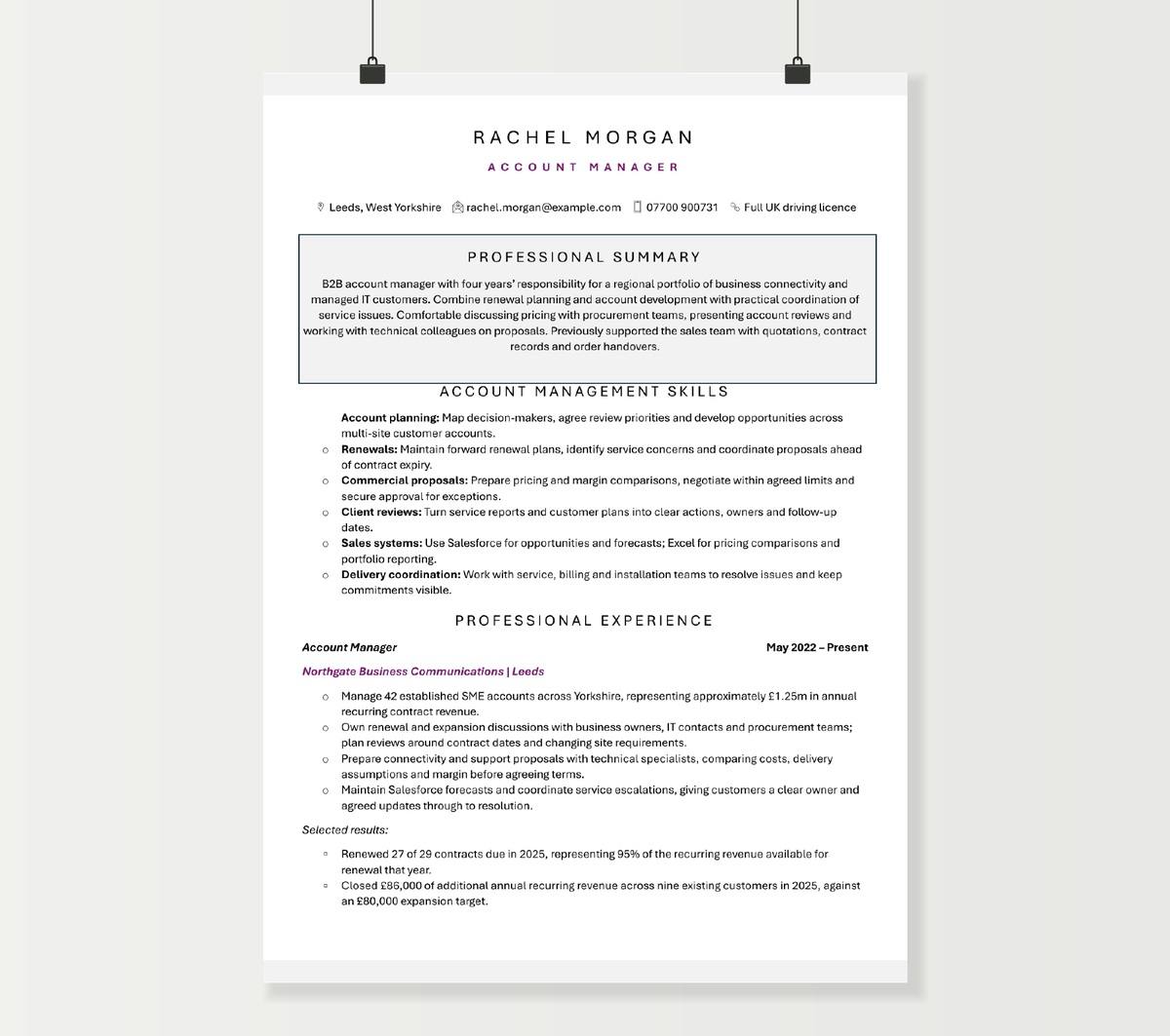
Rachel Morgan
ACCOUNT MANAGER
Leeds, West Yorkshire | [email protected] | 07700 900731 | Full UK driving licence
Professional summary
B2B account manager with four years’ responsibility for a regional portfolio of business connectivity and managed IT customers. Combine renewal planning and account development with practical coordination of service issues. Comfortable discussing pricing with procurement teams, presenting account reviews and working with technical colleagues on proposals. Previously supported the sales team with quotations, contract records and order handovers.
Account management skills
- Account planning: Map decision-makers, agree review priorities and develop opportunities across multi-site customer accounts.
- Renewals: Maintain forward renewal plans, identify service concerns and coordinate proposals ahead of contract expiry.
- Commercial proposals: Prepare pricing and margin comparisons, negotiate within agreed limits and secure approval for exceptions.
- Client reviews: Turn service reports and customer plans into clear actions, owners and follow-up dates.
- Sales systems: Use Salesforce for opportunities and forecasts; Excel for pricing comparisons and portfolio reporting.
- Delivery coordination: Work with service, billing and installation teams to resolve issues and keep commitments visible.
Professional experience
Account Manager | May 2022 – Present
Northgate Business Communications | Leeds
- Manage 42 established SME accounts across Yorkshire, representing approximately £1.25m in annual recurring contract revenue.
- Own renewal and expansion discussions with business owners, IT contacts and procurement teams; plan reviews around contract dates and changing site requirements.
- Prepare connectivity and support proposals with technical specialists, comparing costs, delivery assumptions and margin before agreeing terms.
- Maintain Salesforce forecasts and coordinate service escalations, giving customers a clear owner and agreed updates through to resolution.
Selected results:
- Renewed 27 of 29 contracts due in 2025, representing 95% of the recurring revenue available for renewal that year.
- Closed £86,000 of additional annual recurring revenue across nine existing customers in 2025, against an £80,000 expansion target.
Sales Support Executive | Sep 2018 – Apr 2022
Westfield Workplace Solutions | Leeds
- Supported four account managers supplying office equipment and service contracts to local businesses, progressing from order administration to customer quotations.
- Prepared quotations, checked product availability and recorded customer approvals, coordinating changes with purchasing and the warehouse.
- Maintained renewal dates and customer records, highlighting expiring service agreements for account managers to follow up.
- Handled order and invoice queries, bringing together sales, dispatch and finance colleagues to resolve discrepancies and update customers.
Selected contributions:
- Introduced a quotation checklist; orders returned for missing delivery or billing details fell from 18 to six per month over the following quarter.
- Coordinated a 24-site equipment replacement for one customer, maintaining the delivery schedule and resolving access queries with branch contacts.
Education & development
BA (Hons) Business Management, 2:1 – Leeds Beckett University, 2018
A levels: Business, English Language, Geography – 2015
Negotiation and account planning workshops – employer training, 2024–2025
Salesforce reporting and forecasting training – employer training, 2023
Additional information
- Customer meetings: Regular travel across Yorkshire for account reviews, site visits and joint meetings with technical specialists.
- Colleague support: Helped two new sales-support colleagues learn quotation checks and customer handover routines.
- Interests: Recreational running, live music and trying new recipes.
How to write an account manager CV
An account manager CV should make the shape of your client responsibility clear. A recruiter needs to understand the customers you look after, the commercial decisions you make and what happens to those accounts under your care. A portfolio of 200 small customers calls for a different approach from three strategic enterprise accounts. Both can produce strong evidence, provided the CV explains the context.
Build your experience around the relationship between customer needs and business results. Renewing a contract, widening a service agreement, resolving a delivery problem or developing another division of an existing customer can each be valuable. The strongest examples explain your part in the outcome and give enough detail to show how you work.
Make the type of account management clear from the start
Use your profile to establish your sector, customer type and level of ownership. For a B2B commercial role, that might mean a regional SME portfolio, a renewal and expansion target, and experience dealing with business owners or procurement. For an agency role, it might mean retained clients, campaign budgets, briefs and delivery across creative teams. For a national account role, it could be retailer relationships, annual negotiations, promotional plans and responsibility for account profitability.
A useful profile draws those facts together in a few connected sentences: “Account manager with five years’ experience developing manufacturing customers across the Midlands. Manage a £2m annual sales portfolio, coordinating technical proposals and contract reviews with engineering and procurement teams. Experienced in growing existing accounts while maintaining agreed margins.” The following experience section should then supply the detail behind that description.
Keep the emphasis close to the vacancy. An employer recruiting for renewal ownership will look for different evidence from one expecting prospecting within a large enterprise account. Where the role includes both, show both. Your current title can stay as it is while a short description beneath it explains the balance of responsibilities.
Give each customer portfolio a useful sense of scale
Open each relevant job with a sentence describing the book of business. Choose the measures that help a reader judge its complexity: number of accounts, approximate annual revenue or spend, customer size, geography, products or services, and whether you inherited the portfolio or developed it. Two or three well-chosen details are usually more informative than a string of unrelated numbers.
- A broad SME portfolio: show account volume, how you prioritise reviews, renewal responsibility and the service or product range.
- A small strategic portfolio: show account complexity, business units, stakeholder levels, contract scale and the length of the sales or renewal cycle.
- An agency client portfolio: show retained and project clients, budgets, channels or workstreams, and your responsibility for briefs, approvals and delivery.
- A distributor or product account portfolio: show territory, customer type, sales and margin responsibility, and involvement in pricing, stock or trading plans.
Then distinguish your decisions from the work you coordinate. “Owned renewal negotiations and pricing proposals, with director approval for discounts outside agreed limits” gives a clear picture of commercial authority. “Worked with service delivery and finance” becomes more useful when the reader can see what you brought those colleagues together to resolve.
Present retention and growth as distinct achievements
Retention is often a substantial part of account management, but “maintained excellent customer relationships” leaves its value unclear. Explain which accounts or contracts were due for renewal, the period involved and the result. Rachel’s CV reports 27 of 29 contracts renewed in 2025 and identifies the proportion of recurring revenue retained. That lets the reader distinguish contract count from financial value.
Use the retention measure your business actually reports and spell out what it covers. Customer retention, renewal revenue and net revenue retention answer different questions. A percentage is easier to interpret when the CV identifies its basis and period. In a subscription business, annual recurring revenue can describe the value of an ongoing agreement; in a project business, annual invoiced revenue or repeat commissions may be more useful.
Growth deserves its own evidence. Describe whether it came from additional sites, a wider product range, increased usage, a new business unit or a larger retainer. For example, “Extended an existing support agreement to six additional sites, adding £48,000 in annual contract revenue after coordinating a technical review and phased rollout.” This tells a prospective employer more than a sales figure alone.
Targets help establish performance expectations. Pair the result with the target and time period where that comparison is meaningful: “Delivered £86,000 of annual recurring revenue from existing-account expansion against an £80,000 target in 2025.” For work with a long buying cycle, a separate bullet can cover a qualified opportunity or tender you advanced, with its current stage clearly identified. Closed business and future pipeline are different forms of evidence and each can earn a place.
Show commercial judgement behind the sale
Account growth is more persuasive when the CV also shows how you handled price, margin, scope or contractual commitments. Select an example where you balanced the customer’s requirement with the practical cost of supplying it. That could be a renewal with revised service levels, a proposal involving several vendors, a phased order or a change to an agency retainer.
Explain the point at which your judgement mattered. Perhaps you compared two service options, agreed a longer contract in exchange for a pricing arrangement, secured approval for revised terms or involved a technical specialist before making a delivery commitment. A concise bullet can show the decision and result without reproducing the full negotiation.
Where profitability forms part of your remit, name the measure: gross profit, margin percentage, contribution or account budget. A statement such as “Grew annual sales by 9% while maintaining the agreed gross margin” communicates a different achievement from revenue growth alone. In client services, budget control and the handling of additional scope may be the better evidence.
Turn relationship skills into examples of account work
Account management involves relationships at several levels. Identify the people you work with and the purpose of those conversations: users discussing service problems, an IT lead planning capacity, procurement evaluating terms, or a finance director reviewing value. This is more informative than describing yourself as a strong communicator.
Choose a review or account-planning example that led somewhere. You might have identified an upcoming site move, brought the appropriate delivery team into the discussion and agreed a timetable that supported a renewal. You might have mapped a second division of a customer and arranged a relevant introduction. The useful CV evidence is the connection between the conversation, your action and the next commercial or service outcome.
Service recovery can also demonstrate account ownership. State the issue at a sensible level, the teams you coordinated and how you kept the customer informed. A resolved billing dispute, an agreed recovery plan or a successful handover can be a strong achievement even when it has no headline sales figure. For major accounts, include how you maintained continuity when a key client contact changed.
Explain how you use CRM and reporting
Give the names of the systems you have used, then connect them to account work. “Salesforce: renewal schedules, opportunity stages, stakeholder records and monthly forecasts” is more useful than an isolated software name. HubSpot, Dynamics or another CRM can be presented in the same practical way. Mention Excel where you use it for pricing, portfolio comparisons or reconciliation, identifying the relevant work rather than listing every function you know.
Forecasting can deserve an experience bullet if it is a significant responsibility. Explain the book or pipeline covered, the review cycle and how you maintain visibility of risks and next steps. If you improved the process, describe the change and its effect: earlier renewal discussions, fewer unassigned follow-ups or clearer handovers between sales and delivery. A tool belongs on the CV because it supports something the employer needs done.
Adapt the evidence to the sector
Sector experience often affects how quickly an account manager can become effective. Name the products, services and buying environment you understand, using terms that the intended employer will recognise. In managed IT, relevant evidence could include recurring support agreements, vendor involvement and technical proposals. In recruitment services, it might be hiring-manager relationships, account expansion and coordination with delivery consultants. In a technical service business, the ability to discuss requirements with specialist colleagues and customers may carry considerable weight.
For marketing and creative agencies, give more space to interpreting briefs, managing approvals, coordinating specialists and protecting project budgets. Include campaign results where they help demonstrate the value of your client work, alongside account retention or repeat business. Show the part you played in planning and delivery so the CV gives a fair picture of your contribution within the team.
A move between sectors becomes easier to understand when you connect the buying processes. Experience with multi-site customers, formal procurement, recurring contracts, complex stakeholder groups or long approval cycles may transfer well even when the product changes. Make those similarities visible and identify the product knowledge you have already developed.
Show progression into account management or larger accounts
For a first account manager role, useful evidence can come from sales support, customer service, internal sales or project coordination. Focus on the points where you handled customer requirements, prepared quotations, followed up opportunities, maintained renewal records or brought an issue to resolution. Those examples explain how your existing work prepares you for greater account responsibility.
Rachel’s earlier role earns its space through quotation checks, renewal records and a multi-site delivery. An applicant with less experience could give a fuller example of one customer relationship or an extended placement. Relevant commercial projects can help too, particularly where you worked with a real client, but established work experience should take precedence as your account responsibilities grow.
For a key or senior account role, show what became more complex: larger contracts, several customer divisions, senior relationships, joint business plans, tender leadership or coordination across regions. Mentoring colleagues can support that progression. If you are applying to lead a sales team, the sales manager example shows how to give people management, coaching and team targets more prominence.
Keep qualifications and development relevant to the account role
List your qualifications with the provider and completion date, then select training that helps explain your account management capability. Negotiation, consultative selling, commercial finance, sector knowledge and relevant product training may all contribute. Distinguish an awarded qualification from an employer workshop so each has a clear place.
The weight given to education should reflect your career stage and the vacancy. An experienced account manager will usually have stronger opening evidence in their portfolio and results. A graduate can bring a relevant degree project, placement or commercial part-time role further forward. For field-based vacancies, a driving licence, location and practical travel coverage can be useful additional details.
Read the finished CV as an account story: what you inherited or developed, how you managed it and what changed. A reader should be able to follow that story through the profile, experience and skills without piecing together separate claims. You can compare the presentation with other examples in the CV template library.
Account Manager CV FAQs
Customer names can help when the relationship is public and naming them is appropriate. Otherwise, describe the sector, size and complexity: for example, a national retailer with 80 sites or a portfolio of mid-sized engineering businesses. That gives a recruiter useful context while keeping individual commercial relationships private. The same approach works for pitches and account-review examples.
Use an approved range, an approximate portfolio size, percentage growth or performance against target. You can also describe an outcome such as renewing a multi-year agreement, extending a service to another division or retaining a customer after a difficult transition. A clear explanation of scale, responsibility and outcome can be persuasive without disclosing contract prices.
Performance evidence is usually more helpful than your remuneration package. Show target achievement, recurring revenue, gross profit or another relevant commercial result. Salary and on-target earnings can be discussed in the application process when requested; they do not explain the portfolio or the value of your work by themselves.
Keep the title your employer uses and add a short functional description where it helps, such as Account Executive — existing-client renewals and expansion. Account executive can mean new-business sales in one company and client service in another. Your opening description and experience bullets can make the responsibility clear without relying on the title alone.
Present your experience with the CRM you know and the work you perform in it: forecasts, account plans, renewal schedules or opportunity management. This helps an employer assess how readily that experience could transfer. If you have completed training in the requested platform, list the course separately from your day-to-day system experience. The advert will indicate whether prior use of that specific system is essential or preferred.
Use the agency or consultancy as the employer, then describe the client assignment underneath with its dates and scope. Several short assignments can sit under one employment entry, with selected client examples showing the strongest account responsibility. This keeps the employment history easy to follow while giving substantial client work the detail it deserves.