
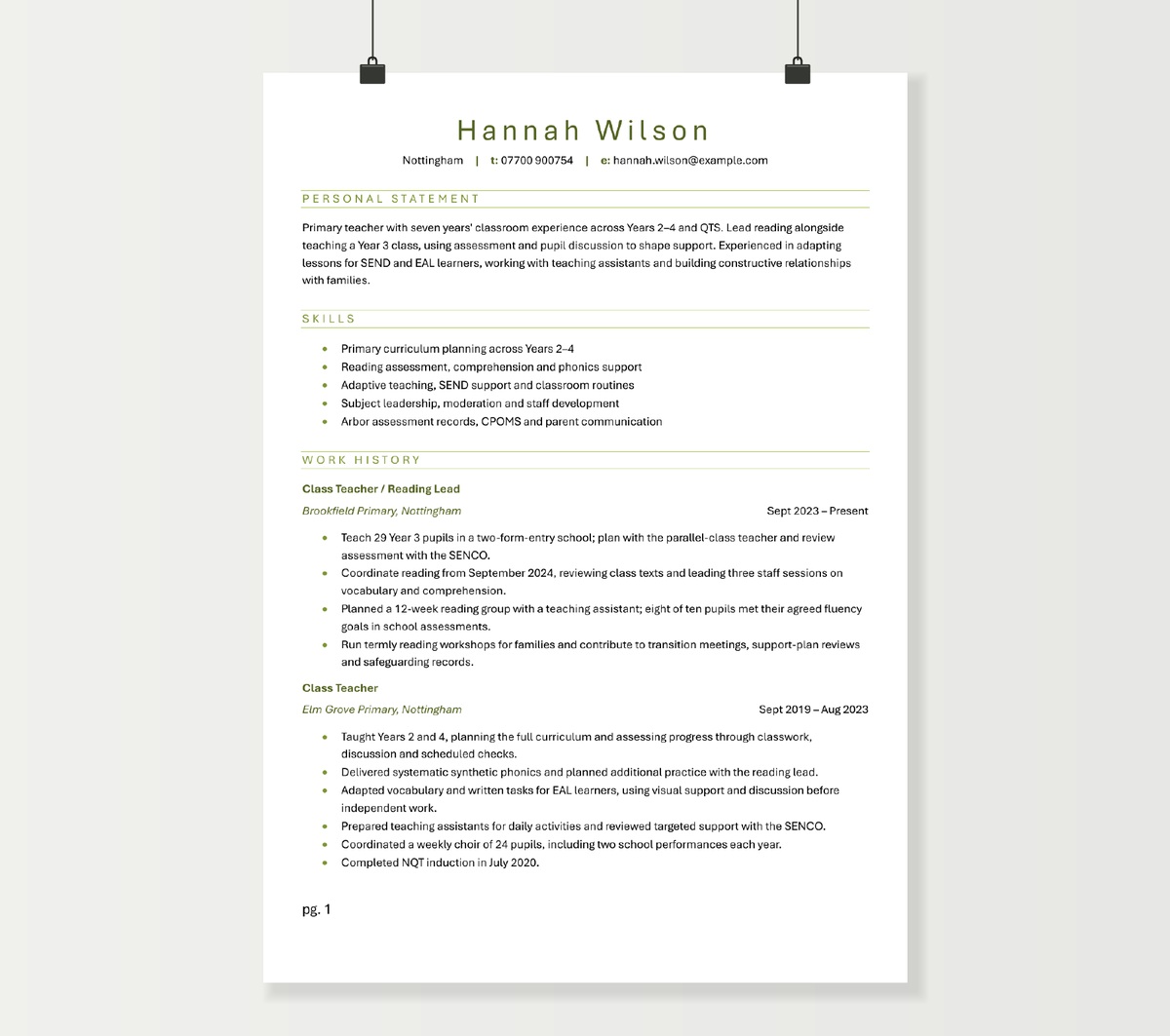
This primary school teacher CV template follows a qualified teacher with experience in Years 2–4 and responsibility for reading. The Word example brings together classroom practice, pupil progress, subject leadership and professional development. The guide also covers early years, supply work and first teaching posts, including how to use your CV evidence when a school requires an application form.
Filename: FreeCVDownload_Primary_School_Teacher.docx
Content of this CV template
Hannah Wilson
Nottingham | t: 07700 900754 | e: [email protected]
Personal statement
Primary teacher with seven years' classroom experience across Years 2–4 and QTS. Lead reading alongside teaching a Year 3 class, using assessment and pupil discussion to shape support. Experienced in adapting lessons for SEND and EAL learners, working with teaching assistants and building constructive relationships with families.
Skills
- Primary curriculum planning across Years 2–4
- Reading assessment, comprehension and phonics support
- Adaptive teaching, SEND support and classroom routines
- Subject leadership, moderation and staff development
- Arbor assessment records, CPOMS and parent communication
Work history
Class Teacher / Reading Lead
Brookfield Primary, Nottingham
Sept 2023 – Present
- Teach 29 Year 3 pupils in a two-form-entry school; plan with the parallel-class teacher and review assessment with the SENCO.
- Coordinate reading from September 2024, reviewing class texts and leading three staff sessions on vocabulary and comprehension.
- Planned a 12-week reading group with a teaching assistant; eight of ten pupils met their agreed fluency goals in school assessments.
- Run termly reading workshops for families and contribute to transition meetings, support-plan reviews and safeguarding records.
Class Teacher
Elm Grove Primary, Nottingham
Sept 2019 – Aug 2023
- Taught Years 2 and 4, planning the full curriculum and assessing progress through classwork, discussion and scheduled checks.
- Delivered systematic synthetic phonics and planned additional practice with the reading lead.
- Adapted vocabulary and written tasks for EAL learners, using visual support and discussion before independent work.
- Prepared teaching assistants for daily activities and reviewed targeted support with the SENCO.
- Coordinated a weekly choir of 24 pupils, including two school performances each year.
- Completed NQT induction in July 2020.
Trainee Primary Teacher
Nottingham Trent University
Sept 2018 – July 2019
- Completed PGCE placements in Year 1 and Year 4 classrooms.
- Taught English, maths and foundation subjects, reviewing lessons with my mentor.
- Assessed pupil work and adjusted subsequent lessons with the class teacher.
- Contributed to parents' evenings and end-of-term assessments.
Qualifications
PGCE Primary / QTS
Nottingham Trent University
2019
- PGCE Primary Education; QTS awarded 2019.
- BA (Hons) English, 2:1 — University of Leicester, 2018.
- Safeguarding update — September 2026; adaptive teaching CPD — 2025.
Reading development
School and local teaching hub
2024 – 2026
- Reading fluency and comprehension CPD; moderation and subject-lead network meetings.
Hobbies and interests
- Music: Singing in a community choir.
- Walking: Weekend walks in the Peak District.
- Art: Watercolour painting.
Additional information
Full UK driving licence; based in Nottingham.
How to write a primary school teacher CV
A primary teaching CV should help a headteacher picture the contribution you could make to a class and to the wider school. Your year groups, curriculum experience and teaching qualification establish the starting point. The most useful detail then explains how you assess learning, respond to pupils’ needs and work with the adults around them.
That evidence changes with the post. A Reception vacancy needs a different emphasis from a Year 6 class, and a subject-lead responsibility calls for more than a list of subjects you have taught. Build your CV around the classroom and responsibilities in the vacancy, drawing on the most relevant parts of your experience.
Use your CV alongside the school’s application process
A teaching CV is useful for agency registration, an initial professional introduction and vacancies that request one. Many schools use an application form and supporting statement instead. In England, Keeping children safe in education says a CV should accompany an application form rather than stand alone. Follow the school’s stated submission format.
You can still use the CV as a well-organised record of your strongest evidence. Its employment entries provide the dates and teaching responsibilities; its selected achievements can become fuller examples in the supporting statement. An application form may ask for a complete history from leaving school, reasons for gaps and referee details. Keep that fuller record available, even when a concise CV gives more space to recent teaching.
For the statement, expand the examples that address the person specification. A short CV bullet about adapting a reading group might become a paragraph explaining the learning need, your contribution and what the assessment showed. This gives the two documents different jobs while keeping the underlying account consistent.
Make your phase, year groups and qualification easy to find
Open with the information that helps the school place your experience: qualified status, years or phases taught, current responsibility and one or two relevant strengths. “Primary teacher with experience in Years 2–4 and responsibility for reading” is more informative than a paragraph about being passionate, dedicated and hardworking.
Be specific about the experience behind a broad phase label. Teaching a Year 2 class for two years, covering PPA across Key Stage 2 and completing a six-week Reception placement each offer useful evidence, but they tell different stories. Identify the year group and type of responsibility where you describe each post or placement.
Keep your training award and professional status visible. A PGCE, BEd or other teaching qualification belongs with its institution and award date; QTS can be stated alongside it. If you are completing training, give the expected completion date and intended age range. Early career teachers can add their induction stage, while experienced teachers usually need only a short completion line.
Use the terminology relevant to the school system. The example here is based in England. For Scottish posts, show your GTC Scotland registration category and status; for maintained-school posts in Wales, your QTS and EWC school-teacher registration; for grant-aided schools in Northern Ireland, your GTCNI registration. If moving between systems, name the curriculum and age groups you have taught and your position in the relevant recognition or registration process. This makes your background easier to assess without turning the CV into an explanation of national qualification rules.
Build employment entries around the class you actually taught
Give the school, role and month-and-year dates, followed by a brief description of your teaching context. Class size, a mixed-age class, two-form entry, a specialist provision or a part-time timetable can all clarify the work. Choose context that affects the responsibilities you describe.
Then select evidence across the main parts of the role. A recent class-teacher entry might cover curriculum planning, assessment, adaptation for learners, work with teaching assistants and a contribution beyond your own class. Older entries can be shorter, particularly where they repeat responsibilities already established in your current post.
Explain the work beneath phrases such as “delivered the curriculum” or “supported all learners”. You might have planned a sequence across history and writing, reviewed misconceptions with your parallel-class colleague, or adapted reading materials following assessment. A concise account of the responsibility and its purpose gives the reader something to discuss at interview.
- EYFS: give evidence of Reception or Nursery teaching, observations that informed next steps, communication and language, continuous provision and transition into school.
- Key Stage 1: show early reading and phonics, writing and mathematical foundations, together with experience supporting the move from Reception into more structured classroom learning.
- Key Stage 2: bring out curriculum breadth, subject knowledge, reading comprehension, developing independence and the assessment responsibilities of the year groups you have taught.
Named schemes are useful when they show relevant experience. Place a phonics programme beside the teaching you delivered, or a maths approach beside the planning and assessment you used. The point is to demonstrate experience the school can build on, rather than fill a skills section with publishers’ names.
Choose pupil-progress evidence that a reader can interpret
Primary teaching achievements need context. A result becomes much more useful when the reader knows the group, period and assessment basis. In the example CV, eight of ten pupils met agreed fluency goals after a 12-week reading group. That is a small, understandable outcome connected to a defined piece of work.
For class or year-group results, identify the academic year and measure. A phonics screening result, a moderated writing judgement and a school reading assessment are different kinds of evidence. Include the relevant starting point if it helps explain progress, and distinguish a change within one cohort from a comparison between successive classes.
The teaching contribution matters as much as the number. Pair the result with the action: reviewing assessment, changing the sequence of work, coordinating additional practice or working with the SENCO and support staff. When a result involved several adults, naming that collaboration helps the school understand how you work.
Strong evidence also exists outside headline attainment figures. A moderation process that helped colleagues agree judgements, a transition programme that settled pupils into their new class, a reading workshop families used, or curriculum resources adopted across a phase can all merit space. Describe the completed work and the practical effect. This is especially useful for newer teachers, supply staff and those whose contribution is not captured by an end-of-key-stage result.
Keep the scale proportionate to the role. Class-level evidence supports a class-teacher application; phase or school-wide evidence becomes more significant when applying for additional leadership responsibility. Two well-explained examples usually tell the reader more than a separate results table with little explanation.
Show inclusion through your work with pupils and adults
SEND, EAL and adaptive teaching are substantial parts of primary practice. Give a concrete example of how you contributed: adapting vocabulary and task presentation, reviewing a support plan, preparing resources with a teaching assistant, or working with the SENCO on a pupil’s access to the curriculum. Explain the learning purpose and how you reviewed whether the support helped.
Where relevant, describe your experience contributing to reviews or working with speech and language therapists, educational psychologists or other specialists. Focus on your teaching responsibility and collaboration. A CV can convey the nature of the work using class or group context, without needing a detailed individual case history.
Classroom relationships also deserve evidence. Calm routines, constructive communication with families and consistent work with colleagues are stronger when linked to something you organised or sustained. For example, a shared handover with support staff or planned transition meetings shows the practice behind “excellent communication”.
Safeguarding can be presented through current training and your routine responsibilities for recording and reporting concerns. If you have an additional designated role, identify it separately with the relevant training. Ordinary classroom responsibility and a specialist safeguarding appointment carry different expectations.
Include school systems where they help explain your experience. Arbor or SIMS might support assessment or attendance records; CPOMS might support safeguarding recording; Tapestry may be relevant to early-years observations. Connect the name to its use. A short, relevant line is enough unless the vacancy includes responsibility for developing colleagues’ use of a system.
Give subject leadership its own evidence
A subject-lead title should be followed by what you took responsibility for and what colleagues or pupils gained. Useful evidence includes reviewing curriculum progression, organising resources, running staff development, moderating work, responding to pupil voice or evaluating an agreed improvement priority.
Separate the start of the leadership responsibility from the start of your employment when they differ. “Class teacher, September 2023–present; reading lead from September 2024” makes the progression clear. If you held a temporary or shared responsibility, label that arrangement and describe your part.
For a phase-lead opportunity, the CV needs evidence of supporting other adults as well as strong classroom teaching. Show how you coached a colleague, coordinated planning, reviewed practice across classes or worked with senior leaders on a priority. Include the size of the team where it helps explain your scope.
Professional development belongs here when there is a clear application. Name a relevant course or network and the work it informed, rather than reproducing every training session attended. An NPQ or other substantial qualification can sit in education with its completed or expected date; shorter updates can be grouped in a compact development section.
Wider-school activities can demonstrate another kind of contribution. A choir, sports club, residential visit or family event is useful when you show responsibility, regularity and participation. A sustained club with a clear purpose usually deserves more space than a list of occasional events.
Adapt the evidence for your career stage
For a first teaching post, place your qualification, expected QTS date and placements near the top. Give each substantial placement a school, dates, year group and a few examples of teaching and assessment. Show how your responsibility developed and how you used mentor feedback. Experience as a teaching assistant, tutor or youth volunteer can add context, with the teaching placements remaining easy to identify. The teaching assistant CV example can help you present an earlier support role distinctly.
For an established teacher, prioritise recent classes, responsibilities and outcomes. Earlier training placements can be reduced or omitted as your qualified teaching history grows. Make progression visible through changes of year group, subject leadership, mentoring or a wider responsibility, including progression within the same school.
For supply work, group short day-to-day assignments under the agency and date range, with the phases covered and the responsibilities involved. Give a sustained placement its own detail when you planned, assessed, wrote reports or worked with parents over a term. Label maternity cover or another fixed-term appointment so the reader understands why the assignment ended. Reliability is best supported by repeat bookings, extended placements or specific continuity responsibilities.
For a move into another phase, bring the most relevant experience forward: a previous year group, PPA teaching, transition work, a placement or recent development. Explain the connection through examples. The CV should make it easy to see both the experience you already bring and the direction of your next step.
Before choosing a different layout, check that the teaching evidence still has room to breathe: year groups, dates, professional status and recent responsibilities should remain easy to scan. You can compare the available designs in the CV template library.
Primary School Teacher CV FAQs
State your qualified status clearly. You can provide the teacher reference number in the recruitment form or secure agency registration process when requested; it does not usually add value to the teaching evidence on a CV circulated more widely. Keep qualification and induction details ready so the school can complete its checks.
Add the working pattern beside the role, such as 0.6 FTE or three days a week. Explain how responsibilities were shared: curriculum areas, planning, assessment, parent communication and handovers. This helps a school understand your contribution to the class and can be particularly useful when applying for another job-share arrangement.
It can help when the school invites supporting material or your work includes a distinctive resource or curriculum project. A small selection of your own planning, resources and reflective notes is more useful than a large collection of lesson files. Keep pupil material anonymised and use only material you have permission to share. A link is optional: the CV itself should still give a clear account of your teaching.
Give the break a dated entry and a brief description, then bring forward recent evidence of readiness: school experience, relevant training, tutoring or renewed familiarity with the curriculum and assessment. Keep your earlier year-group responsibilities visible. A short profile can connect that established experience with the phase and working pattern you are now seeking.
Name the combination in the role description, for example a Year 3/4 class, with the class size if helpful. Use a bullet to explain your responsibility for curriculum coverage, planning across year-group expectations and assessing different starting points. This is especially relevant to small or rural schools, where the organisation of the class is an important part of the job.




