
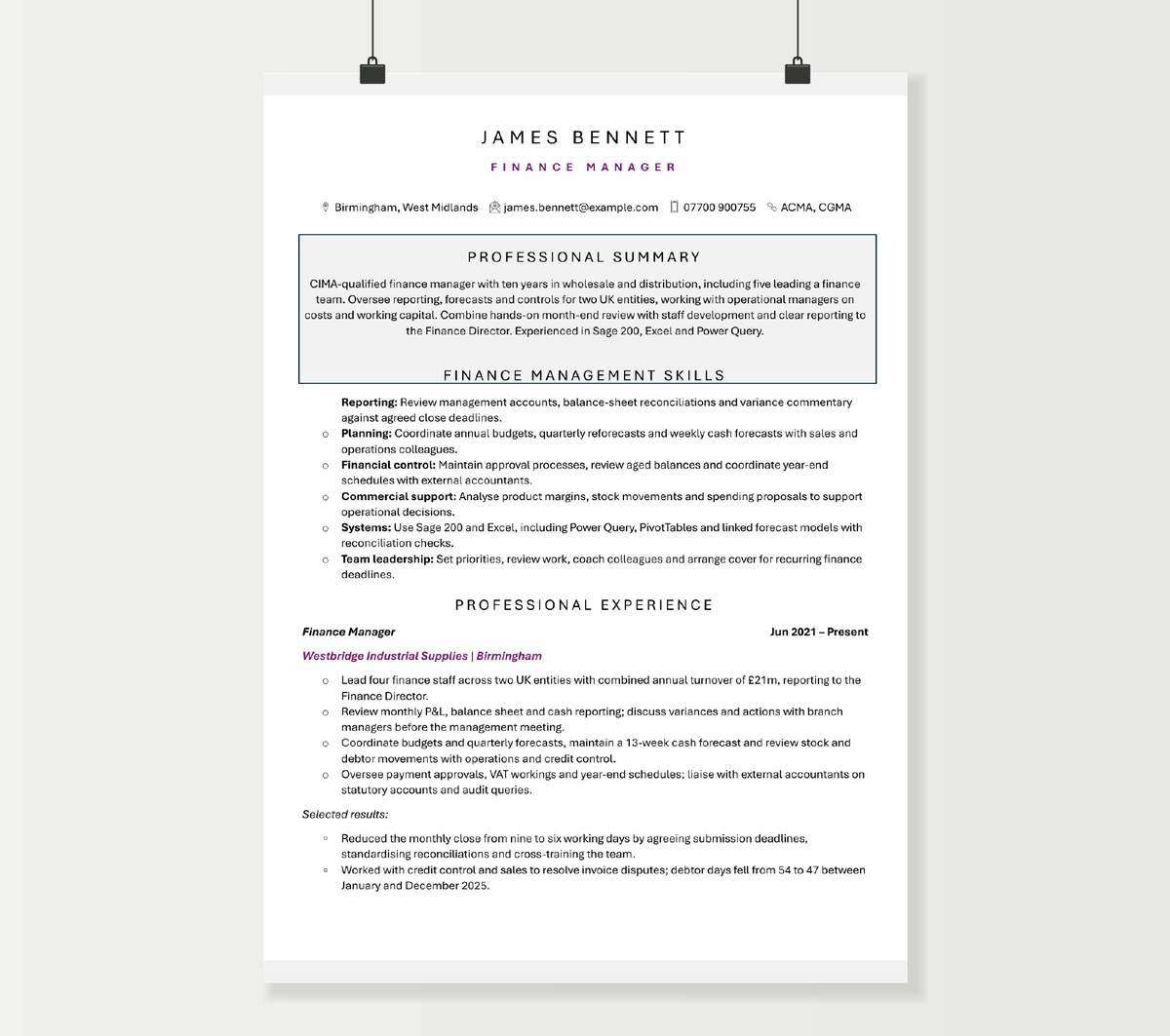
This finance manager CV template follows a CIMA-qualified accountant who now leads a small finance team in a distribution business. The Word example combines reporting and control responsibilities with cash-flow planning, commercial support and practical improvements. The guide covers finance management in different organisations and explains how to develop the evidence for a finance director application.
Filename: FreeCVDownload_Finance_Manager.docx
Content of this CV template
James Bennett
FINANCE MANAGER
Birmingham, West Midlands | [email protected] | 07700 900755 | ACMA, CGMA
Professional summary
CIMA-qualified finance manager with ten years in wholesale and distribution, including five leading a finance team. Oversee reporting, forecasts and controls for two UK entities, working with operational managers on costs and working capital. Combine hands-on month-end review with staff development and clear reporting to the Finance Director. Experienced in Sage 200, Excel and Power Query.
Finance management skills
- Reporting: Review management accounts, balance-sheet reconciliations and variance commentary against agreed close deadlines.
- Planning: Coordinate annual budgets, quarterly reforecasts and weekly cash forecasts with sales and operations colleagues.
- Financial control: Maintain approval processes, review aged balances and coordinate year-end schedules with external accountants.
- Commercial support: Analyse product margins, stock movements and spending proposals to support operational decisions.
- Systems: Use Sage 200 and Excel, including Power Query, PivotTables and linked forecast models with reconciliation checks.
- Team leadership: Set priorities, review work, coach colleagues and arrange cover for recurring finance deadlines.
Professional experience
Finance Manager | Jun 2021 – Present
Westbridge Industrial Supplies | Birmingham
- Lead four finance staff across two UK entities with combined annual turnover of £21m, reporting to the Finance Director.
- Review monthly P&L, balance sheet and cash reporting; discuss variances and actions with branch managers before the management meeting.
- Coordinate budgets and quarterly forecasts, maintain a 13-week cash forecast and review stock and debtor movements with operations and credit control.
- Oversee payment approvals, VAT workings and year-end schedules; liaise with external accountants on statutory accounts and audit queries.
Selected results:
- Reduced the monthly close from nine to six working days by agreeing submission deadlines, standardising reconciliations and cross-training the team.
- Worked with credit control and sales to resolve invoice disputes; debtor days fell from 54 to 47 between January and December 2025.
Management Accountant | Sep 2016 – May 2021
Oakwell Trade Products | Coventry
- Joined as Assistant Accountant in 2016 and progressed to Management Accountant in 2019 while completing CIMA training.
- Prepared management accounts for three branches, including accruals, prepayments, stock adjustments and balance-sheet reconciliations.
- Discussed gross-margin and overhead movements with branch managers and prepared supporting analysis for the Financial Controller.
- Supported annual budgets, VAT workings and year-end audit requests; maintained fixed-asset records and monthly depreciation schedules.
Selected contributions:
- Built a checked Power Query report combining branch sales extracts; reduced monthly report preparation from three hours to one.
- Documented stock-reconciliation steps and trained two accounts assistants, enabling consistent cover during month-end leave.
Qualifications & development
CIMA membership: ACMA, CGMA – admitted 2019
BSc (Hons) Accounting and Finance, 2:1 – Aston University, 2016
Financial reporting and FRS 102 updates – professional CPD, 2025–2026
Coaching and performance management – employer training, 2024
Additional information
- Business reviews: Present monthly performance commentary and follow up agreed cost and working-capital actions with branch managers.
- Professional development: Maintain CPD in financial reporting, finance systems and supporting colleagues through qualification study.
- Interests: Cycling, cooking and watching county cricket.
How to write a finance manager CV
A finance manager CV needs to show that you can keep the finance function dependable and make its work useful to the business. Accurate accounts and effective controls establish confidence. Forecasts, commercial analysis and the way you lead colleagues show what the organisation can do with that information.
The title covers very different jobs. You might be the principal finance person in a small company, manage part of a large group or lead a team serving several sites. Put that context near the start, then choose evidence that matches the responsibilities of the vacancy. The same approach helps when moving towards a finance director role, although the balance of evidence will change.
Establish the scale and boundaries of your responsibility
Give each recent employer a short context line. Useful details include the type of business, approximate turnover or expenditure, number of entities or sites, team size and reporting line. Select the measures that explain the complexity of your role. Turnover alone says little about a group with several currencies, a charity with restricted funding or a business with a large stock holding.
The example CV identifies two UK entities, £21m combined turnover, four finance staff and a Finance Director reporting line. That gives the reader a framework for the responsibilities that follow. For a group role, explain whether you cover one division, particular cost lines or consolidated reporting. For a standalone post, show which activities you handle internally and where external accountants or other specialists contribute.
Distinguish preparing, reviewing and owning a process through the verbs you choose. Preparing the audit schedules, coordinating the audit timetable and leading the relationship with the audit partner each demonstrate different experience. This clarity makes your CV easier to assess against the level of the vacancy.
Your opening profile can then be brief and informative: qualification, sector experience, present scope and a relevant strength. A description such as “CIMA-qualified finance manager leading reporting and planning for a two-entity distribution business” creates a clearer picture than several lines of broad claims about strategic thinking.
Connect reporting and controls to a dependable finance function
Show what you deliver at month-end, how you review it and who uses it. A recent role might include management accounts, balance-sheet reviews, variance commentary and a close timetable. Add the reporting frequency or deadline where it is significant. If you improved the close, explain what changed in the process and how much earlier the information became available.
Balance-sheet responsibility deserves attention alongside the P&L. Examples might include reviewing reconciliations, resolving aged items, improving stock or fixed-asset records, or establishing consistent evidence for review. Choose the areas that matter to the employer’s business rather than listing every account code you have handled.
For controls, describe the improvement or responsibility in practical terms. An approval matrix, a better month-end handover, clearer ownership of reconciliations or a documented review of supplier changes tells the reader more than “ensured robust financial controls”. Explain the scale of the work and the effect on accuracy, review or continuity.
Place statutory reporting, audit and tax work at the right level. Name the reporting framework where it is relevant to the vacancy, and describe the work you performed under it. For example, preparing schedules for statutory accounts is distinct from drafting the accounts or reviewing a consolidation. VAT and payroll can be useful experience in a broad finance-manager role, while a larger organisation may place those activities with specialist teams.
A sector move benefits from this detail. Charity funding and SORP experience, property entities and consolidations, manufacturing stock and costing, or recurring-revenue reporting may each matter to a particular employer. Your CV should make the relevant experience visible without becoming an accounting-policy manual.
Show how planning and cash information changed a decision
“Responsible for budgets and forecasts” establishes a duty but leaves the interesting questions unanswered. State the planning cycle, the parts of the organisation involved and your contribution. You may have coordinated budget holders, challenged assumptions, maintained a cash model, consolidated submissions or presented the likely outturn to the leadership team.
Then add a decision that your work supported. Useful examples include a recruitment plan revised after a workload forecast, a stock purchase phased around cash availability, a branch cost reviewed with its manager or a pricing proposal assessed against margin and delivery assumptions. Explain the analysis, the discussion and the action in a compact sequence.
Cash and working capital should have their own evidence where they are part of your remit. Give the forecast horizon and the people you work with. A 13-week cash forecast used for payment and collection planning is different from a long-range model supporting investment. Debtor days, overdue balances, stock levels and forecast reliability can be relevant measures, provided the period and basis are clear.
For business partnering, identify the people and the issue. “Met branch managers monthly to review margin and agree cost actions” shows a recurring working relationship. A stronger achievement can add the specific action that followed. The reader is looking for your ability to explain financial information, challenge constructively and keep the agreed response moving.
Investment or business-case experience is worth including when you can describe the decision you helped evaluate. State the project type, your modelling responsibility and the stage reached. A recommendation approved for implementation, a proposal revised after sensitivity analysis and a completed project reviewed against its original case are all useful outcomes.
Choose finance achievements with a clear measurement basis
Finance offers plenty of numbers; the challenge is selecting ones that communicate your contribution. Combine an outcome with the process or decision behind it. In the example CV, the close moved from nine to six working days through agreed submissions, standardised reconciliations and team cover. The number and the explanation strengthen each other.
- Reporting: close time, reporting preparation time, reconciliations completed by deadline or a reduction in recurring review queries.
- Cash: collection performance, aged debt resolved, stock released or improved visibility of a funding requirement.
- Commercial work: a realised cost reduction, margin improvement, investment decision or a change to a forecast following operational input.
- People and processes: cover established for key tasks, colleagues developed into broader roles, systems adopted or a backlog brought under control.
Make the financial meaning clear. A cost saving, an avoided future cost, cash released from working capital and additional revenue are different outcomes. Use the measure that reflects the work. If the result is annualised, forecast or realised over a particular period, that short label helps the reader interpret it.
A percentage is stronger with a baseline or scope. “Debtor days fell from 54 to 47 during 2025” is readily understandable. For a large reduction in overdue debt, give the period and say whether it concerns the whole ledger or a defined set of accounts. When sales, operations and credit control contributed, show how you worked with them.
You can also describe a worthwhile decision without attaching a savings figure. Establishing a usable forecast, resolving a long-standing reconciliation issue or giving managers a clearer view of product profitability may be an important result in its own right. Explain what became possible after the work was completed.
Describe how you lead the team and improve its work
Include the number and types of direct reports, then move beyond “managed a team”. Show how you set priorities, review outputs, coach colleagues, manage performance or prepare cover for deadlines. In a finance function, those details demonstrate how quality is maintained when workloads peak or someone is absent.
If your team includes trainees, describe the responsibilities you helped them take on. Supporting exam study is useful context; developing someone from transaction processing into reconciliations or management reporting gives a more concrete picture of progression. For a senior manager, succession planning and the development of other managers may be more relevant.
First-time management applicants can draw on workstream leadership, review responsibilities, mentoring and coordination across a close or budget cycle. Put this evidence where the recruiter can see it. A formal management title is one way to demonstrate leadership; a well-described responsibility can also show readiness for the next step.
Systems improvements belong with the business change they delivered. For an ERP implementation, identify your contribution to requirements, finance data, testing, reconciliations, training or the first close after launch. A short account of the stage you owned is more useful than a general “implemented ERP” claim.
List the systems relevant to your work, with enough detail to distinguish their use. Sage 200, Business Central, SAP, Oracle, NetSuite or Xero may be central to the role; Excel might support modelling and reporting; Power Query or Power BI might improve data preparation and presentation. Connect important tools to a practical output and the checks or review around it. The CV is stronger when the system helps explain the work rather than becoming a separate catalogue.
Make qualifications and progression straightforward
Put the qualification or membership sought by the employer where it can be found quickly. State the body and status, with the completion or admission year where useful. For study in progress, give the current stage and an expected completion date if you have one. This is more informative than a bare “part-qualified” label.
If you are qualified by experience, lead with the scope and depth of that experience: the accounts and controls you own, the organisations you have supported and the decisions you help make. Some employers welcome that route and others specify a professional qualification, so use the vacancy’s requirements to judge the fit.
Show promotions within an employer clearly. You can group the organisation once and give successive titles and dates, or explain the progression in the opening line when the earlier stage is brief. The example follows a move from Assistant Accountant to Management Accountant before a Finance Manager appointment. Earlier transactional experience can be concise; the accounts assistant example shows how that foundation can be described.
Choose development that supports the role you want. Relevant reporting updates, leadership development or a substantial systems project can help. A long training list is less useful than a few current topics and evidence of how you applied them.
Develop the CV for a finance director application
A finance director CV needs to show how you contribute to the organisation’s direction as well as the performance of finance. Bring forward decisions about growth, funding, investment, risk, pricing or the operating model. Explain the organisation’s context and the authority you held within it.
The reporting relationship matters. A divisional director working with a group CFO may own commercial planning while shared services deliver transactions and statutory reporting. A director in a smaller organisation may combine strategy with direct oversight of the ledger, cash and external advisers. Describe that arrangement so the reader understands the role behind the title.
Board exposure becomes useful evidence when you say what you brought to the discussion and what happened next. Preparing a board pack, presenting a proposal and holding an executive responsibility are distinct contributions. Name the subject, such as a funding plan or new service model, and the decision or follow-up you supported.
Include financing, acquisitions, restructuring or investor relations when they are part of your experience and relevant to the opportunity. Explain your role and the stage reached: evaluating an option, supporting due diligence, negotiating terms or integrating reporting after completion. A director application does not need every possible transaction type; it needs a coherent account of the leadership you can bring to this organisation.
As seniority increases, compress routine earlier responsibilities and give more room to the most significant decisions, relationships and changes you led. Keep enough technical evidence to establish the foundation beneath that leadership. You can compare alternative layouts in the CV template library while retaining this balance.
Finance Manager CV FAQs
Label it as interim or fixed term beside the title and give the dates. Add the mandate, such as covering a vacancy, stabilising month-end or supporting a system change, then the work completed during the assignment. If you have several short contracts, a separate interim-experience section can make the pattern easy to follow while keeping each client's sector and scope visible.
Use a level of detail you are authorised to share: approximate business scale, a percentage movement, a time reduction or a description of the decision supported. You can often explain your responsibility for a project without naming the counterparty or disclosing a proposed transaction. Publicly available company figures may help establish context, with your own remit described separately.
Give both their appropriate weight. The employer needs to know you can keep day-to-day accounting moving, coordinate external support and provide useful information to management. State the operational scope briefly, then use selected examples to show planning, cash visibility, control improvements and decisions you supported. The balance should follow the responsibilities in the vacancy.
For a portfolio or fractional role, give the overall date range and describe the client mix, typical size and services you provide. Select a few engagements that demonstrate different responsibilities, such as establishing a forecast or preparing management reporting for a growing business. Make the concurrent nature of the work clear so the dates do not read as overlapping full-time jobs.
It depends on which parts of the vacancy are sector-specific. Identify the transferable complexity in your work, such as stock, project margins, multiple entities or restricted funding, and connect it to the new employer's needs. Where the role asks for a particular reporting framework or funding model, give that experience its own evidence if you have it. A clear comparison is more useful than simply describing yourself as adaptable.
Yes, when it adds relevant evidence of reporting, budgeting, governance or communication with non-finance colleagues. Place it in a separate voluntary or board-experience section, identify the organisation's purpose and describe your responsibilities. Keep it proportionate to the application, particularly if it complements rather than replaces your employed finance leadership experience.




