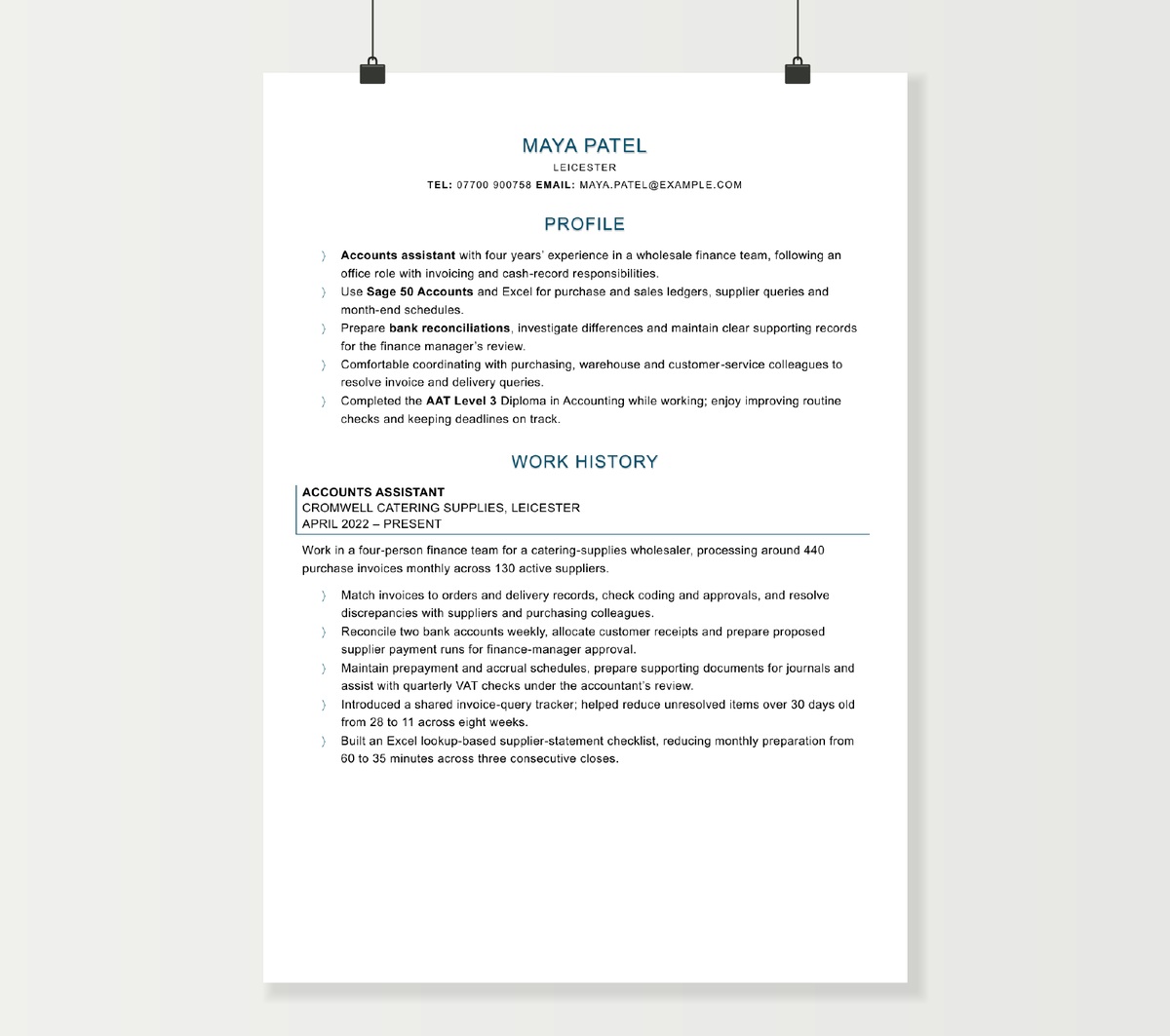
This accounts assistant CV template shows a candidate who progressed from office and finance administration into a broader accounts role. The Word example covers purchase and sales ledgers, bank reconciliations, supplier queries and month-end support. The guide explains how to present the scope of your work, accounting systems and qualifications for an in-house finance team or accountancy practice.
Filename: FreeCVDownload_Accounts_Assistant.docx
Content of this CV template
MAYA PATEL
LEICESTER
tel: 07700 900758 email: [email protected]
PROFILE
- Accounts assistant with four years’ experience in a wholesale finance team, following an office role with invoicing and cash-record responsibilities.
- Use Sage 50 Accounts and Excel for purchase and sales ledgers, supplier queries and month-end schedules.
- Prepare bank reconciliations, investigate differences and maintain clear supporting records for the finance manager’s review.
- Comfortable coordinating with purchasing, warehouse and customer-service colleagues to resolve invoice and delivery queries.
- Completed the AAT Level 3 Diploma in Accounting while working; enjoy improving routine checks and keeping deadlines on track.
WORK HISTORY
ACCOUNTS ASSISTANT
CROMWELL CATERING SUPPLIES, LEICESTER
APRIL 2022 – PRESENT
Work in a four-person finance team for a catering-supplies wholesaler, processing around 440 purchase invoices monthly across 130 active suppliers.
- Match invoices to orders and delivery records, check coding and approvals, and resolve discrepancies with suppliers and purchasing colleagues.
- Reconcile two bank accounts weekly, allocate customer receipts and prepare proposed supplier payment runs for finance-manager approval.
- Maintain prepayment and accrual schedules, prepare supporting documents for journals and assist with quarterly VAT checks under the accountant’s review.
- Introduced a shared invoice-query tracker; helped reduce unresolved items over 30 days old from 28 to 11 across eight weeks.
- Built an Excel lookup-based supplier-statement checklist, reducing monthly preparation from 60 to 35 minutes across three consecutive closes.
OFFICE & FINANCE ADMINISTRATOR
OAKFIELD MAINTENANCE, LEICESTER
SEPTEMBER 2019 – MARCH 2022
Supported a local maintenance contractor with customer bookings, invoice administration and records for the external bookkeeper.
- Raised approximately 90 sales invoices monthly from approved job sheets, checked purchase-invoice details and maintained electronic supporting records.
- Recorded receipts, prepared weekly bank-document packs and followed up overdue invoices with customers using agreed reminders.
- Reconciled petty cash and collected missing expense receipts; answered billing queries with the service coordinator.
- Standardised job-reference checks before invoicing, reducing missing-reference returns from 12 to four per month over the next quarter.
QUALIFICATIONS & DEVELOPMENT
AAT LEVEL 3 DIPLOMA IN ACCOUNTING
COMPLETED 2024
Completed alongside employment, with study in financial statements, management accounting and tax processes.
AAT LEVEL 2 CERTIFICATE IN ACCOUNTING
COMPLETED 2023
EXCEL FOR FINANCE WORKSHOP
PIVOTTABLES, XLOOKUP AND SUMIFS – 2025
OUTSIDE WORK
I enjoy badminton, baking and visiting museums with friends.
How to write an accounts assistant CV
An accounts assistant CV should make it easy to see which parts of the finance routine you can take on. The most useful detail is often practical: the ledgers you work with, the reconciliations you prepare, the queries you resolve and the deadlines you help the team meet.
The title can cover a varied role in a small business, a particular ledger in a larger team or bookkeeping for several practice clients. Start with that context. Then show the level of responsibility you have reached and the evidence most relevant to the vacancy.
Explain where your work sits in the finance team
Open each employment entry with a short description of the organisation and your remit. Team size, the number of entities or clients, and the main accounting system can help. “Accounts assistant in a four-person wholesale finance team, processing around 440 purchase invoices monthly” gives a reader a useful starting point.
Choose the duties that best match the application. A purchase-ledger vacancy needs detail on invoices, approvals, supplier statements and queries. A broader accounts role may also need sales invoicing, receipts, bank reconciliations and month-end schedules. If your role has grown, make the additional responsibilities visible rather than repeating the same general description throughout the CV.
Use verbs that explain the stage you handle. Preparing a payment proposal, uploading a payment file and authorising a payment are different responsibilities. So are preparing a reconciliation and reviewing one. Describing the handover or review point helps the employer understand your experience and how you work within the team.
The profile can draw these details together: your finance background, strongest processes, main systems and relevant study. It should give a clear direction to the application rather than trying to summarise every task you have performed.
Make ledger experience more informative than data entry
Purchase ledger and supplier accounts
Explain what happens around the invoice entry. Relevant work may include matching invoices to orders or receipt records, checking nominal codes, obtaining approvals, handling credit notes, reconciling supplier statements and preparing payment runs. Select the stages you regularly handle and the queries you resolve.
Give workload figures a clear period. Around 440 invoices a month is more useful than an isolated total, especially when accompanied by the number or type of suppliers. If invoices require project coding, multiple currencies or supporting documentation, that complexity may tell the reader more than a higher volume.
Supplier communication is part of the evidence. You might chase a missing credit note, resolve a delivery mismatch with purchasing colleagues or explain the status of an invoice. Describe the issue and your contribution so “good communication skills” has something concrete behind it.
Sales ledger and customer receipts
Show how you create or maintain the customer account. This could include raising invoices from approved records, allocating receipts, checking remittances, resolving billing queries or preparing an aged-debt report. For credit-control work, explain your stage of involvement, such as first reminders and query follow-up or responsibility for an assigned ledger.
Sector context can matter. A property role may involve tenant accounts and charges; a charity may involve donations or Gift Aid records; a service business may invoice against completed jobs. Name the relevant process and system so the reader can see what transfers to the new role.
Give reconciliations and month-end support their own evidence
Reconciliations show more when the CV explains the account, frequency and follow-up. “Prepared weekly reconciliations for two bank accounts and investigated unmatched receipts with customer services” gives a clearer picture than “bank reconciliations”. Supplier, credit-card, petty-cash and balance-sheet reconciliations can be presented in the same practical way.
Include how you dealt with differences when that was part of your role. You may have identified a duplicate entry, obtained missing information, corrected an allocation or prepared an item for the accountant’s review. The value lies in bringing records into a clear, explainable position.
For month-end work, identify the schedules or records you maintained. These might include prepayments, accruals, fixed assets, intercompany balances or supporting documents for journals. Explain whether you prepared calculations, posted approved journals, reconciled balances or supplied information to the person preparing the accounts.
A deadline can help establish responsibility. Completing assigned schedules by an agreed working day, clearing queries before a payment run or preparing records for an external bookkeeper all show how your work fits a wider timetable. Give the scope of your contribution alongside the deadline.
Audit and year-end support can also be useful. Describe the schedules, invoice samples or supporting records you assembled and how you handled follow-up questions. This demonstrates organised records and an understanding of what another person needs to review the work.
Connect accounting software and Excel to the tasks you perform
Name the systems you have used and add the relevant functions. Sage 50 Accounts, Xero, QuickBooks and larger finance systems appear in different environments; the employer needs to know what you did in them. Invoice processing, bank feeds, receipt allocation, reporting and ledger enquiries are more informative than a general claim of software proficiency.
If you are moving between systems, put the shared accounting processes beside the software experience. Someone who has reconciled accounts and investigated ledger queries in one package can make that experience understandable to an employer using another. Recent training in the target package can sit separately from workplace use.
Describe Excel through the finance work it supports. For example:
- Used XLOOKUP to match supplier-statement items against a ledger export and flag differences for investigation.
- Built PivotTable summaries of outstanding invoices for the finance manager’s weekly review.
- Used SUMIFS and structured tables to maintain a monthly expense or prepayment schedule.
- Used Power Query to combine regular exports before reconciliation, with checks on the resulting totals.
Select the examples that reflect your experience; an accounts assistant application does not need every advanced Excel feature. A clear explanation of a useful routine is easier to assess than “advanced Excel”, which can mean very different things to different readers.
Where you helped improve a spreadsheet or system process, explain the effect on the team. The example CV’s statement checklist reduced preparation time across three closes. That gives both the tool and the improvement a practical context.
Show accuracy through the way work is completed
Accuracy is central to accounts work, but repeating the word does little to distinguish an application. Describe the checks and records that make your work dependable: matching supporting documents, reconciling totals, following up exceptions and keeping an organised audit trail.
Useful achievements are often modest improvements to a recurring problem. You might reduce the number of old invoice queries, improve the completeness of expense records, clear an inherited reconciliation backlog or make supporting documents easier to retrieve. Explain what you changed and what improved.
A figure works best with a definition and a period. “Helped reduce invoice queries over 30 days old from 28 to 11 in eight weeks” tells the reader what was measured. It also describes a contribution to a shared result. Transaction volume can show scope, while the quality of the follow-up shows how you handled that workload.
Financial values can be useful when they communicate scale, such as the size of a ledger or a payment run. Pair them with your responsibility. Processing a large value of invoices and deciding how money is spent are different kinds of experience, and each can be described clearly.
If formal performance measures were not available, use an observable outcome. A schedule adopted by the team, a backlog brought up to date or a new colleague able to cover a routine after your handover can all provide worthwhile evidence.
Present AAT and other study precisely
Give the qualification’s full title, awarding body or institution, and completion year. An AAT level is more useful when the reader can see the particular award. Use the title shown on your certificate or current enrolment, especially when qualification names have changed.
For current study, state the programme and progress in plain terms: the units completed, stage reached or expected completion date where it is established. This helps an employer understand how study fits with the role and any support arrangements discussed later.
Keep qualifications, professional membership and software training distinct. Each can strengthen the application, but they tell the employer different things. A short Excel workshop belongs under development; a completed accounting qualification belongs under qualifications; membership can have its own concise line.
For an early-career applicant, relevant study can appear near the top. A short reference to a reconciliation assignment, bookkeeping exercise or financial-statements project can demonstrate applied learning. As workplace experience grows, the employment evidence can take priority and the education section can become shorter.
Experienced applicants without a formal accounting qualification can still lead with substantial practical evidence. Show the breadth of the accounts work, the systems, the review responsibilities and the results. Let the vacancy guide how prominently qualifications or current study need to appear.
Adjust the emphasis for practice, industry or a first finance role
Moving between an accountancy practice and an in-house team
Practice experience may involve several clients, different bookkeeping systems and deadlines for VAT or year-end records. Give the reader a sense of the client mix and the work you prepared for review. Include how you obtained missing information and kept several assignments moving.
In-house experience can show deeper involvement in one organisation’s processes: purchase orders, deliveries, customer billing, payment timetables and month-end routines. When moving into practice, draw attention to reconciliation skills, organised working papers and communication. When moving into industry, emphasise your ability to understand a business process and maintain its records consistently.
Specialist work deserves space when it fits the vacancy. Payroll support, construction-related records, property accounts or charity income may be useful distinctions. Explain the part you handled rather than letting a sector label stand in for the experience.
Starting from administration, retail or study
Choose earlier responsibilities with a clear connection to finance: checking invoices, recording receipts, reconciling cash, resolving billing queries or maintaining accurate spreadsheets. Explain the process and the level of responsibility, then place relevant accounting study alongside it.
The administrator CV example can help with presenting a broader office role where finance was one part of the job. For the accounts application, give the financial work enough detail to show the direction of your progression.
An apprenticeship or first accounts role does not require the same evidence as an experienced vacancy. Relevant coursework, part-time work and voluntary finance responsibilities can each show numeracy, organisation and communication. A concise description of a task completed carefully is more useful than a long profile of personal qualities.
Choose a layout from the CV template collection that makes your ledger experience, reconciliations, systems and study easy to find. The strongest balance is the one that helps the employer see what you can contribute to its particular finance team.
Accounts Assistant CV FAQs
The duties matter more than the label. Some finance assistant roles focus on income, grants or reporting support, while an accounts assistant role may cover purchase and sales ledgers. Compare the responsibilities and put the closest evidence first. Keep your actual employment titles and use a short role description to clarify the work.
Label each assignment as temporary or fixed term and show its dates. Explain the work you took over, the systems used and any handover or backlog you completed. Several short assignments through one agency can be grouped under the agency, with the most relevant placements described underneath.
Yes. Identify the organisation and describe the arrangement, such as part-time bookkeeping support or volunteer treasurer. Give the tasks, frequency, systems and any review by an accountant or committee. This lets the employer assess the practical experience in the same way as other relevant work.
That is useful payroll-support experience. Describe the information you collected or checked, the number of employees where relevant and the handover deadline. If you also checked the returned payroll report or handled queries, include that separately. This gives the employer a clear picture of the stage you supported.
List the qualification or units completed and their dates. If you later resume, add the current programme and progress. Completed learning remains useful evidence, and a short factual presentation lets the employer distinguish the qualifications already achieved from a future study plan.
Usually the CV can describe the spreadsheet, the checks it supported and the result without an attachment. If an employer asks for a sample or practical exercise, a small demonstration using dummy transactions can show formulas, reconciliation logic and a clear layout. Follow the requested format and keep the example focused on the task being assessed.