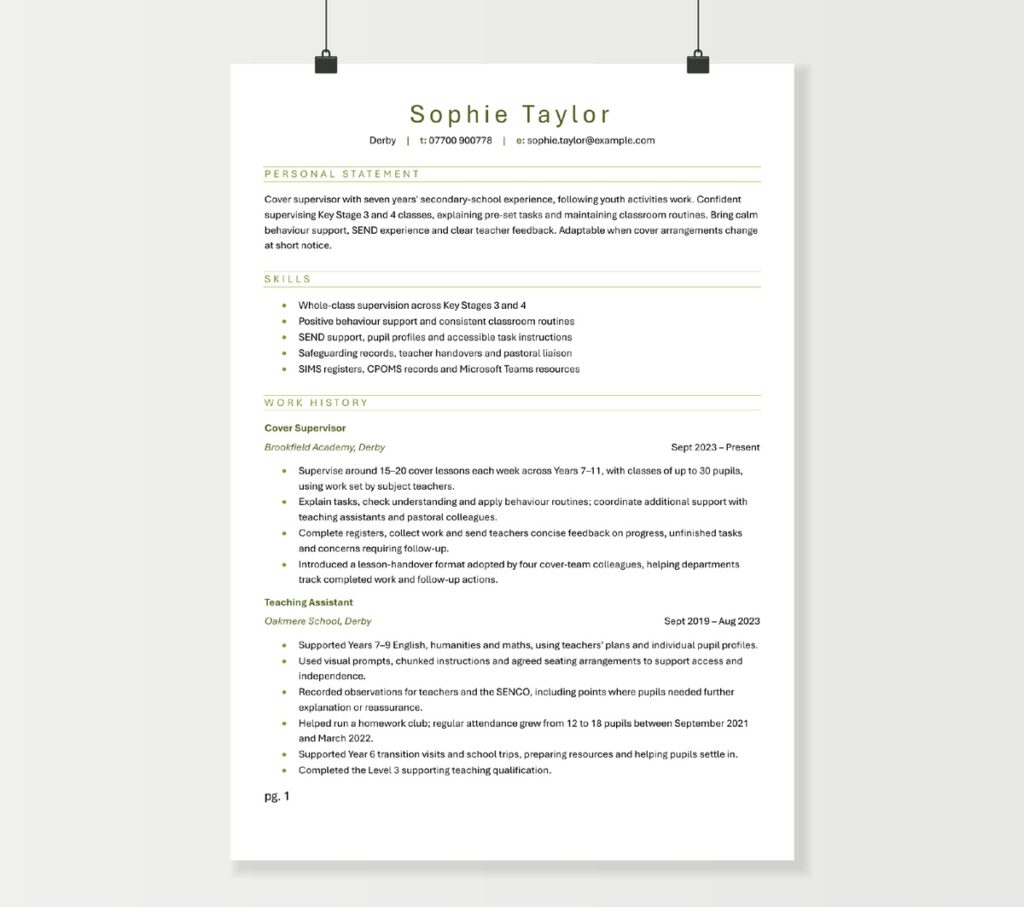
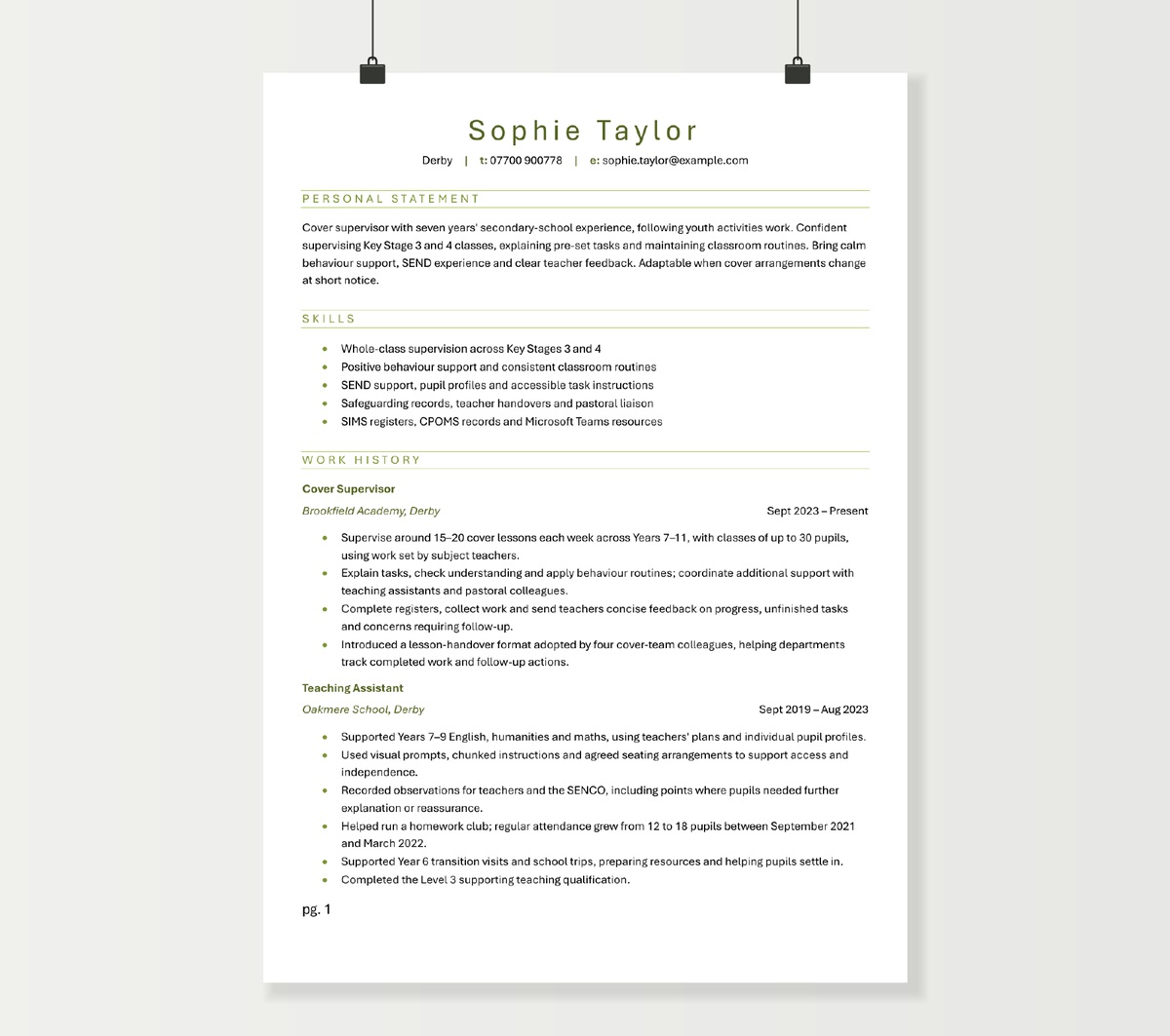
This cover supervisor CV template shows progression from youth activities and classroom support into whole-class cover in a secondary school. The Word example brings together behaviour support, pre-set lessons, safeguarding and practical communication with teachers. The guide helps you present this experience in a CV and organise evidence for school application forms.
Filename: FreeCVDownload_Cover_Supervisor.docx
Content of this CV template
Sophie Taylor
Derby | t: 07700 900778 | e: [email protected]
Personal statement
Cover supervisor with seven years' secondary-school experience, following youth activities work. Confident supervising Key Stage 3 and 4 classes, explaining pre-set tasks and maintaining classroom routines. Bring calm behaviour support, SEND experience and clear teacher feedback. Adaptable when cover arrangements change at short notice.
Skills
- Whole-class supervision across Key Stages 3 and 4
- Positive behaviour support and consistent classroom routines
- SEND support, pupil profiles and accessible task instructions
- Safeguarding records, teacher handovers and pastoral liaison
- SIMS registers, CPOMS records and Microsoft Teams resources
Work history
Cover Supervisor
Brookfield Academy, Derby
Sept 2023 – Present
- Supervise around 15–20 cover lessons each week across Years 7–11, with classes of up to 30 pupils, using work set by subject teachers.
- Explain tasks, check understanding and apply behaviour routines; coordinate additional support with teaching assistants and pastoral colleagues.
- Complete registers, collect work and send teachers concise feedback on progress, unfinished tasks and concerns requiring follow-up.
- Introduced a lesson-handover format adopted by four cover-team colleagues, helping departments track completed work and follow-up actions.
Teaching Assistant
Oakmere School, Derby
Sept 2019 – Aug 2023
- Supported Years 7–9 English, humanities and maths, using teachers' plans and individual pupil profiles.
- Used visual prompts, chunked instructions and agreed seating arrangements to support access and independence.
- Recorded observations for teachers and the SENCO, including points where pupils needed further explanation or reassurance.
- Helped run a homework club; regular attendance grew from 12 to 18 pupils between September 2021 and March 2022.
- Supported Year 6 transition visits and school trips, preparing resources and helping pupils settle in.
- Completed the Level 3 supporting teaching qualification.
Youth Activities Assistant
Derwent Youth Centre, Derby
Sept 2017 – Aug 2019
- Supported after-school sessions for young people aged 11–16.
- Prepared arts, games and sports activities with the youth leader.
- Maintained attendance records and helped new members settle in.
- Followed safeguarding procedures and passed concerns to the lead.
Qualifications
Level 3 Diploma in Supporting Teaching and Learning
NCFE CACHE
2021
- Completed alongside secondary-school classroom support work.
- 3 A levels: English Language, Sociology and Art — 2017.
- 9 GCSEs, including English and Maths at grade B — 2015.
School-based development
Employer training and staff briefings
2025 – 2026
- Annual safeguarding and Prevent updates; SEND-aware classroom practice, de-escalation and behaviour-policy training.
Hobbies and interests
- Swimming: Regular sessions at the local leisure centre.
- Art: Watercolour painting and gallery visits.
- Walking: Exploring the Peak District with friends.
Additional information
Enhanced DBS for the child workforce, issued 2023; subscribed to the Update Service. Full UK driving licence.
How to write a cover supervisor CV
A cover supervisor CV should show that you can step into an unfamiliar classroom, establish a purposeful atmosphere and help pupils work through the lesson their teacher has prepared. Schools need to understand how you work with groups, respond to changing cover arrangements and communicate what happened afterwards. Those details are more useful than a general statement that you enjoy working with children.
Your evidence may come from regular cover, teaching-assistant work, youth activities or another setting where you have supervised young people. The task is to make the connection to classroom responsibility clear, including the ages you have worked with, the size of the groups and the support available around you.
Make your classroom experience visible from the start
Use the profile to identify your relevant experience and the setting you know best. For an established cover supervisor, this might be Key Stage 3 and 4 cover across several subjects, behaviour support and communication with teaching staff. For a teaching assistant moving into cover, it could be small-group work, experience supporting classroom routines and opportunities to supervise a whole class.
Be specific about the pupils and setting. Mainstream secondary, specialist provision, alternative provision and post-16 work involve different routines and support needs. Year groups can be more immediately helpful than the total size of the school. A reader should quickly see whether your experience resembles the vacancy they are filling.
A profile such as “Teaching assistant with four years’ secondary-school experience, including planned cover for Year 7 and 8 groups” creates a clear starting point. The employment section can then show what that cover involved and how your responsibility developed.
Explain your responsibility for a covered lesson
Under each school or agency role, give the dates, setting and scope of the work. If useful, add a typical range of cover lessons per week and class sizes. The example CV uses 15–20 lessons across Years 7–11, which gives its responsibilities a practical scale.
Choose bullets that show the complete contribution, from receiving the work to returning a useful handover. Depending on your role, that could include:
- Checking the cover instructions and accessing the teacher’s materials before the lesson.
- Explaining the task, clarifying what pupils need to produce and checking that they can begin.
- Maintaining registers, established routines and a constructive working atmosphere.
- Working with teaching assistants or pastoral colleagues when additional support is needed.
- Collecting completed work and telling the teacher about unfinished tasks, difficulties and follow-up actions.
These are possible areas of evidence, not a checklist to copy into every application. Select the responsibilities that best show your readiness for the vacancy. A school seeking someone to organise cover as well as supervise classes will also need evidence of timetabling, allocation, resource preparation or communication with departments.
Describe pre-set work as pre-set work. It shows a valuable form of responsibility in its own right. If your role also includes planning interventions, assessing work or teaching within a defined arrangement, explain that additional remit separately so the reader understands the range of your experience.
Turn behaviour-management claims into useful evidence
“Excellent classroom management” is difficult to assess without an example. Describe the age group, the situation you regularly handled and how your approach supported learning. Evidence might involve applying consistent routines, using agreed pupil support strategies, helping a group settle after a disrupted start or working with pastoral staff on recurring concerns.
Keep the account focused on your professional contribution. For example: “Used agreed entry routines and seating plans with Year 8 cover groups, recording recurring concerns for the pastoral team and following up agreed actions.” This gives a school something concrete to discuss at interview.
Behaviour evidence can also show relationships and judgement. A cover supervisor who knows when to provide reassurance, when to use an established school response and when to call for support brings more than a confident manner. Describe those working relationships and the consistency of your approach, rather than trying to fit a full classroom incident into a CV bullet.
Show how you help different pupils access the work
SEND experience is most helpful when the CV explains the support you provided. Identify the setting and relevant needs, then describe practical contributions such as using pupil profiles, breaking instructions into manageable stages, preparing visual prompts or coordinating with a teaching assistant. Connect these to participation in the set activity.
For example, “Used visual prompts and chunked instructions from pupil support plans during mixed-ability Year 7 lessons” tells the reader more than “experienced with SEN”. If you worked closely with a SENCO, specialist teacher or learning-support team, show how you shared observations and used their guidance.
Special-school applications may need more detail about communication approaches, specialist equipment, personal support or training relevant to the pupils. Mainstream applications may benefit more from evidence of adapting explanations while keeping the whole class engaged. Let the actual setting determine which experience leads.
Applicants whose strongest evidence is individual or small-group support may find the teaching assistant CV example useful when deciding how to organise that experience alongside whole-class cover.
Give safeguarding and school systems practical context
A brief safeguarding statement becomes more convincing when connected to ordinary professional practice. You might describe recording concerns through the school system, passing information promptly to the designated safeguarding lead, following pupil collection arrangements or contributing to a safe transition between activities. The emphasis belongs on your role and established reporting route.
List relevant safeguarding and Prevent training with its provider or school and a recent date. For England-based applications, the current Keeping children safe in education guidance provides the national context; your CV can show how school training and procedures inform your work. A short, concrete account is enough here.
Digital systems should also be attached to tasks. SIMS or Arbor may be relevant to registers and pupil information; CPOMS to recording concerns; Teams or Google Classroom to accessing resources and set work. Name the systems you use and explain their purpose within your role. This is more useful than a broad “IT literate” claim.
Choose achievements that fit the cover supervisor’s contribution
Good results are often visible in continuity, organisation and engagement. A clearer handover format, a more usable bank of cover resources, smoother induction for a new colleague or better attendance at a club can all provide strong evidence. Explain what you changed and who benefited.
The example CV describes a handover format used by four colleagues and a homework club whose regular attendance increased from 12 to 18 pupils. These are bounded contributions that a school can understand. Neither requires a claim about a whole cohort’s examination performance.
Where you have feedback from a cover coordinator, teacher or line manager, use the substance of it. Repeated requests to return to a placement, responsibility for a more demanding timetable or being asked to help induct colleagues can demonstrate trust. Explain the responsibility itself rather than relying on a string of flattering adjectives.
Numbers are helpful for scale and change, but a strong qualitative example is equally useful. “Prepared a concise classroom-information pack used to induct three new cover colleagues” describes a worthwhile improvement even without a percentage attached to it.
Build the case from youth work, tutoring or classroom support
For a first cover-supervisor application, give relevant experience its own clear heading and dates, including regular voluntary work. Youth clubs, sports coaching, tutoring and holiday activities can demonstrate group leadership, explanation, organisation and work with young people. Explain the age range, frequency and level of responsibility so the school can judge the transfer.
A sports coach might describe organising sessions for 12–15-year-olds, setting clear expectations and adapting activities for mixed confidence levels. A tutor might show how they explained unfamiliar material and checked understanding. A teaching assistant can foreground opportunities to lead a group, sustain classroom routines or provide feedback to teachers.
Keep paid, voluntary and placement experience clearly labelled. If you have recently completed a degree, a relevant placement or sustained youth role may deserve more space than a list of academic modules. If you have years of classroom experience, lead with that evidence and keep older unrelated employment compact.
Present qualifications in a way that matches the school
Make English and maths qualifications easy to find, alongside relevant supporting-teaching qualifications, degrees or training. Entry requirements differ between schools, so use the person specification to decide what needs prominence. A Level 3 qualification may be central to one application, while another school places greater weight on group supervision and a good standard of general education.
Use the full qualification title, awarding body and year. Include classroom-related development where it has added to your practice, such as de-escalation, communication support or SEND-aware approaches. A short recent selection is easier to assess than a long undifferentiated list of staff briefings.
If teaching is a future ambition, one positive sentence can explain your direction. The main application should still make a strong case for the cover-supervisor work: reliable classroom support, commitment to pupils and a contribution to school life.
Use the CV as a foundation for school application forms
Many schools use an application form and supporting statement, and some do not accept CVs. In England, safer-recruitment guidance says that a CV should only be accepted alongside an application form. A carefully prepared CV remains useful for organising your experience, preparing agency applications and selecting evidence for a school’s own questions.
Map that evidence to the person specification. A requirement to supervise groups needs an example of group responsibility; communication needs an example of liaison or feedback; inclusion needs an example of helping pupils participate. Develop those examples in the supporting statement instead of simply repeating the CV’s skill headings.
Keep the chronology easy to follow, with month-and-year dates for employment, placements and substantial voluntary roles. On the application form, provide the full history and explanations it asks for. The CV can then concentrate its space on the experience most relevant to classroom cover while remaining consistent with the fuller record.
Cover Supervisor CV FAQs
Many cover-supervisor posts are open to applicants without qualified teacher status. The employer's person specification sets the entry requirements, which may include English and maths qualifications, relevant experience or a supporting-teaching qualification. If you hold QTS, include it; if you are working towards teacher training, present that separately from the classroom experience you already bring.
Use one heading for the agency and your overall period of work, then describe the schools, year groups and types of cover. Give a sustained placement its own dated sub-entry if it adds useful evidence. This keeps a series of short assignments readable while showing the range of environments in which you have worked. A school application form may ask for more detailed placement information.
A short line stating the type of check, issue date and Update Service membership, where applicable, is normally enough for a CV. The certificate itself and identifying details belong in the employer's checking process. DBS certificates have no official expiry date; the school or agency decides what checks it needs for the appointment. DBS terminology applies to England and Wales, so use the relevant checking arrangements for the nation in which you are applying.
A relevant degree, previous teaching or substantial subject experience can be a useful strength. Keep that alongside a clear description of your broader cover remit: for example, ‘general secondary cover with a degree in history’. In the employment section, distinguish the subjects you have supervised from any subject teaching or curriculum responsibility you have held.
Include them briefly when they add to the picture of your school experience. Invigilation can demonstrate careful administration and work within formal procedures; lunchtime or pastoral duties can show relationships beyond the classroom. Give classroom cover the most space for a cover-supervisor vacancy, and expand these duties where the advertised post explicitly combines them.