
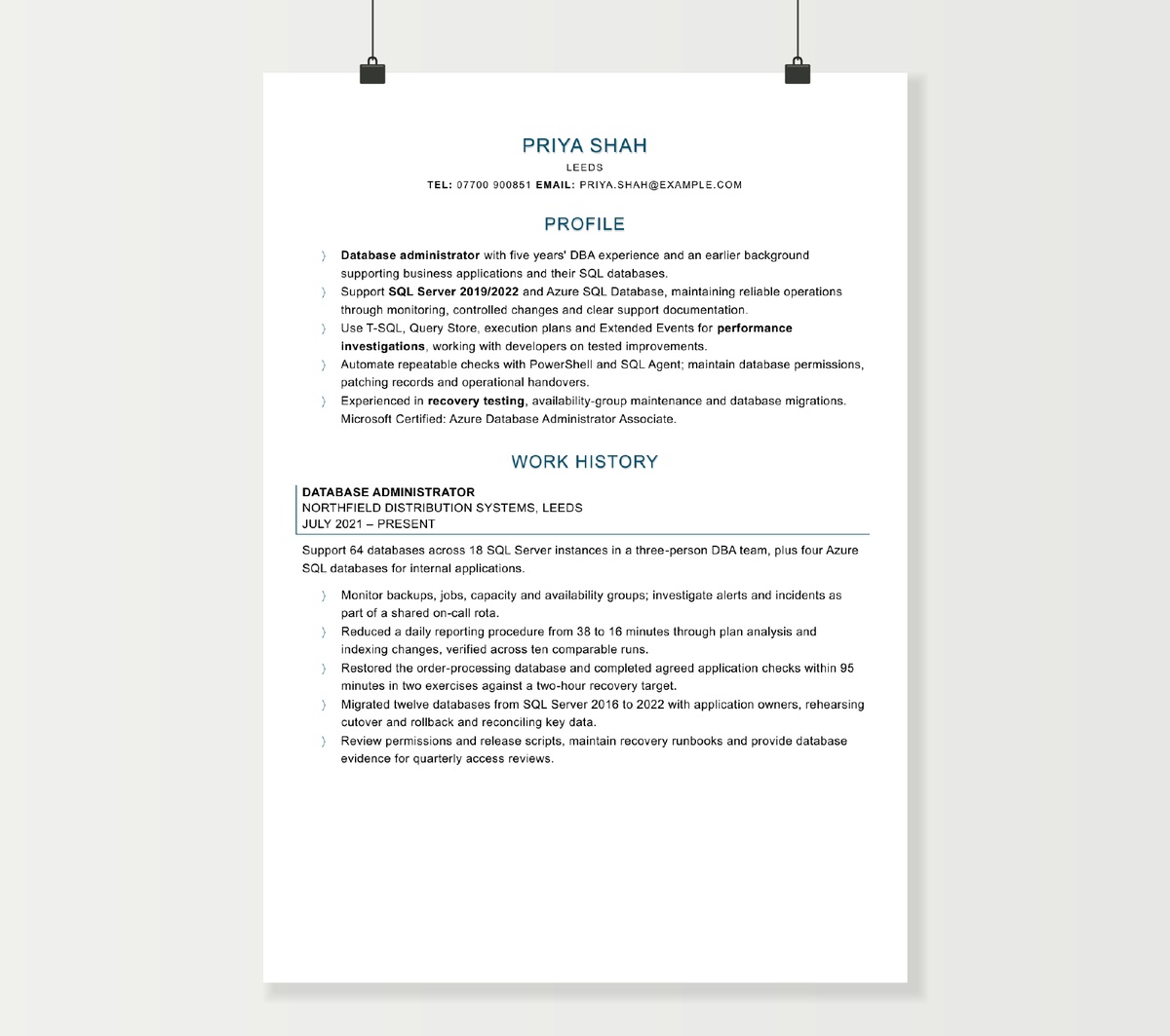
This database administrator CV template shows an application support analyst progressing into SQL Server administration. The Word example combines database operations, tested recovery and performance improvements with support for application changes. The guide explains how to present your database platforms, production responsibilities and technical results for DBA roles across on-premises and cloud environments.
Filename: FreeCVDownload_Database_Administrator.docx
Content of this CV template
PRIYA SHAH
LEEDS
tel: 07700 900851 email: [email protected]
PROFILE
- Database administrator with five years' DBA experience and an earlier background supporting business applications and their SQL databases.
- Support SQL Server 2019/2022 and Azure SQL Database, maintaining reliable operations through monitoring, controlled changes and clear support documentation.
- Use T-SQL, Query Store, execution plans and Extended Events for performance investigations, working with developers on tested improvements.
- Automate repeatable checks with PowerShell and SQL Agent; maintain database permissions, patching records and operational handovers.
- Experienced in recovery testing, availability-group maintenance and database migrations. Microsoft Certified: Azure Database Administrator Associate.
WORK HISTORY
DATABASE ADMINISTRATOR
NORTHFIELD DISTRIBUTION SYSTEMS, LEEDS
JULY 2021 – PRESENT
Support 64 databases across 18 SQL Server instances in a three-person DBA team, plus four Azure SQL databases for internal applications.
- Monitor backups, jobs, capacity and availability groups; investigate alerts and incidents as part of a shared on-call rota.
- Reduced a daily reporting procedure from 38 to 16 minutes through plan analysis and indexing changes, verified across ten comparable runs.
- Restored the order-processing database and completed agreed application checks within 95 minutes in two exercises against a two-hour recovery target.
- Migrated twelve databases from SQL Server 2016 to 2022 with application owners, rehearsing cutover and rollback and reconciling key data.
- Review permissions and release scripts, maintain recovery runbooks and provide database evidence for quarterly access reviews.
APPLICATION SUPPORT ANALYST
CALDER BUSINESS SOFTWARE, LEEDS
SEPTEMBER 2015 – JUNE 2021
Supported order-management and finance applications, developing SQL troubleshooting and database administration experience alongside the infrastructure team.
- Investigated application errors using logs and T-SQL queries, distinguishing data issues from application and connectivity faults.
- Prepared approved data-correction scripts with transaction checks and peer review, documenting the change and validation results.
- Monitored scheduled imports and SQL Agent jobs, resolving failed runs with developers and suppliers.
- Created a PowerShell summary of backup and job status for eight instances, replacing separate morning checks and highlighting exceptions.
QUALIFICATIONS & DEVELOPMENT
MICROSOFT CERTIFIED:
AZURE DATABASE ADMINISTRATOR ASSOCIATE
Renewed September 2026; ongoing development in Azure SQL operations, security and recovery.
BSC (HONS) COMPUTER SCIENCE — 2:1
UNIVERSITY OF LEEDS — 2015
FURTHER TRAINING
ITIL 4 FOUNDATION — 2019; SQL PERFORMANCE WORKSHOP — 2024
INTERESTS
Badminton, photography and walking in the Yorkshire Dales.
Writing a database administrator CV
A database administrator CV should make it clear which platforms you can support and what you have been responsible for keeping reliable. Employers need evidence of recovery, performance, security and controlled change, as well as the ability to work through incidents with application and infrastructure colleagues. A useful CV connects technical work to the service it supports.
Describe the database estate and your part in it
Identify your main database engines near the top of the CV. SQL Server, Oracle, PostgreSQL and MySQL involve different tools and operational experience, so put the platform most relevant to the vacancy first. Include versions where they explain migration work, an important feature or the environment you maintained.
Give context for scale without turning the profile into an inventory. The number of instances or databases, approximate data volume, transaction pattern, service hours and application types may all be useful. Choose the details that explain the demands of the role. A database supporting overnight reporting presents a different operational challenge from one handling customer transactions throughout the day.
State whether responsibility was shared within a DBA team or part of a broader infrastructure role. Distinguish production, test and development environments, and identify any on-call or escalation responsibilities. The example CV describes the estate and team before presenting the individual’s work, making the scope straightforward to assess.
Give recovery and availability evidence proper space
Backup monitoring, restore testing, failover exercises and disaster-recovery planning are related activities with different evidence. Describe the work you performed in each relevant area. A statement that backups completed successfully establishes monitoring; an exercise that restored a database and checked the application establishes more about recoverability.
Where you worked to recovery objectives, distinguish the target from the result. Recovery time objective concerns the time allowed to restore service; recovery point objective concerns the acceptable point to which data can be recovered. On the CV, state the relevant target and what an exercise or incident demonstrated, with the scope clear. The example’s 95-minute result includes agreed application checks, rather than just the database restore stage.
For high availability, name the technology and your responsibility. Maintaining an availability group, monitoring replication, preparing a failover plan and designing the architecture are different contributions. An Oracle, PostgreSQL or cloud specialist should use the equivalent detail for their platform. Briefly explain how the work was tested or supported a service requirement.
Recovery runbooks, dependency checks and coordination with application owners can strengthen this section. They show how the technical procedure became something the team could use during a real service interruption.
Explain how you investigated performance
A claim to tune databases is stronger when it identifies the workload, evidence and change. Useful detail could include execution-plan analysis, wait statistics, blocking, query history, indexing, statistics, connection management or configuration. Select the methods that reflect the problem you addressed.
For a SQL Server role, Query Store, Extended Events and dynamic management views may help explain the investigation. Oracle or PostgreSQL applicants can name the relevant diagnostic tools and plan analysis used in their work. Tool names belong beside an example where possible, so the reader can see what they enabled you to establish.
A performance achievement should define the comparison. A batch reduced from 38 to 16 minutes across comparable runs is easier to interpret than a general percentage improvement. Other useful measures include response-time percentiles, resource consumption, blocking duration or a reporting window consistently met. Include the workload and period where they affect the result.
Show collaboration with developers when the solution involved application SQL, schema changes or transaction behaviour. A concise bullet can establish that you diagnosed the cause, agreed and tested the change, and monitored the result after release. That demonstrates more judgement than a list of indexes created.
Show control of changes, upgrades and migrations
Database migrations and version upgrades can provide some of the strongest project evidence on a DBA CV. State the source and destination, the systems covered and your responsibilities. Compatibility assessment, rehearsal, data reconciliation, cutover, rollback planning and post-change monitoring are useful details when they were part of your work.
Describe the outcome in terms of the agreed service requirements. Examples include completing within the maintenance window, verifying critical data, meeting the application team’s checks or handing over a stable platform with usable support documentation. Where a project was delivered by several teams, make your database contribution clear.
For routine releases, show how you worked with version-controlled scripts, peer review, test environments and deployment arrangements. The employer is looking for evidence that you can support change in production while understanding its dependencies. A short example of reviewing a schema change or preparing a validated data correction can serve that purpose.
Legacy environments also provide relevant experience. Explain the continuity responsibilities, operational constraints and supplier coordination involved, and describe any preparation you contributed to a replacement programme. This gives older technology a clear place in the career story.
Make security and data integrity concrete
Useful database security evidence includes managing roles and permissions, supporting access reviews, maintaining audit information, applying patches or contributing to encryption and key-management arrangements. Describe the part you owned and the colleagues involved. A database administrator’s contribution may sit alongside identity, infrastructure and security teams.
For data integrity, explain the checks and investigations you performed: validating a migration, reconciling records after an interface failure, investigating unexpected changes or confirming the result of an approved correction. These examples demonstrate care with the data itself as well as the platform.
Where your work supported an audit or a regulated service, state the evidence prepared or control maintained. The CV benefits from the practical contribution, such as producing access-review records or documenting restore-test results, rather than a broad claim that the entire environment was compliant.
Present cloud database experience at the right level
Name the service you used. Running SQL Server on a virtual machine, administering Azure SQL Database and managing an Amazon RDS instance involve different responsibilities. Explain the tasks you carried out: configuration, access, monitoring, performance, recovery settings, upgrades, cost reviews or migration.
Managed services still leave important decisions with the team operating them. A CV can show how you chose or reviewed capacity, investigated workload behaviour, tested recovery arrangements or coordinated changes with application owners. Make the work visible alongside the cloud platform name.
If most of your experience is on-premises, give it proper weight and place cloud projects or development separately. A completed migration or a well-documented technical project can demonstrate progress into a new environment without obscuring your established strengths.
Use automation to show operational improvement
PowerShell, Bash, Python, T-SQL and infrastructure-as-code tools can all support database operations. Describe what the automation did and how it changed the team’s work. Examples include consolidating health checks, validating configuration, reporting backup exceptions, preparing repeatable environments or reducing manual deployment steps.
A useful achievement includes the scope and the practical benefit. “Created a daily exception report across eight instances, replacing separate manual checks and giving the support team one view of failed jobs” explains more than “automated DBA tasks”. Where relevant, mention review, testing or version control to show how the automation was maintained.
Keep the technical skills section organised around functions: database engines, diagnostics, resilience, scripting and supporting infrastructure. This makes a broad skill set readable and gives the employment history space to demonstrate the most important areas in depth.
Include incident work and communication
Production support is often where database judgement becomes most visible. Describe the types of incidents you handled, the evidence used to identify the cause and how you worked with other teams. A blocking problem, storage constraint, failed interface or replication issue can each provide a useful example.
Include what happened after recovery where it adds value: a monitoring change, a revised runbook, a permanent fix or a clearer escalation route. These details show that the work improved the service beyond the immediate incident.
Communication can be demonstrated through maintenance-window planning, impact assessments, incident updates and handovers. Explain the audience and purpose. Translating a database issue into an application impact or a decision for a service owner is an important part of the role.
Choose qualifications and projects that support the application
Give certifications their exact names and include current renewal information where relevant. A platform qualification can support your technical background, while the employment examples establish the depth of production experience. Older certifications can remain useful evidence of development when their award dates are clear.
For a first DBA role, draw on application support, development, infrastructure or data work that involved SQL, database troubleshooting, access, scheduled jobs or changes. Identify the tasks completed independently and those carried out with a senior colleague. A relevant degree or apprenticeship can sit alongside a concise project showing applied work.
A worthwhile project might combine a database-backed application with backup and recovery testing, a measured query-tuning exercise or a documented migration between versions. Explain the workload, decisions and results. A repository or short write-up is useful when it contains enough information for someone to understand what you built and tested; it is an optional addition for an experienced production DBA.
If the target role is primarily about building data pipelines and analytical platforms, compare the emphasis in the data engineer CV example. For database work embedded in application development, the software developer example may help you present the broader responsibilities.
Database Administrator CV FAQs
The example is for a technical DBA who supports database platforms, performance, recovery and security. Some employers use the same title for maintaining customer, supporter or service records within an application. For those roles, emphasise data quality, imports, reporting, user support and the specific system used; the administrator or data analyst examples may provide a closer starting point.
Include them where they are relevant to the vacancy or form a meaningful part of your experience. State the product and work performed, such as operating a production cluster, reviewing indexes or supporting a migration. A short separate entry can show useful breadth while keeping your main relational database expertise easy to identify.
Use a rounded range or operational context, such as dozens of production databases, a multi-site transactional service or an overnight reporting workload. Explain the demands that mattered to your work: service hours, recovery objectives, growth, concurrency or maintenance windows. That can establish complexity without disclosing a detailed inventory.
Where the vacancy specifically requests it, give a brief description of your current clearance status in an appropriate application field or additional-information section. The recruiting organisation can confirm the verification or transfer process. For other DBA roles, the space is usually better used for platform experience and operational evidence.
Include development that demonstrates relevant database capability: analysing and improving queries, reviewing schema changes, writing administrative scripts or supporting controlled data fixes. If application development was a substantial separate responsibility, make that scope clear in the job description. Choose examples that show how your SQL work supported performance, integrity or reliable operation.




